

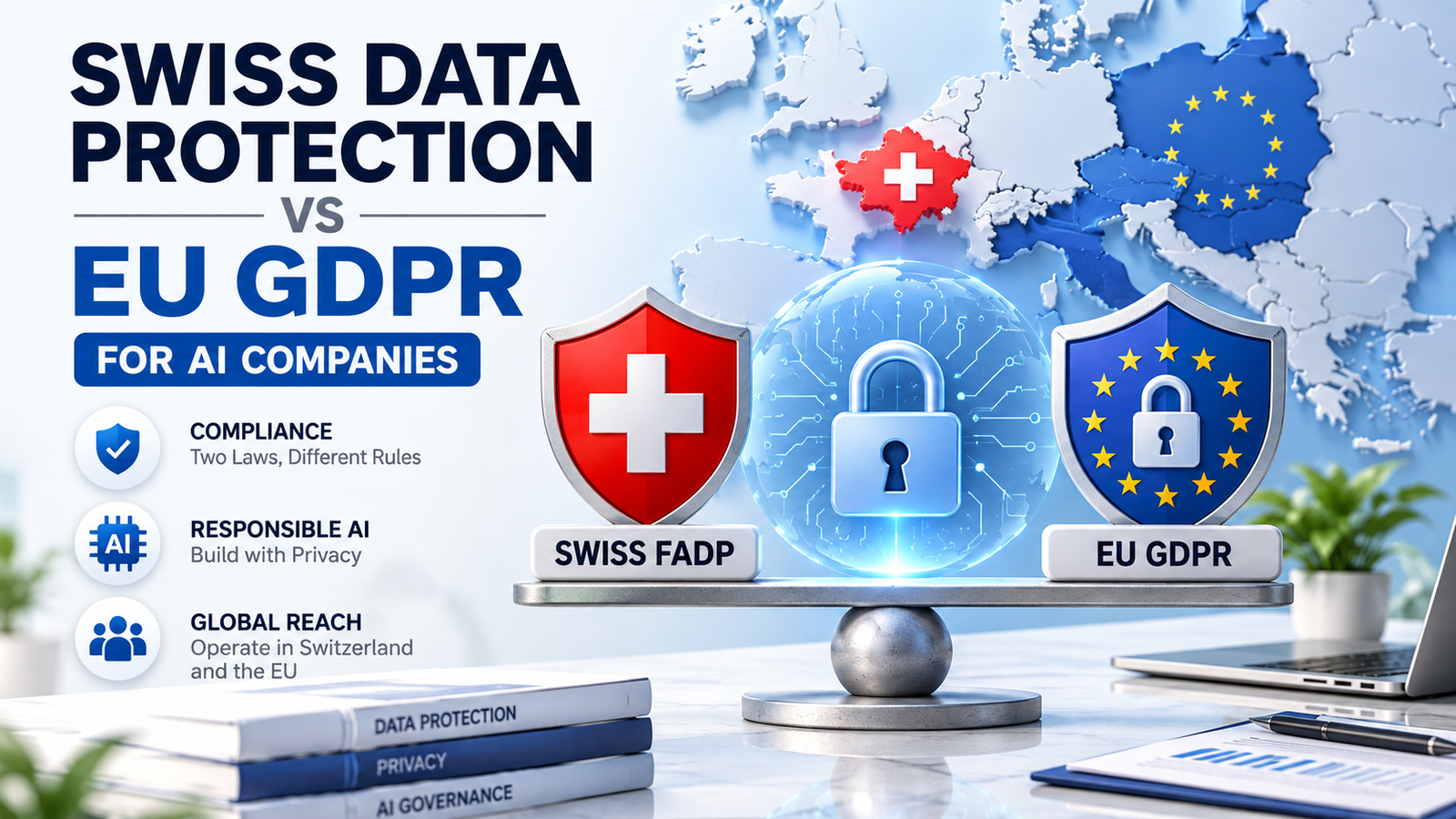
Switzerland Data Protection Law Compared to GDPR for AI Companies

Understanding switzerland data protection law compared to gdpr ai companies is essential for businesses developing generative AI models and automated tools. Switzerland’s revised Federal Act on Data Protection (FADP) shares core principles with the European Union’s General Data Protection Regulation (GDPR), but key differences remain in scope, enforcement, and individual rights.
The key point is that Swiss data protection law is not simply a less demanding version of the GDPR. Both frameworks can apply to the same AI product, depending on where the company operates, where its customers are located and how it processes personal data. Switzerland also applies existing data protection rules directly to AI systems, even without a separate, comprehensive AI law.
This guide explains the major differences, practical obligations, cross-border data transfers and steps AI companies can take to build a compliant service.
What Are Switzerland’s FADP and the EU GDPR?
The Swiss Federal Act on Data Protection, commonly called the FADP or revised FADP, is the main federal law governing the processing of personal data in Switzerland. It protects the privacy and fundamental rights of individuals whose personal information is processed.
The GDPR serves a similar purpose across the European Union and European Economic Area countries where it applies. It establishes rules for collecting, storing, using, sharing and deleting personal data, alongside rights for individuals and obligations for organizations.
For AI companies, both laws can affect information used to train models, customer prompts, uploaded documents, chatbot conversations, employee records and AI-generated profiles of identifiable people.
How the laws apply to AI
Neither framework is limited to traditional databases. An AI system may process personal data when it analyzes customer messages, extracts information from medical documents, identifies faces, predicts a person’s behavior or generates answers based on personal records.
Both Swiss and European data protection rules can apply to AI-supported data processing. Their application depends on the relevant legal requirements and the company’s activities.
Consider a company offering an AI assistant that summarizes uploaded contracts. If those contracts contain names, addresses, signatures or financial information, the company must consider data protection requirements even if the AI is only summarizing the text rather than making decisions about the people mentioned.
The same principle applies to AI APIs, retrieval-augmented generation (RAG), fine-tuning pipelines and automated document-processing systems.
Switzerland Data Protection Law Compared to GDPR: Key Differences
The two frameworks share many core privacy principles, but several differences matter when designing or operating AI products.
| Area | Swiss FADP | EU GDPR |
|---|---|---|
| Protected individuals | Covers personal data relating to natural persons | Covers personal data relating to natural persons |
| Legal scope | Applies under Swiss territorial and other statutory rules | Can apply to EU-based organizations and certain non-EU organizations targeting or monitoring people in the EU |
| Legal basis | Uses Swiss rules on lawfulness, good faith, proportionality and justification | Requires a lawful basis under Article 6, with additional conditions for special-category data |
| Sensitive data | Includes specified sensitive categories, including genetic and biometric data processed to identify a person | Includes special categories such as health, genetic and biometric identification data, subject to Article 9 |
| Privacy impact assessments | Required for processing likely to result in high risk to personality or fundamental rights | Required when processing is likely to result in high risk to individuals’ rights and freedoms |
| Automated decisions | Article 21 addresses decisions based exclusively on automated processing and certain disclosure and review rights | Article 22 regulates certain solely automated decisions with legal or similarly significant effects |
| Data protection officer | Does not impose a universal DPO appointment requirement equivalent to the GDPR | Requires a DPO in specified circumstances under Article 37 |
| Breach notification | Requires notification to the FDPIC as soon as possible when a data security breach is likely to result in a high risk to personality or fundamental rights | Requires notification to the competent supervisory authority within 72 hours where feasible, unless the breach is unlikely to result in a risk to individuals’ rights and freedoms |
| Penalties | Certain intentional violations can attract criminal fines of up to CHF 250,000 under specified provisions | Administrative fines can reach €20 million or 4% of worldwide annual turnover, whichever is higher, for certain infringements |
These differences should not be interpreted as a simple ranking of which law is stricter. The answer depends on the processing activity, the organization, the individuals affected and the specific provision involved.
For example, a Swiss AI startup may have fewer formal obligations under one part of the FADP but still face GDPR requirements when providing its service to EU customers. A company that ignores this distinction could build a product that meets Swiss requirements but fails to meet its obligations in the European market.
Does the GDPR Apply to AI Companies Based in Switzerland?
Yes. A company does not avoid the GDPR simply because it operates from Zurich, Geneva, Basel or another Swiss location.
Article 3 of the GDPR explains when the law applies. It can cover Swiss AI companies that offer services to people in the EU or track their behavior there. The law can also apply when a company processes personal data as part of its operations in the EU, even if the data processing takes place in another country.
Three practical scenarios
- Swiss-only AI service: A company provides an internal AI tool exclusively to Swiss businesses. The FADP will generally be central, although other laws may also apply.
- Swiss AI startup serving EU customers: The company sells a subscription-based AI assistant to individuals or organizations in EU countries. It must assess whether the GDPR applies to its processing activities.
- International AI platform: A company develops its model in Switzerland, uses cloud infrastructure in another country and serves customers across Europe. Its compliance obligations depend on its establishments, target markets, processing arrangements and data transfers.
The important distinction is that the location of an AI server does not, by itself, determine which privacy law applies.
For instance, a Swiss startup might host its application in a Swiss data center but deliberately market the service to French and German customers. Swiss hosting does not remove the possibility of GDPR obligations.
What should companies do?
Before launching in another country, AI businesses should map their customers, operations and data flows. They should also determine whether they need an EU representative under GDPR Article 27, which can apply to certain organizations established outside the EU.
A representative is not required in every case. The GDPR contains exceptions, so the decision should be based on the company’s actual processing activities and circumstances.
How the Two Laws Affect AI Training Data
Training data is one of the most challenging areas for AI privacy compliance. Large language models learn statistical patterns from large collections of text and other information. Those collections may contain personal data, whether intentionally included or present within larger datasets.
The legal question is not simply whether a dataset is publicly accessible. Companies must assess whether collecting, processing and using the information for training is lawful under the applicable framework.
Publicly available data is not automatically unrestricted
Suppose an AI developer collects public professional profiles, online articles and forum posts to train a language model.
The developer should consider:
- Whether the information contains personal data.
- Whether the collection and intended training purpose have a valid legal justification.
- Whether individuals received the required information about the processing.
- Whether the data includes sensitive information.
- Whether the collection is proportionate to the intended purpose.
- Whether people can exercise their applicable privacy rights.
Under the GDPR, companies must identify a lawful basis for processing personal data under Article 6. Legitimate interests may sometimes be relevant, but they require a careful assessment of the purpose, necessity and impact on individuals. Public availability alone does not establish that basis.
The FADP follows a different legal structure. Swiss law assesses processing against principles including lawfulness, good faith and proportionality, alongside applicable rules on personality rights and justification. It should not be treated as identical to the GDPR’s lawful-basis framework.
What about fine-tuning an existing model?
Fine-tuning adapts a pretrained model using additional examples. A business might use customer-support conversations to teach an AI system how to answer questions about its products.
If those conversations contain names, account details or personal circumstances, the company must examine the purpose and legal justification for the additional processing. It should also consider whether the information is necessary for fine-tuning or whether anonymized or synthetic examples would achieve the same objective.
Removing names is not always enough. A dataset may still identify individuals through combinations of details, and trained models can sometimes reproduce information from their training data.
For this reason, data minimization should be part of the model development process rather than a step added immediately before launch.
AI Transparency, Privacy by Design and User Rights
Both the FADP and GDPR require organizations to take privacy seriously throughout the processing lifecycle. However, their specific requirements and individual rights are not identical.
Transparency about AI processing
AI providers and users should explain relevant aspects of AI-supported data processing in accordance with applicable legal requirements. This includes making the purposes of processing clear and explaining how personal information may be used.
For example, an AI writing platform should clearly explain:
- What personal information it collects.
- Why it processes prompts and uploaded files.
- Whether conversations are used for model improvement.
- How long relevant data is retained.
- Which service providers receive the information.
- How users can exercise their privacy rights.
The exact disclosures required depend on the processing activity and applicable law. A privacy policy alone may not be sufficient if the product’s interface creates a misleading impression about how information is used.
Privacy by design and privacy by default
The revised Swiss FADP expressly incorporates privacy by design and privacy by default. The GDPR contains corresponding requirements under Article 25.
Privacy by design means considering data protection when developing the product. Privacy by default means limiting personal data processing to what is necessary for the intended purpose through the default settings.
For an AI assistant, practical measures might include:
- Disabling unnecessary collection of sensitive prompts.
- Limiting access to uploaded documents.
- Setting appropriate retention periods.
- Separating customer data from model-training datasets.
- Restricting employee access to conversation logs.
- Providing clear controls for optional data use.
These safeguards can reduce privacy risks while making it easier to demonstrate compliance.
Individual rights and AI-generated information
Under both frameworks, individuals have rights concerning personal data processed about them, including access and correction rights, subject to the relevant legal conditions and exceptions.
A person might ask an AI recruitment platform to correct an outdated employment record or request access to information used in a profile about them.
The business must evaluate the request under the applicable law. It should not assume that every request requires deletion of an entire model or that every model parameter is automatically personal data. The analysis depends on whether the information remains personal data, how it is stored or used, and the circumstances of the request.
Automated Decision-Making: Swiss FADP vs GDPR
Automated decision-making deserves particular attention because AI systems increasingly influence decisions involving employment, finance, insurance, education and access to services.
Both laws contain protections for certain decisions made exclusively through automated processing, but the wording and scope of those protections differ.
What does the Swiss FADP require?
Article 21 of the Swiss FADP addresses decisions based exclusively on automated processing that have legal consequences for a data subject or significantly affect them.
The company must inform the affected person when the law requires it. The person may also have the right to share their views and request a human review of the decision, depending on the legal requirements and exceptions.
How does GDPR Article 22 compare?
Article 22 of the GDPR gives individuals a right not to be subject to a decision based solely on automated processing, including profiling, when that decision produces legal effects or similarly significantly affects them, subject to specified exceptions.
Those exceptions include certain decisions necessary for a contract, decisions authorized by law with appropriate safeguards, and decisions based on explicit consent. Where the relevant exceptions apply, safeguards are required, including rights to human intervention and to contest the decision in the circumstances specified by the regulation.
| Example | Compliance consideration |
|---|---|
| AI summarizes job applications for a recruiter | Determine whether the tool merely assists a person or effectively determines the outcome |
| AI automatically rejects loan applications | Assess automated-decision rules, applicable legal bases and safeguards |
| AI ranks customer-service tickets by urgency | Examine the impact on individuals and whether the ranking drives consequential decisions |
| AI recommends products based on browsing behavior | Assess profiling, transparency and applicable objection rights |
An AI system does not automatically become subject to the special rules on solely automated decisions just because it uses machine learning. The system’s actual role in the decision is important.
A human reviewer must also have a meaningful role where human intervention is required. Merely adding an approval button to a process in which employees routinely accept algorithmic recommendations may not resolve the underlying issue.
Data Protection Impact Assessments for AI Systems
A data protection impact assessment (DPIA) is a structured evaluation of privacy risks before certain processing activities begin.
The Swiss FADP requires an assessment when processing is likely to result in a high risk to the personality or fundamental rights of the data subject. GDPR Article 35 similarly requires a DPIA where processing is likely to result in a high risk to individuals’ rights and freedoms.
Neither law requires a DPIA for every AI experiment. The assessment depends on the nature, scope, context and purposes of the processing, as well as the risks involved.
When might an AI company need one?
Consider a business developing an AI system that analyzes medical records to predict which patients may require additional care. The system processes sensitive health information and may influence important decisions.
A DPIA would help the company examine:
- Purpose and necessity: Why is the data needed, and can the same result be achieved with less information?
- Data quality: Are the records accurate, relevant and sufficiently current?
- Access and security: Who can view the information, and how is it protected?
- Potential harm: Could errors, bias or unauthorized disclosure harm individuals?
- Safeguards: What technical and organizational measures reduce those risks?
- Residual risk: Does a significant risk remain after the safeguards are applied?
The assessment should lead to concrete design decisions. For example, the company might reduce the amount of information available to the model, separate identifying details from clinical data or require a qualified professional to review high-impact recommendations.
Where the applicable law requires consultation with a supervisory authority because high risks cannot be sufficiently mitigated, the company must follow the relevant procedure.
Cross-Border Data Transfers and Cloud AI Providers
Many AI businesses rely on external model providers, cloud platforms, analytics services and customer-support tools. Those arrangements can introduce international data transfers even when the business itself is based in Switzerland.
The legal analysis must consider where the information goes, who receives it, the purpose of the transfer and which privacy framework governs the activity.
Is Switzerland Considered Adequate Under the GDPR?
Yes. The European Commission considers Switzerland to provide an adequate level of data protection. This means businesses can transfer personal data from the EU to Switzerland without extra transfer safeguards. However, the transfer must fall within the scope of the adequacy decision.
Adequacy does not mean that every data processing activity is allowed. Companies must still follow GDPR rules on lawful data use, transparency, security and individual rights.
The rules may differ when a Swiss company transfers data to the United States or another country. In that case, the company must check Switzerland’s data transfer rules under the FADP. If the GDPR also applies, it must meet the EU’s transfer requirements as well.
Clarify the adequacy scopeAdd a concise practical example
What should AI companies check before choosing a provider?
Review the following points before uploading customer data to an external AI service:
- Data location: Where are prompts, files, logs and backups processed or stored?
- Model training: Can the provider use submitted information to improve its models?
- Retention: How long are inputs and outputs retained?
- Subprocessors: Which other organizations may access or process the information?
- Security: What access controls, encryption and incident-response measures are available?
- Transfer safeguards: Are the relevant adequacy arrangements or other required safeguards in place?
- Contract terms: Does the agreement define the provider’s role and responsibilities clearly?
A provider’s promise to keep data confidential is useful, but it is not a complete compliance assessment.
For instance, a Swiss law firm using an external LLM to summarize client contracts should assess the confidentiality and privacy risks, the provider’s contractual terms, applicable professional obligations and any international transfers. Depending on the circumstances, uploading the original documents may be inappropriate even when the AI service offers business-oriented privacy controls.
Fines, Enforcement and Accountability
Enforcement is another significant difference between Swiss data protection law and the GDPR.
Under the GDPR, supervisory authorities can impose administrative fines of up to €20 million or 4% of an undertaking’s total worldwide annual turnover for certain infringements, whichever is higher. The applicable ceiling depends on the type of infringement.
Swiss law follows a different enforcement model. Certain intentional violations of specified statutory duties can result in criminal fines of up to CHF 250,000. The FADP’s penalty provisions generally focus on responsible natural persons, rather than imposing a directly equivalent GDPR-style administrative turnover fine on companies for every infringement. The law also contains provisions addressing certain circumstances in which an undertaking may be fined instead.
These differences matter when assessing legal exposure, but they should not be used to conclude that non-compliance in Switzerland is harmless.
An AI business may face several types of consequences, including regulatory investigations, complaints, litigation, contractual disputes, reputational damage and the cost of changing its systems. If the GDPR applies alongside Swiss law, the company may also be exposed to EU enforcement.
Accountability in practice
AI companies should maintain evidence showing how privacy decisions were made. Depending on the applicable requirements, this may include:
- Records of processing activities.
- Data protection impact assessments.
- Privacy notices and consent records where relevant.
- Contracts with processors and other service providers.
- Security policies and access logs.
- Data breach procedures.
- Records of requests from individuals and how they were handled.
Good documentation is not simply an administrative exercise. It helps teams identify problems before they become incidents and provides evidence of the measures taken to meet legal obligations.
A Practical Compliance Checklist for AI Companies
Companies operating in Switzerland or serving European customers should build privacy compliance into their AI development process.
The following checklist provides a useful starting point.
Privacy readiness checklist
4 of 10Map personal data used in prompts, training, fine-tuning, retrieval and analytics.Determine whether the FADP, GDPR or both apply to each processing activity.Document the legal justification and purpose for processing personal data.Publish clear notices covering AI interactions, data use, retention and relevant providers.Review data minimization, default settings, access controls and security measures.Assess whether high-risk processing requires a DPIA.Evaluate automated decisions and the availability of meaningful human review.Review provider contracts, subprocessors and international data transfers.Create procedures for access, correction, objection and deletion requests where applicable.Prepare incident-response and breach-notification procedures.
Copy checklist
Recommended approach for startups
Smaller AI businesses do not necessarily need the same compliance infrastructure as large multinational platforms. They do, however, need to understand their actual data processing activities and the obligations that apply to them.
A sensible approach is to start with a data inventory, identify the highest-risk processing activities, select providers carefully and establish clear internal responsibilities. Teams should then review their compliance as the product evolves.
Adding new capabilities can change the privacy assessment. A chatbot that originally answers general questions may create new risks if it later stores user profiles, analyzes health information or automatically rejects applications.
Privacy compliance should therefore be treated as an ongoing product responsibility rather than a one-time legal review.
Navigating Cross-Border US-Swiss-EU Data Transfers for LLMs
Companies that use large language models (LLMs) across the US, Switzerland and the EU must handle personal data carefully. Both Switzerland’s Federal Act on Data Protection (FADP) and the EU’s General Data Protection Regulation (GDPR) set rules for transferring personal data to other countries. However, each law has its own requirements.
The European Commission recognizes Switzerland as providing an adequate level of data protection. This allows personal data to move from the EU to Switzerland without extra transfer safeguards, provided the transfer falls within the adequacy decision. However, sending personal data from Switzerland or the EU to the United States requires a separate assessment. Depending on the circumstances, companies may rely on the EU-US Data Privacy Framework for eligible US organizations or use Standard Contractual Clauses (SCCs) with any required additional safeguards.
For AI companies operating across these borders, managing LLM prompts and API calls means evaluating where the underlying infrastructure sits. If a Swiss AI company processes EU citizen data on US-hosted servers, it must ensure that robust technical safeguards such as end-to-end encryption and strict data minimization—accompany any international transfer. Furthermore, AI businesses must scrutinize subprocessor agreements to prevent third-party cloud providers from using confidential client prompts for autonomous model training without explicit, documented consent from the data subjects.
Managing Cross-Border Data Flows and Model Weights
When deploying large language models across multiple jurisdictions, managing cross-border data flows requires careful alignment between US cloud providers, Swiss infrastructure, and EU targets. Companies must analyze whether model weights themselves constitute personal data under the Swiss Federal Act on Data Protection and the GDPR, especially when deep learning parameters could potentially reconstruct identifiable training instances.
Handling a Data Subject Access Request (DSAR) becomes exceptionally complex when personal information is embedded within complex neural networks rather than traditional databases. While organizations can readily delete source files from cloud storage, extracting specific user data from trained model weights without full retraining remains a major technical and compliance hurdle under both Swiss and European data protection law compared to gdpr ai companies frameworks.
To address cross-border compliance safely, engineering teams should establish robust data minimization pipelines and opt-out mechanisms before data enters fine-tuning cycles. Utilizing synthetic data or localized inference servers in Switzerland can significantly reduce international exposure while maintaining the strict transparency standards enforced by the FDPIC and European regulators.
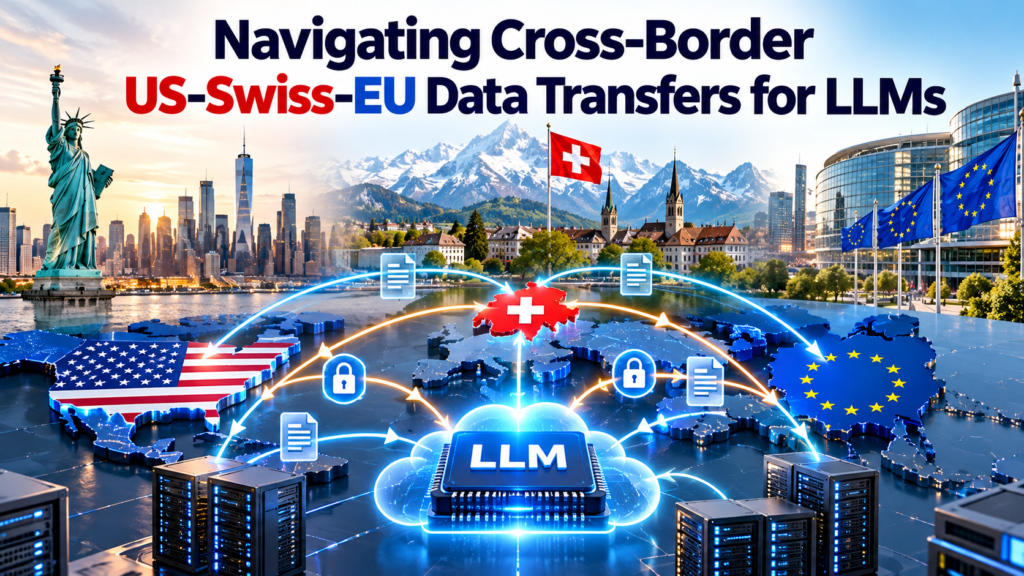
Cross-Border Data Transfers for LLMs Under Swiss Law and GDPR
Managing cross-border transfers when deploying large language models involves navigating the interplay between US infrastructure, Swiss legal standards, and EU requirements. The Swiss Federal Act on Data Protection (FADP) and the GDPR both require robust safeguards when personal data leaves their jurisdictions. When utilizing cloud providers or APIs hosted abroad, AI companies must verify that adequate protection levels are maintained.
For instance, transferring data from Switzerland to the United States requires examining specific contractual safeguards or certification frameworks. The FDPIC oversees these international movements and evaluates whether foreign jurisdictions provide equivalent protections. If an organization also falls under the extraterritorial scope of the European Union rules, it must align its data flow mechanisms to satisfy both Swiss and EU thresholds simultaneously.
Handling a Data Subject Access Request (DSAR) can be difficult when personal data is stored across servers in different countries. Companies should track where they store AI prompts, fine-tuning logs and model weights. This helps them respond to requests for access or deletion when required by law. They should also use clear data processing agreements with all cloud providers to ensure that each party understands its responsibilities and protects personal data throughout the supply chain.
Common Misconceptions About Swiss Data Protection and AI
Several assumptions can lead companies to underestimate their obligations.
Misconception 1: Switzerland follows the GDPR exactly.
The two laws share important principles, but they differ in legal structure, individual rights, enforcement and certain procedural requirements. Companies should compare the actual provisions relevant to their activities.
Misconception 2: Public information can always be used to train AI.
Public accessibility does not remove all data protection obligations. The purpose, legal justification, nature of the data and potential impact on individuals remain relevant.
Misconception 3: Hosting data in Switzerland guarantees compliance.
Where a company stores data is only one factor to consider. It must also understand why it collects and uses the data, who can access it, whether it transfers data to other countries, and which data protection laws apply.
Misconception 4: Every AI tool needs a DPIA.
Both frameworks focus DPIA requirements on processing likely to create high risks. Some AI applications may require an assessment, while others may not.
Misconception 5: A privacy policy is enough.
Written disclosures do not replace appropriate technical safeguards, lawful processing, suitable contracts or procedures for handling individual rights.
Misconception 6: AI-generated information is never personal data.
An AI output can contain or reveal information about an identifiable person. Whether particular outputs or model-related information qualify as personal data depends on the circumstances.
The Interplay Between the FADP, GDPR, and the EU AI Act
As regulatory landscapes evolve, artificial intelligence developers operating in Switzerland must remain aware of how domestic rules intersect with emerging international legislation such as the EU AI Act. While the Swiss Federal Act on Data Protection governs general privacy, the EU AI Act introduces risk-based classifications for AI systems deployed within the European market. Organizations capturing user inputs across borders must comply with both privacy mandates and AI-specific governance structures.
Enforcement authorities like the FDPIC actively monitor compliance, emphasizing transparency in algorithmic processing. When deploying models with extraterritorial scope, companies often find that adhering to the stricter requirements of the GDPR simplifies compliance with Swiss standards. However, unique nuances remain regarding criminal liability for individuals under Swiss law versus administrative fines under European frameworks.
Handling a Data Subject Access Request for complex machine learning models also presents distinct technical challenges. Because neural networks distribute patterns across billions of parameters rather than storing traditional database rows, fulfilling a deletion request requires clear operational policies regarding fine-tuning datasets and training cutoffs. Establishing clear workflows ensures that user rights are respected without compromising core model integrity.
12. Frequently Asked Questions
Is Swiss data protection law less strict than the GDPR for AI companies?
Not in every respect. The frameworks have different requirements and enforcement systems, so the answer depends on the activity and the provisions involved.
Can a Swiss AI company serve EU customers without complying with the GDPR?
Sometimes the GDPR may not apply, but companies targeting or monitoring people in the EU must carefully assess Article 3 and their actual activities.
Does the Swiss FADP apply to ChatGPT-style AI assistants?
Yes, where an assistant processes personal data within the law’s scope. The same applies to other generative AI systems.
Can AI companies use personal data to train models?
Potentially, but the processing must satisfy applicable legal requirements. Public availability alone does not establish permission.
Does every AI company need a data protection officer?
No. The GDPR requires a DPO in specified circumstances, while the Swiss FADP does not impose an equivalent universal appointment requirement.
Is storing AI data in Switzerland enough for compliance?
No. Storage location does not replace the need for lawful processing, transparency, security and appropriate transfer safeguards.
What is the biggest compliance risk for AI startups?
A major risk is failing to understand how personal data moves through the product, including model training, prompts, external providers, retention and automated decisions.
Conclusion
Switzerland data protection law compared to GDPR for AI companies reveals two closely related but distinct legal frameworks. Both require organizations to take personal data protection seriously, including when developing generative AI, training machine learning models or automating decisions. The Swiss FADP provides a technology-neutral foundation for protecting individuals, while the GDPR establishes additional requirements that may apply when an AI business operates in or targets the European market.
For AI companies, the most effective approach is to understand the data lifecycle, assess risks early, choose providers carefully and build privacy safeguards into product design. International expansion also requires a clear view of territorial scope and cross-border transfers. Ultimately, compliance depends on how a system actually works, what information it processes and how its decisions affect people. Companies should obtain qualified legal advice when their activities involve sensitive data, high-impact decisions or complex international operations.
[…] Best Data Analytics Companies for Business Growth Switzerland Data Protection Law Compared to GDPR for AI Companies Vidqu Review 2026: What You Should Know Before Using It DreamJourney AI: Features, Uses, […]
[…] select a model for your project. You will also discover why cost, response speed, reliability, and data privacy matter alongside benchmark […]