

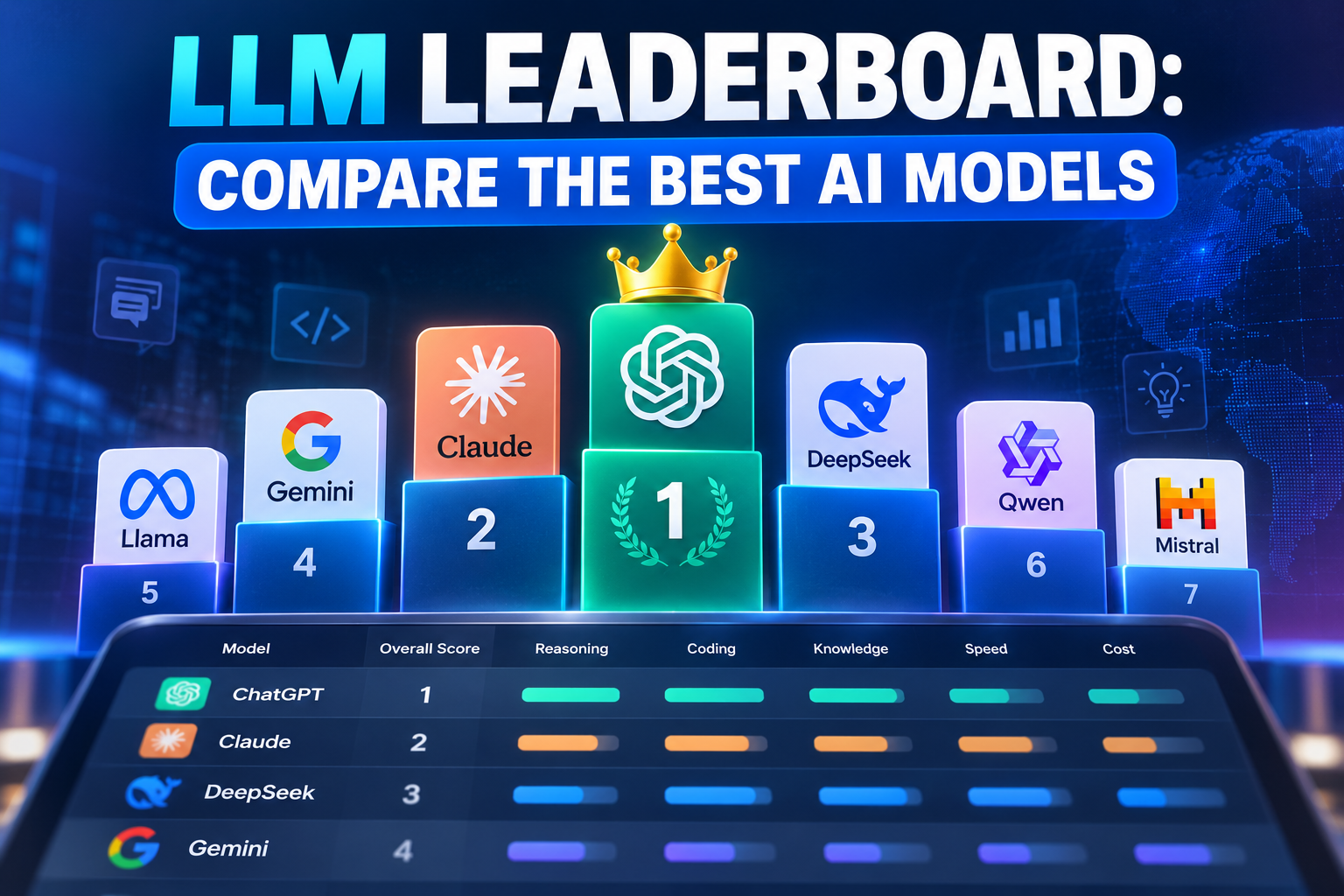
LLM Leaderboard: Compare the Best AI Models

An llm leaderboard is an essential tool for developers and businesses looking to compare large language models using benchmark scores, human preferences, and real-world performance metrics. Instead of relying on marketing claims, you can use these rankings to understand how different AI models perform and which ones best suit your specific needs. By analyzing reasoning capabilities, coding skills, and efficiency, you can make an informed decision that balances quality with operational costs and speed.
However, there is an important detail: no single leaderboard measures everything that makes an AI model useful. A model that performs well in coding tests might not be the best choice for writing, customer support, document analysis, or low-cost API applications. Some rankings rely on human votes, while others use standardized tests or real-world tasks.
In this guide, you will learn which LLM leaderboards are worth exploring, how their scoring systems work, what their results actually mean, and how to select a model for your project. You will also discover why cost, response speed, reliability, and data privacy matter alongside benchmark rankings.
What Is an LLM Leaderboard?
An LLM leaderboard is a ranking system that compares large language models according to defined evaluation criteria. These systems help developers, researchers, businesses, and everyday users identify models that perform well on particular tasks.
A leaderboard may compare models from organizations such as OpenAI, Anthropic, Google, Meta, Alibaba, and DeepSeek. It can also include open-weight models that developers can download and run on their own infrastructure.
Depending on the platform, the rankings may measure:
- Reasoning: How effectively a model solves complex problems.
- Coding: How accurately it generates, explains, and repairs code.
- General knowledge: How well it answers factual questions.
- Human preference: Which model’s responses people prefer when comparing answers.
- Instruction following: How closely a model follows user requests and constraints.
- Efficiency: How much a model costs to run and how quickly it responds.
- Specialized capabilities: Performance in mathematics, scientific research, multilingual tasks, or computer-use workflows.
The exact measurements depend on the leaderboard. Some publish a single overall score, while others provide separate rankings for different capabilities.
The main purpose is not simply to identify the highest-ranked AI. It is to help you understand which model performs best under a particular set of conditions.
The LLM Leaderboard and Goodhart’s Law
When relying on any llm leaderboard, it is critical to understand the concept of Goodhart’s Law: “When a measure becomes a target, it ceases to be a good measure.” As AI developers and researchers prioritize ranking high on popular benchmarks, there is a risk that models are inadvertently optimized to perform well on specific test questions rather than developing generalized intelligence. This phenomenon, often called benchmark gaming, can lead to inflated scores that do not reflect a model’s true utility in real-world applications.
Furthermore, benchmark contamination occurs when test data inadvertently leaks into a model’s training set. If a model has already “seen” the questions on a test, its high score is a result of memorization rather than reasoning. Because of this, you should view leaderboard rankings as a starting point for discovery rather than a definitive ranking of intelligence. Always prioritize your own internal testing over public benchmark scores to ensure the model actually solves the problems your business faces.
Best LLM Leaderboards to Compare AI Models
Several platforms provide useful model rankings, but they serve different purposes. The most effective approach is to compare at least one human-preference ranking with one technical benchmark or performance index.

1. LMArena
Best for comparing conversational quality
LMArena, formerly known for Chatbot Arena, lets people compare anonymous model responses and vote for the answer they prefer. Its rankings use statistical methods based on pairwise comparisons.
This makes it useful for evaluating writing, general chat, and open-ended responses. However, user preferences do not necessarily indicate factual accuracy or technical reliability.

2. Hugging Face Leaderboards
Best for open-weight models and technical research
Hugging Face hosts model evaluation results, community leaderboards, and benchmark datasets. Researchers and developers can use these resources to compare models on specific tasks and explore their capabilities.
Its original Open LLM Leaderboard is archived, so readers should check the status of individual evaluation projects rather than assume historical rankings are current.

3. Artificial Analysis
Best for intelligence, speed, and cost comparisons
Artificial Analysis evaluates AI models and the infrastructure serving them. Its Intelligence Index combines multiple evaluations, while separate measurements help users compare quality, latency, and cost.
This information is especially useful for developers deciding which models offer the best balance of capability and expense.
AI IQ
Best for comparing multiple capability dimensions
AI IQ is another option for exploring model rankings across reasoning, coding, computer use, knowledge work, and reliability.
When using an aggregated ranking, examine its methodology to understand how its scores are calculated and which benchmarks contribute to the final result.
Quick Comparison of LLM Leaderboards
| Platform | Main evaluation method | Best suited for |
|---|---|---|
| LMArena | Human preference votes | Chat quality and writing |
| Hugging Face | Benchmarks and community evaluations | Open-weight models and research |
| Artificial Analysis | Standardized evaluations and performance measurements | Quality, speed, and cost |
| AI IQ | Aggregated benchmark-based capability rankings | Comparing several capability dimensions |
Which one should you choose? Start with LMArena if you care about everyday AI conversations. Choose Hugging Face for open-weight models and technical experimentation. Use Artificial Analysis when operating costs and response speed are important to your decision.
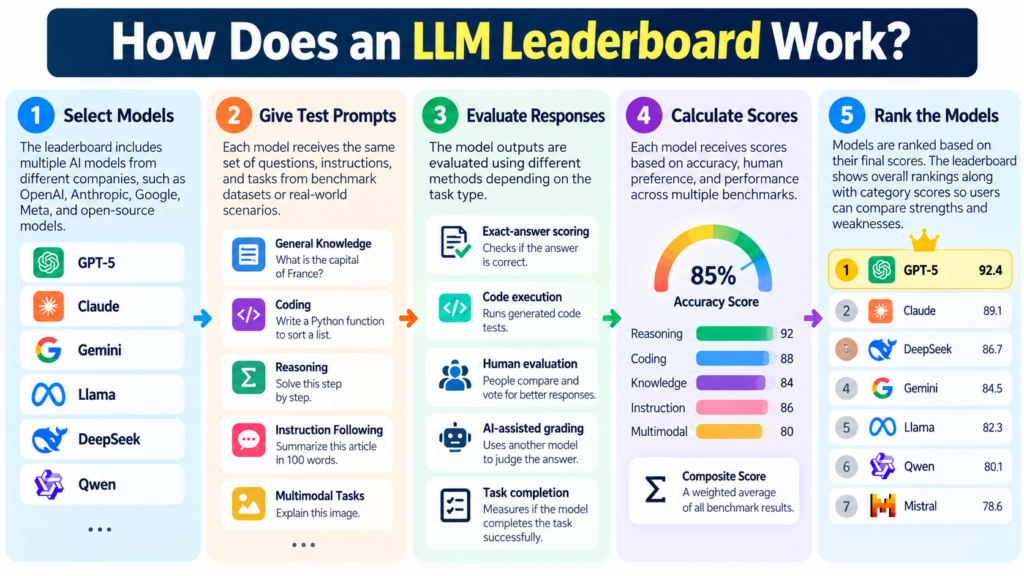
How Does an LLM Leaderboard Work?
A leaderboard begins with a set of models and a method for measuring their performance. The evaluation process determines what the final ranking can tell you.
1. The Models Receive Test Prompts
The platform supplies questions, instructions, coding problems, or other tasks. These may come from established benchmark datasets, newly created test cases, or real user interactions.
For example, a coding evaluation might ask a model to implement a function that processes a list of records and handles invalid inputs.
2. The Platform Evaluates the Responses
The evaluation method depends on the task.
- Exact-answer scoring: Checks whether a response matches a known answer.
- Code execution: Runs generated code against predefined tests.
- Human evaluation: Asks people to judge response quality.
- AI-assisted grading: Uses another model to assess an answer against a rubric.
- Task completion: Measures whether a model or agent completes a sequence of required actions.
Each method has strengths and weaknesses. A correct multiple-choice answer is relatively easy to verify, while judging whether an explanation is clear, complete, and trustworthy is more difficult.
3. The Platform Calculates Scores
Some leaderboards report accuracy or a percentage of completed tasks. Others use normalized scores, weighted averages, or rating systems based on head-to-head comparisons.
A model that wins more human preference comparisons may receive a higher rating on a conversational leaderboard. A benchmark-based leaderboard may instead rank it by performance across a fixed collection of tests.
4. The Models Are Ranked
The platform orders the models using its chosen metric. Some provide confidence intervals, evaluation dates, and separate category scores so readers can understand how reliable the ranking is.
This final step matters because a ranking is only as meaningful as the evaluation behind it. If two models have nearly identical scores and substantial uncertainty, treating their positions as a decisive difference can be misleading.
Key Benchmarks Used in an LLM Leaderboard
Not all AI tests measure the same ability. Understanding the most common benchmarks makes it easier to interpret model scores and identify the rankings that matter for your work.
MMLU and MMLU-Pro
MMLU evaluates knowledge across a wide range of academic and professional subjects. MMLU-Pro is a more challenging variant designed to provide a stronger evaluation of knowledge and reasoning.
These benchmarks can help when comparing models for research, education, and general question answering. However, a strong score does not guarantee that a model will provide accurate answers to every real-world question.
GPQA
GPQA, or Graduate-Level Google-Proof Q&A, tests difficult scientific knowledge and reasoning. Its questions cover areas such as biology, chemistry, and physics.
It is particularly relevant when evaluating models intended to support scientific research or advanced technical work. Still, answering benchmark questions is different from conducting an entire research project.
HumanEval and SWE-bench
HumanEval evaluates code generation using programming problems with executable tests. SWE-bench tests a different capability: resolving real software issues drawn from GitHub repositories.
The distinction is important. A model may produce a correct short function but struggle to understand a large codebase, identify the cause of a bug, modify several files, and pass the project’s existing tests.
IFEval
IFEval measures whether a model follows explicit instructions. These might require a particular response format, specific phrases, or defined structural constraints.
For content creators and businesses, instruction following can be just as important as general intelligence. A model that ignores a required word count or output format may be unsuitable for automated workflows, even if its writing quality is excellent.
Humanity’s Last Exam
Humanity’s Last Exam is a challenging benchmark designed to evaluate advanced knowledge and reasoning across numerous subjects. It is useful for investigating the limits of current AI systems, although results can depend on evaluation methods, tools, and model configurations.
The main lesson is simple: choose benchmarks according to the job you want the model to perform.
Technical Considerations for Model Selection
Beyond simple benchmark scores, professional developers must evaluate technical metrics that directly impact production. The llm leaderboard ecosystem often focuses on accuracy, but factors like inference latency, context window size, and model quantization are equally important for deployment. For instance, a model like Gemini 2.5 might offer superior reasoning, but its latency might be too high for real-time customer support applications. Similarly, while DeepSeek V3 may show impressive coding capabilities, you must verify if its API rate limits align with your traffic needs.
Most platforms now utilize an Elo rating system to track human preferences, which helps account for the nuance of conversational quality that static benchmarks often miss. However, you should also look for data regarding context window limits and multimodal capabilities if your project requires processing large documents or analyzing images. By combining these technical metrics with public rankings, you can build a more robust selection strategy that balances raw intelligence with the practical constraints of your specific infrastructure and budget.
LLM Leaderboard Rankings: What Do Scores Tell You?
A leaderboard score only makes sense when you know what it represents.
Consider three common scoring approaches.
| Scoring method | What it measures | Important limitation |
|---|---|---|
| Accuracy or pass rate | Correct answers or completed tests | Depends on the test’s difficulty and coverage |
| Elo-style or Bradley–Terry rating | Relative preference in head-to-head comparisons | Depends on the evaluated prompts and voters |
| Composite intelligence score | Performance across several weighted evaluations | Depends on benchmark selection and weighting |
Human-preference rankings are useful for open-ended tasks because people can compare two responses without needing a single predefined correct answer. However, a preference vote does not necessarily establish which answer is factually correct.
Composite scores offer a broader view, but they can hide differences between individual skills. A model with an excellent overall score might still be weaker in a specific programming language or business workflow.
Why Leaderboard Positions Change
Rankings can move for several reasons:
- New models enter the evaluation.
- Additional human votes improve or change preference estimates.
- Benchmark datasets or scoring methods are updated.
- Providers change their hosted models or inference settings.
- A model’s reasoning effort, tools, or prompt configuration differs between tests.
For this reason, check the evaluation date, model version, score uncertainty, and methodology before relying on a ranking. A model’s position on one day should not be treated as a permanent judgment of its capabilities.
Which LLM Is Best for Different Tasks?
The best model depends on your requirements, not simply its overall position on a leaderboard.
Writing and Content Creation
Look for strong creative-writing and instruction-following results. Test whether the model maintains your preferred tone, avoids repetition, and follows SEO requirements without inventing facts.
Software Development
Prioritize coding benchmarks, repository-level problem solving, test success, and the ability to work with your development tools. A model that writes code quickly is not necessarily the one that fixes complex bugs most reliably.
Education and Research
Examine subject-specific benchmarks, factual accuracy, source handling, and reasoning quality. Important conclusions should still be checked against reliable evidence.
Business Automation
Evaluate tool use, structured output, reliability, and successful task completion. Also consider access controls, privacy, and the cost of correcting failed tasks.
Local AI and Private Deployments
Focus on open-weight models, hardware requirements, licensing, quantization, and performance on your own machine. The highest-ranked hosted model may not be practical to run locally.
A Practical Example
Suppose a small company wants an AI assistant to answer questions about its product manuals.
Rather than selecting the model with the highest overall score, the company could test three candidates using the same set of representative questions. It could measure answer accuracy, whether the assistant cites the correct document sections, response time, and cost per successful answer.
If the assistant uses retrieval-augmented generation (RAG), the evaluation should also test whether the retrieval system supplies the correct documents. Even an excellent language model can produce a poor answer when it receives incomplete or irrelevant context.
This hypothetical example illustrates why an application-specific test can be more useful than a general ranking.
Advantages of Using an LLM Leaderboard
LLM leaderboards provide several practical benefits when used carefully.
- Faster research: They help narrow a large selection of AI models to a manageable shortlist.
- More informed comparisons: Shared evaluation methods can make comparisons more meaningful than unverified marketing claims.
- Specialized model discovery: Separate coding, reasoning, and instruction-following categories help reveal particular strengths.
- Better budget decisions: Some platforms publish API pricing, inference speed, and other efficiency measurements.
- Research transparency: Detailed benchmark results can help developers reproduce experiments and understand performance differences.
- Ongoing evaluation: Updated rankings can reveal how new releases compare with previously tested models.
For organizations building AI products, these benefits can reduce the time spent testing unsuitable candidates. However, a leaderboard should guide experimentation rather than replace it.
Limitations and Risks of AI Model Rankings
A leaderboard is not a complete measure of an AI system’s usefulness, safety, or reliability.
Benchmark Contamination
A model may have encountered benchmark questions or similar material during training. This can make its results less representative of its ability to solve genuinely new problems.
Private test sets, carefully designed evaluation procedures, and new test examples can help reduce this risk.
Different Testing Conditions
Two companies might report results from different prompt formats, sampling settings, tool configurations, or scoring implementations. Even when they use the same benchmark name, their results may not be directly comparable.
For a fair comparison, look for evaluations that use consistent conditions and clearly document their methodology.
Human Preference Is Subjective
People may prefer an answer because it is more detailed, confident, or elegantly written. Those qualities do not always correspond to factual accuracy.
A concise but correct response might receive fewer votes than a polished answer containing an important mistake.
Performance Does Not Guarantee Safety
A model can achieve excellent reasoning scores and still produce misleading information, mishandle sensitive data, or follow malicious instructions.
Businesses should separately test privacy, security, fairness, and resistance to prompt injection when relevant.
Overall Scores Hide Real Differences
A composite ranking combines selected measurements into one number. Its results depend on which benchmarks are included and how much weight each receives.
Two models with similar overall scores may behave very differently in production. The detailed results are often more valuable than the final position.
How to Choose an LLM Using a Leaderboard
A reliable model-selection process combines public rankings with testing on your own tasks.
- Define the task. Decide whether you need writing, coding, research, document extraction, customer support, or an AI agent that uses external tools.
- Choose relevant benchmarks. Use evaluations that measure the capability you actually need rather than relying exclusively on an overall score.
- Shortlist several models. Compare their scores, evaluation dates, context windows, access methods, and licensing conditions.
- Build a representative test set. Collect real examples of the inputs your application will receive, including difficult and unusual cases.
- Measure practical performance. Track accuracy, task completion, consistency, latency, and how often human intervention is required.
- Calculate the total cost. Consider input and output tokens, reasoning usage, retrieval, tool calls, hosting, and the cost of fixing mistakes.
- Review privacy and deployment requirements. Check data-handling terms, retention policies, access controls, and whether local deployment is necessary.
What Should You Compare Beyond Benchmark Scores?
For an API-based application, consider the following:
| Factor | What to check |
|---|---|
| Accuracy | How often does it produce a correct result? |
| Latency | How long does it take to respond? |
| Cost | What does a successful task cost, not just one request? |
| Context window | Can it handle the documents and conversation history you need? |
| Tool use | Can it call the required APIs or functions reliably? |
| Deployment | Is the model available through an API or suitable for local hosting? |
| Privacy | Are the data-handling arrangements acceptable for your application? |
An expensive model may be justified for difficult, high-value tasks, while a smaller and cheaper model may be sufficient for classification, routine extraction, or simple support questions.
Some systems also use a routing strategy: a smaller model handles straightforward requests, and a more capable model receives complex ones. This can improve the balance between cost and performance, provided the routing process is itself reliable.
The Future of LLM Leaderboards
AI evaluation is moving beyond static question-and-answer tests. Newer approaches increasingly examine whether models can complete realistic tasks, use tools, work across multiple steps, and avoid violating defined safety constraints.
For example, Artificial Analysis has developed its Intelligence Index to combine evaluations of capabilities such as coding, scientific reasoning, and general intelligence. Its methodology and individual evaluation results should be checked before making current model comparisons.
Other important developments include:
- Agent benchmarks: Measuring whether an AI system can complete multi-step workflows rather than just answer a prompt.
- Multimodal evaluations: Testing combinations of text, images, audio, and video.
- Reliability measurements: Evaluating factual errors, incomplete tasks, and consistency across repeated attempts.
- Efficiency comparisons: Measuring quality alongside latency, inference cost, and computing requirements.
- Domain-specific testing: Assessing performance in fields such as medicine, law, science, and software engineering.
These developments make rankings more useful for real applications, but they also introduce new challenges. Agent performance can depend on the tools, execution environment, and instructions surrounding the model. A leaderboard result for one configuration may not transfer to another.
The most useful future rankings will make these conditions clear and allow readers to inspect detailed results rather than relying on a single score.
Frequently Asked Questions
1. What is the best LLM leaderboard?
LMArena is useful for human-preference comparisons, Hugging Face is valuable for open-weight models and benchmark research, and Artificial Analysis helps compare capability, speed, and cost. The best option depends on your goal.
2. Is an LLM leaderboard updated in real time?
Not always. Some platforms update rankings frequently, while others publish results only after new evaluations. Check the latest update date and model version.
3. Which LLM leaderboard is best for coding?
Look for rankings that include coding benchmarks such as HumanEval and SWE-bench. For practical software development, prioritize repository-level tasks, test success, and performance in your own development environment.
4. Are open-source AI models included in LLM leaderboards?
Yes. Many platforms include open-weight models alongside proprietary models. Check the model’s actual license because open weights do not automatically mean unrestricted commercial use.
5. Can a smaller AI model outperform a larger one?
Yes. A smaller model can perform better on particular tasks, especially when it is well trained for a specific purpose. It may also offer lower latency and reduced deployment costs.
6. Are LLM leaderboard scores always reliable?
No. Scores depend on benchmark quality, test conditions, possible data contamination, and statistical uncertainty. Review the methodology and verify results with your own tests.
7. How often should I check an LLM leaderboard?
Check it when evaluating a new model, reviewing your AI system, or reconsidering your deployment costs. For production systems, periodic testing is more useful than changing models every time the rankings shift.
Conclusion
An LLM leaderboard is a valuable starting point for understanding the rapidly changing AI model landscape, but the highest-ranked model is not automatically the right choice for every user. Human-preference rankings, standardized benchmarks, and cost-performance evaluations answer different questions, so using them together provides a more balanced picture.
Start by identifying your main requirement, then compare models using relevant benchmarks and examine their individual strengths. Pay attention to testing conditions, score uncertainty, response speed, licensing, and data privacy. Most importantly, test your shortlisted models on realistic examples before committing to one.
For developers and businesses, the strongest choice is the model that delivers reliable results at an acceptable cost under real operating conditions. For everyday users, the most useful model is the one that consistently handles their tasks well. A leaderboard can guide that decision, but practical evidence should make the final call.