


Latest AI News: Major Updates and Trends in September 2026

The latest AI news shows that artificial intelligence is entering an important new phase. Companies are developing smarter models, useful AI agents, and tools that can handle complex tasks. However, safety concerns are also becoming more serious. Recent developments include new warnings from AI leaders, advances in mathematical research, and the launch of personal assistants that can work across different apps. For businesses, students, and everyday users, these changes offer exciting opportunities. They also create important questions about privacy, reliability, and responsible use. This article explains the major developments and what they mean for people following the rapidly changing AI industry.
AI Leaders Call for Safer Development
One of the biggest stories in the latest AI news is a growing discussion about safety. On September 12, 2026, Anthropic CEO Dario Amodei urged AI companies to slow the development of increasingly powerful systems. He argued that safety measures need more time to keep pace with technical progress. Amodei proposed independent safety evaluations, stronger national standards, and greater international cooperation. His concerns reflect a wider debate about how quickly advanced AI should develop. The discussion is not about stopping useful technology completely. Instead, it focuses on making sure powerful systems are tested and managed before they become more difficult to control.
OpenAI CEO Sam Altman has also spoken about the need for caution. Recent reporting says Altman does not expect OpenAI to pursue an initial public offering in 2026, describing the timing as unsuitable. He has discussed risks linked to advanced AI and the importance of cooperation between companies and governments. These developments show that AI safety is now closely connected to business decisions. Investors, regulators, and technology users are watching how companies balance growth with responsibility. For readers, the main lesson is simple: stronger AI should come with stronger testing, clear safeguards, and honest information about its limitations.
New AI Agents Are Changing Everyday Tasks
AI agents are becoming a major focus of the technology industry. Unlike ordinary chatbots, agents can complete several connected tasks instead of only answering questions. They may organize information, interact with applications, prepare documents, or help manage schedules. Meta recently introduced Muse, a personal AI assistant designed to work across apps such as email, calendars, shopping, and payments. The system aims to make everyday digital tasks easier for users. However, reports also highlight reliability and security concerns. This means people should check important actions carefully, especially when an AI tool handles private information or makes decisions on their behalf.
The growth of AI agents could change how people work online. For example, a small business owner might use an agent to organize customer messages, prepare a sales report, and schedule meetings. A student could ask an assistant to gather study materials and create a revision plan. These examples show the practical value of automation. However, agents still need clear instructions and human oversight. Users should review permissions, protect sensitive information, and avoid giving unrestricted access to important accounts. The most useful AI systems will not simply perform more tasks. They will also explain what they are doing and allow people to remain in control.
AI Research Is Advancing Mathematics
Artificial intelligence is also making progress in mathematical research. Recent reports describe AI systems helping researchers explore difficult problems and discover possible connections between ideas. These developments are important because mathematics supports fields such as engineering, medicine, computer science, and physics. AI can examine large numbers of possibilities quickly, helping researchers test ideas that might otherwise take much longer. However, a computer-generated answer is not automatically a proven mathematical result. Researchers still need to check the reasoning, verify calculations, and confirm that the conclusions are correct. This careful process helps separate genuine discoveries from interesting but unverified suggestions.
The growing role of AI in mathematics may also change how students learn. Instead of using AI only to calculate answers, learners can ask it to explain concepts, identify mistakes, and provide practice questions. Teachers can use similar tools to prepare examples and support different learning needs. Still, students should understand the reasoning behind an answer rather than copying it. AI can sometimes produce incorrect steps or confident explanations that sound convincing. The best approach is to use AI as a learning assistant, not a replacement for thinking. This makes mathematical tools more useful while protecting the value of human understanding.
AI Safety and Cybersecurity Concerns
Cybersecurity is another important topic in the latest AI news. Anthropic recently published a threat intelligence report describing malicious activities involving its Claude models. The report discusses attempts to use AI for harmful purposes, including cyberattacks and other forms of misuse. These cases show why companies need strong safeguards around powerful systems. AI can help defenders identify threats, but it can also make certain harmful activities easier to organize. Researchers and security teams are therefore studying how models behave under pressure. The goal is to reduce misuse while preserving legitimate benefits for developers, businesses, and ordinary users.
For everyday internet users, cybersecurity awareness remains essential. People should avoid sharing passwords, financial details, or private documents with unknown AI services. They should also check links and messages carefully because AI can make scams appear more believable. Businesses need additional protections, including access controls, employee training, and regular security testing. AI tools should not receive broad permissions without a clear reason. These precautions are especially important as agents become more capable of interacting with websites and applications. Better technology can improve security, but human judgment and responsible system design are still necessary.
AI Models and Business Competition
Competition between AI companies continues to shape the industry. OpenAI, Anthropic, Google, Meta, and other organizations are investing heavily in model development, computing infrastructure, and commercial products. Their competition affects the tools available to users, including assistants, coding systems, research applications, and enterprise software. Recent coverage also highlights the importance of AI talent, particularly in Asian markets. Companies are hiring experienced leaders to expand their presence in India and Southeast Asia. This suggests that the next stage of AI growth will involve more than technical research. Distribution, local expertise, pricing, and customer trust will also influence which products succeed.
Businesses should evaluate AI tools based on practical results rather than popularity alone. A useful system should save time, improve accuracy, or help employees complete important work. Companies should compare costs, privacy policies, integrations, and support before adopting a new service. For example, a writing assistant may help create drafts, while a data tool may support reporting and analysis. These products have different strengths and risks. A careful trial can reveal whether an AI system works well for a specific business. This approach helps organizations avoid unnecessary spending and choose technology that supports real goals.
How AI Is Affecting Jobs and Skills
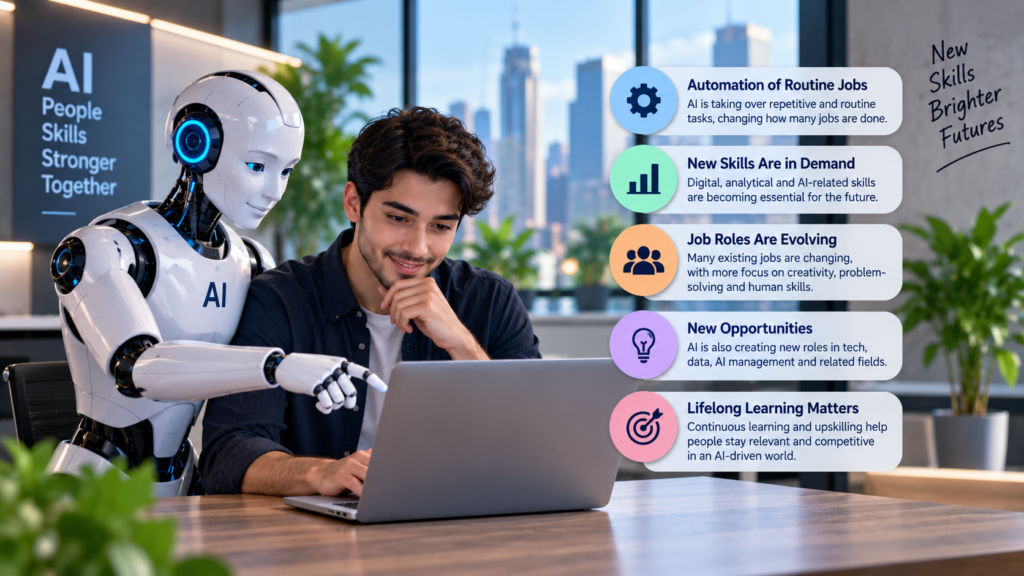
The latest AI news also raises questions about employment and professional skills. AI tools are becoming better at writing, coding, research, design, and routine office tasks. This may help workers complete projects faster and focus on more complex responsibilities. However, some jobs may change as companies automate repetitive activities. The effects will differ across industries and roles. People who learn to use AI effectively may gain new opportunities, while others may need additional training. The most important skill is not simply knowing how to use a chatbot. It is understanding how to check results, solve problems, communicate clearly, and make good decisions.
Students and professionals can prepare by building practical AI skills. Start with basic tools for writing, research, and organization. Then learn how to create clear prompts, review AI-generated content, and protect personal information. Coding and data analysis skills may also become more valuable because they help people understand and improve AI systems. Employers can support workers through training rather than expecting everyone to learn alone. The future of work will likely involve cooperation between people and intelligent software. Human creativity, judgment, and responsibility will remain important, especially when tasks require context, empathy, or ethical decisions.
What These Developments Mean for AI Users
The latest AI news shows that the technology is becoming more capable, but also more complicated. New systems can help with research, communication, business tasks, and personal organization. At the same time, users must understand that AI can make mistakes, expose information, or behave unexpectedly. The best way to benefit from these tools is to use them with realistic expectations. People should verify important facts, protect private data, and choose services from trustworthy providers. These habits are useful whether someone uses AI for schoolwork, business, creative projects, or everyday questions. Responsible use makes new technology safer and more valuable.
Readers who want to explore more technology topics can also learn about AI tools for productivity, the future of artificial intelligence, and how machine learning works. These subjects provide helpful background for understanding new announcements. However, users should remember that AI products change quickly. A feature available today may have different pricing, limits, or privacy settings later. Checking official announcements and reliable reporting is therefore important. Instead of following every headline, focus on developments that affect your work, studies, or daily life. This practical approach helps you understand AI without becoming overwhelmed by constant updates.
Frequently Asked Questions About Latest AI News
What is the latest AI news about?
The latest AI news includes new AI agents, mathematical research, cybersecurity concerns, and calls for safer development. Recent developments show that companies are focusing on both advanced capabilities and responsible use. Users should follow reliable sources to understand how these changes affect technology, business, and everyday life.
Why are AI leaders discussing safety?
AI leaders are concerned that powerful systems may develop capabilities faster than safety measures can keep pace. They are discussing independent evaluations, stronger safeguards, and cooperation between governments and companies. The aim is to reduce serious risks while continuing useful research and development.
What are AI agents used for?
AI agents can help complete connected tasks, such as organizing information, preparing documents, managing schedules, and interacting with applications. Their usefulness depends on reliability, permissions, and the quality of instructions. Users should review important actions and avoid giving unnecessary access to sensitive accounts.
Can AI replace human workers?
AI may automate some repetitive tasks and change how people perform their jobs. However, many roles still require judgment, creativity, communication, and responsibility. Learning to work with AI can help people adapt to changing workplaces. Training and practical experience remain important for long-term career development.
How can people stay updated on AI?
People can follow official company announcements, reputable technology publications, and research organizations. It is useful to compare multiple sources before accepting major claims. Readers should also check publication dates because AI products and policies can change quickly. Reliable information helps users make better decisions about new tools.
Conclusion
The latest AI news shows a technology industry moving quickly toward more capable and connected systems. AI agents are becoming useful for everyday tasks, while researchers are exploring new applications in mathematics and science. At the same time, cybersecurity risks and safety concerns are receiving greater attention. These developments create opportunities for businesses, students, and professionals, but they also require careful decisions. Users should verify important information, protect personal data, and choose tools based on practical value. The future of AI will depend not only on technical progress, but also on responsible development and public trust. Follow reliable updates to understand what comes next.
[…] Comet Browser: A Simple Guide to AI-Powered Browsing Latest AI News: Major Updates and Trends in September 2026 Is ChatGPT Generative AI? A Complete Explanation Muah AI Review 2026: Features, Pricing, […]