

Best Data Analytics Companies for Business Growth

Data analytics companies help businesses turn raw information into useful insights, improve decision-making, understand customers, and identify opportunities for growth. Some specialize in consulting and data strategy, while others provide cloud platforms, business intelligence software, data engineering, or artificial intelligence solutions. Choosing the right provider depends on what a business needs to achieve, the quality of its existing data, its technical resources, and its budget.
The market includes established consulting firms such as Accenture and IBM, alongside technology providers such as Databricks and Snowflake. These organizations do not all offer the same type of service, so comparing them requires more than looking at brand recognition. This guide explains what data analytics companies do, which providers are worth evaluating, how artificial intelligence fits into modern analytics, and what businesses should consider before signing a contract.
What Are Data Analytics Companies?
Data analytics companies help organizations collect, organize, examine, interpret, and use information to make better decisions. Their work can involve anything from building a simple sales dashboard to designing a cloud-based data platform that supports forecasting, machine learning, and AI-powered applications.
For example, an online retailer might work with an analytics provider to understand why customers abandon shopping carts. The provider could combine website activity, advertising performance, order records, and customer information to identify patterns. The retailer could then test changes to its checkout process and measure whether those changes improve completed purchases.
Most providers fall into three broad categories:
- Analytics consulting companies: Help organizations define data strategies, develop analytics solutions, and improve existing systems.
- Data and AI platform providers: Supply software for storing, processing, analyzing, and using data in analytics or AI applications.
- Specialist analytics firms: Focus on particular industries, data engineering, predictive modeling, business intelligence, customer analytics, or other specific requirements.
Some companies operate across multiple categories. A consulting firm may implement another vendor’s platform, while a platform provider may offer tools for data engineering, reporting, and machine learning.
The important distinction is that buying analytics software and hiring an analytics company are different decisions. A business may need one, the other, or a combination of both.
Leading Data Analytics Companies to Consider
There is no single provider that is best for every organization. The following companies are useful starting points for businesses comparing enterprise consulting, data infrastructure, AI development, and analytics capabilities.
1. Accenture
Best for: Enterprise-wide data transformation and AI strategy
Accenture helps businesses connect data strategy, engineering, cloud infrastructure, artificial intelligence, and business operations. Its data and AI services are designed for organizations that need more than a reporting tool, particularly those modernizing complex systems or introducing AI across several departments.
Accenture can be worth evaluating when a company needs help integrating data from different systems, preparing information for generative AI, or moving from experimental AI projects to production applications.
Consider Accenture if: Your organization has several business units, complex technology requirements, or a large transformation project that requires consulting and implementation support.
2. IBM Consulting
Best for: Enterprise data architecture, modernization, and governance
IBM Consulting works with organizations to develop data strategies, modernize data environments, improve architecture, and implement advanced analytics and machine learning. Its services also address data governance and the preparation of business information for AI applications.
This can matter when a company has decades of information spread across legacy databases, cloud services, and departmental applications. Before introducing predictive models or generative AI, the organization may need to improve data access, consistency, and security.
Consider IBM Consulting if: You operate a large or regulated business and need a structured approach to modernizing existing systems while maintaining governance and operational control.
3. Deloitte
Best for: Analytics strategy, business transformation, and risk management
Deloitte combines analytics and AI capabilities with business consulting. Its services cover data modernization, analytics, AI readiness, AI strategy, and governance. The company also helps organizations assess potential applications before investing in larger implementations.
This business-focused approach can be useful when a company knows it has a data problem but has not yet decided which technology or project will deliver the most value. The work may begin with identifying measurable business goals, reviewing current systems, and prioritizing use cases.
Consider Deloitte if: You need help connecting an analytics program to financial performance, operational improvements, compliance, or broader organizational change.
4. Databricks
Best for: Large-scale data engineering, machine learning, and AI development
Databricks provides a platform that brings data engineering, data science, machine learning, and analytics into a shared environment. Its architecture builds on technologies including Apache Spark and supports the development of data-driven applications and AI systems.
Databricks is particularly relevant when an organization needs to process large datasets, develop predictive models, or connect enterprise information to AI applications. However, using the platform effectively may require engineers, analysts, data scientists, or an implementation partner, depending on the project’s complexity.
Consider Databricks if: Your priority is building a scalable technical foundation for advanced analytics and AI rather than outsourcing every analytical task to a consulting firm.
5. Snowflake
Best for: Cloud data warehousing, analytics, and governed data access
Snowflake offers cloud-based data capabilities for querying, sharing, governing, and analyzing business information. Its analytics offering includes support for business intelligence, interactive queries, and AI-related workloads.
A company might use Snowflake to bring sales, finance, inventory, and customer data into a managed analytical environment. Teams can then query consistent datasets and connect supported reporting or AI tools to that information.
One important consideration is that a data platform does not automatically deliver business insights. Data modeling, access controls, cost management, and the design of useful reports still require planning and expertise.
Consider Snowflake if: You want a managed cloud data platform and need to make governed information accessible to multiple analytical teams.
6. Amazon Web Services (AWS)
Best for: Cloud-based analytics and scalable data processing
Amazon Web Services offers a broad collection of analytics services covering data integration, processing, streaming, SQL queries, data warehousing, and business intelligence. Relevant services include AWS Glue, Amazon Athena, Amazon Redshift, and Amazon QuickSight.
AWS is useful for organizations that want to build analytics systems within a cloud environment. For instance, a logistics business could collect delivery events, process incoming information, analyze performance, and create dashboards to monitor delays.
The trade-off is complexity. AWS offers many separate services, and selecting, securing, integrating, and monitoring them can require technical expertise.
Consider AWS if: Your organization already uses AWS or wants flexible cloud infrastructure for growing data workloads.
7. Google Cloud
Best for: Cloud analytics, SQL-based analysis, and AI-enabled data workflows
Google Cloud provides data analytics services, including BigQuery and tools for business intelligence, data processing, and AI-supported analysis. Its capabilities include querying data, developing predictive models, and building analytical workflows.
BigQuery can be particularly relevant for teams that want to analyze substantial datasets using SQL without managing traditional database infrastructure themselves. AI-assisted features may also help users explore information or develop analytical workflows, depending on the service and configuration.
Consider Google Cloud if: Your organization needs scalable cloud analytics and wants to connect data analysis with machine learning or AI applications.
8. Thoughtworks
Best for: Custom data engineering and analytics modernization
Thoughtworks combines technology consulting, software engineering, data engineering, and AI expertise. Its approach is relevant to organizations that need custom-built solutions or want to modernize systems that do not work well together.
For example, a business may need to combine information from older applications, develop reliable data pipelines, and build a reporting application around its specific operations. A technology consultancy can help design and implement that system rather than forcing every requirement into a standard product.
Consider Thoughtworks if: You need hands-on engineering and a solution tailored to your existing technology environment.
Quick Comparison of Leading Providers
| Company | Main strength | Best suited to |
|---|---|---|
| Accenture | Data and AI transformation | Large transformation programs |
| IBM Consulting | Data architecture and governance | Complex enterprise environments |
| Deloitte | Strategy and business outcomes | Analytics planning and organizational change |
| Databricks | Data engineering and AI | Advanced analytics development |
| Snowflake | Cloud data warehousing | Centralized analytical data |
| AWS | Cloud analytics services | Scalable cloud-based workloads |
| Google Cloud | Cloud analytics and AI | SQL analysis and AI-enabled workflows |
| Thoughtworks | Custom engineering | Tailored data solutions |
This is a practical comparison of different service models, not an independent ranking of overall performance. Project outcomes depend on the implementation team, requirements, existing systems, and quality of the data.
What Services Do Data Analytics Companies Provide?
The term data analytics services covers several distinct activities. Understanding these services makes it easier to identify what your business actually needs.
Data Collection and Integration
Businesses often store information in separate systems, such as customer relationship management software, accounting applications, e-commerce platforms, and operational databases. Data integration brings information from these sources together in a usable form.
The process may involve APIs, scheduled data transfers, event streams, and automated pipelines. A good implementation also checks whether records match correctly and whether important fields are missing.
Data Engineering and Management
Data engineering creates the systems that make analysis possible. Typical responsibilities include:
- Building pipelines that move data between systems.
- Cleaning and transforming raw information.
- Organizing datasets for reporting and analysis.
- Managing data warehouses, data lakes, or lakehouse architectures.
- Monitoring pipeline failures and data quality.
Without this foundation, even advanced analytical software can produce misleading results.
Business Intelligence and Reporting
Business intelligence, commonly called BI, turns business information into dashboards, reports, and interactive visualizations.
A retailer might track revenue, average order value, inventory levels, and returns. A finance department might compare actual spending with budgets. A marketing team might measure campaign performance and customer acquisition costs.
Effective dashboards focus on decisions rather than displaying every available metric.
Predictive Analytics and Machine Learning
Predictive analytics uses historical information and statistical or machine learning methods to estimate future outcomes.
Common applications include demand forecasting, customer churn prediction, fraud detection, and equipment maintenance. These models estimate probabilities or likely patterns; they do not guarantee what will happen.
The value depends on the quality of historical data, the relevance of the variables, and whether the model continues to perform well when conditions change.
AI-Powered Analytics
Some providers combine conventional analytics with generative AI and other machine learning techniques. These systems may help users ask questions in natural language, summarize findings, classify documents, or develop analytical queries.
For example, a manager could ask why sales fell in a particular region. An AI-enabled analytics workflow might translate that question into a database query, compare regional sales data, and summarize the results.
However, the output should be checked against the underlying data. A large language model can misunderstand a question, generate an incorrect query, or present an unsupported explanation. Reliable implementations use appropriate permissions, validated calculations, and traceable data sources.
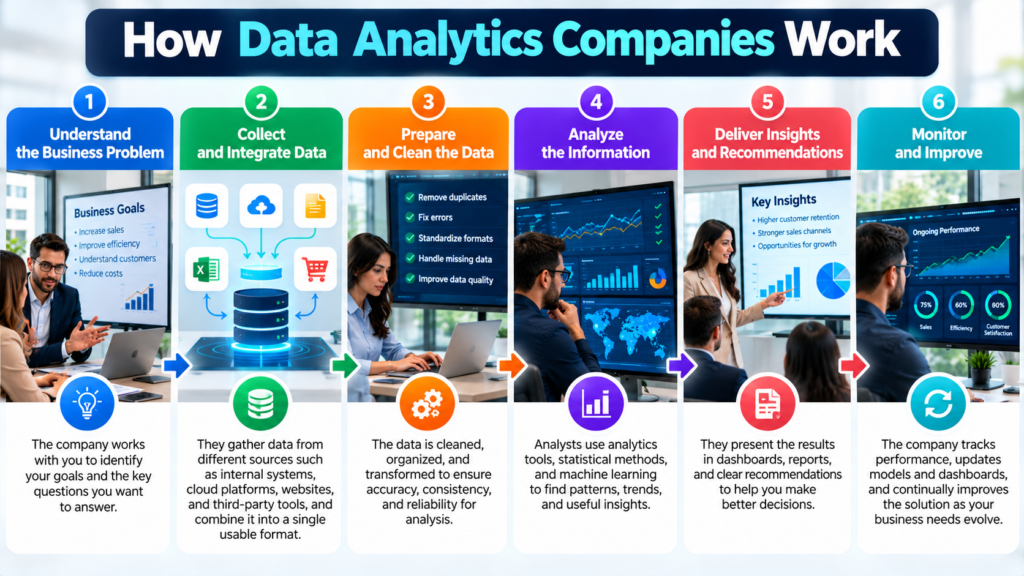
How Data Analytics Companies Work
A successful analytics project usually follows a sequence of connected steps. The exact process varies, but the objective is the same: produce reliable information that helps people make better decisions.
1. Define the business problem. Identify a question that needs answering, such as why customer retention is falling or which products are likely to run out of stock.
2. Assess the available data. Examine relevant sources, identify missing or inconsistent records, and determine whether the information is suitable for the task.
3. Integrate and prepare the data. Combine datasets, standardize formats, resolve errors, and establish repeatable processing pipelines.
4. Analyze the information. Use SQL, statistics, visualization, or machine learning to identify patterns and test possible explanations.
5. Deliver insights and recommendations. Present results in reports, dashboards, forecasts, or applications that help employees decide what to do next.
6. Measure results and maintain the system. Track whether the analysis improves the intended business outcome and update the data pipelines, reports, or models when necessary.
Consider a hypothetical online store that wants to reduce late deliveries. Its analytics partner could combine order timestamps, warehouse records, shipping events, and destination information. Analysis might reveal that delays are concentrated in particular warehouses or shipping routes.
The business could then adjust staffing, inventory placement, or delivery arrangements and compare results against a baseline. The value comes from connecting reliable evidence to a measurable action, not simply producing a sophisticated dashboard.
How Artificial Intelligence Is Changing Data Analytics
Artificial intelligence is expanding what analytics teams can automate, but it does not eliminate the need for sound data management, statistical reasoning, or human judgment.
Generative AI and Natural-Language Queries
Generative AI systems can translate ordinary language into suggested SQL queries, explain unfamiliar fields, summarize reports, and help users explore datasets. This can make analytics more accessible to employees who do not write code regularly.
However, natural-language access is only as reliable as the definitions, permissions, and data available to the system. A question such as “Which product performs best?” is ambiguous unless the organization defines whether performance means revenue, profit, growth, or customer satisfaction.
Machine Learning and Forecasting
Machine learning can identify patterns in historical data and use them to classify records, detect anomalies, or forecast future values. It is especially useful when relationships are too complex for simple manual rules.
A manufacturer, for example, might use sensor readings to estimate when equipment needs maintenance. The model’s effectiveness still depends on representative training data, appropriate evaluation, and ongoing monitoring.
Retrieval-Augmented Generation and Business Data
Retrieval-augmented generation, or RAG, connects a generative AI model to relevant external information at response time. In a business setting, that information might include approved documents, internal policies, or selected database results.
RAG can help an AI assistant answer questions using company-specific information. It does not guarantee correctness, however, and a RAG system is not automatically a replacement for a properly designed analytical database or reporting system.
AI Agents and Automated Workflows
AI agents can be designed to carry out multistep tasks, such as gathering permitted information, checking conditions, preparing a report, and requesting human approval. Their actual autonomy depends on the tools, permissions, and safeguards provided.
For financial reporting, for example, an agent might prepare a draft variance summary from approved figures. A person should still review material discrepancies before the report is used to make important financial decisions.
The practical lesson: Businesses should first establish trustworthy, accessible data. AI can then improve how employees query, interpret, and act on that information.
Benefits of Working With a Data Analytics Company
Hiring an analytics provider can be valuable when internal teams lack the time, skills, or infrastructure needed to solve a particular problem.
- Better decision-making: Decisions can be based on measured performance instead of assumptions or incomplete reports.
- Improved operational efficiency: Automated pipelines reduce repetitive data preparation and reporting work.
- Stronger forecasting: Appropriate statistical and machine learning methods can help estimate demand, costs, and operational risks.
- A clearer view of customers: Combining customer interactions, purchases, and feedback can reveal patterns that individual systems miss.
- Scalable infrastructure: Cloud-based platforms can support changing workloads without requiring every component to be managed on local hardware.
- A foundation for AI: Organized, governed data makes it easier to build useful AI applications and evaluate their outputs.
These benefits are not automatic. An analytics project can fail to deliver value if the original business question is poorly defined, the data is unreliable, or employees do not use the resulting insights.
Challenges and Risks to Consider
Data analytics projects involve technical, financial, and organizational risks. A reputable provider should explain these limitations before implementation.
Poor Data Quality
Duplicated records, missing values, inconsistent definitions, and outdated information can distort results. A dashboard may look accurate while comparing incompatible figures from different departments.
Ask how the provider will assess data quality and who will be responsible for correcting problems in the source systems.
Privacy and Security
Customer, employee, and financial information may be sensitive. Organizations should review access controls, encryption, retention periods, data residency requirements, subcontractors, and incident-response procedures.
If an AI service is involved, clarify whether information is sent to an external model provider, how it is handled, and whether it can be used for model training. Contractual and regulatory obligations may affect which services are appropriate.
AI Errors and Misleading Conclusions
Models can generate incorrect explanations, overlook important variables, or perform poorly when circumstances change. Correlation also does not establish causation: two business metrics moving together does not prove that one caused the other.
Important findings should be validated with source data, appropriate statistical tests, and subject-matter expertise.
Vendor Lock-In
A company can become dependent on a particular platform’s proprietary data formats, processing tools, or APIs. Moving to another provider may then require significant engineering work.
Review data-export options, ownership rights, portability, open standards, and the practical cost of switching vendors.
Unexpected Costs
The purchase price is only one part of an analytics project’s cost. Data migration, storage, computing, software licenses, consulting, employee training, security reviews, and ongoing maintenance can all add to the total.
Ask for a cost model based on realistic usage and growth assumptions rather than relying solely on an initial implementation estimate.
How to Choose the Right Data Analytics Company
The best provider is the one that can solve your specific business problem with an acceptable level of cost, risk, and complexity.
1. Define the Result You Want
Start with a measurable objective. Examples include reducing reporting time, improving inventory forecasts, identifying unprofitable customer segments, or consolidating inconsistent financial reports.
Avoid starting with a vague goal such as “use AI to improve the business.” A clear objective makes it easier to compare proposals and judge success.
2. Match the Provider to the Project
A business that needs a few operational dashboards may not need a major consulting engagement. An enterprise replacing several legacy systems may need specialist architects, data engineers, security experts, and change-management support.
Determine whether you need advice, a software platform, implementation services, ongoing management, or some combination.
3. Examine Relevant Experience
Ask prospective providers about projects involving similar data sources, technical requirements, regulations, and business goals. Request references or documented case studies where available.
Do not rely on a list of well-known clients alone. What matters is whether the provider can explain the work performed, the obstacles encountered, and how outcomes were measured.
4. Evaluate the Proposed Architecture
Ask how the solution will connect to your existing systems, control access, handle data quality, and support future growth. Check whether your internal team can maintain it after implementation.
For AI projects, also ask how outputs will be tested, how errors will be detected, and where human approval is required.
5. Compare Total Cost and Contractual Terms
Review implementation fees, subscriptions, cloud consumption, support, maintenance, training, and future expansion costs.
Contracts should clearly address data ownership, confidentiality, security responsibilities, service levels, intellectual property, termination, and data retrieval when the engagement ends.
6. Start With a Measurable Pilot
When the project is uncertain, begin with a limited use case rather than committing to a large transformation immediately.
Agree on a baseline, a target, a timeline, and criteria for success. A pilot should establish whether the proposed approach works with real data and whether the expected benefits justify further investment.
How Much Do Data Analytics Companies Cost?
There is no reliable universal price for data analytics services. Costs depend on the provider, project scope, data volume, required expertise, technology choices, security requirements, and ongoing support.
A small reporting project may involve limited setup and dashboard development. A large enterprise program can require extensive migration, integration, governance, and ongoing engineering.
| Cost factor | What to examine |
|---|---|
| Consulting | Discovery, strategy, architecture, and project management fees |
| Development | Data pipelines, dashboards, integrations, and custom applications |
| Software | Platform subscriptions, licenses, and third-party tools |
| Cloud usage | Storage, computing, queries, data transfer, and processing |
| Maintenance | Monitoring, troubleshooting, upgrades, and support |
| AI usage | Model inference, API consumption, evaluation, and safeguards |
| Training | Employee onboarding and ongoing technical education |
Before comparing proposals, ask each provider to separate one-time implementation costs from recurring expenses. Request assumptions for data growth, user numbers, workload frequency, and support levels.
For AI-enabled systems, include model usage and evaluation costs in the estimate. A solution that performs well in a small demonstration may become more expensive when thousands of employees use it regularly.
A transparent proposal should explain not only what the company will deliver, but also how the solution will be maintained and how success will be measured.
Frequently Asked Questions About Data Analytics Companies
1. What are the best data analytics companies?
Accenture, IBM Consulting, Deloitte, Databricks, Snowflake, AWS, Google Cloud, and Thoughtworks are useful options to evaluate. The right choice depends on whether you need consulting, cloud infrastructure, data engineering, business intelligence, or AI development.
2. What does a data analytics company do?
It helps businesses collect, organize, analyze, and interpret data. Services may include dashboard development, data integration, forecasting, machine learning, and AI-powered reporting.
3. Are data analytics companies suitable for small businesses?
Yes. Small businesses can benefit from sales dashboards, marketing analysis, inventory forecasting, and automated reports. A focused project using existing tools may be more practical than a large enterprise platform.
4. How do I choose a data analytics provider?
Define your business objective, compare relevant experience, review technical capabilities, evaluate security practices, and calculate total costs. Start with a measurable pilot if the project’s value is uncertain.
5. What is the difference between data analytics and AI?
Data analytics examines information to identify patterns and support decisions. AI includes techniques that can learn from data, generate content, make predictions, or automate tasks. The two often work together, but they are not interchangeable.
6. Can data analytics companies help with generative AI?
Yes. Some providers prepare enterprise data for AI, integrate approved information sources, develop RAG applications, and establish evaluation and governance processes. Capabilities vary by provider and project.
7. How long does a data analytics project take?
A limited reporting project may take weeks, while a complex enterprise transformation can take months or longer. The timeline depends on data readiness, integration requirements, security reviews, and the scope of implementation.
Conclusion
Choosing among data analytics companies starts with understanding the problem you want to solve. A consulting firm may be the right choice for a business that needs strategic guidance and implementation support, while a cloud platform or specialist engineering company may be more suitable for building a particular analytics capability.
Before committing, examine the provider’s technical approach, experience with similar projects, security practices, ongoing costs, and ability to demonstrate measurable results. If artificial intelligence is part of the plan, pay particular attention to data quality, model evaluation, privacy, and human oversight.
The most effective solution is not necessarily the most advanced or expensive one. It is the solution that turns reliable data into decisions your organization can act on, while remaining secure, maintainable, and financially sustainable as your needs grow.
[…] Interesting Engineering: Inventions, Ideas, and Breakthroughs Best Data Analytics Companies for Business Growth Switzerland Data Protection Law Compared to GDPR for AI Companies Vidqu Review 2026: What […]
[…] likely remain the standard for high-stakes business applications, often paired with insights from data analytics companies to measure […]