

FictionLab AI: Features, Pricing, Uses & Review

FictionLab AI is an AI-powered roleplay and interactive storytelling platform designed around conversations with fictional characters and scenarios. Instead of functioning like a general-purpose chatbot, it focuses heavily on immersive roleplay, character-driven conversations, world-building, and community-created scenarios.
The platform is designed for people who want to participate in fictional stories rather than simply read them. Users can explore existing scenarios, create characters, build fictional worlds, and guide conversations as stories develop. Features such as story cards, memory cards, model selection, message editing, regeneration, and narration are designed to make longer roleplay sessions more flexible.
That distinction matters. Someone looking for an AI assistant for emails, research, or coding may find FictionLab unnecessarily specialized. A writer, roleplay fan, or creator who wants to experiment with persistent fictional worlds may find its approach much more useful.
This guide explains what FictionLab AI is, how it works, its main features, practical uses, pricing structure, advantages, limitations, and who is most likely to benefit from it.
What Is FictionLab AI?
FictionLab AI is a specialized conversational AI platform built primarily for AI roleplay and interactive fiction. Users can discover scenarios created by the community or create their own, then interact with AI-controlled characters within those scenarios.
The important difference from a conventional AI chatbot is the emphasis on an ongoing fictional experience. Rather than simply asking a question and receiving an answer, the user participates in a story. The AI can portray one or more characters while the user plays a defined character or takes another role according to the scenario.
For example, a user could enter a fantasy scenario, define a character with a particular personality and background, and then interact with an AI-controlled cast. The conversation can evolve as the user makes decisions instead of following a fixed story written entirely in advance.
FictionLab is therefore best understood as a specialized AI storytelling environment rather than another general chatbot.
How Does FictionLab AI Work?
At a technical level, FictionLab uses large language models (LLMs) to generate responses based on the conversation and information supplied to the model.
An LLM does not literally understand a fictional universe in the same way a human author does. It generates text based on patterns learned during training and the information included in its current context. FictionLab adds systems around the underlying models to make that process more useful for long-running roleplay.
A typical interaction can involve several layers:
- User input — You write dialogue, actions, instructions, or other information.
- Scenario information — The AI receives relevant details about the setting and characters.
- Conversation context — Previous messages provide the immediate history of the roleplay.
- Story or memory information — Additional stored information can help maintain continuity.
- AI generation — The selected model generates the next response.
- Editing and controls — Users can adjust or regenerate responses when necessary.
This structure becomes especially important during long conversations. AI models have limits on how much information they can process at once. FictionLab’s story and memory systems are designed to help preserve important details without relying entirely on the entire conversation history.
FictionLab AI’s Story Cards and Memory System
One of FictionLab’s useful features is the distinction between story cards and memory cards.
Story cards work somewhat like a lorebook. They can contain information about fictional elements such as locations, factions, characters, races, organizations, or important concepts. Relevant information can be brought into the AI’s context when appropriate.
Imagine a fantasy scenario containing a kingdom called Eldoria. A story card could explain its history, political structure, important locations, rulers, and relationship with neighboring kingdoms.
Memory cards serve a different purpose. They are designed to preserve important events that have already happened during a roleplay session.
This distinction is useful:
| Feature | Main Purpose |
|---|---|
| Story Cards | Store world-building and permanent lore |
| Memory Cards | Preserve important past events |
| Custom Instructions | Guide AI behavior and writing style |
| Conversation History | Provide immediate context |
The difference matters because a fictional world’s permanent rules and the events that happened yesterday are not the same type of information.
FictionLab AI Models and Customization
FictionLab provides access to different AI models and allows users to adjust aspects of the roleplay experience. Model availability can change over time, so specific model names should not be treated as permanent features.
Different models can produce noticeably different writing styles. One may be better at descriptive prose, while another may produce shorter dialogue or respond differently to detailed instructions.
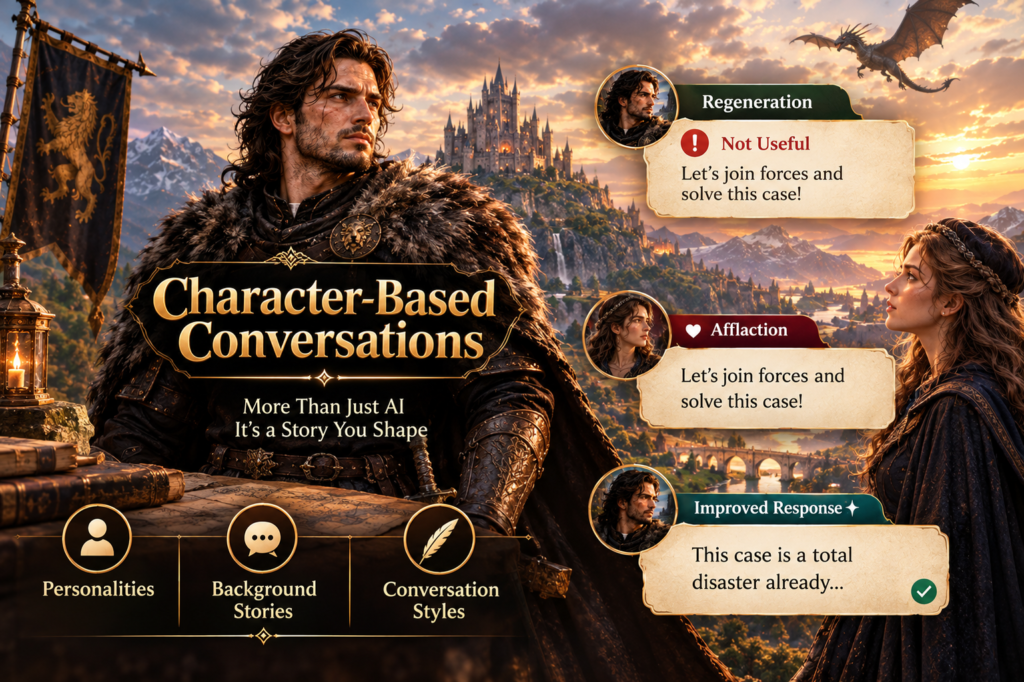
Users can also influence responses through custom instructions. These instructions can establish rules for character behavior, narration, dialogue, tone, and storytelling.
For example, a creator might instruct the AI to:
- Keep narration in third person.
- Avoid controlling the user’s character.
- Maintain a serious tone.
- Keep a character’s personality consistent.
- Follow established world rules.
- Avoid repeating information unnecessarily.
Clear instructions generally work better than long lists of contradictory rules.
What Can You Do With FictionLab AI?
FictionLab AI supports several types of fictional interaction and creative experimentation.
Interactive Storytelling
Users can participate directly in stories rather than simply reading them. Their decisions influence what happens next, making the experience closer to interactive fiction than conventional AI-generated prose.
Character Roleplay
The AI can portray fictional characters while the user plays a predefined or custom character. Character information can help establish personality, appearance, background, relationships, and behavioral traits.
World-Building
Creators can establish fictional settings with story cards, scenario instructions, and character information. This can be especially useful when a story contains its own terminology, history, factions, locations, or rules.
Community Scenarios
Users can explore scenarios created by other members instead of starting every story from scratch. This gives newcomers an easier way to experiment with different genres and roleplay formats.
Voice Narration
Narration features can make AI-generated messages available in spoken form, adding another layer to the storytelling experience.
Editing and Regeneration
Users can edit or regenerate messages when the AI produces an undesirable response. These controls are particularly useful because generative AI does not always take a story in the direction the user expects.
Translation
Translation features can also help users interact with generated content in supported languages.
Who Is FictionLab AI Best For?
FictionLab AI makes the most sense for people who want interactive fictional experiences rather than general productivity assistance.
It can be particularly useful for:
Roleplay enthusiasts: People who enjoy character-driven conversations can build or explore scenarios without writing every character response themselves.
Creative writers: Writers can use AI roleplay to experiment with dialogue, characters, scenes, or alternative story directions.
World-builders: Story cards provide a structured way to organize fictional settings and recurring concepts.
Interactive fiction fans: The platform combines aspects of chatbots, roleplaying games, and collaborative storytelling.
It is less suitable if your primary goal is conventional office productivity, programming assistance, academic research, factual research, or business automation. Those tasks generally require tools designed around those specific workflows.
FictionLab AI Pricing and Free Access
FictionLab offers free access as well as paid subscription options. The paid tiers are designed to provide additional capabilities, model access, or higher limits.
Pricing and subscription benefits can change, so users should check the current pricing displayed by FictionLab before subscribing. Older articles and reviews may contain prices or feature descriptions that are no longer accurate.
The platform’s free experience can be useful for newcomers who want to test the basic interface and storytelling quality before spending money.
For someone who is mainly interested in casual roleplay, the free version may be enough. More serious users who create many characters or require additional model access may have more reason to consider a paid plan.
Is FictionLab AI Free?
Yes, FictionLab provides a free experience, although free accounts have limitations compared with paid access.
Paid users may receive higher limits and access to additional capabilities. The exact differences depend on the current subscription structure.
The practical approach is simple: try the free version first. This lets you evaluate the AI’s writing quality, character consistency, interface, and available scenarios before deciding whether a subscription is worthwhile.
Strengths of FictionLab AI
FictionLab has several characteristics that distinguish it from a general-purpose AI chatbot.
Designed Specifically for Roleplay
Roleplay is central to the platform rather than being an afterthought. Scenarios, characters, world-building, and conversation controls are built around fictional interaction.
Useful World-Building Tools
Story cards and memory cards provide separate ways to manage fictional information and past events. This can be particularly helpful during long-running stories.
Extensive Customization
Users can customize characters, instructions, models, narration, and other elements of the roleplay experience.
Community Content
Community-created scenarios give users a large starting point for exploring different fictional settings and storytelling styles.
Flexible Conversation Controls
Editing and regeneration features give users more control when an AI response does not fit the direction of the story.
Limitations and Risks to Consider
FictionLab is still powered by generative AI, so its strengths should not be confused with human-level storytelling consistency.
AI Can Lose Continuity
Even with memory systems, an AI may change details, forget information, misunderstand relationships, or contradict earlier events.
For example, a character who was established as living in one city might suddenly be described as living somewhere else. These errors are a normal limitation of generative AI systems.
Generated Text Can Be Inconsistent
An AI may produce an excellent response in one scene and a repetitive or awkward response in another. Different models can also have different writing tendencies.
Memory Is Not Perfect
Memory features do not mean the AI remembers everything. They provide additional structured information that helps guide the model.
Users still need to maintain important details carefully, particularly in complicated stories with many characters and locations.
Adult Content
FictionLab is intended for adults, and its current app listing identifies mature content. This is an important consideration for parents and anyone looking for an AI service suitable for younger users.
Privacy Matters
Users should also consider privacy before sharing personal information in AI conversations. Even when a platform provides privacy and data-safety measures, it is sensible to avoid entering sensitive information that does not need to be part of a fictional conversation.
FictionLab AI vs. a General AI Chatbot
The biggest difference is purpose.
A general AI assistant is normally designed for answering questions, writing documents, summarizing information, analyzing data, coding, and handling many different tasks.
FictionLab is designed primarily around fictional interaction.
| Area | FictionLab AI | General AI Assistant |
|---|---|---|
| Primary purpose | Roleplay and interactive fiction | General assistance |
| Scenario system | Core feature | Usually prompt-based |
| Character roleplay | Central workflow | One of many possible uses |
| World-building | Dedicated tools | Usually handled through prompts |
| Long-form roleplay | Strong focus | Depends on model and setup |
| Community scenarios | Important feature | Usually not central |
| Productivity | Limited focus | Usually stronger |
| Research | Not the main purpose | Usually stronger |
| Coding | Not the main purpose | Usually stronger |
If your goal is to explore a fantasy world through interactive conversations, FictionLab’s specialized design can be an advantage.
If you want to analyze a spreadsheet, research a technical subject, write a business document, or debug software, a general-purpose AI assistant is usually a better match.
How to Get Better Results From FictionLab AI
The quality of an AI roleplay session depends heavily on how clearly the scenario is designed.
Start with a specific character description instead of a vague personality label.
For example, rather than writing:
A mysterious detective.
You could write:
A cautious detective who speaks in short sentences, avoids discussing her past, notices small physical details, and becomes more open only after trust has been established.
The second description gives the model concrete behavioral information.
It is also useful to separate world facts from past events. Permanent information about a fictional setting belongs in your world-building structure, while significant developments from the current story should be treated as memories.
Another important habit is correcting mistakes early. If the AI suddenly changes a character’s name or moves the story to another city, edit or regenerate the response instead of continuing for dozens of messages.
Small corrections can prevent inconsistencies from becoming part of the story.
Common Misconceptions About FictionLab AI
Is FictionLab AI an AI model?
No. FictionLab is better understood as an AI-powered platform that uses language models for its roleplay experience. The platform provides the interface, scenario system, memory tools, character features, and other functionality around those models.
Does FictionLab AI write complete novels automatically?
It can generate substantial fictional text, but that does not make it a replacement for a human novelist. Long-form storytelling requires consistency, editing, pacing, characterization, and deliberate artistic decisions.
Does a larger AI model guarantee better storytelling?
No. Model size is only one factor. Training, context handling, instructions, model design, and the surrounding application can all affect the final result.
Does memory mean the AI remembers everything?
No. Memory systems help preserve important information, but they are not equivalent to perfect human memory.
Frequently Asked Questions
What is FictionLab AI used for?
FictionLab AI is mainly used for interactive roleplay, character conversations, scenario creation, and AI-assisted storytelling.
Is FictionLab AI free?
Yes. FictionLab provides free access, while paid options offer additional capabilities and higher limits. Subscription details can change over time.
Can I create my own FictionLab scenario?
Yes. Creating customized scenarios is one of the platform’s core functions. Users can establish characters, settings, instructions, and other elements of a fictional experience.
Does FictionLab AI remember previous conversations?
FictionLab provides memory-related features designed to preserve important information from longer roleplay sessions. However, users should not expect perfect recall of every previous message.
Is FictionLab AI suitable for children?
No. FictionLab is positioned as an adult-oriented platform, and its current app listing identifies mature content. Parents should not treat it as a child-focused AI service.
Is FictionLab AI good for writers?
It can be useful for experimenting with characters, dialogue, scenarios, and alternative story directions. However, writers should review AI-generated material carefully for continuity, originality, characterization, and overall quality.
What is the best way to use FictionLab AI?
The best results generally come from creating clear character descriptions, specific scenario instructions, organized world information, and meaningful memories. Users should also correct AI mistakes rather than allowing them to accumulate.
Conclusion
FictionLab AI occupies a specific part of the growing AI market: interactive storytelling and AI roleplay. Its focus on characters, scenarios, world-building, memory, model selection, and conversation controls makes it considerably different from a conventional general-purpose chatbot.
The platform can be valuable for roleplay enthusiasts, creative writers, and people who enjoy experimenting with fictional worlds. At the same time, it is important to understand what the technology cannot guarantee. AI-generated characters can lose continuity, repeat information, misunderstand instructions, or introduce details that conflict with the established story.
For that reason, FictionLab works best when users actively guide the experience rather than expecting the AI to manage an entire fictional universe perfectly on its own. If immersive roleplay is your main goal, fictionLab AI is worth exploring; for research, coding, productivity, or business tasks, a general-purpose AI tool may be the better choice.
[…] Muah AI Review 2026: Features, Pricing, and Is It Worth It? FictionLab AI: Features, Pricing, Uses & Review Humanity’s Last Exam: A Complete Guide to the AI Benchmark AI Agents in Healthcare: […]