

DeepSeek V3: Features, Architecture, Uses, and Limitations

DeepSeek V3 is a large open-weight language model developed by the Chinese AI company DeepSeek. Released in December 2024, it attracted significant attention because it combined a very large model architecture with a relatively small number of parameters activated for each token. DeepSeek reports 671 billion total parameters, with about 37 billion activated for an individual token, alongside a 128K-token context window.
The model is built around a Mixture-of-Experts (MoE) architecture and incorporates technologies including Multi-head Latent Attention (MLA), DeepSeekMoE, auxiliary-loss-free load balancing, and multi-token prediction. It was trained on 14.8 trillion tokens and evaluated across reasoning, mathematics, coding, knowledge, and language tasks.
This guide explains what DeepSeek V3 actually is, how its architecture works, what it can be used for, where it performs well, where it has limitations, and why its release was important to the wider AI industry.
What Is DeepSeek V3?
DeepSeek V3 is a Mixture-of-Experts large language model (LLM) designed for general-purpose text generation and understanding.
At a practical level, it can perform many tasks associated with modern generative AI:
- Answering questions
- Writing and rewriting text
- Summarizing documents
- Generating and explaining code
- Solving mathematical problems
- Following detailed instructions
- Extracting information from text
- Translating between languages
- Assisting with research and analysis
The important distinction is that DeepSeek V3 is a model, not simply a chatbot application. A model can be integrated into applications through an API or deployed using its released model weights, subject to the applicable license.
DeepSeek released both the model and its technical report, making the system considerably more accessible to researchers and developers than a completely closed model. The model has 671 billion total parameters, approximately 37 billion activated parameters per token, and a 128K context length.
DeepSeek V3 at a glance
| Specification | DeepSeek V3 |
|---|---|
| Model type | Mixture of Experts (MoE) |
| Total parameters | 671 billion |
| Activated parameters per token | 37 billion |
| Context length | 128K tokens |
| Training data | 14.8 trillion tokens |
| Architecture technologies | DeepSeekMoE, MLA |
| Training stages | Pre-training, supervised fine-tuning, reinforcement learning |
| Initial release | December 2024 |
| Model weights | Released for developers and researchers |
| Primary uses | Text, coding, reasoning, analysis and generation |
Why DeepSeek V3 Became Important
DeepSeek V3 mattered for more than its headline parameter count.
The AI industry had increasingly focused on enormous models, expensive training runs, and proprietary systems. DeepSeek V3 demonstrated another approach: build a very large model but use an MoE architecture so that only a fraction of the parameters need to be active for each token.
That distinction is important.
A conventional dense model generally uses essentially the same complete parameter set for every token. An MoE model contains multiple expert networks and routes different tokens to selected experts. This allows the total model to be extremely large without requiring every parameter to participate in every calculation.
DeepSeek combined that architecture with several efficiency-oriented techniques. Its technical report says the model was pretrained on 14.8 trillion tokens and required 2.788 million H800 GPU-hours for the complete training process, according to DeepSeek’s reported methodology.
Those figures helped fuel discussion about whether frontier-level AI necessarily requires the same scale of computing infrastructure and expenditure traditionally associated with the largest models.
That does not mean DeepSeek proved that training advanced AI is cheap or easy. Training and deploying a 671B-parameter MoE model still requires substantial infrastructure and engineering expertise. The more useful takeaway is that architectural efficiency can materially change the economics of large models.
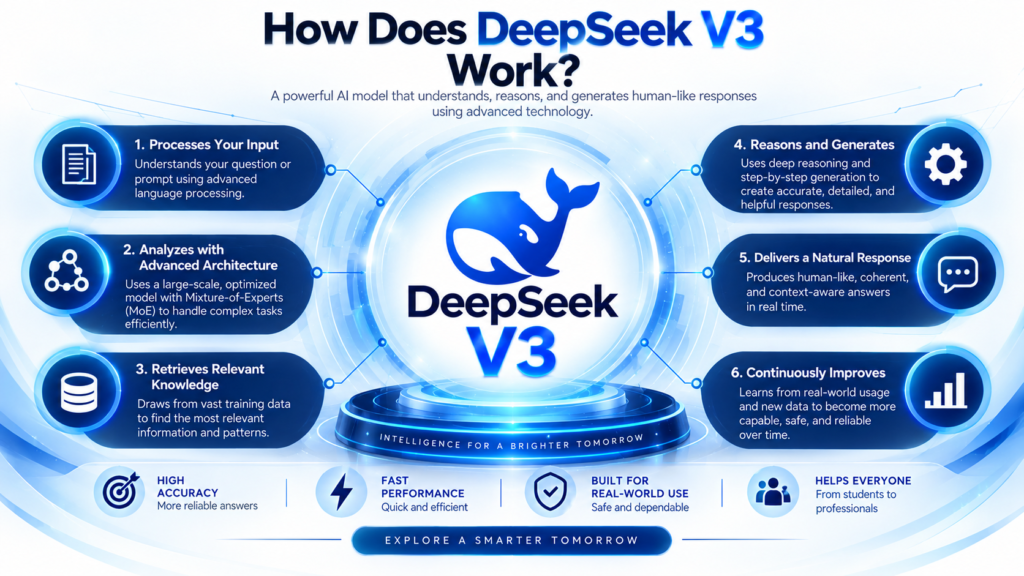
How Does DeepSeek V3 Work?
Mixture-of-Experts Architecture
The core idea behind DeepSeek V3 is the Mixture-of-Experts architecture.
Imagine a company with hundreds of specialists. A customer asking a programming question does not need every specialist to work on the request. Instead, the system routes the request to the specialists most relevant to the problem.
An MoE model works in a broadly similar way.
DeepSeek V3 contains many expert components, but only a subset is activated for a particular token. The model therefore has 671 billion total parameters while activating about 37 billion parameters per token.
This approach can provide a useful balance:
Very large total capacity + selective computation = potentially better efficiency.
It is one of the main reasons the 671B figure should not be interpreted as meaning that every generated token requires computation equivalent to a dense 671B model.
Multi-head Latent Attention
DeepSeek V3 also uses Multi-head Latent Attention (MLA).
Attention is one of the fundamental mechanisms behind transformer-based language models. It allows a model to determine which parts of its available context are relevant when generating the next token.
MLA is designed to make attention more memory-efficient by compressing information used during inference. DeepSeek had already developed and used MLA in its earlier model family, and V3 continued that architectural direction.
For developers, this matters because memory requirements during inference can become a major bottleneck when dealing with very large models and long contexts.
Auxiliary-Loss-Free Load Balancing
An MoE system needs to distribute tokens among its experts effectively.
If a small number of experts receive most of the work while others remain underused, the architecture loses some of its efficiency. DeepSeek V3 introduced an auxiliary-loss-free strategy for load balancing, which the research team designed to improve expert utilization without relying on the traditional auxiliary balancing loss.
This is a technical improvement, but its practical significance is straightforward: better routing can help an MoE model make more effective use of its expert capacity.
Multi-Token Prediction
DeepSeek V3 also uses a multi-token prediction training objective.
Traditional language models are generally trained to predict the next token. DeepSeek’s approach adds objectives involving multiple future tokens, with the goal of improving the model’s learning efficiency and performance.
The model repository also includes a Multi-Token Prediction module alongside the main model weights.
Training DeepSeek V3
DeepSeek reports that V3 was pretrained using 14.8 trillion high-quality tokens. After pre-training, the model went through supervised fine-tuning and reinforcement-learning stages.
This distinction is important because pre-training and post-training serve different purposes.
Pre-training
During pre-training, the model learns statistical relationships in enormous quantities of text and other training material.
It develops broad capabilities such as:
- Language understanding
- Knowledge representation
- Code patterns
- Mathematical relationships
- Text generation
- General instruction-following foundations
Supervised Fine-Tuning
Supervised fine-tuning exposes the model to carefully prepared examples designed to improve its behavior on useful tasks.
For example, training examples can demonstrate what a good answer to a question should look like, how code should be structured, or how an instruction should be followed.
Reinforcement Learning
Reinforcement learning can then be used to further shape model behavior and improve selected capabilities.
DeepSeek’s published report describes the complete V3 training process and reports that training remained stable without irrecoverable loss spikes or rollbacks.
DeepSeek V3 Context Window
DeepSeek V3 supports a 128K-token context length according to its model documentation.
A context window is the amount of information a model can consider within a particular interaction.
A larger context can be useful when working with:
- Long reports
- Large source-code files
- Contracts
- Research papers
- Multiple related documents
- Long conversations
- Extensive technical specifications
For example, a developer could provide a large software module and ask the model to identify related functions or explain how different components interact.
However, a large context window does not automatically mean perfect understanding. A model can still overlook details, misunderstand instructions, or produce incorrect conclusions when processing long inputs.
That is why context length and reliability should be treated as separate properties.
DeepSeek V3 Performance and Benchmarks
DeepSeek’s published evaluations showed strong performance across a range of academic and coding-related benchmarks.
For example, its reported evaluations include scores such as:
- 89.1 on MMLU-Redux
- 75.9 on MMLU-Pro
- 91.6 F1 on DROP
- 86.1 on IF-Eval
The evaluation table compares DeepSeek V3 with models including Qwen2.5 72B, Llama 3.1 405B, GPT-4o and Claude 3.5 Sonnet.
Benchmark results are useful, but they should not be treated as a universal ranking.
Different benchmarks measure different abilities, and results can vary according to prompting, evaluation methodology, model versions, and test contamination. A strong benchmark score does not guarantee that a model will be the best choice for a particular company’s workload.
For a real deployment, testing the model against your own prompts and data is more informative than relying on a single leaderboard.
What Can You Use DeepSeek V3 For?
DeepSeek V3 is broad enough to support many different workflows.
1. Coding Assistance
One of its most useful applications is software development.
A developer can use an LLM such as DeepSeek V3 to:
- Explain unfamiliar code
- Generate functions
- Find potential bugs
- Write tests
- Convert code between languages
- Generate documentation
- Refactor repetitive code
- Explain error messages
For example, a developer could provide a Python function and ask for an explanation of its logic followed by a set of unit tests.
The output should still be reviewed by a human. AI-generated code can contain subtle security, performance, or correctness problems.
2. Research and Summarization
DeepSeek V3’s long context can be useful for document-heavy workflows.
A researcher could provide several related documents and ask the model to:
- Summarize each document.
- Identify areas of agreement.
- Highlight contradictory claims.
- Extract important terminology.
- Create a structured comparison.
This can reduce manual reading time, although important conclusions should be checked against the original sources.
3. Content Creation
Writers and marketers can use DeepSeek V3 for tasks such as:
- Drafting outlines
- Rewriting paragraphs
- Generating headline ideas
- Creating first drafts
- Summarizing source material
- Adapting content for different audiences
The strongest workflow is usually human-led editing rather than one-click publishing.
The model can accelerate drafting, but factual verification, originality, tone, and editorial judgment remain important.
4. Business Automation
Businesses can integrate language models into applications that handle repetitive text-based tasks.
A hypothetical customer-support system, for example, could use a model to classify incoming messages and draft responses. A human or a separate business-rule system could handle sensitive cases.
Another workflow could extract fields from invoices or business documents and place them into structured records.
For production applications, developers generally need additional components such as validation, logging, access controls, and sometimes retrieval-augmented generation (RAG).
5. Educational Assistance
Students can use a model such as DeepSeek V3 to:
- Explain difficult concepts
- Create practice questions
- Review writing
- Walk through programming problems
- Summarize study material
The best use is as an interactive tutor rather than an unquestioned answer machine.
For example, instead of asking for the answer to a mathematics problem, a student can ask the model to explain the solution step by step and identify where the student’s reasoning went wrong.
DeepSeek V3 and RAG
DeepSeek V3 can also be used as part of a retrieval-augmented generation (RAG) system.
RAG combines a language model with an external knowledge source.
Instead of expecting the model to know every fact, the application first retrieves relevant documents and places them into the model’s context. The model then generates an answer using that retrieved information.
A simple business workflow might look like this:
Company documents → Search/retrieval system → Relevant passages → DeepSeek V3 → Answer
This can be particularly useful for internal knowledge bases, technical documentation, policies, and product information.
RAG does not eliminate hallucinations, though. The retrieval system itself can return poor information, and the language model can still misunderstand or incorrectly use the retrieved material.
Advantages of DeepSeek V3
DeepSeek V3 has several characteristics that made it particularly notable.
Large Model Capacity
Its 671B total parameters give the model substantial representational capacity, while its MoE architecture means only a subset is activated for each token.
Long Context
The 128K context window makes it suitable for many document-heavy and code-heavy workflows.
Strong Benchmark Performance
DeepSeek’s published evaluations showed competitive performance against several major models on a range of tests.
Open Model Availability
Developers and researchers can access model weights and supporting code rather than being limited to a completely closed API.
That makes experimentation, customization, evaluation, and self-hosting more accessible—although running the full model remains technically demanding.
Research Transparency
DeepSeek published a detailed technical report explaining major parts of its architecture and training approach.
For researchers, that is valuable because it allows the wider community to study and reproduce parts of the approach.
Limitations and Risks of DeepSeek V3
Strong benchmark performance does not make DeepSeek V3 infallible.
Hallucinations
Like other large language models, DeepSeek V3 can generate information that sounds convincing but is incorrect.
This is particularly dangerous when the output is used for:
- Legal decisions
- Medical information
- Financial decisions
- Security-sensitive software
- Academic research
- News reporting
Important claims should be independently verified.
Hardware Requirements
The phrase “open model” can create a misleading impression that the model is easy to run locally.
DeepSeek V3 is enormous.
Although MoE reduces the number of active parameters per token, the complete model still contains hundreds of billions of parameters. Running the full model at its original scale requires substantial memory and infrastructure.
Smaller quantized versions can make deployment more practical, but quantization can introduce trade-offs in quality, memory use, and performance.
Licensing Is Not Simply “MIT”
This is an important technical distinction.
The code in the DeepSeek V3 repository is released under the MIT License. However, the model itself is governed by a separate DeepSeek model license containing additional use-based restrictions.
Therefore, developers should not assume that the model weights have exactly the same terms as the code.
Organizations planning commercial deployment should review the current model license carefully and obtain appropriate legal advice when necessary.
Privacy and Security Considerations
Using an online AI service is different from running a model locally.
Any organization handling confidential information should understand:
- Where data is sent
- How data is stored
- What retention policies apply
- Whether prompts may be used for service improvement
- Which jurisdiction governs the service
- What security controls are available
There was also a reported January 2025 incident in which cybersecurity company Wiz found an exposed DeepSeek database containing sensitive information, including chat logs and software-related secrets. The database was subsequently secured after notification.
That incident does not prove that every use of DeepSeek is insecure, but it illustrates why organizations should perform their own privacy and security assessment before sending sensitive information to any external AI service.
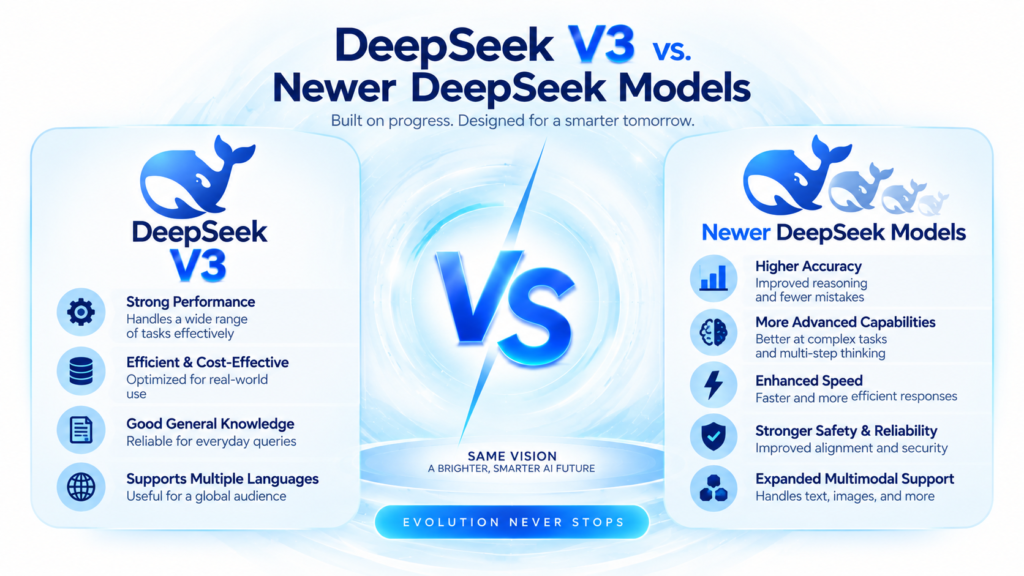
DeepSeek V3 vs. Newer DeepSeek Models
One of the easiest mistakes when researching DeepSeek V3 today is confusing the original V3 release with later models.
The original DeepSeek V3 was released in December 2024. DeepSeek subsequently released DeepSeek V3.1, which is built on the V3 family and includes additional post-training and long-context training work.
By 2026, DeepSeek’s official API documentation lists newer V4 models rather than the original V3 as its current API offerings.
That means a search for “DeepSeek V3” can refer to several different things:
| Term | Meaning |
|---|---|
| DeepSeek V3 | Original V3 model released in December 2024 |
| DeepSeek V3 Base | Base version intended for model-level use and research |
| DeepSeek V3 Chat | Post-trained conversational model |
| DeepSeek V3.1 | Later model in the V3 family with additional training |
| DeepSeek V4 | Newer DeepSeek generation |
For historical analysis, research, or self-hosted V3 deployments, the original model remains relevant. For a new API integration, however, developers should check the latest DeepSeek documentation rather than assuming V3 is still the recommended endpoint.
Is DeepSeek V3 Free?
The answer depends on how you use it.
The model weights were released for developers and researchers, which allows self-hosting and experimentation subject to the model license.
But self-hosting a 671B-parameter model is not equivalent to having a free AI service. The hardware, electricity, storage, networking, and engineering required to operate a model of this scale can be substantial.
API access is also a separate commercial service whose pricing can change over time. Because DeepSeek has introduced newer model generations, historical V3 API prices should not automatically be treated as current prices.
Who Should Use DeepSeek V3?
DeepSeek V3 can make sense for:
- AI researchers studying MoE models
- Developers experimenting with open-weight LLMs
- Organizations evaluating self-hosted language models
- Engineers building coding assistants
- Teams creating document-analysis systems
- Researchers testing long-context workflows
- AI enthusiasts interested in model architecture
It may be less appropriate when a project requires a managed service with a specific enterprise compliance profile, specialized multimodal functionality, guaranteed behavior, or a newer model with capabilities that the original V3 does not provide.
The right choice depends on the actual workload rather than the model’s reputation.
Practical Tips for Using DeepSeek V3
If you are evaluating DeepSeek V3, a sensible process is to start small.
Test Representative Prompts
Do not evaluate a model using only simple questions. Build a test set based on the tasks your application actually performs.
Measure Accuracy
For important applications, create expected answers or evaluation criteria and compare model outputs systematically.
Test Long-Context Behavior
If your application depends on large documents, test whether the model actually retrieves and uses information from different parts of the context.
Check Generated Code
AI-generated code should pass automated tests, static analysis, security checks, and human review before production use.
Protect Sensitive Information
Avoid sending confidential information to external AI services unless the relevant privacy, security, contractual, and regulatory requirements have been evaluated.
Check the License
The distinction between the MIT-licensed code and the separate model license matters for commercial and redistributed deployments.
Common Misconceptions About DeepSeek V3
Is DeepSeek V3 a 671B dense model?
No. It has 671B total parameters, but approximately 37B are activated per token because it uses a Mixture-of-Experts architecture.
Does 671B mean it always needs 671B parameters for every calculation?
No. That is one of the key benefits of its MoE design.
Is DeepSeek V3 the same as DeepSeek R1?
No. They are different models with different training goals and positioning. DeepSeek R1 became particularly associated with reasoning-focused AI, while V3 is a general-purpose foundation model.
Is DeepSeek V3 completely open source?
It is more open than a conventional closed commercial model, with released weights, code, and research documentation. However, the model license contains specific restrictions, so calling every component simply “MIT open source” would be inaccurate.
Is DeepSeek V3 still the newest DeepSeek model?
No. The original V3 has been followed by later releases, including V3.1 and newer generations. Anyone choosing a model for a new project should compare the current offerings rather than automatically selecting the original V3.
Frequently Asked Questions
What is DeepSeek V3?
DeepSeek V3 is a large Mixture-of-Experts language model released by DeepSeek in December 2024. It has 671 billion total parameters and activates about 37 billion parameters for each token.
What is the context window of DeepSeek V3?
The original DeepSeek V3 model supports a context length of 128K tokens.
Is DeepSeek V3 good for coding?
Yes. Coding is one of the practical areas where DeepSeek V3 can be useful. It can generate, explain, debug, transform, and document code, although developers should validate all generated code before using it in production.
Can DeepSeek V3 run locally?
Yes, the model weights were released for developers and researchers, and the project documentation describes methods for running the model locally. However, the full 671B-parameter model has substantial hardware requirements.
Is DeepSeek V3 free?
The model weights are available for download subject to their license, but running the full model locally requires significant computing resources. API access is a separate service and its pricing can change.
What is the difference between DeepSeek V3 and V3.1?
V3.1 is a later model in the same family. It builds on the V3 foundation with additional training and post-training improvements.
Is DeepSeek V3 better than ChatGPT?
There is no universal answer. Different models are better suited to different tasks, and performance changes as models are updated. A fair comparison should use the specific prompts, data, latency requirements, costs, privacy requirements, and evaluation criteria of the intended application.
Conclusion
DeepSeek V3 remains an important model in the development of open-weight AI, even though newer DeepSeek generations have since appeared. Its significance comes from the combination of a 671B-parameter Mixture-of-Experts architecture, 37B active parameters per token, a 128K context window, and a training approach designed around efficiency as well as capability.
For developers, the most valuable lesson is not simply that DeepSeek V3 is “large” or “powerful.” Its architecture demonstrates how selective computation, attention efficiency, and careful training can make very large models more practical.
At the same time, model size and benchmark scores should never replace real-world testing. Hallucinations, hardware requirements, licensing conditions, privacy concerns, and deployment costs all matter. Because DeepSeek has moved beyond the original V3 generation, anyone choosing a model for a new project should compare V3 with the company’s newer offerings rather than treating the 2024 release as the final word.