


Interesting Engineering: Inventions, Ideas, and Breakthroughs

Interesting engineering is about more than impressive machines or complicated technology. It explains how people solve real problems, improve everyday life, and turn scientific ideas into practical solutions. From robots that assist surgeons to bridges designed to withstand earthquakes, engineering combines creativity, mathematics, science, and careful testing to make things work safely and efficiently.
Some of the most fascinating engineering developments happen behind the scenes. Engineers design systems that deliver clean water, develop batteries that store renewable energy, build spacecraft that explore distant worlds, and create artificial intelligence tools that help people analyze complex information. These innovations often depend on several engineering disciplines working together.
Whether you are a student exploring career options, a technology enthusiast, or simply curious about how the world works, understanding interesting engineering projects can reveal how much thought goes into everyday objects and major scientific achievements. This guide explores remarkable engineering fields, practical applications, emerging technologies, and the challenges engineers must solve before an idea becomes reality.
What Makes Engineering Interesting?
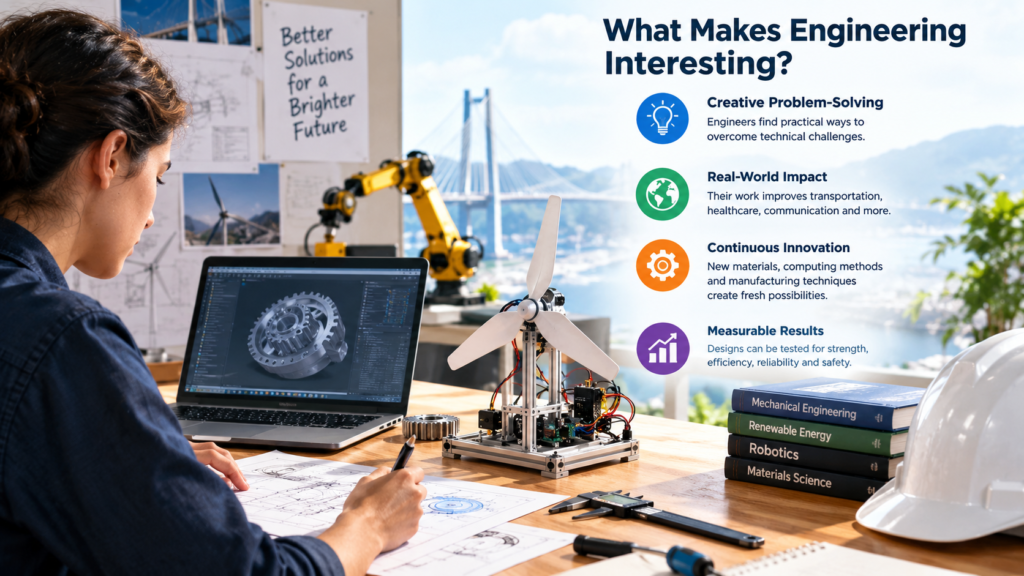
Engineering becomes particularly interesting when a difficult problem requires an unusual solution. A structure must support enormous loads without using unnecessary material. A medical device must operate accurately inside the human body. An electric vehicle needs a battery that balances energy capacity, weight, safety, and cost.
Engineers approach these challenges by combining scientific principles with practical constraints. They calculate what should work, build models or prototypes, test their assumptions, and improve the design when results fall short.
Several characteristics make engineering especially fascinating:
- Creative problem-solving: Engineers find practical ways to overcome technical limitations.
- Real-world impact: Their work can improve transportation, healthcare, communication, and energy access.
- Continuous innovation: New materials, computing methods, and manufacturing techniques create fresh possibilities.
- Measurable results: Designs can be tested for strength, efficiency, reliability, and safety.
The most impressive projects are not always the largest or most expensive. Sometimes, a simple mechanism or a small improvement in efficiency can make a significant difference.
1. Interesting Engineering Innovations Changing the World
Engineering breakthroughs often attract attention because they change what people can build, produce, or accomplish. Several areas demonstrate how scientific knowledge becomes useful technology.
Robotics and Autonomous Machines
Robotics combines mechanical engineering, electronics, control systems, and computer science. Modern robots can perform repetitive industrial tasks, inspect dangerous environments, assist with surgery, and move materials through warehouses.
Industrial robots commonly handle activities such as welding, painting, and component assembly. Their value comes from repeatability and the ability to work in controlled environments with consistent precision. However, they still require suitable programming, maintenance, safety systems, and supervision.
Autonomous robots face a more difficult challenge because they must respond to changing surroundings. A mobile robot may use cameras, lidar, and other sensors to estimate its position and detect obstacles. Software then helps it select a safe route. Even advanced systems can struggle with unusual conditions, poor visibility, or unexpected objects.
Renewable Energy and Advanced Batteries
Renewable energy engineering focuses on generating electricity from sources such as sunlight, wind, and flowing water. Solar panels convert light into electricity, while wind turbines use aerodynamic blades to drive generators.
One major challenge is matching electricity supply with demand. Solar production changes with sunlight, and wind output varies with weather. Battery storage can help by saving electricity when production is high and releasing it when needed.
Battery engineers must balance several competing requirements, including energy density, charging speed, operating temperature, cycle life, cost, and safety. Lithium-ion batteries are widely used in electric vehicles and consumer electronics, but alternative chemistries are also being developed for particular applications.
The engineering challenge is not simply creating a battery that stores more energy. It is developing a complete system that remains reliable, affordable, and safe throughout its operating life.
Spacecraft and Reusable Launch Systems
Space engineering pushes materials, propulsion, electronics, and thermal protection to demanding limits. Rockets must generate enough thrust to overcome gravity, while spacecraft need to function in an environment with extreme temperature variations, radiation, and limited opportunities for repair.
Reusable launch vehicles introduce another important engineering problem: designing hardware that can survive launch and return for inspection, refurbishment, and another flight. Reuse can reduce the need to manufacture an entirely new vehicle for every mission, although actual savings depend on refurbishment requirements and operational costs.
Spacecraft also rely on careful trajectory calculations, communication systems, onboard computers, and power management. A relatively small design error can have serious consequences because correcting a problem millions of kilometers away may be impossible.
2. Interesting Engineering Projects for Students
Engineering projects help students understand how scientific principles work outside textbooks. A good project starts with a clear question, uses available materials, and produces results that can be measured or compared.
Here are five useful ideas for school, college, or independent learning.
Build a Miniature Earthquake-Resistant Building
Construct two small buildings using identical materials but different structural designs. Test them on a simple shaking platform and compare how much movement each structure withstands.
Students can investigate diagonal bracing, wider foundations, structural symmetry, and the effect of building height. The experiment demonstrates why engineers consider lateral forces as well as the downward force of gravity.
Keep the test controlled by using the same platform movement and building materials for each trial. A model that performs well in a classroom experiment is not automatically suitable for real construction, but the results can help explain important structural principles.
Create a Small Solar-Powered System
A miniature solar-powered fan or LED circuit can demonstrate how photovoltaic cells convert sunlight into electrical energy.
Measure the output under different lighting conditions and, where possible, different panel angles. Students can record voltage and current to estimate electrical power using the relationship between voltage, current, and power.
The experiment also illustrates a practical limitation: a solar panel’s output depends on illumination, temperature, orientation, and the electrical load connected to it.
Design a Water Filtration Model
A simple filter containing gravel, sand, and activated carbon can demonstrate how different materials capture particles and affect water clarity.
Compare samples before and after filtration, documenting visible changes. However, clearer water is not necessarily safe to drink. Ordinary classroom filtration does not reliably remove every pathogen or dissolved contaminant, so the experiment should not be treated as a drinking-water treatment method.
Program a Basic Obstacle-Avoiding Robot
A small wheeled robot equipped with distance sensors can detect obstacles and change direction. Students can adjust its detection threshold, turning behavior, and movement speed.
This project introduces sensor feedback, control logic, and the relationship between hardware and software. It also shows why real-world robots need more than a simple set of instructions: sensor readings can be noisy, and a robot may react differently on different surfaces.
Compare Bridge Designs
Build model bridges using identical quantities of paper, wooden sticks, or another suitable material. Test how much load each design supports before it bends or fails.
Compare truss, beam, and arch structures, while keeping the span and testing conditions consistent. Record the maximum load and examine where the structure failed.
These experiments teach an important engineering lesson: a successful design depends on the relationship between material properties, geometry, applied forces, and construction quality.
3. How Artificial Intelligence Is Transforming Engineering
Artificial intelligence is changing how engineers design products, analyze information, and identify possible failures. Instead of relying exclusively on manual calculations or physical prototypes, engineering teams can use machine learning, simulations, and automated analysis to explore more design options.
Generative Design and Engineering Simulations
Generative design software can produce multiple design alternatives based on requirements such as weight, strength, available materials, and manufacturing constraints. Engineers evaluate these alternatives and select designs that satisfy the project’s objectives.
For example, an aerospace engineer might use generative design to explore a lightweight bracket that supports a specified load. The software can suggest unusual shapes that use material efficiently, but the final design still needs appropriate structural analysis, manufacturing checks, and physical validation.
Simulation software serves a related purpose. It allows engineers to study how a design might respond to forces, heat, fluid flow, or vibration before building a physical prototype.
These methods can reduce unnecessary trial and error. However, their results depend on the accuracy of the models, assumptions, boundary conditions, and input data.
AI-Powered Maintenance and Fault Detection
Industrial equipment often produces useful information through vibration sensors, temperature measurements, pressure readings, and electrical signals. Machine-learning systems can analyze these measurements to identify patterns associated with developing faults.
A factory, for instance, might monitor a motor’s vibration over time. If its operating pattern changes significantly, the system can alert maintenance staff to investigate possible bearing wear or misalignment.
This approach is often called predictive maintenance. It can help organizations plan inspections before a failure interrupts production, although the system cannot guarantee that every fault will be detected in advance.
AI can also help engineers search technical documents, summarize inspection reports, and compare equipment specifications. Generative AI tools are useful for these tasks, but their outputs should be checked against original documentation, particularly when safety or regulatory compliance is involved.
4. Amazing Civil Engineering Achievements
Civil engineering shapes the places where people live, travel, and work. Its most interesting achievements often involve overcoming difficult geographical conditions while protecting people and limiting environmental damage.
Bridges That Overcome Extreme Terrain
Large bridges demonstrate how structural engineering, geotechnical engineering, and materials science work together. Engineers must account for the weight of the structure, traffic loads, wind, temperature changes, earthquakes where relevant, and the behavior of the ground supporting the foundations.
The Huajiang Grand Canyon Bridge in China’s Guizhou province is a striking example of modern high-bridge engineering. Opened to traffic in 2025, it spans a deep canyon and reaches approximately 625 meters above the river below, making it a landmark in bridge construction.
Building such a structure requires careful planning of the foundations, steel components, cable systems, construction equipment, and installation sequence. Engineers must also consider how the bridge will be inspected and maintained after opening.
Earthquake-Resistant Buildings
Earthquake-resistant design does not mean making a building completely motionless during an earthquake. Instead, engineers aim to control movement, reduce the risk of collapse, and provide a suitable level of safety for occupants.
Common strategies include:
- Ductile structural elements: Components are designed to deform in controlled ways rather than fail suddenly.
- Shear walls and bracing: These resist sideways forces and help limit excessive movement.
- Base isolation: Specialized bearings can reduce the transfer of some earthquake motion from the ground to the building.
- Energy dissipation devices: Dampers absorb energy and can reduce structural movement.
The appropriate system depends on the building’s height, location, soil conditions, expected seismic forces, and applicable building codes. Good engineering also requires reliable construction and regular maintenance.
5. Biomedical Engineering: Technology That Supports Human Health
Biomedical engineering combines engineering principles with biology and medicine. It produces technologies that help clinicians diagnose conditions, monitor patients, restore movement, and deliver treatment.
Prosthetic Limbs and Advanced Medical Devices
Modern prosthetic limbs can combine lightweight materials, mechanical joints, sensors, and electronic control systems. Some myoelectric prostheses use electrical signals associated with muscle activity to control movements.
However, a sophisticated device is not automatically suitable for every patient. Comfort, weight, durability, battery life, affordability, and individual rehabilitation needs all influence its usefulness.
Engineers work with clinicians and users to improve how devices respond to human movement. Small changes in socket fit, control sensitivity, or mechanical alignment can significantly affect everyday usability.
Medical Imaging and AI Assistance
Medical imaging systems such as MRI, CT, and ultrasound rely on complex engineering to produce useful views of internal structures. AI systems can assist with selected image-analysis tasks, including identifying patterns that deserve further review.
These systems require careful validation because performance may vary across patient groups, scanners, and clinical settings. An AI-generated result should not automatically be treated as a medical diagnosis.
Biomedical engineering illustrates an important principle: technical performance matters, but safety, usability, clinical evidence, and patient needs matter just as much.
6. Interesting Engineering Materials That Seem Almost Futuristic
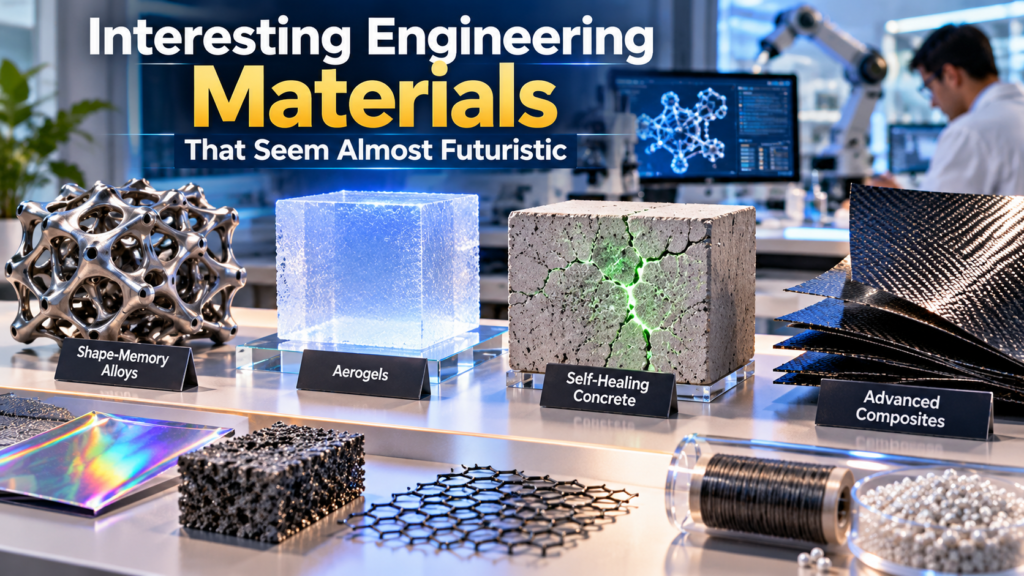
Materials engineering investigates how a material’s composition and internal structure affect its strength, flexibility, weight, electrical behavior, and resistance to heat or corrosion.
Developing a new material can change what engineers are able to build. However, a promising laboratory result does not always translate into affordable, large-scale production.
Shape-Memory Alloys
Shape-memory alloys can recover a previously established shape under suitable conditions after being deformed. Certain nickel-titanium alloys, commonly known as nitinol, exhibit this behavior.
These materials are used in applications such as medical devices and specialized mechanical components. Their behavior depends on temperature, alloy composition, processing, and loading conditions.
The engineering appeal is that a component can perform a movement without requiring a conventional motor in every application. Designers must still consider fatigue, operating temperatures, force requirements, and long-term reliability.
Self-Healing Concrete
Conventional concrete can develop cracks as it shrinks, experiences loading, or faces environmental changes. Researchers have investigated several ways to help concrete repair small cracks, including mineral-forming bacteria, encapsulated healing agents, and chemical processes that promote further mineral formation.
Some approaches can seal certain cracks under suitable conditions, potentially reducing water penetration and maintenance needs. However, self-healing concrete is not a universal solution for structural damage, and performance depends on the method, crack size, exposure conditions, and cost.
Aerogels and Lightweight Insulation
Aerogels are highly porous materials that can provide excellent thermal insulation at relatively low weight. Their structure contains a large amount of empty space, which limits heat transfer in appropriate formulations.
Silica aerogels have applications in specialized insulation and scientific equipment. Their use in ordinary buildings or consumer products depends on factors such as cost, mechanical strength, installation requirements, and durability.
These examples show why material selection is a central engineering decision rather than a minor detail.
7. Mechanical and Electrical Engineering in Everyday Life
Many technologies that appear simple from the outside depend on careful engineering across multiple systems.
Electric Vehicles
Electric vehicles combine electric motors, power electronics, batteries, thermal management, braking systems, and software. An electric motor converts electrical energy into mechanical motion, while power electronics regulate the energy supplied to it.
Regenerative braking can recover some of the vehicle’s kinetic energy during deceleration and return it to the battery. The amount recovered depends on driving conditions, battery charge, temperature, and system design.
Engineers must also manage battery temperature, protect electrical components, and ensure that the vehicle behaves predictably under different conditions. Improving one characteristic, such as acceleration, can affect energy consumption, component temperatures, or battery life.
Smart Homes and the Internet of Things
Smart thermostats, connected lighting, environmental sensors, and automated security systems rely on electronics, communications, and control engineering.
A temperature sensor, for example, can send readings to a controller that adjusts heating or cooling to maintain a target temperature. The system must account for sensor accuracy, response delays, and the changing conditions inside a building.
Connectivity introduces additional considerations. Devices need secure communication, reliable software updates, and sensible privacy protections. An automated system should also have a safe fallback when its network connection or sensor fails.
8. The Main Benefits and Limitations of Engineering Innovation
Engineering creates opportunities, but every design involves trade-offs. Understanding these trade-offs helps separate genuinely useful technology from impressive demonstrations that are difficult to implement.
Key Benefits
- Improved efficiency: Better designs can reduce energy consumption, material waste, or production time.
- Greater safety: Monitoring systems and carefully tested structures can help reduce certain risks.
- Better accessibility: Assistive devices and inclusive infrastructure can make daily activities easier for more people.
- New capabilities: Advanced materials, robotics, and computing allow engineers to tackle problems that were previously difficult or impractical.
- Long-term resource savings: Durable equipment and efficient systems can reduce maintenance and replacement needs.
Important Limitations
- Cost: Advanced materials, specialist equipment, and research can be expensive.
- Reliability: Components may wear out, software can fail, and operating conditions can differ from simulations.
- Environmental impact: Manufacturing and disposal can consume resources or create pollution.
- Technical complexity: Modern systems often depend on several interconnected components, making diagnosis and repair more difficult.
- Safety and regulation: High-risk technologies need testing, documentation, and compliance with relevant standards.
A successful engineering project balances performance with affordability, safety, maintainability, and environmental responsibility. The best design is not necessarily the most advanced one; it is the one that meets the real requirements reliably.
9. How to Start Learning Engineering
You do not need expensive equipment or advanced mathematics to begin exploring engineering. A small project can teach you how to identify a problem, test an idea, measure results, and improve a design.
Start with something you can build or investigate using accessible materials. A paper bridge, simple electrical circuit, basic robot, or solar-powered model can introduce fundamental concepts.
Follow this process:
- Identify a problem. Decide what you want to improve, measure, or understand.
- Research the principles. Learn which scientific concepts explain the problem.
- Set measurable requirements. Define what success means before building anything.
- Create a prototype. Start with a simple version that can be tested safely.
- Measure performance. Record results rather than relying only on visual impressions.
- Improve the design. Change one important variable at a time when possible.
- Document the findings. Explain what worked, what failed, and what you would test next.
Students interested in digital engineering can explore programming, computer-aided design, circuit simulation, or introductory robotics. Those interested in structures can study geometry, forces, materials, and basic structural analysis.
University engineering departments and professional engineering organizations can also provide educational materials, career guidance, and technical resources for beginners.
10. The Future of Interesting Engineering
Engineering is likely to become increasingly interdisciplinary. AI-assisted design, advanced robotics, improved energy storage, new materials, and digital simulation are already changing how many technical problems are approached.
One promising direction is the development of digital twins: virtual representations of physical systems that can be updated using real operating data. Depending on the application, a digital twin can help engineers monitor equipment, compare possible operating conditions, and investigate maintenance needs.
Another area is sustainable engineering. Designers are increasingly concerned with the energy and resources consumed throughout a product’s life, from material extraction and manufacturing to repair and disposal. Designing components for reuse, recycling, and easier maintenance can be as important as improving their initial performance.
AI will also influence engineering workflows by helping analyze large datasets, generate design alternatives, and automate selected repetitive tasks. Nevertheless, engineering judgment remains essential. Generated designs and predictions must be checked against physical laws, reliable measurements, safety requirements, and real-world constraints.
Future progress will depend not only on technical breakthroughs but also on whether new systems can be manufactured, maintained, afforded, and used responsibly.
Frequently Asked Questions About Interesting Engineering
What Are Some Examples of Interesting Engineering?
Examples include earthquake-resistant buildings, reusable rockets, surgical robots, electric vehicles, self-healing materials, and renewable energy storage systems.
Which Engineering Field Is the Most Interesting?
It depends on your interests. Robotics suits people who enjoy machines and programming, civil engineering focuses on infrastructure, and biomedical engineering connects technology with healthcare.
What Are Some Easy Engineering Projects for Beginners?
Paper bridges, miniature solar circuits, water filtration demonstrations, simple robots, and earthquake-resistant building models are useful starting points.
How Is AI Used in Engineering?
AI can help analyze sensor data, identify possible equipment faults, explore design alternatives, and summarize technical documents. Engineers must validate important results.
Is Engineering Difficult to Learn?
Engineering requires practice in mathematics, science, and problem-solving, but beginners can start with simple projects and gradually develop more advanced skills.
Why Is Engineering Important in Everyday Life?
Engineering supports clean water, transportation, electricity, communication, healthcare, housing, and many products people use daily.
What Is the Future of Engineering?
Major areas of development include AI-assisted design, robotics, sustainable infrastructure, advanced materials, energy storage, and more efficient manufacturing.
Conclusion
Interesting engineering reveals how scientific knowledge becomes practical solutions to real problems. From bridges and electric vehicles to medical devices and intelligent robots, engineering influences almost every part of modern life. Its most important achievements are not simply impressive designs but systems that work safely, reliably, and efficiently under real conditions.
For students and curious readers, the best way to understand engineering is to explore how things work, build small projects, and learn from testing. For professionals, emerging tools such as AI and advanced simulation offer new ways to investigate complex problems, but they do not eliminate the need for sound engineering judgment.
As technology develops, the strongest innovations will be those that combine creativity with evidence, responsible design, and practical value. Understanding these principles makes it easier to appreciate engineering breakthroughs and recognize which ideas can genuinely improve the world.
[…] Quote Finder: Find Quotes, Sources, and Meaning Interesting Engineering: Inventions, Ideas, and Breakthroughs Best Data Analytics Companies for Business Growth Switzerland Data Protection Law Compared […]