

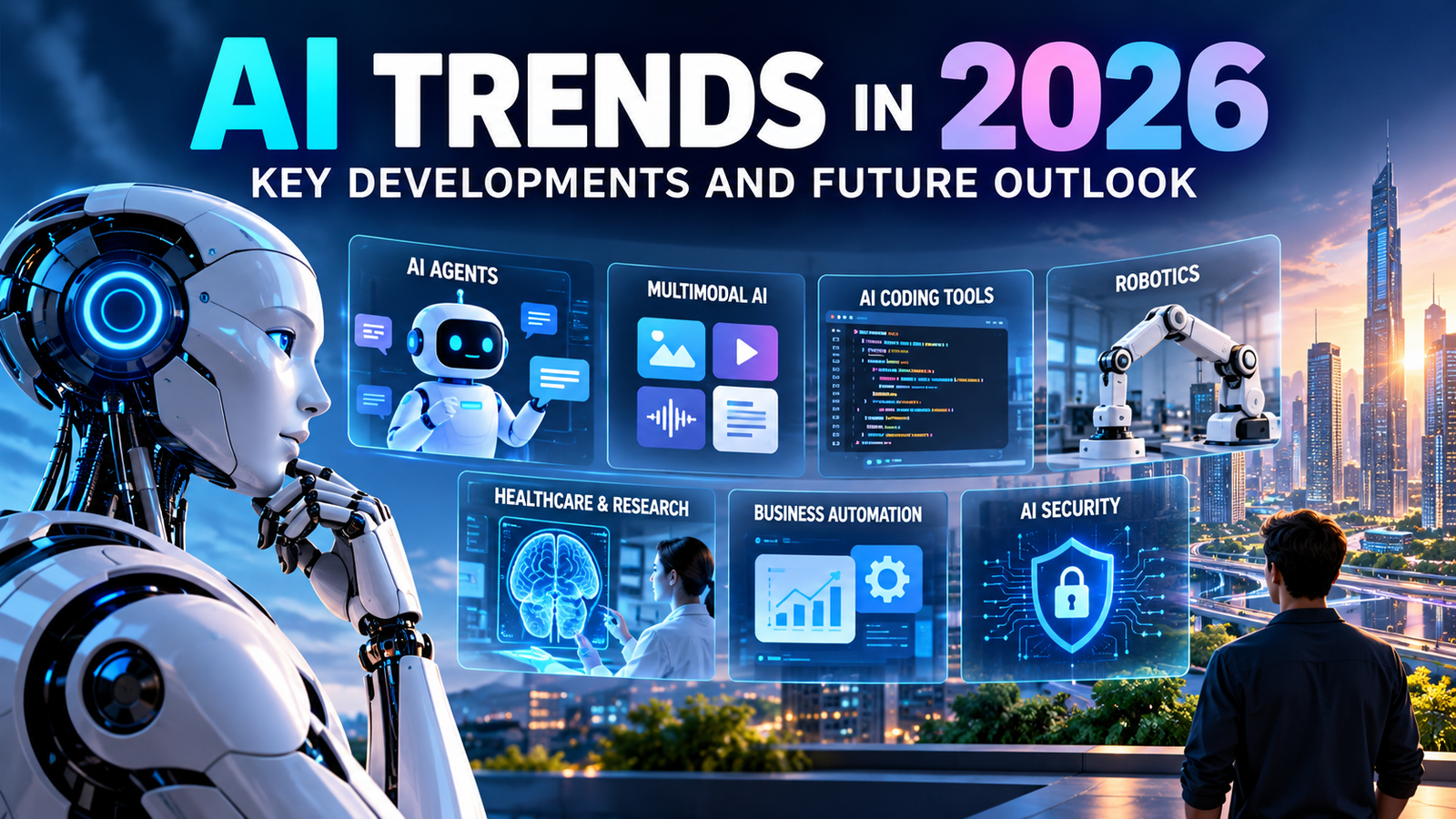
AI Trends in 2026: The Technologies Shaping the Future

AI trends in 2026 are shifting from simple chatbots to sophisticated systems that handle complex, real-world tasks across industries. This evolution marks a transition toward autonomous agents, multimodal models, and efficient on-device processing that supports critical business operations. While generative AI remains a cornerstone, the industry is increasingly prioritizing practical application, security, and measurable value. Understanding these developments is essential for professionals and businesses aiming to distinguish between genuine innovation and temporary marketing hype in a rapidly changing technological landscape.
The Stanford AI Index 2026 report highlights the scale of this change, reporting that generative AI reached approximately 53% population-level adoption within three years, while 88% of surveyed organizations reported using AI in 2025. However, adoption does not automatically mean that every implementation delivers measurable value.
Understanding these trends helps individuals and businesses distinguish useful innovations from marketing hype. This guide examines the most important AI developments, their practical applications, their limitations, and the skills worth developing.
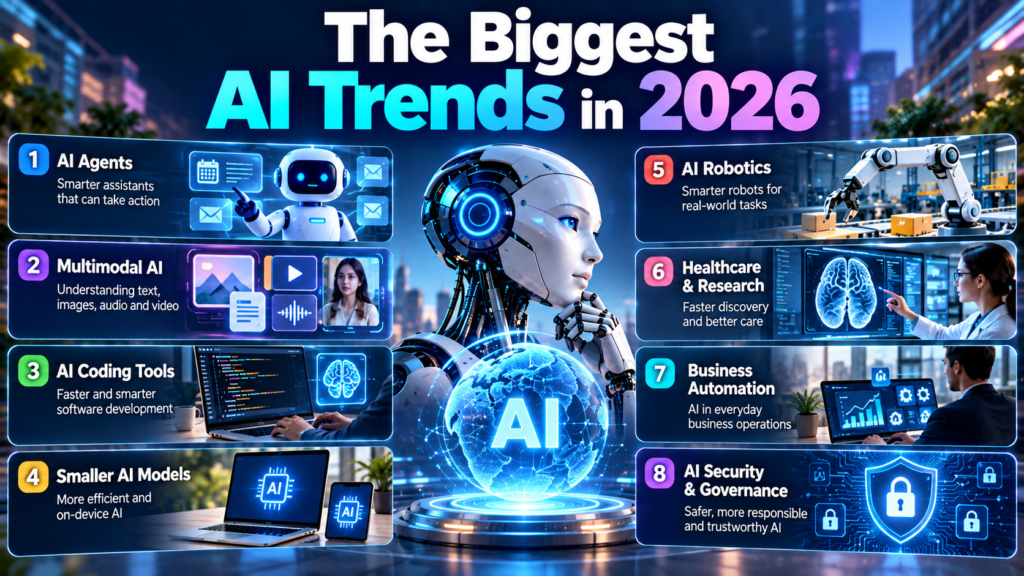
The Biggest AI Trends in 2026
The most important AI trends are not limited to increasingly powerful models. Much of the progress involves making AI more useful, affordable, connected, and reliable in everyday work.
Here are the major developments to watch:
- AI agents: Systems that can carry out multistep tasks using tools and external services.
- Multimodal AI: Models that process combinations of text, images, audio, and video.
- AI coding assistants: Tools that help developers write, test, explain, and maintain software.
- Smaller AI models: More efficient models that can run on personal devices or specialized hardware.
- AI-powered robotics: Systems that combine machine learning with physical machines and sensors.
- AI in healthcare and scientific research: Applications for analyzing data, supporting research, and accelerating discovery.
- Enterprise AI automation: AI integrated into existing business software and workflows.
- AI security and governance: Measures for managing privacy, misinformation, bias, and unauthorized actions.
These developments overlap. For example, an AI agent may use a multimodal model to interpret a document, a coding tool to generate a script, and a business application to complete a workflow.
The important distinction is that these capabilities are developing at different speeds. Some are already practical, while others remain experimental or require substantial human supervision.
Retrieval-Augmented Generation (RAG) and Enterprise Accuracy
Retrieval-Augmented Generation, or RAG, has become a cornerstone of enterprise AI adoption. Unlike standard models that rely solely on their pre-trained knowledge, RAG systems connect to a company’s private, verified data sources—such as internal wikis, databases, or document repositories—to generate answers. This architecture significantly reduces the risk of hallucinations, as the AI must ground its responses in provided facts rather than probabilistic guesses. For businesses, this is one of the most practical ai trends because it allows for the deployment of specialized assistants that understand proprietary information without the need for expensive, time-consuming model retraining. By integrating RAG, organizations can ensure that their AI tools remain current and context-aware, providing accurate support for internal operations and customer inquiries alike. As companies refine their data hygiene, RAG will likely remain the standard for high-stakes business applications, often paired with insights from data analytics companies to measure success.
AI Agents Are Moving Beyond Simple Chatbots
One of the most significant AI trends is the development of AI agents. A traditional chatbot responds to a question or instruction. An AI agent can go further by using tools, retrieving information, following a sequence of steps, and performing actions within a defined workflow.
For example, a customer support agent could retrieve an order record, check a delivery status, draft a response, and prepare an escalation when the problem requires human assistance. Each action depends on the tools, permissions, and safeguards provided by the business.
Modern agent systems can use tools, manage multistep workflows, and coordinate tasks. However, the level of autonomy depends on the particular implementation.
How AI agents work
A typical agent workflow includes:
- Understanding the goal: Interpreting the user’s request and relevant constraints.
- Planning: Breaking a larger task into smaller actions.
- Using tools: Accessing approved APIs, databases, search systems, or software.
- Checking results: Evaluating whether the actions produced the expected outcome.
- Completing or escalating: Returning a result or requesting human intervention.
The practical challenge is reliability. An agent may choose the wrong tool, misinterpret a result, or repeat an unsuccessful action. Businesses should test agents against real tasks and restrict access to sensitive systems.
For now, the strongest starting point is a repeatable, well-defined workflow rather than an agent with unrestricted access to everything.
Multimodal AI Is Making Computers More Flexible
Multimodal AI refers to systems that work with more than one type of information. Depending on the model, this may include text, images, audio, video, or structured data.
Earlier AI applications often focused on one task, such as recognizing objects in photographs or converting speech into text. Multimodal systems can connect several of these capabilities within a single interaction.
Consider a student who photographs a complicated physics problem. A multimodal assistant might interpret the diagram, explain the question, and provide a step-by-step solution. A business user could provide a chart and ask the system to summarize its main findings. A developer could discuss an interface using a screenshot instead of describing every visual detail.
Different AI models now support various combinations of language, audio, image, video, and other capabilities. Their exact functionality still varies by model and application.
Why multimodal AI matters
- Education: Explaining diagrams, photographs, and spoken questions.
- Marketing: Helping creators develop visual concepts and supporting copy.
- Accessibility: Supporting speech transcription, image descriptions, and other assistive tasks.
- Business operations: Extracting information from scanned documents, charts, and recordings.
- Research: Helping scientists examine different forms of experimental data.
There are important limitations. AI can misread small text, overlook details in an image, misunderstand a video, or produce an incorrect explanation of a chart. High-stakes results still need independent verification.
AI Coding Tools Are Changing Software Development
AI-assisted software development has moved beyond basic code suggestions. Modern tools can help developers understand unfamiliar codebases, generate functions, explain errors, write tests, and propose changes across multiple files.
Some systems can also work through a task in several stages. A developer might ask an AI coding assistant to investigate a reported bug, identify the likely cause, suggest a patch, and run relevant tests in an authorized environment.
AI coding tools have demonstrated progress on software engineering benchmarks, but benchmark performance should not be confused with a guarantee that generated code will work correctly in every production environment.
What developers should expect
AI coding assistants are particularly useful for:
- Generating routine code and boilerplate.
- Explaining unfamiliar functions or programming concepts.
- Drafting unit tests and documentation.
- Finding potential bugs and suggesting fixes.
- Exploring APIs and prototyping applications.
They can also introduce security vulnerabilities, use outdated libraries, misunderstand project requirements, or produce code that passes a limited test but fails in real use.
The best workflow keeps a developer responsible for reviewing changes, running tests, checking dependencies, and evaluating security. AI can speed up implementation, but it does not remove the need for engineering judgment.
Smaller AI Models and On-Device Intelligence Are Growing
Not every AI task requires the largest available model. A smaller, specialized model may provide enough capability while reducing latency, infrastructure requirements, and the amount of information sent to an external service.
This is driving interest in on-device AI, quantization, model distillation, and efficient inference.
- On-device AI: Runs some or all processing on a phone, computer, or other local device.
- Quantization: Uses lower-precision numerical representations to reduce memory or computing requirements.
- Model distillation: Trains a smaller model to reproduce useful behavior learned by a larger model.
- Efficient inference: Reduces the resources needed to generate an answer or prediction.
For instance, a laptop application might summarize local notes without uploading every document to a cloud service. A company could use a compact model to classify routine support tickets and reserve a more capable model for complex cases.
Cloud AI versus on-device AI
| Factor | Cloud-based AI | On-device AI |
|---|---|---|
| Computing power | Can use large remote systems | Limited by local hardware |
| Internet access | Usually required for remote inference | May work offline |
| Privacy | Depends on service and data policies | Data can remain local |
| Updates | Provider can update the service | Local models may need updates |
| Best use | Complex tasks and large-scale services | Private, fast, or offline tasks |
Neither option is automatically better. A hybrid approach can run simple tasks locally and send more demanding requests to the cloud. Organizations should compare accuracy, operating costs, privacy, and hardware requirements before choosing.
The Sustainability Challenge in Modern AI
The rapid advancement of large-scale models has brought the environmental cost of computation into sharp focus. Training and running massive neural networks require significant electricity and water for cooling data centers, leading to increased scrutiny regarding the carbon footprint of modern technology. Consequently, a major shift within current ai trends is the move toward “Green AI”—a focus on optimizing model architecture, improving hardware efficiency, and reducing the energy required for inference. Developers are increasingly prioritizing model distillation and quantization, techniques that allow smaller, more efficient models to perform tasks previously reserved for massive, power-hungry systems. This shift is not just environmental; it is economic. By reducing the computational resources needed for daily operations, companies can lower their cloud infrastructure costs while improving latency. As sustainability becomes a core metric for corporate responsibility, the industry will continue to favor solutions that balance high performance with lower energy consumption, often utilizing multimodal capabilities to achieve more with less.
AI Is Accelerating Scientific Research and Healthcare
Scientific research is becoming an important area for AI development. Researchers are using machine learning to identify patterns in complex datasets, predict molecular properties, analyze medical images, and explore potential treatments.
In drug discovery, for example, AI models can help researchers identify promising molecules or estimate how biological systems may respond to different interventions. These predictions can narrow the search space, allowing scientists to focus laboratory resources on more promising candidates.
AI is also becoming useful in medical research, scientific literature analysis, and the interpretation of complex experimental data.
Practical applications of AI in healthcare
- Medical imaging: Helping clinicians identify patterns in X-rays, scans, and other images.
- Drug discovery: Predicting molecular properties and supporting early-stage research.
- Clinical documentation: Summarizing consultations and preparing draft notes for professional review.
- Medical research: Searching scientific literature and organizing research findings.
- Personalized care research: Exploring how patient characteristics may relate to treatment outcomes.
These applications should not be confused with autonomous medical decision-making. A promising prediction does not establish that a treatment is safe or effective. Clinical trials, regulatory review, data quality, and professional judgment remain essential.
Privacy is another major consideration. Health information requires appropriate security, access controls, and compliance with applicable laws.
Generative AI Is Expanding Across Content Creation
Generative AI remains one of the most visible AI trends because it can produce text, images, audio, video, and software code from instructions.
Content creators are using these capabilities to develop first drafts, explore creative concepts, prepare social media posts, edit images, and produce supporting material for articles and videos.
For example, a blogger might use AI to organize research notes, identify unanswered reader questions, create an initial outline, and suggest alternative headlines. The blogger still needs to verify facts, add original insight, and ensure the final article meets the audience’s needs.
Where generative AI provides value
Text and content generation
AI can help draft outlines, summaries, product descriptions, email messages, and social media content.
Image and design generation
Creators can develop visual concepts, create campaign assets, and edit existing images.
Audio and video production
AI tools can support transcription, voice generation, video concepts, captions, and editing workflows.
The biggest limitation is that generated content can be plausible without being correct. Images may contain visual inconsistencies, synthetic voices can be misused, and written content may include fabricated details.
For publishers, the practical lesson is to treat AI as a production assistant rather than an automatic replacement for research, editorial judgment, or original reporting.
AI Is Becoming More Useful in Everyday Business Operations
Businesses are moving beyond isolated experiments toward integrating AI into customer service, document management, analytics, marketing, and internal knowledge systems.
Industry research indicates widespread organizational AI adoption, but AI-agent deployment remains at an early stage across many business functions. This distinction matters: using an AI tool is much easier than redesigning a business process around a dependable automated system.
Examples of business AI applications
| Business function | Practical application | Important safeguard |
|---|---|---|
| Customer service | Drafting replies and classifying support requests | Human escalation for complex cases |
| Marketing | Grouping customer feedback and brainstorming campaigns | Review claims and brand accuracy |
| Finance | Extracting data from invoices | Reconcile amounts with original records |
| Human resources | Organizing job descriptions and training materials | Protect applicant data and check for bias |
| Operations | Summarizing reports and identifying unusual patterns | Validate findings against source data |
How companies can implement AI successfully
Start with one repetitive task that has a clear business outcome. Measure how long it takes before and after introducing AI, record the error rate, and calculate the total cost of operating the solution.
A system that saves time but creates frequent errors may not provide meaningful value. Likewise, an expensive model may be unnecessary for a task that a simpler tool can handle.
The strongest implementations combine automation with clear ownership, quality checks, and a process for correcting mistakes.
AI Robotics Is Connecting Software With the Physical World
Robotics is another important area of AI development. Traditional robots often rely on carefully programmed movements and controlled environments. AI-enabled robotics aims to improve how machines perceive their surroundings, interpret instructions, and adapt to different situations.
These systems combine several technologies, including computer vision, machine learning, motion planning, sensors, and physical control systems.
Potential applications include:
- Warehouse robots that move goods between designated areas.
- Industrial robots that inspect products or assist with assembly.
- Agricultural systems that identify crops and support targeted operations.
- Research robots that manipulate objects in controlled experiments.
- Assistive robots designed to help people with specific physical tasks.
AI research is increasingly exploring ways to connect advanced models with robotic systems. However, success in a simulation or demonstration does not establish reliable performance in every real-world setting.
Physical environments are difficult because objects can move unexpectedly, lighting can change, and small perception errors can lead to failed actions. Safety is especially important when robots operate near people.
For this reason, AI robotics is likely to develop unevenly. Highly controlled industrial environments are generally easier to automate than unpredictable homes, streets, or public spaces.
AI Security, Privacy, and Responsible Use Are Becoming Essential
As AI becomes connected to business systems and personal information, security and governance are becoming central parts of implementation rather than optional additions.
AI introduces familiar technology risks alongside new ones. A system may reveal sensitive information, generate misleading content, reproduce bias, or respond to instructions hidden inside untrusted documents. An agent with excessive permissions may also perform an unintended action.
The National Institute of Standards and Technology published its Generative AI Profile in July 2024 as a companion to its AI Risk Management Framework. The guidance addresses identifying, evaluating, and managing risks throughout the generative AI lifecycle.
Main risks businesses should understand
- Hallucinations: AI generates information that sounds convincing but is false or unsupported.
- Data privacy: Sensitive information may be exposed through prompts, logs, integrations, or inappropriate retention practices.
- Bias: Training data or system design may produce unfair results.
- Prompt injection: Malicious instructions in untrusted content may attempt to manipulate an AI system.
- Deepfakes: Synthetic audio, images, and video can be used to mislead people.
- Excessive autonomy: Agents may take actions beyond their intended scope if permissions and controls are poorly designed.
A practical AI safety checklist
Before deploying an AI system, organizations should:
- Identify the data the system can access.
- Limit permissions to what the task requires.
- Test outputs against realistic failure scenarios.
- Require approval for sensitive or irreversible actions.
- Maintain appropriate logging and incident-response procedures.
- Review data retention, vendor policies, and applicable legal requirements.
Responsible AI does not mean avoiding the technology altogether. It means matching the controls to the risks and testing whether those controls work.

Global AI Regulation and Compliance
As ai trends shift toward widespread deployment, governments worldwide are establishing frameworks to ensure safety and ethical use. The EU AI Act, for instance, has set a global benchmark for how organizations must classify, test, and monitor AI systems based on their risk level. Compliance is no longer an optional consideration but a core component of the development lifecycle. Businesses must now implement robust governance structures, including transparency reports, data lineage tracking, and bias auditing, to align with these evolving legal requirements. This regulatory environment is forcing companies to move away from “move fast and break things” approaches toward more deliberate, documented AI strategies. For organizations aiming to scale their AI initiatives, prioritizing compliance today prevents costly retrofitting tomorrow. Understanding these legal landscapes is essential for any business leader tracking the current trajectory of ai trends and their impact on long-term operational strategy.
What AI Trends Mean for Jobs and Skills
AI is changing the tasks people perform at work, but its effects differ by occupation, employer, and type of activity.
Some jobs involve repetitive tasks that are relatively easy to automate. Others depend on physical work, personal relationships, complex judgment, accountability, or unpredictable situations. Many occupations combine both types of work.
Research on AI and employment points to changing skill requirements and uneven effects across industries. However, predictions about future employment should not be treated as proof that every AI-exposed occupation will disappear.
Skills worth developing
AI literacy: Understand what AI can do, where it fails, and how to check its outputs.
Critical thinking: Evaluate evidence rather than accepting fluent answers at face value.
Data literacy: Interpret charts, understand data quality, and recognize misleading conclusions.
Automation skills: Learn how APIs, workflow tools, and integrations connect applications.
Domain expertise: Build knowledge in a specific profession so that AI-generated work can be assessed properly.
Communication: Explain requirements clearly, collaborate with colleagues, and handle situations requiring human judgment.
For example, a digital marketer who understands search intent, audience research, analytics, and editorial quality can use AI to accelerate routine work without relying on it to make every strategic decision.
The practical goal is not simply to learn more AI tools. It is to become better at solving meaningful problems with them.
What to Expect From AI in the Coming Years
Several developments are worth watching, although their speed and eventual impact remain uncertain.
- More capable agents: AI systems may handle longer workflows with better planning, monitoring, and recovery from errors.
- More efficient models: Smaller models and improved inference methods may make AI practical for a wider range of devices and budgets.
- Deeper software integration: AI capabilities may become standard features in productivity tools, business applications, and development environments.
- More advanced scientific applications: AI may help researchers explore complex biological, chemical, and physical systems.
- Stronger governance: Organizations may invest more in evaluation, auditability, privacy, security, and access controls.
- Greater competition between model providers: Differences in cost, reliability, openness, speed, and specialized capabilities may matter as much as headline benchmark scores.
These are directions to monitor, not guaranteed outcomes.
AI capabilities are improving quickly, but evaluation methods and responsible AI practices do not always keep pace. A useful way to follow future developments is to examine what a system can demonstrably accomplish, how often it fails, what it costs to operate, and whether it provides a measurable improvement over existing methods.
Frequently Asked Questions About AI Trends
1. What are the biggest AI trends in 2026?
Key trends include AI agents, multimodal models, coding assistants, smaller models, scientific applications, robotics, business automation, and AI security.
2. How is AI changing business?
AI helps businesses draft content, analyze documents, support customers, organize information, and automate selected workflows. Results depend on implementation quality and human oversight.
3. Are AI agents better than chatbots?
AI agents can perform multistep tasks using tools, while traditional chatbots mainly respond to requests. Agents are more action-oriented but can also make more consequential mistakes.
4. Will AI replace human jobs?
AI may automate some tasks and change others. Its employment impact varies by occupation, industry, adoption rate, and the ability of workers and organizations to adapt.
5. What is multimodal AI?
Multimodal AI processes more than one kind of information, such as text, images, audio, or video, depending on the system’s capabilities.
6. Is AI safe to use for business?
AI can be useful when organizations protect sensitive data, test outputs, limit system permissions, and apply human review to important decisions.
7. How can beginners keep up with AI trends?
Follow reputable AI research and product documentation, test useful tools on small tasks, learn basic AI terminology, and verify important claims using reliable sources.
Conclusion: Focus on Useful AI Trends, Not Just Hype
The most important AI trends in 2026 show that artificial intelligence is expanding beyond text generation into software development, multimodal interaction, scientific research, robotics, and connected business workflows. At the same time, improvements in model efficiency are creating new options for developers, businesses, and individual users.
However, more capable technology does not automatically produce better outcomes. Accuracy, privacy, operating costs, security, and human oversight remain important factors when choosing an AI solution.
For individuals, building AI literacy and strong problem-solving skills is a practical starting point. For businesses, the better strategy is to identify a specific problem, test a suitable tool, measure its results, and expand only when the benefits are clear.
Ultimately, the most valuable AI trends are those that solve real problems reliably, responsibly, and at a reasonable cost.
[…] Cloud AI: How It Works, Benefits, Uses, and Challenges AI Trends in 2026: The Technologies Shaping the Future LLM Leaderboard: Compare the Best AI Models Fireworks AI: A Complete Guide to Features, […]