

Is ChatGPT Generative AI? A Complete Explanation

Yes, ChatGPT is a generative AI system. More specifically, it is an AI assistant built around large language models (LLMs) that can generate new responses from natural-language instructions. Instead of simply retrieving a fixed answer from a database, ChatGPT can produce text and, depending on the model and available tools, work with other types of information such as images, audio, files, and data.
That distinction explains much of what makes ChatGPT useful. It can draft an email, explain a difficult concept, summarize information, help write code, brainstorm ideas, analyze documents, and assist with many other tasks.
However, calling ChatGPT “generative AI” does not mean it is always correct or that it thinks exactly like a human. Its responses are produced by models that learn patterns from large amounts of data and generate outputs based on those learned patterns. Understanding that process makes it easier to use ChatGPT effectively—and to recognize when its answers need to be checked.
Is ChatGPT Generative AI?
Yes. ChatGPT is a generative AI application.
Generative AI refers to artificial intelligence systems designed to create new content based on an input or instruction. Depending on the system, that content can include:
- Text
- Images
- Computer code
- Audio
- Video
- Summaries
- Structured information
ChatGPT primarily uses generative AI to understand instructions and produce responses. OpenAI describes ChatGPT as an AI service capable of tasks including writing, summarization, translation, coding assistance, research, analysis, and image-related work.
The important distinction is between generative AI and traditional software that follows a fixed set of manually programmed rules. A conventional calculator, for example, calculates according to explicit mathematical operations. A generative AI model instead learns statistical patterns from training data and uses those patterns to construct an output.
That does not make every ChatGPT response correct. Generation and factual accuracy are separate issues.
How Does ChatGPT Generate Answers?
At the technical level, ChatGPT is built on large AI models. These models process information as tokens—small units that can represent words, parts of words, punctuation, or other pieces of input.
During training, a language model learns relationships between tokens in large collections of data. One fundamental task involves predicting what token is likely to come next given the preceding context.
Consider a simplified sentence:
“The cat climbed onto the ___.”
A language model learns from enormous numbers of examples that words such as “roof,” “table,” or “chair” might follow in different contexts. Modern models perform this kind of prediction at a far greater scale and use context from the surrounding conversation to generate coherent responses.
The process is more sophisticated than simply selecting the most common word. The model contains a large number of learned parameters that encode patterns acquired during training. When you submit a prompt, the model uses those parameters and the available context to calculate possible continuations and generate a response.
Training Is Different From Using ChatGPT
It is useful to separate two processes:
Training is when a model learns patterns from large datasets and is adjusted to improve its behavior.
Inference is what happens when you actually use the model. Your prompt is processed by the trained model, which then generates an answer.
OpenAI explains that its foundation models are developed through stages that include data preparation, pre-training, post-training, evaluation, and ongoing improvement. The exact methods and datasets can differ between models and over time.
This distinction matters because ChatGPT is not simply searching through a giant document and copying the matching paragraph. The model generates an answer using patterns represented in its learned parameters and the context available to it.
Why Is ChatGPT Called an LLM?
LLM stands for Large Language Model.
The “language” part refers to the model’s ability to process and generate language. “Large” generally refers to the scale of the model and the amount of data and computation involved in developing it.
An LLM can learn relationships involving:
- Vocabulary and grammar
- Sentence structure
- Different writing styles
- Programming languages
- Concepts and factual relationships
- Patterns across long passages of text
- Relationships between different types of information, depending on the model
ChatGPT is the product experience through which users interact with OpenAI’s models. An LLM is the underlying type of technology that enables much of the language generation.
This is similar to the difference between an application and the technology powering it. ChatGPT provides the interface, conversation experience, tools, and other capabilities, while the underlying models perform the core AI processing.
Is ChatGPT the Same as Generative AI?
No. ChatGPT is an example of generative AI; generative AI is the broader category.
Generative AI includes many different types of systems. Some generate text, while others specialize in images, music, speech, video, code, or combinations of these formats.
A useful way to think about the relationship is:
Artificial Intelligence → Machine Learning → Deep Learning → Generative AI → Applications such as ChatGPT
These categories overlap, so the hierarchy is simplified rather than a strict technical taxonomy. The key point is that generative AI is a category of AI technology, while ChatGPT is a particular AI product that uses generative models.
Generative AI vs. Traditional AI
Traditional AI systems can be designed for tasks such as classification, prediction, detection, or recommendation.
For example, an AI system might classify an email as spam or legitimate. The output could be a category rather than newly created content.
A generative system can instead produce something new. Given the instruction “Write a professional reply to this customer complaint,” it can construct an original response based on the supplied context.
That is the defining difference: generative AI creates an output rather than merely assigning an existing label or retrieving a predetermined response.
What Can ChatGPT Generate?
The exact capabilities available to a ChatGPT user depend on the model, product plan, tools, and current product configuration. Broadly, ChatGPT can assist with many forms of content and knowledge work.
Text
Text generation remains one of its most common uses.
People use ChatGPT to:
- Draft emails
- Rewrite documents
- Create outlines
- Explain complicated subjects
- Summarize supplied material
- Brainstorm ideas
- Translate or transform text
- Generate stories and other creative writing
The quality of the result depends heavily on the prompt and the information supplied.
Code
ChatGPT can also generate and explain programming code.
For example, a developer might provide a Python error and ask for an explanation. Another user could ask for a small JavaScript function or request help restructuring existing code.
This can save time, but generated code should still be reviewed and tested. A syntactically valid program can contain incorrect assumptions, security problems, or logic errors.
Images and Other Modalities
Modern AI systems increasingly work across multiple modalities rather than text alone. Depending on the available ChatGPT capabilities, users may be able to provide or generate images and work with other forms of information.
This is often called multimodal AI.
Multimodal systems are important because real-world information is rarely limited to plain text. A business document may contain paragraphs, charts, tables, and images. A student may want to discuss a diagram. A developer may want help interpreting a screenshot.
The ability to work across formats expands what generative AI can do beyond traditional text-based chat.
Real-World Uses of ChatGPT
The most useful applications are often surprisingly practical.
Students and Educators
A student can ask ChatGPT to explain a difficult concept at a beginner level, create practice questions, compare two theories, or help organize study notes.
The best use is usually as a learning assistant rather than an unquestioned answer machine. Students should verify important facts and understand the material instead of submitting generated work without review.
Businesses
Companies can use generative AI for tasks such as drafting customer responses, summarizing meetings, analyzing documents, creating internal content, and assisting employees with routine knowledge work.
For sensitive business information, organizations should pay close attention to the specific product’s data controls, security arrangements, access permissions, and organizational policies.
Developers
Developers can use ChatGPT to explain unfamiliar code, generate prototypes, identify possible bugs, write tests, or explore different implementation approaches.
The productivity benefit comes from reducing repetitive work, not from eliminating the need for engineering judgment.
Writers and Marketers
A writer might use ChatGPT to brainstorm headlines, restructure an article, produce an outline, or adapt content for a different audience.
A marketer could use it to generate variations of copy or summarize customer feedback.
Human editing remains important because generated text can sound polished while still containing inaccurate claims or weak reasoning.
Researchers and Analysts
Generative AI can help organize large amounts of supplied information, summarize documents, explain technical terminology, and assist with analysis.
However, research workflows require particular care. A fluent answer is not automatically evidence. Citations, source documents, calculations, and important claims should be independently verified.
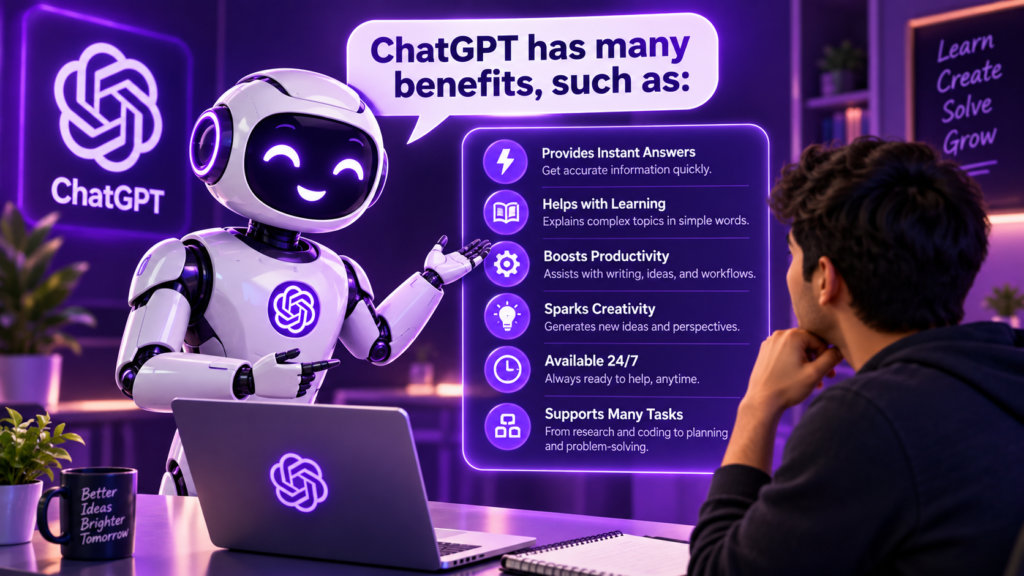
What Are the Main Benefits of ChatGPT?
The strongest advantage of ChatGPT is not simply that it can “write.” It is the ability to interact with information through natural language.
1. Natural interaction
Users can describe what they want conversationally instead of learning a complicated software interface.
2. Rapid drafting
A first draft of an email, report structure, explanation, or piece of code can be produced quickly.
3. Adaptable communication
The same information can be rewritten for a beginner, executive, student, developer, or customer.
4. Brainstorming
ChatGPT can generate multiple approaches when a user is stuck or exploring possibilities.
5. Assistance across tasks
Instead of using one application for writing, another for brainstorming, and another for basic explanations, users can perform many related tasks through a conversational interface.
The benefit is greatest when people treat the model as an assistant whose output they evaluate—not as an infallible authority.
What Are the Limitations of Generative AI?
Generative AI has an important weakness: it can produce convincing information that is wrong.
NIST uses the term “confabulation” for cases where generative AI produces erroneous or false content, including content that may be presented confidently. These errors are often called hallucinations.
This happens partly because language models are designed to generate plausible sequences based on learned patterns. Producing a fluent answer and establishing that the answer is factually correct are different problems.
Common limitations include:
- Incorrect facts
- Outdated or incomplete information
- Misinterpretation of ambiguous prompts
- Calculation or reasoning mistakes
- Fabricated citations or references
- Overconfident answers
- Bias inherited from data or evaluation processes
- Poor performance on some specialized tasks
- Security and privacy concerns when sensitive information is handled improperly
For high-stakes subjects such as medicine, law, finance, safety, or critical business decisions, AI output should be treated as assistance rather than the final authority.
Is ChatGPT Always Connected to the Internet?
Not necessarily.
Whether ChatGPT can access current online information depends on the capabilities and tools available in the particular ChatGPT experience at the time.
This distinction is important because an LLM’s learned knowledge and live information retrieval are not the same thing. A model can generate an answer from its existing capabilities, while a browsing or retrieval system can obtain information from external sources.
When current information matters—such as today’s news, changing regulations, live prices, current product specifications, or recent events—the user should ensure that an appropriate current-information tool or authoritative source is being used.
Does ChatGPT Store Everything It Was Trained On?
A common misconception is that an AI model functions like a searchable archive containing complete copies of every training document.
That is not how the model is generally described. During training, model parameters are adjusted as the system learns patterns. The resulting model does not simply operate as a database of the original training documents.
However, this does not mean privacy concerns disappear.
Users should still understand how the particular ChatGPT service handles their conversations and what data controls apply. OpenAI states that individual ChatGPT content may be used to improve models depending on the user’s settings, while its business offerings have different data-use commitments.
For sensitive information, users should follow their organization’s privacy policies and the applicable product’s data controls rather than assuming that “AI” automatically means private.
Is ChatGPT Safe to Use?
ChatGPT can be useful and generally safe for many everyday tasks, but “safe” depends on how it is used.
The major issue is not simply whether the system can generate harmful content. Trustworthiness also involves accuracy, privacy, bias, security, transparency, and appropriate human oversight.
A sensible approach is to use different levels of verification for different tasks.
For example:
Low-risk task:
Ask ChatGPT to rewrite a casual email.
Moderate-risk task:
Ask it to summarize a business document, then compare the summary with the original.
High-risk task:
Use AI as an assistant for researching a medical, legal, financial, or safety-related question, but verify critical information with qualified professionals and authoritative sources.
NIST’s Generative AI Risk Management Profile highlights the need to identify and manage risks throughout the AI lifecycle rather than assuming that a model is trustworthy simply because its responses sound natural.
How to Get Better Results From ChatGPT
The quality of an AI response often depends on the quality of the instructions and context.
Instead of asking:
“Write something about marketing.”
A stronger prompt might be:
“Write a 700-word beginner-friendly explanation of email marketing for small online businesses. Use simple English, include three practical examples, and avoid unsupported statistics.”
The second prompt gives the model information about:
- Audience
- Length
- Topic
- Purpose
- Style
- Evidence expectations
You can improve results further by providing source material, defining the desired output format, and asking the model to identify assumptions or uncertainties.
However, better prompting does not eliminate factual errors. Even a highly detailed prompt cannot guarantee that every generated statement is correct.
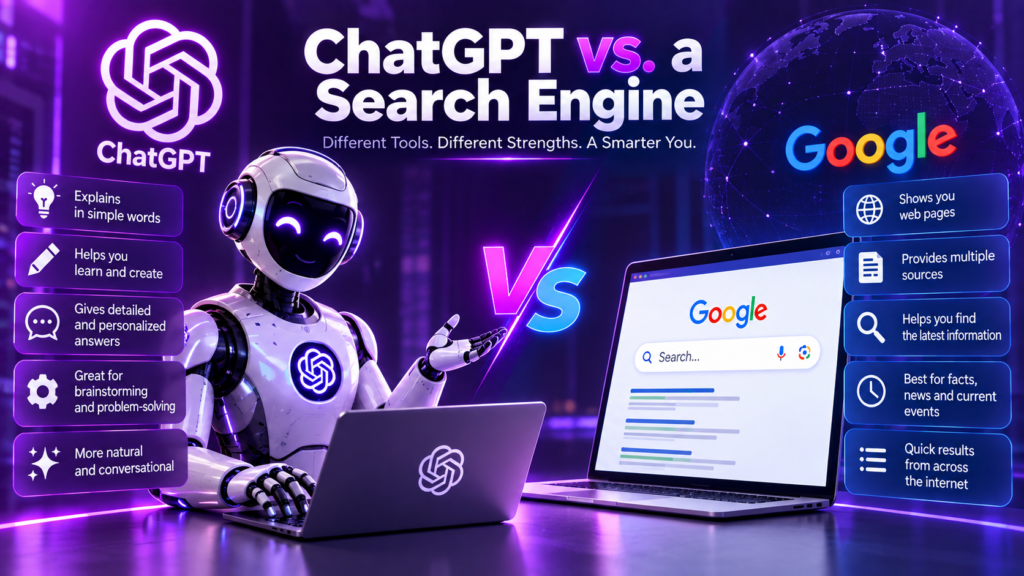
ChatGPT vs. a Search Engine
ChatGPT and search engines serve different purposes.
A search engine is primarily designed to help users locate information and websites. ChatGPT is designed for conversational interaction and content generation.
For example, if you want a list of official government pages about a new regulation, a search engine can help locate those sources.
If you already have the regulation and want a plain-English explanation, ChatGPT can be useful for transforming the information into something easier to understand.
In practice, the two approaches can complement each other. Search helps locate evidence; generative AI can help interpret, organize, or transform that information.
ChatGPT, Generative AI, and the Future of Work
The larger significance of ChatGPT is not that it can produce paragraphs in seconds. It is that natural-language interaction is becoming a practical interface for software and knowledge work.
People can describe a goal in ordinary language and increasingly expect AI systems to help with the steps required to reach it.
That may include drafting, analyzing information, writing code, interacting with tools, processing documents, and completing multi-step workflows.
But this shift does not remove the need for human expertise. In many professional settings, the valuable skill is moving from manually producing every first draft toward defining the problem, supplying good context, checking outputs, and making the final decision.
The most effective approach is therefore not “AI instead of humans.” In many situations, it is AI for acceleration, humans for judgment and accountability.
Common Misconceptions About ChatGPT
Is ChatGPT just autocomplete?
No. Although next-token prediction is fundamental to language-model generation, modern systems can perform much more complex tasks using learned representations, extensive training, post-training, context, and additional tools.
Does ChatGPT understand everything like a human?
No. It can process language and produce sophisticated responses, but that does not mean it possesses human understanding, experience, consciousness, or perfect knowledge.
Does a confident answer mean the answer is correct?
No. Fluency and confidence are not reliable indicators of factual accuracy.
Is all AI generative AI?
No. Many AI systems perform classification, prediction, recommendation, detection, optimization, or other tasks without generating new content.
Can ChatGPT replace every human knowledge worker?
No. Its usefulness varies by task, and important work often requires domain expertise, verification, judgment, accountability, and access to information the model may not have.
Frequently Asked Questions
Is ChatGPT an example of generative AI?
Yes. ChatGPT is a generative AI application that uses AI models to produce responses based on user instructions and available context.
What type of AI is ChatGPT?
ChatGPT is an AI assistant built around large AI models, including large language models capable of generating and processing natural-language content. Depending on the available model and tools, it can also work across other modalities.
Is ChatGPT machine learning?
Yes. The models underlying ChatGPT are developed using machine-learning techniques, including deep learning.
Does ChatGPT create original content?
ChatGPT generates new outputs from learned patterns and the information available in the interaction. “Original” does not mean that every idea is guaranteed to be unique, nor does it guarantee freedom from factual or copyright-related issues.
Can ChatGPT make mistakes?
Yes. It can produce inaccurate, incomplete, misleading, or internally inconsistent answers. Important information should be verified against reliable sources.
What is the difference between ChatGPT and an LLM?
An LLM is a type of AI model designed to process and generate language. ChatGPT is a user-facing AI assistant that uses such models along with its product features and, where available, additional tools.
Is generative AI the same as artificial intelligence?
No. Generative AI is a category within the broader field of artificial intelligence. AI also includes systems designed for prediction, classification, recommendation, perception, planning, and many other tasks.
Conclusion
So, is ChatGPT generative AI? Yes. ChatGPT is a prominent example of generative AI because it can create new responses from natural-language instructions rather than simply returning a fixed database entry.
Its underlying technology relies heavily on large AI models that learn patterns from data and generate outputs using those learned representations. That allows ChatGPT to support writing, coding, analysis, learning, research, brainstorming, and many other activities.
The most important point, however, is that generative does not mean infallible. ChatGPT can produce impressive and useful results while still making factual errors or missing important context. The best users understand both sides of the technology: its ability to accelerate knowledge work and its need for human judgment.
Used thoughtfully—with appropriate verification and attention to privacy—ChatGPT can be a powerful practical application of generative AI rather than simply a chatbot that produces text.
[…] Latest AI News: Major Updates and Trends in September 2026 Is ChatGPT Generative AI? A Complete Explanation Muah AI Review 2026: Features, Pricing, and Is It Worth It? FictionLab AI: Features, […]