

InnoCams: What It Is, How It Works, and What to Know

The term “InnoCams” can be confusing because it is used online in connection with different camera-related products and services. In the context of smart surveillance, it is generally associated with modern cameras that combine video recording with software-based monitoring, motion detection, and, in some cases, artificial intelligence.
Unlike a basic camera that simply captures and stores footage, an AI-assisted camera can analyze what appears in its field of view. Depending on the specific product, it may identify movement, distinguish between different types of objects, send alerts, or organize recorded footage.
This guide explains what InnoCams can refer to, how intelligent camera systems work, their practical uses, important limitations, privacy concerns, security considerations, and what buyers should check before choosing a connected camera.
What Is InnoCams?
InnoCams is not a universally defined technical standard for one specific type of camera. The name may be associated with different camera products, so it is important to verify the exact manufacturer and model rather than assuming that every product carrying the name has identical features.
When the term is used in connection with smart surveillance, it generally points toward the idea of connected or intelligent cameras that can do more than simply record video.
A modern smart camera may combine:
- A digital image sensor
- Image-processing hardware
- Motion or object detection
- Network connectivity
- Mobile or web access
- Local or cloud storage
- Software-based video analysis
The exact combination depends on the individual product.
How AI-Powered Cameras Work
An intelligent camera starts by capturing images through its camera sensor. The device or an associated computer system then processes the video to identify changes, objects, or other patterns.
A simplified process is:
Camera → Image Processing → Video Analysis → Event Detection → Alert or Recording
For example, a camera facing a front door may detect movement. A more advanced system could analyze that movement and determine whether it appears to come from a person, vehicle, animal, or another object.
This can make alerts more useful than basic motion detection. However, AI analysis is not perfect and should not be treated as completely reliable.
Edge AI and Cloud AI
AI camera systems generally process information in one of several ways.
Edge AI means that analysis takes place on or near the camera itself. This can reduce the amount of video that needs to be transmitted elsewhere.
Cloud processing means video or selected data is sent to remote servers for analysis or storage.
Some systems use a hybrid approach, with certain tasks handled locally and others performed through cloud services.
The difference matters because processing architecture affects latency, internet dependence, cost, security, and privacy.
Common Features of Smart Cameras
Because InnoCams can refer to different products, features should always be confirmed for the specific model. However, modern intelligent cameras commonly offer several capabilities.
Motion Detection
Motion detection identifies changes within the camera’s view. When movement occurs, the camera may begin recording or send a notification.
Basic motion detection can sometimes react to shadows, trees, animals, changing light, or other movement. More advanced systems attempt to determine what caused the movement.
Person Detection
Some cameras use computer vision to distinguish people from other objects.
For example, instead of receiving a notification every time a tree branch moves, a person-detection system may send an alert specifically when it detects a person.
Object Detection
More advanced video-analysis systems can classify different objects.
Depending on the camera and software, this could include categories such as people, vehicles, or animals.
The accuracy depends heavily on lighting, distance, camera placement, image quality, and the software being used.
Remote Viewing
Connected cameras can allow users to view live footage through a smartphone, tablet, or computer.
Remote access is convenient for checking a property while away, but it also creates an additional security responsibility because the camera becomes part of an internet-connected system.
Alerts and Notifications
Smart cameras can send notifications when certain events occur.
The usefulness of these alerts depends on how accurately the camera distinguishes meaningful events from harmless activity.
Video Storage
Depending on the product, recordings may be stored:
- On a memory card
- On a local recording device
- On network storage
- In cloud storage
- Through a combination of these options
Storage choices can affect privacy, subscription costs, accessibility, and security.
Practical Uses of InnoCams-Style Technology
AI-assisted cameras can be useful in many everyday situations.
Home Security
A homeowner might install a smart camera near a front entrance, driveway, garage, or backyard.
Instead of continuously checking footage, the user can rely on event-based notifications to identify potentially important activity.
For example, if someone approaches the front door while the homeowner is away, the camera may record the event and send an alert.
Pet Monitoring
Smart cameras can also help people check on pets while they are away.
A camera can provide live video and, depending on its capabilities, detect movement inside a particular room.
However, users should remember that a household camera can also capture visitors and private activities, so placement matters.
Business Monitoring
Small businesses may use cameras to monitor entrances, storage areas, offices, parking spaces, or other locations.
AI-assisted detection can help staff identify activity that deserves attention without requiring someone to watch a video feed continuously.
Workplace Security
Businesses can use intelligent cameras to monitor restricted areas or unusual activity.
However, workplace surveillance raises additional privacy and legal considerations. Organizations should establish clear policies about what is recorded, who can access it, and how long footage is retained.
Healthcare and Specialized Applications
Camera technology is also used in specialized environments such as healthcare and telemedicine.
This shows why the term “InnoCams” should not automatically be interpreted as referring only to home-security cameras. The exact product and intended application should always be confirmed.
Advantages of AI-Assisted Cameras
When properly designed and configured, intelligent cameras can provide several practical benefits.
- Smarter alerts: AI can reduce some unnecessary notifications by distinguishing different types of activity.
- Remote access: Users can check live or recorded footage from another location.
- Automated monitoring: Cameras can analyze activity without requiring continuous human observation.
- Faster event review: Intelligent detection can make it easier to locate relevant footage.
- Flexible applications: The same general technology can support homes, businesses, offices, and specialized environments.
The biggest advantage is usually not simply better image quality. It is the ability to turn raw video into more useful information.
Limitations of InnoCams and AI Cameras
AI-powered surveillance should not be treated as flawless.
A camera may fail to detect an event or incorrectly classify something. Problems can become more common in difficult conditions such as darkness, heavy rain, crowded environments, unusual viewing angles, or when an object is partly hidden.
Another important limitation is that AI detection does not equal understanding.
A system may identify something as a person without knowing why that person is there or whether their activity is dangerous. Human interpretation is still important.
Camera placement also makes a major difference. An expensive camera positioned poorly can produce less useful footage than a simpler camera installed in the right location.
Privacy Concerns
Privacy is one of the most important issues surrounding smart cameras.
A connected camera may capture much more than the person who purchased it expects. Depending on its location and capabilities, footage could include family members, children, visitors, employees, neighbors, conversations, or daily routines.
Before using an internet-connected camera, consider:
- What information does it collect?
- Does it record audio?
- Where is the footage stored?
- Who can access the recordings?
- How long is data retained?
- Can recordings be permanently deleted?
- Is two-factor authentication available?
- Is the connection encrypted?
- Does the manufacturer provide security updates?
These questions can be more important than resolution or the number of AI features.
How to Secure an InnoCams-Style Camera
A smart camera should be treated like any other internet-connected computing device.
Start by changing the default password and creating a strong, unique password. If the manufacturer supports two-factor authentication, enable it.
Keep the camera’s firmware and associated mobile application updated. Security updates can address vulnerabilities that might otherwise expose the device or its data.
It is also sensible to review account permissions regularly. Remove access for people who no longer need it and disable unnecessary remote-access features.
For particularly sensitive environments, separating smart cameras from other important devices on the network can provide an additional layer of protection.
InnoCams vs. Traditional Security Cameras
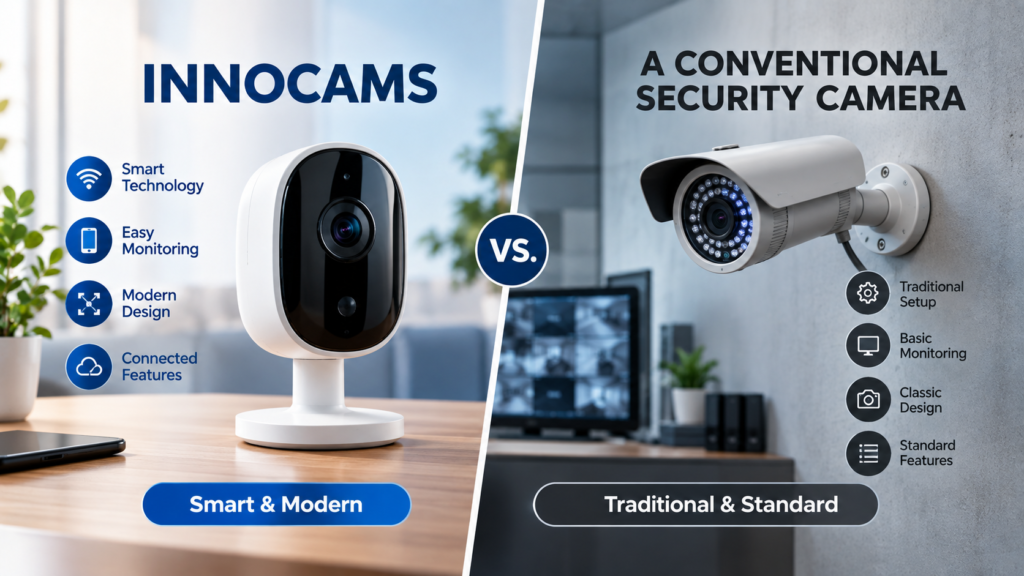
The main difference between traditional and AI-assisted cameras is what happens after the camera captures video.
| Feature | Traditional Camera | AI-Assisted Camera |
|---|---|---|
| Video recording | Common | Common |
| Basic motion detection | Often available | Usually available |
| Person detection | Limited or unavailable | May be available |
| Object classification | Limited | May be available |
| Intelligent alerts | Limited | Often available |
| Remote viewing | Product-dependent | Common |
| Local processing | Possible | Increasingly common |
| Cloud processing | Product-dependent | May be available |
An AI camera is not automatically better.
If a user only needs simple recording, an affordable conventional camera may be sufficient. If intelligent notifications and automated video analysis are important, an AI-assisted model may provide greater value.
What to Check Before Choosing an InnoCams Product
If you are considering an InnoCams-related camera, do not rely only on the product name or marketing description.
Check the actual specifications for the exact model.
Image Quality
Look at resolution, field of view, low-light performance, night vision, and image quality at the distance where the camera will actually be used.
AI Capabilities
Determine exactly what the AI does. “AI-powered” can mean something as simple as improved motion detection or something more advanced such as object classification.
Storage
Check whether footage is stored locally, remotely, or both. If cloud storage is offered, determine whether it requires an ongoing subscription.
Security
Look for strong authentication, encrypted communication, security updates, and account-management features.
Privacy
Read the privacy policy and understand how video and other collected information are handled.
Long-Term Support
A camera is not just a piece of hardware. It depends on software and security updates. A device that stops receiving updates may become increasingly difficult to trust over time.
Common Misconceptions About InnoCams
Is every InnoCams product the same?
No. The name can be associated with different products, so specifications should be checked individually.
Does AI guarantee accurate detection?
No. AI systems can produce both false positives and false negatives.
Does higher resolution automatically mean better security?
No. Camera placement, lighting, field of view, software quality, and reliability can matter just as much.
Is cloud storage always safer?
Not necessarily. Cloud services can offer strong infrastructure, but they also introduce account-security, data-retention, and provider-related privacy considerations.
Can an AI camera replace a security professional?
Generally, no. AI can automate detection and alerts, but it cannot reliably understand every situation or replace human judgment in serious security scenarios.
Frequently Asked Questions
What is InnoCams?
InnoCams is a camera-related term that can refer to different products or services. When used in the smart-security context, it generally relates to connected cameras with automated monitoring or AI-assisted video analysis.
Are InnoCams AI cameras?
Some products associated with the term may use AI or intelligent video analysis, but the exact capabilities depend on the specific product. The name itself does not guarantee a particular AI feature set.
How do AI cameras detect people?
They use computer-vision algorithms to analyze video frames and identify visual patterns associated with people. Detection accuracy varies according to software, lighting, camera position, and image quality.
Do smart cameras need Wi-Fi?
Not always. Some cameras can record locally without an internet connection. However, features such as remote viewing and cloud services generally require network access.
Are AI cameras safe for home use?
They can be, provided they are properly secured. Strong passwords, software updates, two-factor authentication, secure networking, and careful camera placement are important.
Do AI cameras record everything?
That depends on the model and its settings. Some cameras continuously record, while others record only when motion or another configured event is detected.
What should I check before buying an InnoCams camera?
Check the exact model’s image quality, AI features, storage options, privacy practices, security controls, app support, update policy, and any recurring costs.
Conclusion
InnoCams is not a single standardized camera technology, so the most important step is to identify the exact product behind the name and verify its specifications. In the smart-surveillance context, the underlying idea is straightforward: cameras can combine video capture with software that detects movement, identifies certain objects, organizes events, and provides automated alerts.
The technology can make monitoring more convenient, but AI should not be treated as infallible. Detection errors, poor camera placement, privacy concerns, and cybersecurity weaknesses can all reduce its usefulness.
Before choosing an InnoCams-related product, focus on the things that matter after installation: reliable image quality, useful detection features, secure software, sensible storage options, transparent privacy practices, and continued security updates. A smart camera is valuable when its technology improves awareness without creating unnecessary security or privacy risks.
[…] Character Tavern: Create and Chat With AI Characters InnoCams: What It Is, How It Works, and What to Know Flint AI: Features, Uses, Pricing and Guide Hammer AI: Features, Privacy, Pricing, and How […]