

Character Tavern: Create and Chat With AI Characters

Character Tavern is an AI character platform built around interactive conversation, roleplay, storytelling, and user-created character cards. Instead of interacting with a general-purpose chatbot through a blank prompt, users can choose a predefined character, create their own, or import an existing character and build conversations around that character’s personality, background, and scenario.
What makes Character Tavern interesting is that the character itself is only one part of the experience. Character definitions, greetings, example dialogue, personas, lorebooks, model selection, and conversation context can all influence how an AI responds. This makes the platform particularly relevant to people interested in AI roleplay rather than ordinary question-and-answer chat.
What Is Character Tavern?
Character Tavern is a community-driven platform where people can discover, create, customize, and chat with AI characters. It combines a character library with creation tools and an integrated chat environment.
The platform began as a TypeScript side project and developed into a dedicated character platform with tools for creating and sharing AI characters. Its main purpose is to make character-based AI conversations easier to create and access.
The important distinction is that Character Tavern itself is not simply an AI model. It is better understood as an AI character and roleplay platform that provides the environment, character information, conversation interface, and access to underlying AI models.
Character Tavern Is Not an AI Model
One common misunderstanding is to think of Character Tavern as the actual AI model.
A more accurate way to understand it is
Character Tavern = platform + character system + conversation interface + AI model infrastructure
The underlying language model generates the responses. Character information and conversation history provide context that helps guide those responses.
This distinction matters because changing the underlying model can affect writing quality, response style, context handling, reasoning, and adherence to character instructions.
How Character Tavern Works
At a basic level, an AI character conversation can be represented like this:
Character definition → scenario/context → conversation history → user message → AI model → generated response
The character definition provides information about who or what the AI should portray. The conversation history supplies information about what has already happened. The user’s latest message provides the immediate context.
The AI model then generates a response based on the available information.
This is different from a traditional scripted chatbot. Instead of having a fixed response for every possible question, a language model generates new responses dynamically.
Character Cards Are Important
Character cards provide the information that helps define an AI character.
A basic card might include:
- Personality
- Background
- Motivations
- Behavior
- Speaking style
- Scenario
- Opening greeting
- Example dialogue
- Relationships
- World information
For example, simply describing a character as “brave, intelligent, and sarcastic” gives relatively limited guidance.
A stronger character description might explain that the character uses humor when nervous, distrusts authority because of a previous experience, refuses to abandon friends, and becomes quiet when discussing a particular event.
The second approach gives the AI more specific behavioral information to work with.
Main Features of Character Tavern
Character Tavern offers several features designed around AI characters and interactive storytelling.
AI Character Library
The platform provides a large library of community-created characters covering different genres, personalities, scenarios, and roleplay styles.
Characters can represent:
- Fictional people
- Original characters
- Narrators
- Game masters
- Fantasy worlds
- Text-based RPGs
- Writing assistants
- Specialized AI helpers
- Multi-character scenarios
This means an AI character does not necessarily have to behave like one individual person. Some characters can effectively function as interactive environments or storytelling systems.
Character Creation
Users can create their own AI characters rather than relying only on existing ones.
A useful character can contain information about personality, history, motivations, behavior, dialogue style, greetings, scenario details, and world-building.
The goal is not simply to make the character description as long as possible. Relevant and specific information is generally more useful than large amounts of unrelated biography.
Character Card Compatibility
It can also be useful outside the original platform.
Character Tavern supports downloadable character-card formats designed to work with compatible character-card applications, including SillyTavern.
This is particularly useful for experienced AI roleplay users who want to move characters between different environments.
Lorebooks
Lorebooks provide additional information that can be used when specific concepts become relevant.
Imagine creating a fantasy world containing dozens of kingdoms, organizations, characters, creatures, and historical events. Putting every piece of information directly into the main character description could make the prompt unnecessarily large.
A lorebook can instead hold additional world information that becomes useful during a conversation.
This can be particularly helpful for:
- Long-running roleplays
- Large fictional worlds
- RPG campaigns
- Recurring characters
- Complex settings
- Detailed world-building
Personas
A character describes the AI side of the conversation, while a persona can describe the user side.
For example, someone participating in a fantasy roleplay might create a persona containing their fictional name, occupation, personality, abilities, and background.
This gives the AI additional context about the person it is interacting with.
What Can You Use Character Tavern For?
Character Tavern is most useful when the goal is sustained interaction rather than receiving a single answer.
Interactive Roleplay
Roleplay is one of the most obvious uses.
A user can enter a fantasy world, science-fiction scenario, mystery, historical setting, or original universe and interact with AI-controlled characters.
Instead of simply asking an AI to write a story, the user becomes part of the interaction and can make decisions that influence what happens next.
Creative Writing
Character Tavern can also function as a creative writing partner.
A writer could create a fictional character and use conversations to explore:
- Dialogue
- Character voice
- Emotional reactions
- Conflicts
- Relationships
- Story ideas
- Alternative scenarios
However, AI-generated dialogue should still be reviewed by the writer. A response can sound convincing while still being inconsistent with the intended personality or story.
Text-Based RPGs
Some community characters can work as lightweight text-based RPG systems.
A character may be designed to track things such as:
- Inventory
- Statistics
- Locations
- Quests
- Relationships
- Abilities
- Game rules
There is an important limitation, though. A language model is not the same thing as a traditional game engine.
If an AI is asked to track many numerical values across a very long conversation, mistakes can eventually occur. Important game state should therefore be checked instead of being treated as perfectly reliable.
Brainstorming
Character-based AI can also be used for brainstorming.
For example, someone writing a novel could create a fictional editor character and use that character to discuss plot problems, character motivations, or possible scenes.
The advantage is consistency. Instead of repeatedly explaining the desired role, the character can already contain the relevant instructions.
Why Character Design Matters
The quality of an AI character depends heavily on how its instructions are constructed.
A good character definition should answer four important questions:
- Who is the character?
- What does the character want?
- What obstacles or conflicts does the character face?
- How does the character normally behave?
Specific details are usually more useful than generic personality labels.
Example of a Stronger Character Definition
Suppose you are creating a detective.
A weak definition might be
- Intelligent
- Serious
- Observant
- Mysterious
A stronger definition could explain that the detective notices small physical inconsistencies, dislikes unnecessary conversation, distrusts wealthy clients because of a previous case, and uses dry humor when under pressure.
The second version gives the AI behavioral patterns it can actually use when generating dialogue.
Advantages of Character Tavern
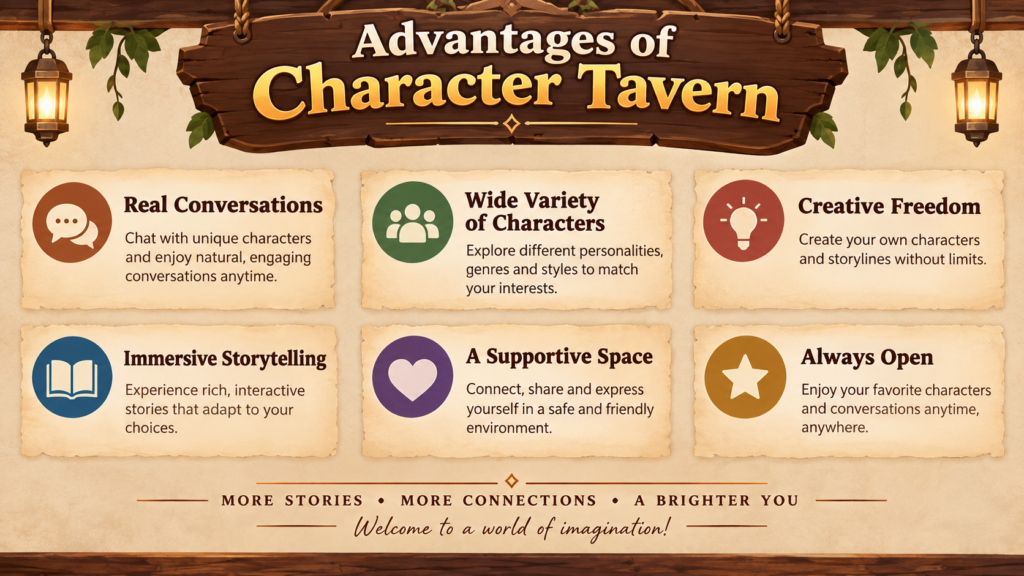
Character Tavern has several strengths for people interested in AI roleplay.
Easy Access
The browser-based approach makes it relatively straightforward to start chatting with characters without setting up an AI system from scratch.
Large Character Library
A large community library gives beginners an easy starting point.
Instead of designing everything yourself, you can explore existing characters and learn from their structures.
Character Portability
Downloadable character-card formats can be valuable for users who want to keep copies of their creations or use them with compatible applications.
Advanced Customization
Experienced users can work with character definitions, personas, greetings, lorebooks, and different AI models.
This makes the platform useful for both casual users and people who enjoy experimenting with AI prompting and character design.
Community Content
Community-created characters provide a wide range of styles and scenarios.
The quality can vary, but this variety is also one of the platform’s biggest attractions.
Limitations and Risks
Character Tavern is useful for its intended purpose, but it has the same fundamental limitations associated with generative AI.
AI Can Forget Details
Language models do not have perfect human-like memory.
As conversations become longer, earlier details can become less influential or fall outside the active context.
A character might therefore forget an earlier promise, change a detail about its background, or contradict something that happened previously.
Roleplay Can Drift
Even a carefully designed character can gradually become more generic.
This can happen when the conversation moves away from the strongest information in the character card or when the model begins relying on common patterns associated with a particular character type.
Specific motivations, conflicts, behavioral instructions, and dialogue examples can help reduce this problem.
AI Hallucinations
An AI character can confidently invent information that was never established.
In a fictional conversation, this can sometimes be entertaining. In an RPG, however, it can damage continuity.
For example, an AI might suddenly invent a new character, claim that an event happened earlier, or incorrectly remember an important game rule.
Important details should therefore be checked when consistency matters.
Privacy Considerations
Users should be careful about sharing sensitive information with any AI service.
Avoid entering passwords, financial credentials, confidential business information, private documents, or other sensitive data unless you have reviewed the platform’s current privacy and data-handling policies.
Community Content Varies
Community libraries naturally contain characters of different quality.
Some cards may have carefully written personalities, scenarios, and dialogue examples. Others may contain minimal information or poorly structured instructions.
A popular character is not necessarily a technically well-designed character.
Is Character Tavern Free?
Character Tavern has offered access without requiring a traditional subscription for its basic platform experience. The platform also has references to premium access and virtual currency features.
Because AI services can change their usage limits, models, and account features, users should check the current platform interface and terms before assuming that every model or feature has identical availability.
The important point is that free access does not necessarily mean unlimited access to every AI model or feature.
Character Tavern vs. Traditional Chatbots
The main difference is the emphasis on persistent character context.
| Approach | Main Purpose | Character Customization | Roleplay Focus |
|---|---|---|---|
| General AI chatbot | Questions and tasks | Moderate | Low to moderate |
| Character Tavern | AI characters and roleplay | High | High |
| Character-card software | Advanced character interaction | Very high | High |
| Traditional game engine | Structured gameplay | Depends on engine | High |
A general-purpose AI chatbot is usually better for factual research, coding, productivity, and general questions.
Character Tavern makes more sense when the goal is character-driven conversation, interactive fiction, or roleplay.
A traditional game engine is still better when strict rules, deterministic mechanics, physics, or precise numerical state are important.
How to Create a Better Character
If you want to create your own character, start with behavior rather than appearance.
1. Give the Character a Specific Motivation
Don’t simply write “ambitious.”
Explain what the character wants and why.
For example:
She wants to become the city’s most respected architect because her family was forced out of their home after a corrupt development project.
This gives the AI a reason behind the character’s ambition.
2. Add Friction
Perfect characters can become predictable.
Give the character weaknesses, fears, contradictions, habits, or competing goals.
A loyal character might also be proud. A brilliant scientist might hate admitting mistakes. A confident leader might avoid discussing one particular failure.
These tensions can produce more interesting conversations.
3. Demonstrate the Voice
Instead of writing:
“He speaks sarcastically.”
Show the model what that sounds like through example dialogue.
Examples can provide clearer behavioral guidance than a list of adjectives.
4. Avoid Unnecessary Detail
A longer character card is not automatically a better character.
Irrelevant information can consume context without improving the conversation.
Focus on information that is likely to influence future interactions.
5. Test the Character
Before publishing a character, test different types of conversations.
Try:
- Normal questions
- Emotional situations
- Unexpected choices
- Arguments
- Topic changes
- Long conversations
Look for repetitive dialogue, personality drift, contradictions, unwanted narration, and forgotten information.
How to Get Better AI Roleplay Results
Your own messages also affect the quality of the interaction.
Instead of repeatedly writing:
Continue.
Provide meaningful actions, thoughts, dialogue, or decisions.
For example:
I hesitate at the doorway and look at the letter again. I recognize the handwriting but cannot remember where I saw it before.
This gives the AI several concrete elements to respond to.
It is also useful to correct important continuity errors quickly. If a character suddenly claims that you met three years ago when that never happened, correcting the detail early is better than allowing the mistake to become part of the story.
Who Should Use Character Tavern?
Character Tavern is particularly suitable for people who enjoy:
- AI roleplay
- Interactive fiction
- Character development
- World-building
- Text RPGs
- Creative writing
- AI character design
- Long-form fictional conversations
- Character-card experimentation
It is less suitable if your primary goal is reliable factual research, precise calculations, deterministic gameplay, or professional workflows that require guaranteed consistency.
The platform is built around generative conversation, and generative AI naturally involves some uncertainty.
Frequently Asked Questions
What is Character Tavern?
Character Tavern is a platform for discovering, creating, and chatting with AI characters. It focuses on roleplay, interactive storytelling, character cards, and community-created content.
Is Character Tavern an AI model?
No. Character Tavern is a platform and interface. AI models generate the responses, while the platform handles characters, conversations, creation tools, and related infrastructure.
Can I create my own character?
Yes. Character Tavern provides tools that allow users to create their own AI characters and customize their personality, background, scenario, greetings, and other details.
Can Character Tavern characters be exported?
Yes. Character cards can be downloaded in compatible formats, allowing users to keep copies of their characters and potentially use them with compatible character-card applications.
What are character cards?
A character card is structured information that tells an AI how a character should behave, speak, and respond. It can contain personality, background, scenario information, dialogue examples, and other instructions.
Does Character Tavern support roleplay?
Yes. Roleplay is one of its primary purposes. Users can interact with characters designed for fictional conversations, storytelling, RPG scenarios, and interactive worlds.
Can AI characters remember everything?
No. AI characters can forget or distort information, particularly during long conversations. Important details should be reinforced when continuity matters.
Conclusion
Character Tavern is best understood as an AI character ecosystem rather than simply another chatbot. Its combination of a community character library, creation tools, personas, lorebooks, and character-card support makes it particularly interesting for people who want more than ordinary question-and-answer conversations.
For beginners, it provides an accessible way to experiment with AI roleplay and interactive storytelling. More experienced users can explore character engineering by designing motivations, conflicts, dialogue patterns, scenarios, and world information.
At the same time, users should understand the limitations of generative AI. Characters can forget information, invent details, contradict previous events, or gradually drift away from their intended personality. Used with those limitations in mind, Character Tavern can be a flexible tool for roleplay, creative writing, world-building, and experimenting with AI-driven characters.
[…] Clever AI Humanizer: Features, Uses, Limits, and How It Works Character Tavern: Create and Chat With AI Characters InnoCams: What It Is, How It Works, and What to Know Flint AI: Features, Uses, Pricing and […]