

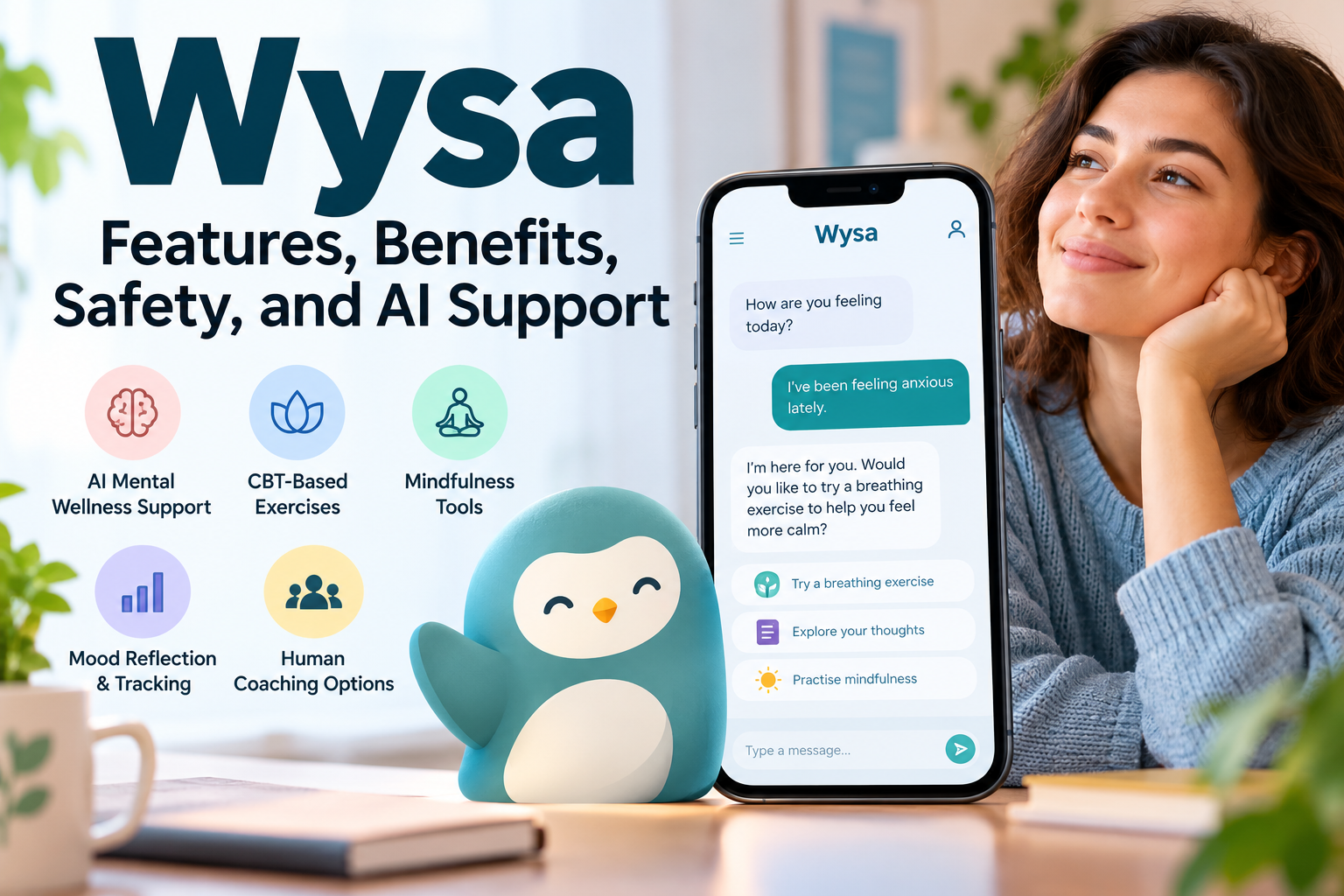
Wysa: A Complete Guide to the AI Mental Wellness App

Wysa is an AI-powered mental wellness app designed to help people manage everyday stress, anxiety, low mood, and difficult emotions through guided conversations and self-help exercises. Instead of acting as a general-purpose chatbot, it combines conversational artificial intelligence with structured techniques developed for emotional well-being. Users can explore their feelings, practise coping skills, and work through everyday challenges at their own pace.
What makes Wysa different from a standard AI assistant is its focus on mental wellness. Its tools draw on approaches such as Cognitive Behavioural Therapy (CBT), mindfulness, and solution-focused techniques. Depending on the version and service available, users may also have access to human coaching or additional support resources.
However, Wysa is not a replacement for a qualified mental health professional, and its AI cannot diagnose medical conditions. Understanding how the app works, what it offers, and where its limitations lie can help you decide whether it suits your needs.
What Is Wysa?
Wysa is a digital mental wellness platform that uses artificial intelligence to support emotional self-reflection and the practice of evidence-based coping skills. It is available through mobile applications and, depending on the service, web-based access.
The platform is designed for people who want practical support with everyday emotional challenges. For example, someone feeling overwhelmed by work might use Wysa to identify the thoughts contributing to their stress and practise a short relaxation exercise.
According to Wysa’s official documentation, its conversational system combines rule-based algorithms with large language model (LLM) technology in certain versions. Other versions may rely more heavily on structured, rule-based conversations. This means the experience can differ depending on whether someone uses the direct-to-consumer app or a service provided through an employer, healthcare organisation, or another institution.
Wysa is therefore best understood as a focused digital wellness tool rather than an unrestricted AI chatbot or a virtual doctor.
How Does Wysa Work?
Wysa uses conversational AI to help users explore their emotions and practise coping strategies. However, it does not work exactly like a general-purpose chatbot that generates unrestricted responses to almost any question.
According to Wysa’s published documentation, its AI combines natural language understanding, structured decision-making, clinician-approved responses, and selected large language model capabilities. The precise combination depends on the version being used.
Here is how the experience generally works.
1. You Describe What You Are Feeling
You begin by sharing what is bothering you. This could be work pressure, relationship difficulties, poor sleep, anxiety before an important event, or a general feeling of being overwhelmed.
For example, you might write:
“I have an important presentation tomorrow, and I cannot stop worrying about making mistakes.”
Wysa can use the information you provide to guide the conversation toward understanding your concerns and exploring practical coping techniques.
2. The AI Guides Your Reflection
Rather than simply offering generic encouragement, Wysa can ask structured questions that help you examine your thoughts and feelings.
For example, it might guide you to distinguish between what you know will happen and what you fear might happen.
This process encourages self-reflection instead of treating every negative thought as an established fact.
3. You Practise a Coping Technique
Depending on the conversation and the version available, Wysa may suggest an exercise from its mental wellness library.
Possible activities include breathing exercises, mindfulness practices, and structured thought-reflection techniques.
4. You Apply the Technique Outside the App
The purpose is to help you practise useful skills in everyday situations.
For instance, someone who experiences anxiety before meetings might practise a breathing exercise before joining a video call. Over time, regularly practising coping strategies may help them recognise and respond to stressful situations more effectively.
Important distinction: Wysa can guide self-help exercises, but it cannot reliably understand every aspect of a person’s mental health. Its responses should not be treated as a clinical assessment or a substitute for professional care.
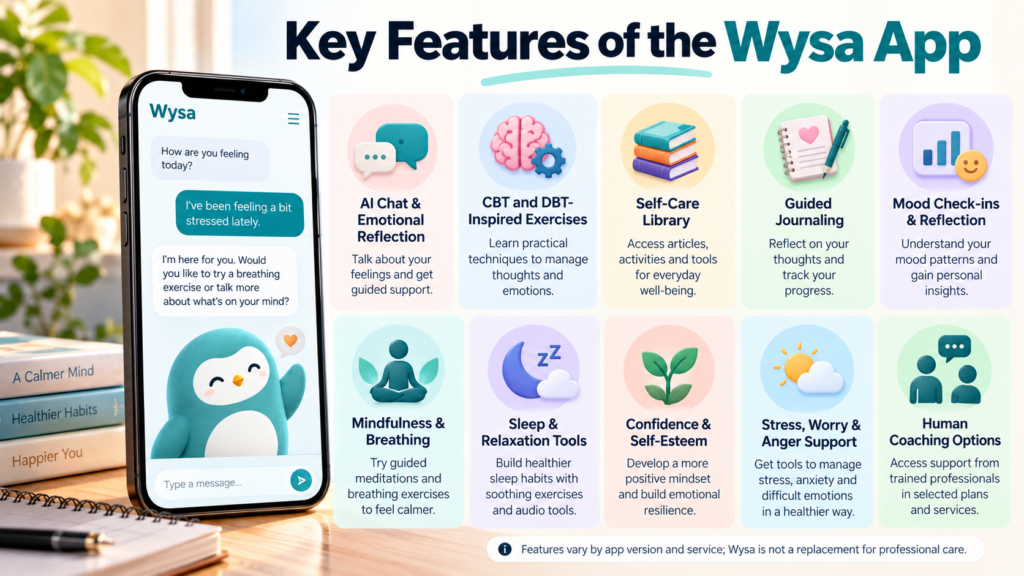
Key Features of the Wysa App
Wysa brings together conversational support and structured self-help resources. The exact features available can vary by subscription, location, age eligibility, and institutional arrangement.
AI Mental Wellness Chatbot
The conversational feature allows users to describe their concerns in their own words.
It is intended to support emotional reflection and suggest relevant self-help techniques. Unlike an unrestricted general-purpose chatbot, Wysa uses a more structured approach to keep conversations within its intended mental wellness role.
This focused design can be useful for people who prefer guided questions and practical exercises over open-ended conversations.
CBT-Based Exercises
Cognitive Behavioural Therapy, commonly known as CBT, is an approach that explores relationships between thoughts, feelings, and behaviours.
Wysa includes tools based on CBT principles. These can help users examine unhelpful thinking patterns and consider alternative ways of responding to everyday problems.
For example, imagine a student who receives a lower grade than expected and immediately thinks, “I am terrible at everything.”
A CBT-based exercise might encourage the student to examine the evidence for that conclusion, consider other explanations, and identify a constructive next step.
The exercise does not guarantee that the student will feel better immediately. Its purpose is to practise a more balanced way of thinking.
Mindfulness and Relaxation Tools
Wysa also offers mindfulness-based resources designed to help users pay attention to their thoughts, emotions, and physical sensations.
Depending on the available version, these resources may include guided activities and audio exercises.
They can be useful when someone wants to pause, slow down, or practise responding to stress more deliberately.
However, relaxation exercises do not address every underlying cause of distress. Persistent anxiety, severe sleep difficulties, or continuing emotional problems may require additional support.
Mood Reflection and Self-Monitoring
Self-monitoring involves paying attention to changes in your emotional state and identifying patterns over time.
Wysa’s self-help approach encourages users to reflect on what they are experiencing and work toward meaningful personal goals. Available tracking and insight features can differ across versions.
For example, a person who regularly feels stressed after work might reflect on whether particular responsibilities, difficult conversations, or sleep habits appear to influence their mood.
These observations can help someone identify areas worth addressing. They are not, by themselves, a medical diagnosis.
Human Coaching Options
Some Wysa services provide access to human mental health and well-being professionals through additional paid services or institutional arrangements.
This is different from chatting with the AI.
A human coach can offer a level of personal interaction that automated conversations cannot fully reproduce. The qualifications, scope of support, appointment options, and availability depend on the particular service.
Do not assume that every Wysa installation includes human coaching or that coaching is automatically included in a free version.
What Can You Use Wysa For?
Wysa is intended primarily for everyday emotional well-being and self-help. Its usefulness depends on the problem you want to address and the type of support you need.
Here are some practical examples.
Managing Everyday Stress
Workload, exams, family responsibilities, and financial uncertainty can all contribute to stress.
Someone who feels overwhelmed might use Wysa to organise their thoughts, identify a manageable next step, or practise a relaxation technique.
For example, an employee preparing for a busy week could reflect on which tasks are urgent, which can wait, and which responsibilities require help from another person.
The app can support that reflection, although it cannot change an unreasonable workload or resolve an underlying workplace problem on its own.
Understanding Anxious Thoughts
Anxiety sometimes involves imagining a negative outcome before there is enough evidence to conclude that it will happen.
Wysa’s structured exercises can help users examine such thoughts.
Consider someone who is worried that a friend has not replied to a message. They might assume that the friend is angry with them, even though several other explanations are possible.
A guided reflection exercise can help them consider those alternatives rather than immediately accepting the most worrying interpretation.
This is a practical use of cognitive techniques, not proof that the AI understands the user’s circumstances completely.
Building Better Sleep Habits
Stress and irregular routines can make it harder to wind down at night.
Depending on the available resources, Wysa may help users practise relaxation techniques and reflect on habits that affect their well-being.
For example, someone might notice that work-related worries become more intense when they start thinking about unfinished tasks in bed.
Writing down those tasks and deciding when to address them the following day may help establish a more manageable bedtime routine.
Persistent insomnia or sleep problems associated with other symptoms should be discussed with a qualified healthcare professional.
Improving Emotional Awareness
Some people find it difficult to explain what they are feeling. They may know that something is wrong without being able to identify whether they feel disappointed, anxious, frustrated, or exhausted.
Guided questions can help users put their experiences into words.
That process can be useful when preparing to speak with a friend, family member, counsellor, or therapist.
Practising Personal Goals
Wysa’s approach also includes goal-setting and behavioural techniques.
A user who wants to become more comfortable with challenging tasks, for example, could break a large goal into smaller actions.
Instead of aiming to eliminate all nervousness before giving a presentation, they might practise the introduction, prepare notes, and complete a short rehearsal.
The benefit comes from practising manageable actions rather than expecting an app to remove every uncomfortable emotion.
Is Wysa Free?
Wysa offers a free AI conversational experience, while certain tools and human support services may require payment. The exact arrangement depends on the product version and how the service is accessed.
For example, an individual using the consumer app may encounter different options from someone accessing Wysa through an employer, healthcare provider, insurer, or other organisation.
Before paying for a subscription, check the current options in the official app or through Wysa’s website.
Pay particular attention to:
- Free access: Which conversations and self-help exercises are available without payment?
- Premium features: Are additional exercises or other tools included in the paid plan?
- Human support: Does the price include coaching, or is that a separate service?
- Subscription renewal: Is the payment recurring, and how can you cancel?
- Regional availability: Are the advertised features available in your country?
Avoid relying on old reviews for current prices. Subscription terms and included features can change, and a price shown in one region may not apply elsewhere.
For the most reliable information, visit the official Wysa website or check the listing for your device and region.
Is Wysa Safe to Use?
Wysa is designed for mental wellness support, but safety depends partly on how the app is used and what information a person shares.
Its structured approach and clinically developed self-help resources are intended to keep conversations focused on appropriate techniques. However, no AI system can guarantee that every response will be suitable for every individual or situation.
Can Wysa Replace a Therapist?
No. Wysa does not replace a qualified therapist, psychologist, psychiatrist, or other appropriate healthcare professional.
The app can help users practise coping skills and reflect on everyday difficulties. A mental health professional can conduct a fuller assessment, consider a person’s medical and social circumstances, and provide care suited to their needs.
Wysa’s official documentation states that the app does not diagnose medical conditions and is not intended to replace professional medical advice.
If symptoms persist, interfere with daily life, or become difficult to manage, professional support is the more appropriate next step.
Is Wysa Suitable for a Mental Health Crisis?
Wysa is not a substitute for emergency or crisis services.
Someone experiencing an immediate risk of suicide, self-harm, or harm from another person should seek appropriate emergency assistance or contact a local crisis service. They should not rely on an AI conversation to keep them safe.
Although some Wysa services include safety resources and signposting, these features do not make the app an emergency response service.
If you are in immediate danger, contact local emergency services or go to the nearest emergency department.
Is Wysa Suitable for Children?
Age eligibility depends on the particular version and the arrangements under which it is provided.
Wysa’s general app documentation describes use for people aged 13 and older, with certain institutional arrangements permitting use from age 11. Additional restrictions may apply to younger users and paid services.
Anyone under 18 should review the applicable terms and privacy policy with a parent or legal guardian, where appropriate, before using the service.
Parents should not assume that a mental wellness chatbot is a substitute for age-appropriate professional support.
Wysa Privacy: What Should You Know?
Privacy is especially important when using an app to discuss emotions, relationships, work problems, or other personal experiences.
Wysa publishes a privacy policy explaining how it handles information collected through its services. The precise details can depend on which product or institutional version a person uses.
Before sharing sensitive information, review the privacy policy applicable to your app.
Consider these questions:
- What information is collected? Check what the service says about messages, account details, usage information, and other data.
- How is information used? Review the stated purposes for processing your information.
- How long is information retained? Look for details about retention and deletion.
- Who may receive information? Check the policy’s explanation of service providers, institutional partners, and other permitted disclosures.
- What privacy choices are available? Review the options for managing your information and exercising applicable privacy rights.
If you access Wysa through an employer, university, insurer, or healthcare organisation, read the terms for that specific service. The organisation’s arrangements may differ from those of the direct-to-consumer app.
Do not assume that every institutional service has the same privacy settings or that your employer necessarily receives the contents of individual conversations. Check the applicable documentation for the actual arrangement.
A sensible rule is to share only the personal information necessary to use the service. Avoid entering passwords, financial account details, identity documents, or other information that is not needed for your intended use.
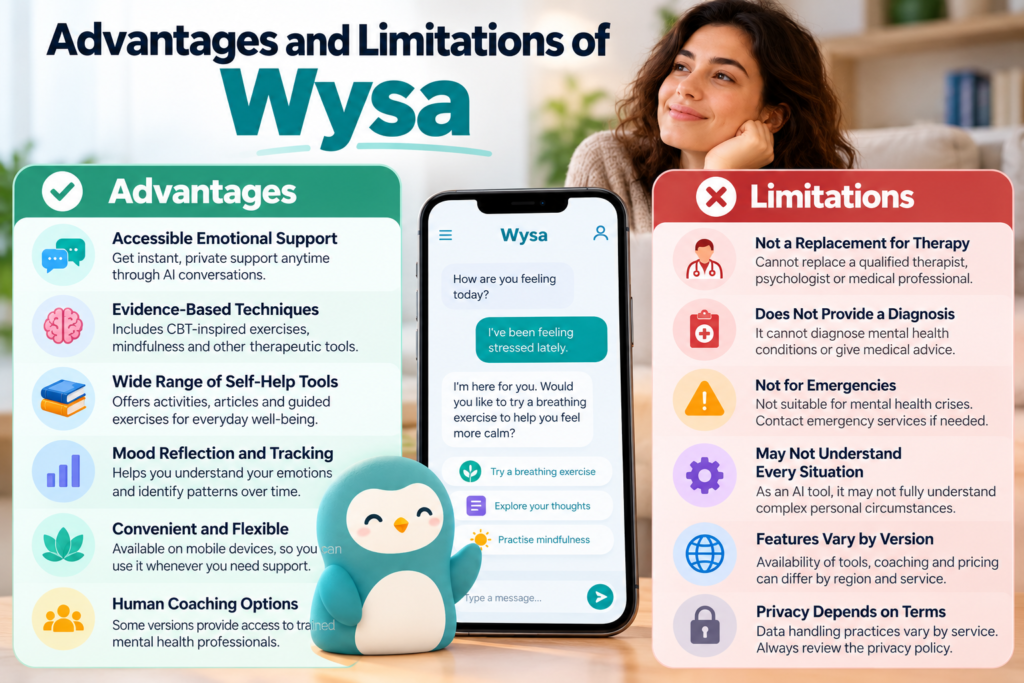
Advantages and Limitations of Wysa
Wysa can be useful for practising emotional self-help, but it is important to understand both its strengths and its boundaries.
| Advantages | Limitations |
|---|---|
| Offers a conversational way to explore emotions | Cannot replace professional mental healthcare |
| Includes exercises based on established therapeutic approaches | Does not diagnose medical conditions |
| Provides access to self-help resources through digital devices | May not understand every personal situation correctly |
| Can support reflection and goal-setting | Features and access vary between services |
| May be available outside traditional appointment hours | Is not a substitute for crisis or emergency assistance |
| Some services offer human coaching | Additional support may require payment |
The Main Benefit: Accessible Self-Help
One of Wysa’s practical strengths is that users can explore their feelings without having to organise a formal appointment for every everyday concern.
A person who wants to practise a breathing exercise or reflect on a stressful interaction may find that convenient.
The app also provides a structured alternative for people who are unsure where to begin when thinking about their emotions.
The Main Limitation: AI Has an Incomplete Picture
An AI chatbot works from the information available to it. It does not automatically know a person’s full medical history, living circumstances, relationships, or the events that have shaped their emotional state.
Even when a response sounds understanding, that does not mean the system has correctly interpreted the situation.
This limitation matters because mental health concerns can have complex causes. A short conversation cannot reliably capture every relevant factor.
The most sensible approach is to use Wysa as a self-help resource, not as the final authority on important personal or medical decisions.
Wysa vs. General AI Chatbots
People sometimes compare Wysa with general-purpose assistants such as ChatGPT. Both can respond conversationally, but they have different primary purposes.
| Comparison | Wysa | General-purpose AI chatbot |
|---|---|---|
| Primary purpose | Mental wellness and guided self-help | A broad range of information and tasks |
| Conversation style | Focused on emotional reflection and coping techniques | Varies with the question and instructions |
| Therapeutic resources | Includes structured mental wellness exercises | May discuss mental health, depending on its capabilities and safeguards |
| Scope | Focused on well-being support | Broader and more flexible |
| Human professional support | Available through certain Wysa services | Depends on the separate service being used |
| Medical diagnosis | Not intended to diagnose conditions | Should not be treated as a substitute for professional diagnosis |
Neither type of chatbot should be assumed to provide reliable clinical care simply because it communicates fluently.
The main difference is the intended experience. Wysa is built around guided well-being activities, while a general-purpose chatbot can help with a wider range of questions.
For someone specifically seeking structured emotional self-help, Wysa’s focused approach may be a useful starting point. Someone looking for help with unrelated tasks may prefer a general assistant.
Wysa Alternatives: What Else Can You Consider?
Wysa is not the only option for people interested in digital mental wellness. The best alternative depends on whether you want guided exercises, mood tracking, a broader AI conversation, or access to a human professional.
Youper
Youper is a digital mental health platform associated with AI-supported emotional health tools.
It may be worth comparing with Wysa if your primary interest is guided emotional reflection. Before choosing either service, check its current features, availability, privacy policy, and subscription terms.
Woebot
Woebot is associated with conversational mental health technology and structured psychological support.
However, its availability and intended use can differ from those of a consumer wellness app. Check the current official information rather than assuming a particular version is available to everyone.
General-Purpose AI Assistants
Tools such as ChatGPT can help users organise their thoughts, prepare questions for a counsellor, or learn general information about stress-management techniques.
However, a general-purpose assistant does not necessarily provide the same structured care library or guided workflow as Wysa.
It is also important to understand the privacy terms of whichever service you choose before sharing sensitive information.
Human Counselling or Therapy
For persistent emotional difficulties, a qualified mental health professional may be more appropriate than any chatbot.
A professional can consider the wider context of a person’s circumstances, ask follow-up questions, and adjust their approach as new information emerges.
If cost or access is a concern, community health services, reputable charitable organisations, or local healthcare providers may offer options worth investigating.
How to Get Started With Wysa
If you want to try Wysa, begin by confirming that the service is available and suitable for your age and location.
Step 1: Find the official app. Visit Wysa’s official website or use the relevant app store listing to avoid downloading an unrelated application.
Step 2: Review the terms. Read the age requirements, privacy policy, and available subscription options before creating an account or sharing personal information.
Step 3: Choose one manageable goal. Start with a specific concern, such as managing work stress, reflecting on a difficult day, or practising relaxation.
Step 4: Try a relevant exercise. Follow an appropriate guided activity and consider whether it helps you understand your situation or practise a useful skill.
Step 5: Evaluate the experience. Ask yourself whether the app is helping you develop practical habits. If the conversations feel repetitive or unhelpful, consider another approach.
Step 6: Seek additional help when necessary. If your difficulties continue or become more serious, contact a qualified professional rather than relying exclusively on the app.
You do not need to share every detail of your life to benefit from a self-help tool. Start with what is relevant to your goal and keep your expectations realistic.
Frequently Asked Questions About Wysa
Is Wysa a real person?
No. Wysa’s AI conversations are generated by software. Certain services offer separate access to human coaches or other professionals.
Is Wysa completely free?
Wysa offers free AI conversation access, but some tools and human support services may require payment. Check the current terms for your version.
Can Wysa help with anxiety?
Wysa provides self-help techniques designed to support people experiencing everyday anxiety and stress. It cannot guarantee improvement or replace professional care.
Does Wysa provide a medical diagnosis?
No. Wysa is not intended to diagnose mental health conditions or provide medical advice.
Is Wysa safe for private conversations?
Wysa publishes a privacy policy explaining its data practices. Review the policy for your particular service before sharing sensitive information.
Can I use Wysa instead of therapy?
Wysa can complement self-help efforts, but it is not a substitute for professional therapy when clinical care is needed.
Is Wysa available worldwide?
Availability and features can vary by country, app store, and service arrangement. Check the official website or your local app store for current access information.
Conclusion: Is Wysa Worth Trying?
Wysa offers a focused approach to digital mental wellness by combining conversational AI with structured self-help exercises. Its emphasis on techniques such as CBT and mindfulness makes it different from a general-purpose chatbot, particularly for people who want guided ways to reflect on everyday stress and emotions.
The app may be useful if you want accessible exercises, a structured starting point for emotional reflection, or support between other activities. Its value will depend on your needs, the tools available in your version, and whether you find the exercises helpful in practice.
However, Wysa has clear boundaries. It cannot diagnose medical conditions, fully understand every personal circumstance, or replace professional mental healthcare. It is also not designed for emergencies.
Before using it, review the current features, subscription terms, and privacy policy. Treat Wysa as a potential self-help resource rather than a complete mental healthcare solution.
[…] JanitorAI: Features, How It Works, Safety and Alternatives Wysa: A Complete Guide to the AI Mental Wellness App C.ai Plus: Features, Pricing, Filters & Alternatives InferKit: What It Was, How It […]
[…] privacy concerns to consider. This guide explains free access, possible costs, search limitations, safer alternatives, and how to evaluate results without jumping to conclusions about another person’s […]