

JanitorAI: Features, How It Works, Safety and Alternatives

JanitorAI is an AI character-chat platform designed for interactive storytelling, fictional conversations, and roleplay. Instead of interacting with a general-purpose assistant that mainly answers questions, users can explore characters created by the community or build their own with specific personalities, backgrounds, and dialogue styles. The platform appeals to people interested in creative writing, anime-inspired characters, fantasy adventures, and immersive fictional scenarios. Its appeal also comes from the flexibility to use different AI language models, although the available options and costs depend on the configuration.
Understanding how JanitorAI works requires looking beyond its character library. The underlying language model influences response quality, conversational memory, and content restrictions. Users should also understand how API keys, context windows, subscriptions, and privacy settings affect their experience. This guide explains the platform’s main features, practical uses, advantages, limitations, safety considerations, and alternatives to help readers decide whether it suits their needs.
What Is JanitorAI?
JanitorAI is a community-driven AI chatbot platform built around fictional characters and interactive conversations. Users can browse characters created by other people, start roleplay sessions, or design characters with their own personalities and storylines.
The experience differs from a traditional chatbot. A general-purpose AI assistant is usually designed to answer questions, explain concepts, or help complete tasks. JanitorAI focuses more on maintaining a character’s identity and participating in an ongoing fictional interaction.
For example, a user writing a fantasy novel could create a mysterious wizard who speaks formally, hides important information, and responds differently depending on the decisions made during the conversation.
Who Uses JanitorAI?
The platform can appeal to several types of users:
- Creative writers: Develop characters, explore dialogue, and test different story directions.
- Roleplay enthusiasts: Participate in fictional scenarios with AI-controlled characters.
- Anime and fantasy fans: Explore original characters inspired by familiar fictional genres.
- Character creators: Build chatbots with distinctive personalities and backgrounds.
- Interactive storytellers: Experiment with branching narratives and character relationships.
JanitorAI is primarily a roleplay and entertainment platform. Although conversations may help someone brainstorm ideas, it should not automatically be treated as a reliable source for factual research, professional advice, or educational information.
How Does JanitorAI Work?
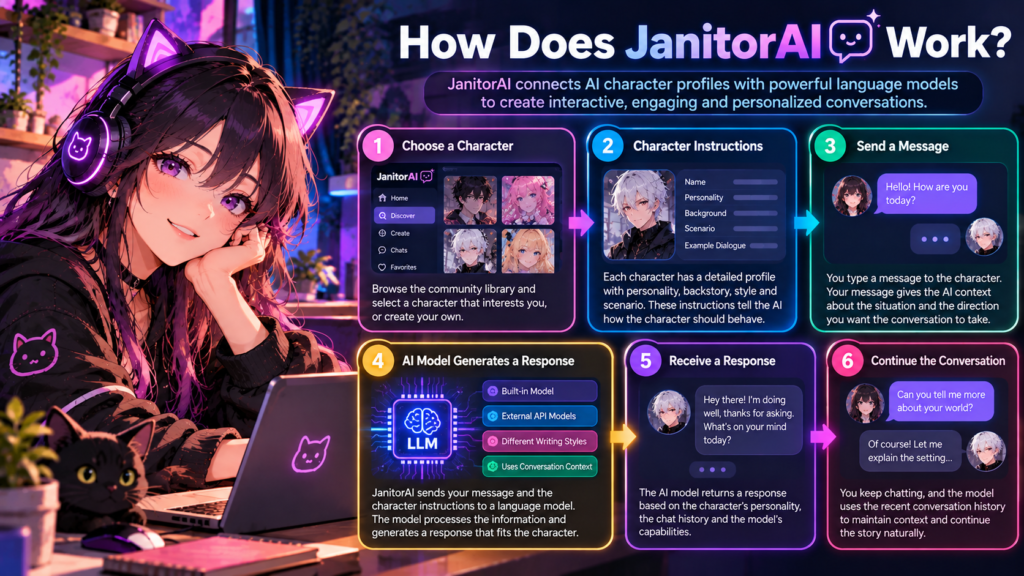
JanitorAI combines a character interface with an underlying language model. The interface manages the character’s information and conversation, while the model generates responses based on the available instructions and chat history.
A large language model (LLM) is an AI system trained to process and generate text. It predicts appropriate continuations from the information supplied to it, allowing it to produce dialogue, descriptions, and responses that fit a particular scenario.
The general process works as follows:
- Choose a character: Browse the available character library and select a profile that interests you.
- Start a conversation: Read the opening message and respond to the character.
- Provide context: Your messages give the model information about the situation and your intended direction.
- Generate a response: The connected language model produces dialogue or narrative text.
- Continue the interaction: Subsequent messages build on the conversation history available to the model.
The exact experience depends on the selected character and language model.
What Role Does the AI Model Play?
The character profile and the AI model perform different jobs.
A character profile describes how the chatbot should behave. It may contain a backstory, personality traits, speaking style, relationships, and details about the fictional setting.
The language model uses these instructions to generate the actual conversation.
For instance, a character might be described as a cautious detective who avoids revealing personal information. A suitable model can use that description to produce guarded dialogue and maintain a consistent tone.
However, instructions are not guarantees. The character may occasionally contradict its backstory, repeat phrases, or respond in a way that does not match its intended personality.
The underlying model matters because different models have different writing abilities, context limits, response speeds, and content policies.
Main JanitorAI Features
JanitorAI’s central features revolve around character discovery, customization, and conversational roleplay. The precise interface and available options can change as the service develops.
1. Community-Created AI Characters
One of the platform’s main attractions is its collection of user-created characters.
Instead of relying exclusively on a fixed cast, users can explore characters developed by different creators. Their profiles may describe their personalities, appearances, backgrounds, relationships, and fictional situations.
This variety gives users more opportunities to find characters suited to particular storytelling preferences.
However, the quality of these characters varies. Some have detailed personalities and carefully written opening messages, while others contain limited information or conflicting instructions.
A detailed character description does not necessarily mean that the chatbot will consistently follow every instruction.
2. Custom Character Creation
Users can create their own characters rather than relying entirely on existing profiles.
A well-designed character generally benefits from several elements:
- Name: Identifies the character.
- Description: Establishes the character’s background and general identity.
- Personality: Defines important traits, motivations, and behavior.
- Scenario: Explains the situation in which the conversation begins.
- Opening message: Establishes the initial scene and gives the user something to respond to.
- Example dialogue: Demonstrates the character’s preferred speaking style.
Consider a hypothetical character named Elena, an investigative journalist working on a mysterious disappearance.
Her profile could describe her as curious, skeptical, observant, and reluctant to trust strangers. The opening message might introduce a confidential document that she has discovered.
These details give the language model a clearer foundation for generating relevant dialogue.
The important distinction is that character creation involves writing instructions, not training a new AI model from scratch. The model generates responses using the character information and conversation context available to it.
3. Interactive Roleplay and Storytelling
JanitorAI supports conversations that develop over multiple exchanges. Users can influence the direction of a scene through their choices, dialogue, and actions.
For example, an interactive mystery could begin with a detective asking the user to examine a suspicious letter. The user might investigate the sender, question another character, or search for hidden clues.
Each choice gives the model a different direction for continuing the story.
This approach can be useful for brainstorming fictional scenes, experimenting with dialogue, and exploring alternative plot developments.
However, AI-generated stories are not always logically consistent. A character may forget a clue or introduce an event that contradicts an earlier scene.
4. Flexible AI Model Options
JanitorAI is not simply a single chatbot with one fixed response style. Depending on the current configuration, users may be able to use its built-in language model or connect an external model through API settings.
An API, or application programming interface, allows different software systems to communicate. In this context, it can connect JanitorAI’s chat interface to a language model supplied by another provider.
This flexibility can be useful when users want to experiment with different writing styles or model capabilities.
However, external model access comes with additional considerations:
- Some providers require an API key.
- Usage may be billed separately by the provider.
- Model providers can impose their own content restrictions.
- Different models may produce noticeably different responses.
- Incorrect API settings can prevent conversations from working.
An external model is not automatically better than the built-in option. The result depends on the model, its configuration, the character definition, and the available context.
How to Create a Character on JanitorAI
Creating a useful character involves more than choosing a name and writing a short description. Clear instructions make it easier for a language model to maintain a consistent personality.
Step 1: Define the Character’s Purpose
Start by deciding what the character is supposed to do.
Is it a fantasy companion, a fictional detective, a historical-style storyteller, or a supporting character in a romance narrative?
A clear purpose helps determine which personality traits and background details matter.
Avoid giving the character too many unrelated roles. A chatbot designed to be a serious detective, a comedian, and a carefree adventurer at the same time may behave inconsistently unless these traits are explained carefully.
Step 2: Write a Specific Personality
Describe behavior rather than relying entirely on broad adjectives.
For example, instead of writing:
Elena is intelligent and mysterious.
Use a more informative description:
Elena observes small details, asks direct questions, and rarely trusts information without evidence. She speaks calmly under pressure but becomes defensive when someone asks about her past.
The second description gives the model clearer behavioral guidance.
Step 3: Establish the Scenario
The scenario explains what is happening when the conversation starts.
A useful scenario answers three questions:
- Where does the scene take place?
- What has happened before the conversation?
- What does the character want from the interaction?
For a detective story, the scene might begin in a quiet office after an anonymous letter arrives. The detective wants help determining whether the letter contains a genuine clue.
This provides a natural reason for the user to participate.
Step 4: Create an Engaging Opening Message
The first message should establish the scene and invite a response.
A weak opening might simply say, “Hello, how are you?”
A stronger opening could describe Elena placing a sealed envelope on the desk and asking whether the user recognizes the handwriting.
The second approach gives the conversation a clear direction without forcing the user into a predetermined response.
Step 5: Test and Refine the Character
After creating the character, test several different interactions.
Check whether the chatbot:
- Maintains its defining personality traits.
- Responds appropriately to unexpected questions.
- Remembers important details within the available context.
- Follows the intended tone and writing style.
- Avoids repeatedly introducing contradictory information.
If the character behaves inconsistently, simplify conflicting instructions and clarify its motivations.
Character quality usually depends on the combination of well-written instructions, a suitable language model, and sufficient conversational context.
JanitorAI Pricing: Is It Free?
JanitorAI has offered free access to its character-chat experience, but the total cost depends on how the user accesses language models and which optional services are available.
It is important to distinguish between the platform itself and the model generating its responses.
A free character-chat interface does not necessarily mean every connected AI model is free.
Free Access
The built-in chat option may allow users to interact with characters without paying an external AI provider directly.
This can be an accessible starting point for beginners who want to explore character creation and roleplay.
However, free access may involve practical trade-offs, such as waiting times, model limitations, or changes to the service’s available features.
Using an External API
Some users connect their own API keys to supported third-party language models.
In that arrangement, the external provider generally determines the model’s usage charges.
The total cost can depend on factors such as:
- Which model is selected.
- How much text the conversation processes.
- The length of generated responses.
- The provider’s input and output token rates.
- The amount of conversation history included in each request.
A token is a small unit of text processed by an AI model. It can represent a whole word, part of a word, punctuation, or other text elements.
Long conversations can consume more tokens because the model may need to process character instructions and previous messages along with the latest user input.
Optional Paid Services
JanitorAI has also offered a paid subscription under the janitor+ name, alongside options related to external models. Features, billing arrangements, and prices can change.
For that reason, do not assume that an advertised price from an older review is still valid.
Before subscribing, check the current pricing information and confirm what the plan includes. If you connect an external API, review that provider’s pricing separately.
Practical advice: Start with the available free option if it meets your needs. Consider a paid plan or external model only when you understand the limitations you are trying to overcome.
Advantages of JanitorAI
JanitorAI has several characteristics that make it appealing to users interested in interactive fiction.
A Broad Range of Creative Possibilities
Community-created characters offer different personalities, settings, and storytelling approaches. Users can explore existing ideas or create original characters for their own fictional worlds.
This can be particularly useful when a writer wants to test dialogue between characters with opposing motivations.
Greater Character Customization
Users can define a character’s background, behavior, speaking style, and opening situation.
This level of customization offers more creative control than a chatbot that provides only a small set of predefined personalities.
Flexible Conversation Styles
Depending on the character and underlying model, conversations can involve dialogue, descriptive narration, fictional problem-solving, or extended storytelling.
Users can also refine their prompts to encourage shorter responses, more descriptive writing, or a particular narrative perspective.
Opportunities for Creative Experimentation
Writers can use fictional conversations to explore alternative scenes, develop character motivations, and identify potential weaknesses in a plot.
For example, a novelist could ask a fictional antagonist to explain why they oppose the protagonist. The resulting dialogue might reveal motivations worth exploring in the manuscript.
The output should still be reviewed and edited rather than accepted as finished writing automatically.
Limitations and Risks to Understand
JanitorAI can be entertaining and useful for creative work, but it has limitations that users should consider before relying on it.
Inconsistent Memory
Language models do not necessarily remember every detail from a long conversation.
Their context window determines how much text they can consider during a generation. When a conversation grows beyond the available context, older information may become unavailable or receive less attention.
This can cause characters to forget names, repeat questions, or contradict earlier events.
One practical solution is to maintain a concise story summary containing the main characters, important events, unresolved questions, and established facts. If the platform provides suitable memory or persona features, use them to preserve relevant information.
Repetitive or Unnatural Responses
A character may repeat familiar expressions, describe the same action multiple times, or respond with dialogue that feels generic.
This can happen because of the underlying model, character instructions, generation settings, or insufficient context.
Improving the character description may help, but it cannot guarantee consistently high-quality responses.
If the problem continues, experimenting with another available model may produce different results.
Dependence on Third-Party Models
When an external provider generates responses, its policies and technical requirements affect the experience.
A model may refuse a request that the character’s instructions encourage, or a provider may change its service without any corresponding change to the character profile.
Users should understand that JanitorAI’s interface and the external language model are separate parts of the system.
Privacy and Data Security
Conversations may contain personal information, private thoughts, or details users would not normally share publicly.
Before using the platform, review its current privacy policy and understand how chat information is processed, stored, and handled.
If an external language model is connected, the conversation may also be sent to that provider. Its data-handling rules may differ from those of JanitorAI.
Avoid entering passwords, financial information, identification documents, confidential business material, or other sensitive details into character chats.
API keys also require careful handling. Do not share them with strangers or enter them into unofficial tools you do not trust.
Age and Content Considerations
JanitorAI is associated with adult-oriented roleplay as well as general fictional conversations. Content availability and access restrictions depend on the platform’s current rules and settings.
Users should follow applicable age requirements and content policies.
Parents and guardians should also consider whether AI character-chat services are appropriate for younger users. Fictional conversations can sometimes present misleading information or create emotionally intense interactions, even when the user understands that the character is artificial.
Is JanitorAI Safe to Use?
The answer depends on what kind of safety you mean.
For basic account security, use a strong, unique password and avoid sharing account credentials. If you use an external API, protect the associated key and monitor usage charges.
For privacy, review the platform’s current policies rather than assuming that a private conversation is equivalent to an end-to-end encrypted message. Character visibility and conversation handling are separate issues.
For emotional well-being, remember that AI characters generate responses through software. They can simulate warmth, concern, and understanding, but their responses do not establish that they possess human feelings or personal awareness.
It is also important to recognize that AI-generated statements may be inaccurate. A convincing response is not necessarily a truthful one.
JanitorAI is best approached as a creative and entertainment tool, with sensible boundaries around personal information, spending, and emotional reliance.
JanitorAI Alternatives: Which Platforms Should You Consider?
JanitorAI is not the only option for AI character conversations. Several alternatives focus on different aspects of interactive storytelling and virtual companionship.
| Platform | Main Focus | What to Consider |
|---|---|---|
| JanitorAI | Community-created characters and roleplay | Character customization and model configuration |
| Character.AI | Character-based conversations and storytelling | Platform-specific content policies and character experience |
| Replika | Virtual companionship and personal conversation | Companion-oriented features and subscription options |
| Chai | AI chatbot discovery and conversational entertainment | Character variety, availability, and current usage limits |
| SillyTavern | A customizable interface for AI conversations | More technical setup and responsibility for model configuration |
Character.AI
Character.AI focuses on conversations with fictional and user-created characters.
It is worth considering if you want a character-chat experience with an established interface and community. Its content policies and available features differ from JanitorAI, so check whether they suit your intended use.
Replika
Replika emphasizes virtual companionship and ongoing personal conversations.
It may be a better fit for someone seeking a companion-oriented experience rather than a broad library of fictional roleplay scenarios. Available features and subscription terms should be checked before signing up.
Chai
Chai offers AI character conversations and user-oriented chatbot discovery.
Its suitability depends on the characters available, the current content rules, and the features included in the user’s region and account.
SillyTavern
SillyTavern is a customizable interface for interacting with AI models and character definitions.
It can appeal to technically confident users who want greater control over their setup. However, configuration may require more effort than using a hosted website, and model access, costs, and privacy depend on the connected services.
The best alternative depends on your priorities. Someone who wants a simple companion app may prefer a different service from a writer who wants detailed character customization and control over the underlying model.
Tips for Getting Better Results From JanitorAI
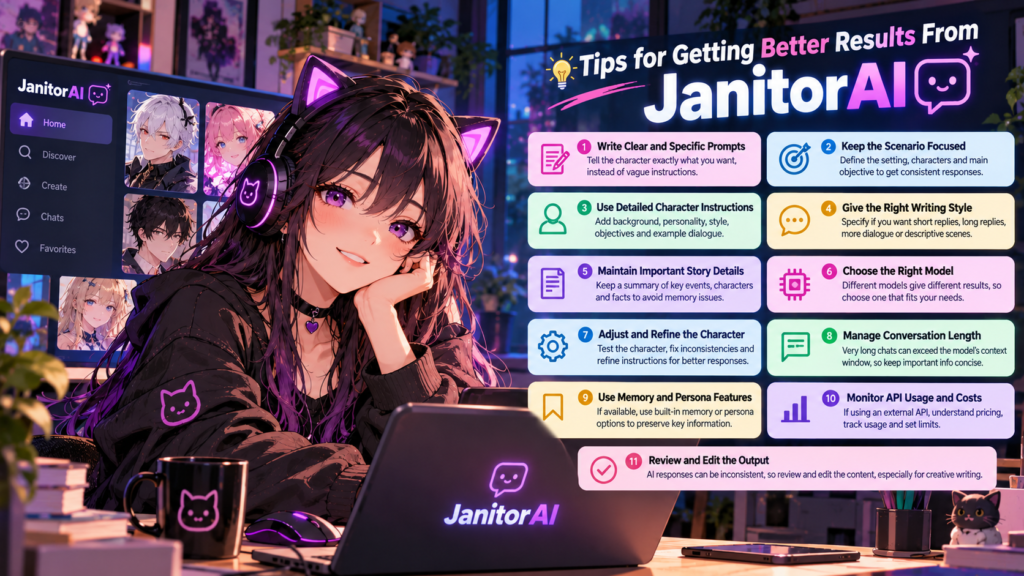
The quality of a conversation often improves when users provide clear instructions and manage the information available to the model.
Write specific prompts. Explain what you want the character to do rather than giving vague instructions such as “make the story better.”
Keep the scenario focused. Establish the setting, the characters involved, and the immediate objective. Too many unrelated details can make the intended direction harder to follow.
Use consistent character instructions. Avoid giving the same character contradictory personality traits unless the conflict is intentional and explained.
Guide the writing style. If responses are too long, ask for shorter paragraphs. If the scene lacks atmosphere, request more environmental details or dialogue that reveals character motivations.
Maintain important story details. Keep a brief summary of major events and update it when the plot changes significantly.
Choose models according to your needs. A model that works well for casual conversation may not be the best choice for complex storytelling. Compare response quality, context capacity, speed, and cost.
Review API permissions and charges. When connecting an external provider, understand how its API works and how to monitor usage. Never assume that a connected service has unlimited free access.
These practices cannot eliminate every limitation, but they can make character conversations more coherent and predictable.
Frequently Asked Questions About JanitorAI
1. What is JanitorAI used for?
JanitorAI is primarily used for AI character conversations, interactive roleplay, creative writing, and fictional storytelling. Users can interact with community-created characters or design their own.
2. Is JanitorAI free?
The platform has offered free character-chat access. However, external AI models and optional paid services may involve additional charges. Check the current terms before spending money.
3. Do you need an API key to use JanitorAI?
Not necessarily. API requirements depend on the selected model and configuration. The built-in chat option may work without a personal external API key, while third-party models can require one.
4. Can you create your own AI character on JanitorAI?
Yes. Character creation allows users to define details such as personality, background, scenario, and opening dialogue. The quality of the resulting conversations depends partly on these instructions and the selected model.
5. Does JanitorAI remember previous conversations?
It can use available conversation history and supported memory features, but its recall is limited by the model’s context window and configuration. Long conversations may require summaries to preserve important details.
6. Are JanitorAI conversations private?
Do not assume that private chats are end-to-end encrypted or inaccessible to every service involved. Review the platform’s privacy policy and the policies of any external model provider before sharing personal information.
7. What is the best alternative to JanitorAI?
There is no single best alternative for everyone. Character.AI focuses on character conversations, Replika emphasizes companionship, Chai offers chatbot discovery, and SillyTavern provides a more customizable technical setup.
Conclusion: Is JanitorAI Worth Trying?
JanitorAI offers a flexible environment for people who enjoy interactive storytelling and conversations with fictional characters. Its community-created character library and customization options make it useful for exploring different personalities, developing story ideas, and experimenting with dialogue.
However, the experience depends on more than the character itself. The underlying language model affects response quality, memory, and content restrictions, while external API connections can introduce additional costs and privacy considerations.
For beginners, the sensible approach is to start with the available built-in features, learn how character instructions work, and evaluate the experience before paying for additional services. More advanced users may appreciate the ability to experiment with external models, provided they understand the technical and security implications.
Ultimately, JanitorAI is best suited to creative exploration rather than unquestioning reliance. Use it with realistic expectations, protect your personal information, and remember that convincing AI-generated dialogue is still generated text not proof of human understanding.
[…] Lightshade AI: Features, Privacy, Pricing, and Alternatives JanitorAI: Features, How It Works, Safety and Alternatives Wysa: A Complete Guide to the AI Mental Wellness App C.ai Plus: Features, Pricing, Filters […]