

InferKit AI: Why It Was Discontinued and What Happened?

InferKit AI was an artificial intelligence writing tool that helped users generate text by continuing a passage they had already written. It attracted writers, creative professionals, and developers who wanted to experiment with AI-generated content or integrate text generation into their applications. However, anyone searching for the InferKit AI text generator today needs to know one important fact: InferKit has been discontinued, and its original writing service is no longer available.
The official website explains that advances in artificial intelligence made the writing application outdated and that the team decided to move on to new projects. The announcement also confirms that paid subscriptions were cancelled and the last payments were refunded.
But why did InferKit become outdated? What made the tool useful in the first place, and what can former users do now? This article examines InferKit’s original purpose, its discontinuation, the limitations of its approach to text generation, and the alternatives available to writers and developers.
What Was InferKit AI?
InferKit AI was a neural-network-based text generation service designed to predict and produce text based on a user’s input. Rather than requiring users to ask questions in a chatbot, it allowed them to provide an initial passage and generate a continuation.
For example, a writer could enter the beginning of a short story and let the system suggest what might happen next. A developer could also use its API to incorporate text generation into an application.
The service served two broad audiences:
- Writers and content creators: People looking for story ideas, writing inspiration, dialogue, or draft content.
- Developers: Programmers who wanted to integrate AI-generated text into their own applications.
InferKit is also associated with the earlier Talk to Transformer project, which introduced many people to AI text generation through a simple browser-based interface. Its approach reflected an earlier stage of generative AI, when predicting the next words in a passage was a central way of demonstrating what language models could do.
The distinction is important: InferKit was primarily a text continuation tool, not a modern conversational assistant capable of handling a wide range of instructions through an ongoing dialogue.
Why Was InferKit AI Discontinued?
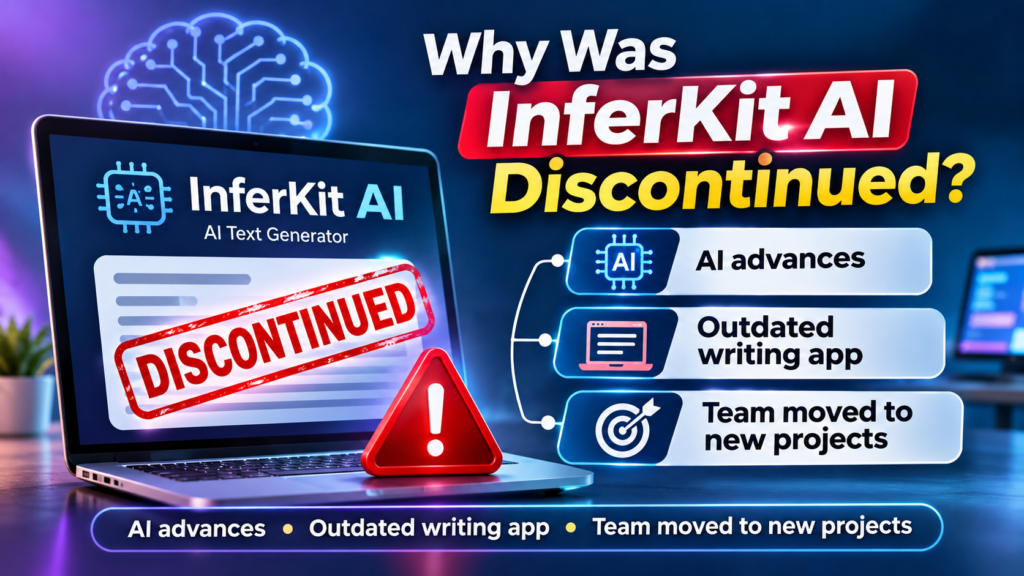
The clearest answer comes directly from the company’s official website. InferKit states that advances in artificial intelligence had made its writing application outdated and that the team wanted to focus on new projects. The announcement does not provide a detailed technical explanation or identify a specific commercial reason for the closure.
Several developments in the wider AI industry help explain why a text continuation service could become less competitive. However, these are industry-level observations, not additional reasons officially confirmed by InferKit.
1. AI Writing Technology Advanced Rapidly
Early text generators demonstrated that machine learning models could produce plausible sentences based on existing text. However, their output could be difficult to control, particularly when users wanted a specific format, factual explanation, or carefully structured document.
Modern large language models (LLMs) support a much broader range of tasks. Depending on the model, users can request an outline, change a paragraph’s tone, summarize a document, generate code, or revise an answer through follow-up instructions.
This development changed what people expected from an AI writing tool.
For example, someone drafting a technology article might want an AI system to explain a technical concept, organize the information into headings, and rewrite a section for beginners. A simple continuation tool was not designed around that complete workflow.
2. Users Began Expecting More Than Text Continuation
The InferKit text generator focused on extending an existing passage. That was useful for creative experimentation, but users increasingly needed tools that could follow specific instructions.
Consider the difference between these two requests:
- Text continuation: Start with a paragraph about renewable energy and generate what comes next.
- Instruction-based writing: Explain three advantages of renewable energy in simple English, use an H2 heading, and finish with a concise summary.
A continuation model primarily predicts a plausible sequence of words based on the supplied context. An instruction-following model is designed to respond to the task described by the user.
These approaches overlap, but they are not identical. The second approach gives users more direct control over the output.
3. General-Purpose AI Assistants Expanded the Competition
AI writing became part of larger platforms rather than remaining limited to dedicated text generators.
Tools such as ChatGPT, Claude, and Google Gemini offer text-generation capabilities alongside other functions, with features varying by product and plan. Their broader workflows can include drafting, rewriting, summarization, coding, and question answering.
For users, this creates a practical advantage: they can handle several writing tasks in one place instead of switching between separate tools.
It is reasonable to see this wider industry shift as part of the context in which InferKit became outdated. However, there is no verified public evidence that identifies competition from any particular company as the direct cause of its discontinuation.
4. Maintaining a Standalone AI Product Became More Challenging
Running an AI writing service involves more than providing a text box and a generation button. Depending on the system, the operator must manage computing resources, model performance, application reliability, security, customer support, and operating costs.
As AI models and user expectations change, a standalone product may require substantial ongoing development to remain competitive.
These considerations are relevant to AI services generally, but InferKit’s official announcement does not disclose its operating costs, financial performance, staffing decisions, or internal business strategy. It would therefore be inaccurate to claim that financial problems caused its closure.
The key takeaway: InferKit’s own explanation is that its writing app had become outdated as AI advanced. The wider shift toward more flexible, instruction-following AI tools helps explain that statement, but the company’s full internal reasoning has not been publicly established.
Is InferKit AI Still Available in 2026?
No. As of November 2026, the official InferKit website displays a discontinuation notice instead of an active text-generation service. The original application should not be treated as available for new users.
The announcement also clarifies what happened to paid subscriptions.
| Question | Confirmed information |
|---|---|
| Is InferKit still operational? | The official website says it is discontinued. |
| Can new users access the original writing tool? | The service is no longer offered. |
| What happened to paid subscriptions? | The announcement says they were cancelled. |
| Were paid users refunded? | The announcement says the last payment was refunded. |
| Why did it close? | The company says its writing app became outdated as AI advanced. |
| Is the exact shutdown date confirmed? | The official notice does not specify a closure date. |
When Did InferKit Shut Down?
The exact shutdown date remains unclear from the official announcement. Third-party websites have reported different dates, so assigning a specific month or year without a reliable primary source would create unnecessary uncertainty.
For an article published in 2026, the most defensible statement is that InferKit is discontinued and its official website confirms the closure. Readers do not need an unverified shutdown date to understand its current status.
What Happened to the InferKit API?
InferKit previously offered an API that developers could use to integrate text generation into applications. Since the original service has been discontinued, developers should not assume that its API remains available.
Anyone maintaining an application that previously depended on InferKit should review the code for old API endpoints, credentials, and request formats. The next step is to select a replacement service and test the integration before deploying it.
Can You Recover Previously Generated Text?
The official discontinuation notice does not promise access to old writing or stored account content. If you previously generated stories, articles, or other material, check your local documents, exported files, backups, or other locations where you may have saved it.
For account or billing questions, the official notice lists contact@inferkit.com as its contact address. However, the continued availability of support is not guaranteed.
How Did the InferKit Text Generator Work?
Understanding how InferKit worked helps explain both its usefulness and its limitations.
The service relied on neural language generation. In simple terms, a language model learns statistical patterns in text and uses those patterns to estimate what text should come next.
When a user supplied a passage, the model used that context to generate a continuation.
A simplified workflow looked like this:
- Enter a prompt: The user supplied a sentence, paragraph, or other starting text.
- Process the context: The model used the supplied text to establish the context for generation.
- Predict the next text: The system generated a continuation based on learned language patterns and generation settings.
- Review the output: The user evaluated the result and could edit or use suitable portions.
For example, a user might enter:
The old library had remained closed for twenty years. One evening, a light appeared in the upstairs window, and the caretaker decided to investigate.
A text continuation model could generate a possible next paragraph describing the caretaker entering the building, discovering a forgotten room, or encountering an unexpected visitor.
The continuation would be a generated possibility, not a verified event or a guaranteed continuation of the writer’s intended plot.
What Is the Role of a Language Model?
A language model learns relationships between words and other elements of language during training. When generating text, it uses the available context to estimate likely next tokens. A token can represent a whole word, part of a word, punctuation, or another text unit.
The model then produces a sequence of tokens that forms the response.
This process can create fluent writing, but fluency is not the same as accuracy. A model can produce a convincing sentence containing incorrect information, an inconsistency, or an unsupported claim.
That limitation applies to generative AI more broadly, not just to InferKit.
Was InferKit the Same as a Modern AI Chatbot?
No. Both systems can generate text, but the user experience and intended interaction differ.
A traditional text continuation tool predicts what should follow a supplied passage. A conversational assistant can be instructed to answer a question, explain a concept, revise previous text, or perform several related tasks through follow-up messages.
Modern language models may support both continuation and instruction-following. The distinction is primarily about how the system is designed and used, rather than whether it generates text.
What Were the Main Uses of InferKit AI?
InferKit’s text generation approach made it useful for several writing and development tasks. These are historical use cases, not features available through the discontinued service today.
Creative Writing and Story Development
Writers could use a continuation tool to explore possible directions for a story.
For example, a novelist who had written the opening of a mystery could generate a few possible continuations to overcome writer’s block. The suggestions might introduce a new character, reveal a clue, or create a conflict.
The writer would still need to decide which ideas fit the characters, plot, and intended tone.
Brainstorming and Draft Creation
A content creator could enter an unfinished paragraph and use generated text to explore possible ways of developing the subject.
This can be helpful when a writer knows the main idea but is unsure how to continue. However, a generated passage may introduce repetition or drift away from the original purpose, so editing remains important.
Dialogue and Fictional Scenes
Text continuation can suggest dialogue, descriptions, and transitions between scenes. A writer developing a conversation between two fictional characters might use generated text to explore different responses.
The suggestions should be treated as rough creative material rather than finished writing.
Application Development
Developers could use the InferKit API to add text generation to their applications.
A game developer, for example, might want to experiment with automatically generated fictional dialogue. A prototype could send a prompt to a language model and display the resulting text to the player.
In a production application, however, developers must also consider response quality, latency, API availability, costs, and content safety. Since InferKit is discontinued, a new project should use a currently supported service instead.
What Were the Advantages and Limitations of InferKit?
InferKit’s appeal came from its focused approach to generating text. However, its limitations are important when evaluating the service historically or choosing a replacement.
| Aspect | Potential advantage | Important limitation |
|---|---|---|
| Text continuation | Could suggest what to write next. | The generated direction might not match the writer’s intention. |
| Creative writing | Could help explore story ideas and dialogue. | Users still needed to review plot consistency and style. |
| Ease of use | A direct text-generation workflow could be accessible to nontechnical users. | Simple generation does not guarantee useful or accurate output. |
| Developer integration | The API allowed text generation to be incorporated into applications. | Integrations depended on a service that is now discontinued. |
| Content creation | Could provide a starting point for a draft. | Generated information required review and fact-checking. |
| Current availability | The historical product remains relevant when researching AI writing tools. | The original service is no longer available for new work. |
One limitation deserves particular attention: a language model can produce text that sounds plausible without being factually correct.
For fiction, that may simply create a scene that needs revision. For a technology article, it could introduce a false date, an incorrect product feature, or an unsupported statement.
Writers should therefore distinguish between using AI to generate ideas and relying on AI to establish facts.
Best InferKit AI Alternatives in 2026
Since the original InferKit service is discontinued, choosing a replacement depends on what you used it for. A novelist looking for story inspiration has different needs from a developer replacing an API or a blogger producing SEO articles.
Here are practical alternatives to consider.
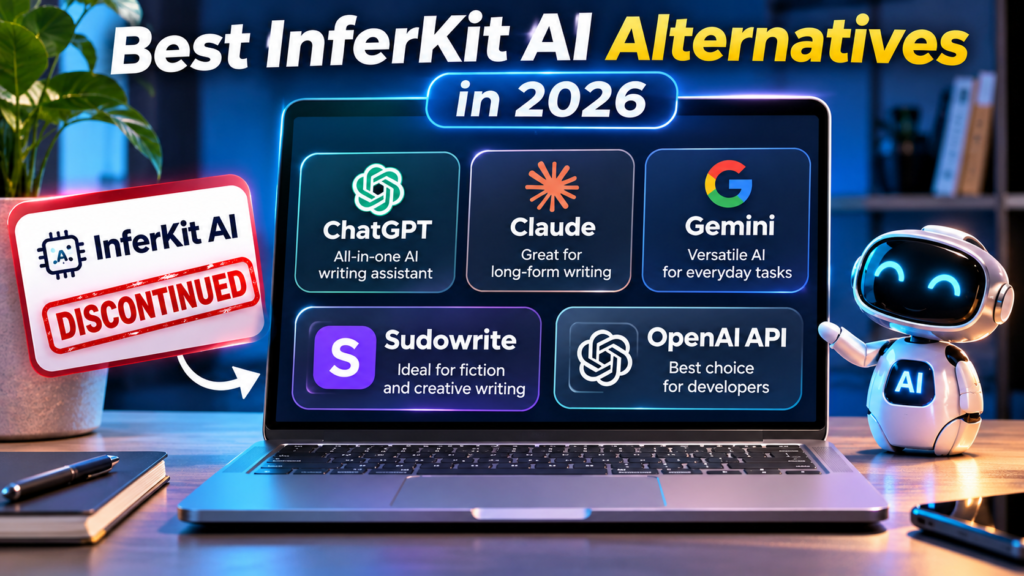
1. ChatGPT for General Writing and Text Generation
ChatGPT is a practical option for people who want to generate, continue, or revise text using natural-language instructions.
You can ask it to develop a story, expand a paragraph, rewrite an introduction, or produce several alternative versions of a passage.
For example, a writer could enter:
Continue this mystery story in a suspenseful style. Keep the existing characters consistent, avoid revealing the culprit, and write approximately 300 words.
Unlike a basic continuation prompt, this request specifies the desired tone, plot constraints, and approximate length.
ChatGPT can also help with research, summaries, and other writing tasks. However, its responses still require fact-checking when accuracy matters.
2. Claude for Long-Form Writing and Editing
Claude is another option for writers who need help developing, revising, and analyzing longer pieces of text.
It can be useful when working on a manuscript, reviewing a lengthy draft, or improving the flow of an article. Its suitability depends on the model, available context, and the specific writing task.
A novelist could provide a scene and request a continuation that preserves the established tone. A content editor could ask for unclear sentences to be identified and rewritten.
As with any AI writing assistant, users should review the output for factual errors, repetition, and unwanted changes to meaning.
3. Google Gemini for Everyday AI Assistance
Google Gemini provides another way to generate and revise text through natural-language prompts.
It can help with brainstorming, drafting, summarizing, and rewriting. It may be worth considering if you already use Google’s ecosystem, although available integrations and features depend on your account and plan.
For example, a blogger could ask Gemini to turn rough notes into a structured article outline, then revise individual sections before publication.
The same editorial rule applies: verify claims against reliable sources rather than assuming that fluent output is accurate.
4. Sudowrite for Fiction and Creative Writing
Sudowrite is worth investigating if you primarily used InferKit for novels, short stories, or fictional scenes.
Its focus on fiction makes it a relevant category of replacement for writers interested in story development, scene expansion, and creative revision.
For example, a writer could use a fiction-oriented tool to explore alternative descriptions of a setting or develop a rough scene into a more detailed draft.
However, a specialized fiction tool is not necessarily the best choice for technical documentation, factual articles, or API integration. Check its current features and pricing before subscribing.
5. OpenAI API for Developers
Developers who previously integrated InferKit into their software may prefer a replacement API rather than a browser-based writing application.
The OpenAI API provides text-generation capabilities that developers can incorporate into their applications. Its official documentation explains how to submit prompts and receive generated text.
For example, a developer building a storytelling application could send a user’s story context to a text-generation model and display the response in the application.
Before migrating, the developer should review authentication, request formats, output limits, error handling, usage costs, and data-handling requirements.
Which Alternative Should You Choose?
| Your main requirement | Alternative to investigate | Why it fits |
|---|---|---|
| General writing and rewriting | ChatGPT | Supports a broad range of text tasks. |
| Long-form drafting and editing | Claude | Suitable for working with substantial pieces of text. |
| Everyday AI writing assistance | Google Gemini | Offers text-generation and revision capabilities. |
| Fiction and story development | Sudowrite | Focuses on creative writing workflows. |
| Building an application | OpenAI API | Allows developers to integrate text generation into software. |
These are recommendations based on product focus, not a claim that any alternative reproduces InferKit’s original model or produces identical results. Review current plans, limits, and technical requirements before choosing a replacement.
How to Replace InferKit in Your Existing Workflow
If you previously relied on InferKit, switching tools is an opportunity to make your writing process more controllable.
Step 1: Identify What You Used InferKit For
Start by identifying your primary use case.
Did you use it to continue stories, generate blog paragraphs, brainstorm ideas, or power an application? Your answer will determine which replacement makes the most sense.
A general writing assistant may be sufficient for occasional drafting. Developers with existing integrations will need an API-compatible solution that meets their technical requirements.
Step 2: Save Your Existing Prompts and Writing
If you still have access to your previous prompts, generated passages, or project notes, save them locally.
These materials can help you reproduce your old workflow with another tool. Do not assume the discontinued service will retain or restore your content.
Step 3: Rewrite Prompts as Clear Instructions
Text continuation tools often rely heavily on the passage supplied by the user. Modern instruction-following models can also respond to explicit requirements.
For example, instead of providing only an unfinished paragraph, try specifying:
- The topic and intended audience.
- The tone and writing style.
- The purpose of the passage.
- Important facts or constraints.
- The desired length and format.
This gives the replacement model a clearer target.
Step 4: Test the Output Before Committing
Run several representative prompts through the replacement tool.
Check whether it preserves context, follows instructions, produces suitable output, and handles revisions consistently. If you are replacing an API, also test failures, response times, costs, and formatting.
A short trial using your actual workload is more informative than choosing a service based solely on promotional claims.
Step 5: Review Privacy and Data Requirements
Before submitting unpublished manuscripts, client documents, or confidential business information, review the provider’s data-use and retention policies.
For applications, consider how prompts and generated responses are stored, who can access them, and whether the service meets your organization’s security requirements.
Choosing a replacement involves more than finding a tool that can generate similar sentences. Reliability, privacy, cost, and ongoing support also matter.
Frequently Asked Questions About InferKit AI
1. Why was InferKit AI discontinued?
InferKit’s official website states that advances in AI made its writing application outdated and that the team decided to focus on new projects. It does not disclose a more detailed explanation.
2. Is InferKit AI still working in 2026?
No. The official website displays a discontinuation notice. The original writing service is no longer available.
3. Was InferKit AI free to use?
InferKit previously offered a free option alongside paid plans, according to historical third-party listings. These were former offerings, not current plans that users can purchase.
4. Can I still use the InferKit API?
You should not rely on the original API because the service has been discontinued. Developers should migrate to a currently supported text-generation provider.
5. What is the best alternative to InferKit AI?
The best choice depends on your needs. ChatGPT and Claude are options for general writing, Sudowrite is worth considering for fiction, and the OpenAI API is an option for developers.
6. When did InferKit shut down?
The official discontinuation notice does not provide an exact shutdown date. Secondary sources report different dates, so a precise date cannot be confidently established from the official announcement.
7. Can modern AI tools perform the same tasks as InferKit?
Modern AI writing assistants can generate and continue text, brainstorm ideas, and revise passages. However, their models, interfaces, and outputs differ, so none should be assumed to reproduce InferKit exactly.
Conclusion
InferKit AI represents an earlier approach to AI-assisted writing: give a model some text and let it predict what should come next. That approach was useful for creative experimentation, drafting, and application development, but the wider AI industry has moved toward tools that support more flexible, instruction-based workflows.
The reason for InferKit’s discontinuation is clear at a basic level. Its official website says that advances in artificial intelligence made the writing application outdated. However, the company has not publicly established a more detailed explanation, so claims about specific financial or competitive pressures should be treated cautiously.
For former users, the practical next step is to identify the tasks InferKit handled and select a suitable replacement. Writers can explore modern AI assistants or specialized fiction tools, while developers can migrate to a supported API. Whichever option you choose, review the output, verify important facts, and check privacy and usage requirements before relying on it.
[…] AI News: Latest Developments, Tools and Trends InferKit AI: Why It Was Discontinued and What Happened? Fiction Lab Review: Is FictionLab Worth Using? NovelAI: Features, Pricing, and How It […]