

OpenAI Models: Complete Guide to GPT-6 and GPT-5.6

OpenAI models now cover far more than a single chatbot model. The company’s current lineup includes general-purpose reasoning models, lower-cost models for high-volume workloads, specialized coding and cybersecurity systems, image-generation models, realtime voice models, transcription systems, embeddings, and open-weight models. For developers and businesses, that variety creates an important question: which OpenAI model should you actually use?
As of September 2026, GPT-6 Astra is OpenAI’s flagship model for the hardest end-to-end work, while the GPT-5.6 family provides several choices for balancing intelligence, speed, and cost. OpenAI also maintains specialized models for images, audio, realtime interactions, embeddings, and other workloads.
This guide explains the current OpenAI model ecosystem in practical terms. It covers what the models do, how reasoning models differ from traditional language models, where the major model families fit, what they cost in the API, and how to choose an appropriate model without paying for capabilities you do not need.
What Are OpenAI Models?
OpenAI models are machine-learning systems designed for specific AI tasks. Some are general-purpose models capable of reasoning over text and images, while others are optimized for particular jobs such as image generation, speech processing, realtime conversations, embeddings, or cybersecurity.
The distinction matters because an AI model is not simply a stronger or weaker version of the same product. Different models can have different:
- Reasoning capabilities
- Context-window sizes
- Input and output modalities
- Tool support
- Latency
- Pricing
- Output limits
- Knowledge cutoffs
- Reliability characteristics
- Intended workloads
For example, a company building a document-analysis application may need a powerful reasoning model, while a service processing millions of relatively simple requests may benefit more from a smaller, cheaper model.
OpenAI’s current API catalog lists GPT-6 Astra as its most capable general-purpose model, alongside GPT-5.6 Sol, GPT-5.6 Terra, and GPT-5.6 Luna. The catalog also includes specialized families for image generation, realtime audio, transcription, embeddings, and cybersecurity.
The Current OpenAI Model Landscape
The easiest way to understand OpenAI’s catalog is to divide it into several broad groups.
| Model family | Primary purpose | Best suited for |
|---|---|---|
| GPT-6 Astra | Advanced general-purpose reasoning and agents | Complex research, coding, computer use and professional workflows |
| GPT-5.6 Sol | High-end professional intelligence | Complex reasoning and production applications |
| GPT-5.6 Terra | Intelligence/cost balance | General production workloads |
| GPT-5.6 Luna | Cost-efficient intelligence | High-volume and cost-sensitive applications |
| GPT-5.5 / Pro | Professional reasoning and coding | Complex professional work and demanding workflows |
| GPT-5.4 family | Coding, computer use and production workloads | Development and agentic applications |
| GPT-5.3 Codex | Agentic coding | Long-running software-engineering tasks |
| GPT-Image family | Image generation and editing | Visual content creation |
| GPT-Realtime family | Realtime speech and tool use | Voice applications and live interactions |
| Transcription models | Speech-to-text | Audio and meeting transcription |
| Embedding models | Vector representations of text | Search, retrieval and RAG |
| gpt-oss models | Open-weight AI | Self-managed and customizable deployments |
This is a more useful way to think about OpenAI models than treating the model list as a simple ranking. The “best” model depends heavily on the task.
GPT-6 Astra: OpenAI’s Flagship Model
GPT-6 Astra is currently positioned as OpenAI’s most capable model. OpenAI describes it as a system built for difficult end-to-end work involving reasoning, coding, computer use, research, and document creation. Its reasoning settings include low, medium, high, xhigh, and max.
Astra has a 1.05-million-token context window and supports up to 128,000 output tokens. OpenAI lists a knowledge cutoff of April 30, 2026 for the current model.
The large context window is particularly useful for workflows involving substantial amounts of information. For example, a developer could provide a large software project, technical documentation, requirements, and supporting files as part of a workflow rather than repeatedly splitting the task into tiny pieces.
Astra also supports tools including web search, file search, computer use, code interpreter, hosted shell, MCP, and other agent-oriented capabilities. This moves the model beyond simply generating text: an application can give it tools that allow it to retrieve information, manipulate files, interact with software, and carry out multi-step work.
However, high capability comes with a higher API price. OpenAI currently lists GPT-6 Astra at $10 per million input tokens and $50 per million output tokens, before applicable discounts or additional tool costs.
That makes Astra attractive for difficult tasks where quality matters more than minimizing every inference cost. It may be unnecessary for a simple classification or straightforward text transformation performed millions of times per day.
GPT-5.6 Models: Sol, Terra and Luna
The GPT-5.6 generation introduces a clearer separation between different performance and cost requirements.
GPT-5.6 Sol
GPT-5.6 Sol is the flagship model in the GPT-5.6 family and is intended for complex professional work. OpenAI lists the gpt-5.6 alias as routing to GPT-5.6 Sol. It supports reasoning settings ranging from none through max.
The model has a 1.05-million-token context window and a maximum output of 128,000 tokens. Its current listed API price is $4 per million input tokens and $20 per million output tokens.
This makes Sol a strong middle ground when an application needs substantial reasoning capability but does not necessarily require the flagship GPT-6 Astra.
GPT-5.6 Terra
GPT-5.6 Terra is designed to balance intelligence and cost. OpenAI describes it as roughly corresponding to the mini tier used by earlier GPT-5 generations.
Its listed API price is $2 per million input tokens and $12 per million output tokens, with the same 1.05-million-token context window and 128,000-token maximum output listed for the GPT-5.6 family.
Terra can make sense for production systems where model quality matters but using the most expensive model for every request would not be economically sensible.
GPT-5.6 Luna
GPT-5.6 Luna is optimized for cost-sensitive, high-volume workloads. OpenAI says it roughly corresponds to the nano tier from earlier GPT-5 families.
Its current listed API pricing is $0.20 per million input tokens and $1.20 per million output tokens. It also supports the same broad reasoning-effort range used by the other GPT-5.6 models.
For a company processing a very large number of straightforward requests, the economics can matter more than choosing the most powerful model available.
Why Reasoning Matters in OpenAI Models
One of the biggest changes in modern OpenAI models is the increasing importance of reasoning.
A traditional language-model interaction can be thought of as producing an answer directly from the input. Reasoning models are designed to spend additional computation working through a problem before producing the final response.
This distinction becomes important when the task involves multiple constraints.
Consider a simple request:
“Rewrite this paragraph in a friendlier tone.”
A lightweight model may handle that extremely well.
Now consider:
“Review this software architecture, identify security and scalability risks, compare three possible designs, explain the trade-offs, and produce an implementation plan that fits the stated constraints.”
The second task involves several layers of analysis. A stronger reasoning model can be more valuable because the challenge is not simply generating fluent language; it is maintaining consistency across multiple decisions.
OpenAI’s current GPT-5.6 and GPT-6 model documentation exposes configurable reasoning effort. Higher reasoning settings can be used when a task warrants additional computation.
The practical lesson is simple: do not automatically use maximum reasoning for every request. More computation can improve difficult tasks, but it can also increase cost and latency.
What Can OpenAI Models Do?
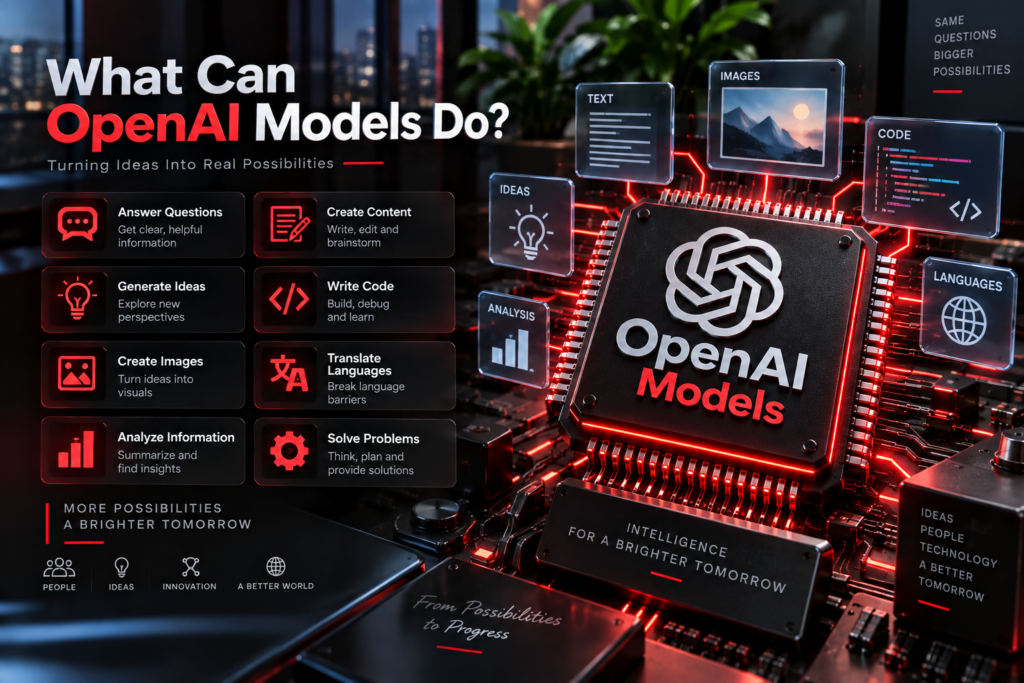
The capabilities vary by model, but current OpenAI systems cover a wide range of applications.
Writing and content work
General-purpose models can help with drafting, editing, summarizing, rewriting, classification, extraction, and structured content generation.
A marketing team might use a model to turn product specifications into several versions of a product description while enforcing a particular tone and output structure.
The model can also transform information rather than simply create new text. For example, a company could provide a long policy document and ask the system to extract deadlines, responsibilities, exceptions, and required actions.
Software development
Coding is one of the major areas of emphasis in current OpenAI models.
GPT-6 Astra is specifically positioned for coding and complex software-engineering work, while OpenAI also maintains specialized Codex models for agentic coding workflows.
A practical coding workflow might involve:
- Providing a repository and requirements.
- Asking the model to inspect the existing implementation.
- Identifying relevant files.
- Proposing a change.
- Applying the change through available tools.
- Running tests.
- Reviewing failures.
- Making corrections.
The important difference is that an agentic coding workflow can involve repeated actions and verification rather than simply returning a block of code.
Research and analysis
Large-context reasoning models are useful for tasks involving multiple documents, research materials, reports, datasets, or technical specifications.
For example, a researcher might ask a model to compare several documents and create a structured synthesis. The model can help identify themes and differences, but important factual claims should still be checked against the original sources.
AI-generated analysis is not automatically equivalent to verified research.
Document processing
Businesses can use models to extract information from contracts, reports, invoices, policies, manuals, and other documents.
A useful architecture might combine:
Document → extraction → retrieval → reasoning → structured output
This is where OpenAI models can work alongside RAG, or retrieval-augmented generation. Instead of expecting the model to memorize every company document, an application retrieves relevant information from a database or search system and supplies it to the model at inference time.
Customer support
A support system can use an OpenAI model to classify incoming requests, retrieve relevant documentation, draft answers, summarize previous conversations, or route complex cases to human agents.
The model does not have to make every decision itself. A well-designed system can restrict it to clearly defined tasks and require human approval for sensitive actions.
Multimodal applications
Many current OpenAI models accept images as input in addition to text. GPT-6 Astra, for example, supports image input.
That enables applications such as:
- Analyzing charts
- Understanding screenshots
- Extracting information from images
- Reviewing diagrams
- Interpreting visual layouts
- Combining written instructions with visual information
Multimodal does not mean that every model supports every type of media. Audio and video capabilities are handled by specialized model families in OpenAI’s catalog.
Specialized OpenAI Models
Not every AI task should be handled by a general-purpose language model.
OpenAI’s catalog includes specialized models for several important areas.
Image generation
OpenAI currently lists GPT-Image-2.5 Sunburst as its most capable image-generation and editing model, alongside GPT-Image-2.5 Flare for faster everyday image generation.
A developer building an image-generation application therefore does not necessarily need to use a general-purpose GPT model to create the image itself.
Realtime voice
The GPT-Realtime family is designed for real-time speech and tool-use workflows. These models are more appropriate for applications where low-latency voice interaction is central to the product.
This could include a voice assistant, interactive service, or application where spoken conversation needs to happen continuously rather than through separate text requests.
Transcription
OpenAI also provides specialized transcription models such as GPT-Transcribe and GPT-Live-Transcribe. These are designed for converting speech into text rather than serving as general-purpose conversational models.
For a meeting application, for example, a sensible architecture might use a transcription model to convert audio into text and then a reasoning model to summarize decisions and action items.
Embeddings
Embedding models serve a different purpose altogether.
An embedding converts text into a numerical representation that captures semantic relationships. Applications can use those representations for similarity search, retrieval, recommendation systems, and RAG.
OpenAI currently lists text-embedding-3-large and text-embedding-3-small among its embedding models.
An embedding model is therefore not a replacement for GPT-6 or GPT-5.6. It performs a different job in the overall AI architecture.
Open-Weight OpenAI Models
OpenAI’s catalog also includes gpt-oss-120b and gpt-oss-20b, which are described as open-weight models under the Apache 2.0 license. The 120B model is positioned as the more powerful option, while the 20B model targets lower-latency use cases.
Open-weight models can be relevant when an organization wants more control over how a model is deployed and managed.
This is different from using a hosted API. With an API, the model inference infrastructure is provided by the service provider. With an open-weight system, the organization has substantially more responsibility for infrastructure, deployment, security, scaling, monitoring, and model operations.
That flexibility can be valuable, but it is not automatically cheaper or easier.
OpenAI Models and API Pricing
API pricing is based on usage rather than a simple monthly “model ownership” fee. OpenAI generally expresses language-model prices per million input and output tokens.
Current listed prices illustrate the range:
| Model | Input / 1M tokens | Output / 1M tokens | Context |
|---|---|---|---|
| GPT-6 Astra | $10 | $50 | 1.05M |
| GPT-5.6 Sol | $4 | $20 | 1.05M |
| GPT-5.6 Terra | $2 | $12 | 1.05M |
| GPT-5.6 Luna | $0.20 | $1.20 | 1.05M |
| GPT-5.5 | $5 | $30 | 1.05M |
These are current listed API rates and can change as OpenAI updates its model catalog and pricing.
There is another important consideration: token cost is not the same as total task cost.
Suppose a cheaper model needs several attempts, produces more errors, or requires extensive post-processing. A more capable model may cost more per token but complete the task with fewer iterations.
For that reason, businesses should evaluate cost per successful task, not just cost per million tokens.
Context Windows and Tokens Explained
Two terms appear frequently when comparing OpenAI models: tokens and context window.
A token is a unit used to process text. It is not exactly the same as a word. A word can correspond to one or multiple tokens depending on the language and text.
The context window is the amount of information the model can consider within a particular request or conversation context.
A larger context window is useful when working with:
- Long documents
- Large codebases
- Multiple files
- Extended conversations
- Large research collections
- Complex instructions and supporting material
Current GPT-6 Astra and GPT-5.6 models list context windows of approximately 1.05 million tokens.
However, a large context window should not be treated as a guarantee of perfect understanding. More information can also create noise. Good retrieval, organization, prompting, and document selection remain important.
Advantages of OpenAI Models
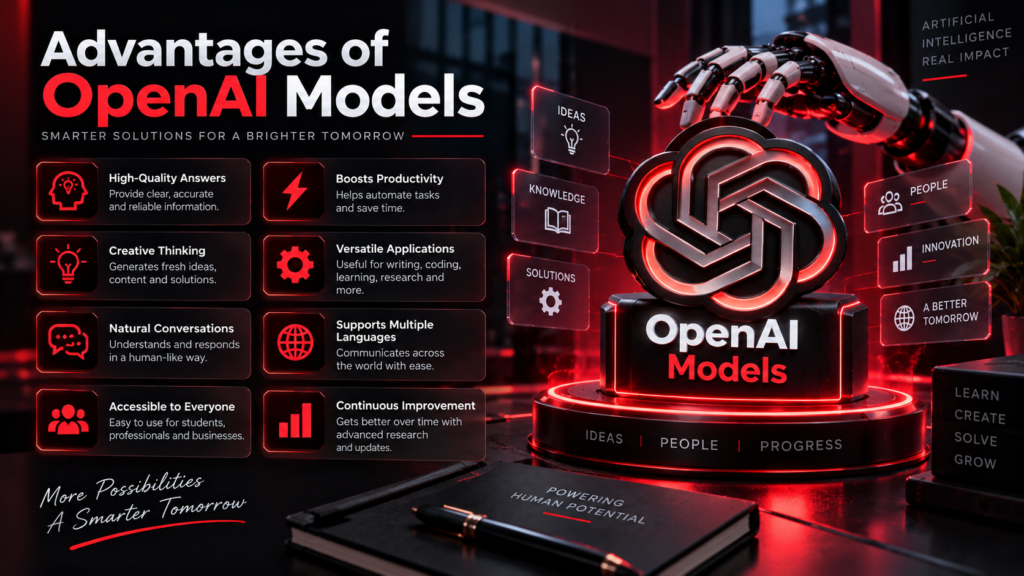
OpenAI’s model ecosystem offers several practical advantages.
Broad model selection
Developers can choose between general-purpose, reasoning, low-cost, coding, image, audio, realtime, transcription, embedding, and open-weight systems rather than forcing every application into one model.
Scalable architecture
The range of model sizes makes it possible to reserve expensive models for difficult tasks and use less expensive models for simpler workloads.
Tool integration
Current high-end models can work with tools such as web search, file search, code execution, computer use, and other interfaces depending on the model and API configuration.
This enables applications that do more than generate text.
Long-context processing
The large context windows offered by current flagship models can simplify workflows involving lengthy documents and large collections of information.
Reasoning controls
Modern models provide configurable reasoning effort, giving developers more control over the trade-off between computational effort, quality, and latency.
Limitations and Risks
Despite their capabilities, OpenAI models are not infallible.
Hallucinations still matter
A model can generate information that sounds convincing but is incorrect. Improvements in model reliability reduce this problem, but they do not eliminate the need for verification.
OpenAI reported that GPT-5 was substantially less likely to produce factual errors than earlier models in its own evaluations, but benchmark improvements should not be interpreted as a guarantee that every answer is accurate.
For high-stakes applications, important outputs should be checked against authoritative sources or reviewed by qualified humans.
Higher capability can mean higher cost
The strongest models can be significantly more expensive than lightweight models. Using a flagship model for every low-complexity request can make an otherwise efficient application unnecessarily expensive.
Latency can vary
More complex reasoning and multi-step agentic workflows can take longer than straightforward generation.
Security and privacy require architecture
An AI model does not automatically make an application secure. Developers must consider authentication, permissions, data retention, prompt injection, tool access, logging, and the sensitivity of information supplied to the system.
This becomes especially important when an AI agent has access to external tools or can take actions on a user’s behalf.
Models can change
API aliases and model families may be updated over time. OpenAI provides snapshots for some models so developers can lock applications to a specific model version when consistency is important.
For production systems, model versioning and evaluation should therefore be treated as part of normal software maintenance.
How to Choose the Right OpenAI Model
The best approach is to start with the task, not the model name.
Ask these questions:
1. How difficult is the task?
For complex reasoning, coding, research, or multi-step workflows, a high-end reasoning model may be justified.
For simple extraction, classification, rewriting, or routing, a lower-cost model may be sufficient.
2. Does the application need tools?
If the model must search the web, inspect files, execute code, or interact with a computer, choose a model that supports the required tools.
3. How much data must it process?
Long documents and large codebases make context-window capacity more important.
4. What is the required latency?
A customer-facing application may prioritize speed, while an overnight research workflow may accept higher latency in exchange for deeper reasoning.
5. What is the cost per successful result?
Measure the entire workflow rather than looking only at token prices.
6. How important is consistency?
If reproducibility matters, evaluate snapshot availability and establish regression tests before changing models.
A practical model-selection strategy
A sensible development process is:
Start with the least expensive model that can plausibly meet the quality requirement → test it on representative tasks → measure failures → move upward only when necessary.
For a difficult application, the opposite mistake is just as common: developers sometimes choose the most powerful model immediately without measuring whether a cheaper model could have done the job.
The right model is the one that meets the application’s quality, latency, reliability, and cost requirements.
OpenAI Models vs. ChatGPT
One common misconception is that OpenAI models and ChatGPT are the same thing.
They are related, but they are not identical concepts.
ChatGPT is a product and user-facing experience that can use OpenAI models alongside tools, interfaces, memory, settings, and other product capabilities.
The API, meanwhile, gives developers programmatic access to models for building their own applications.
A model available in ChatGPT may also have a corresponding API model, but the names, aliases, capabilities, availability, and recommended usage can differ. OpenAI’s API documentation explicitly distinguishes models used in ChatGPT from models recommended for API development.
This distinction is important when reading older articles that say things like “the latest OpenAI model.” Such statements can become outdated quickly.
Common Misconceptions About OpenAI Models
“The newest model is always the best choice.”
Not necessarily. A flagship model may be technically stronger but economically unnecessary for a simple task.
“A larger context window means the model understands everything perfectly.”
No. Context capacity determines how much information can be supplied, not whether every piece of that information will be interpreted correctly.
“Reasoning models never make mistakes.”
They can still make factual, logical, or implementation errors. Reasoning improves performance on many difficult tasks; it does not provide mathematical or factual perfection.
“Every OpenAI model can generate images, audio and video.”
No. OpenAI separates many of these capabilities into specialized model families.
“AI agents can safely operate without supervision.”
That depends on the workflow. The more permissions an agent has, the more important boundaries, confirmation steps, monitoring, and error handling become.
Frequently Asked Questions
What is the best OpenAI model in 2026?
As of September 2026, GPT-6 Astra is OpenAI’s most capable model and is positioned for the hardest end-to-end tasks, including complex reasoning, coding, research, computer use, and document creation.
What is the cheapest current OpenAI model?
Among the flagship general-purpose models listed by OpenAI, GPT-5.6 Luna is the cost-optimized option, currently listed at $0.20 per million input tokens and $1.20 per million output tokens.
Which OpenAI model is best for coding?
The answer depends on the type of coding. GPT-6 Astra is designed for demanding end-to-end coding and agentic workflows, while OpenAI also offers specialized Codex models for agentic software engineering.
What is the difference between GPT-6 and GPT-5.6?
GPT-6 Astra is positioned as OpenAI’s most capable model for difficult end-to-end work. GPT-5.6 is a family with Sol, Terra, and Luna variants that provide different points on the intelligence-versus-cost spectrum.
What are OpenAI embeddings used for?
Embeddings convert text into numerical representations that applications can use for semantic search, retrieval, recommendations, clustering, and RAG systems. OpenAI lists the text-embedding-3 family among its embedding models.
Can OpenAI models work with images?
Yes, supported models can accept image input. OpenAI also provides dedicated image-generation and editing models for creating or modifying images. The exact capabilities depend on the model.
Should businesses always use the most powerful OpenAI model?
No. Businesses should select a model based on the actual task and measure quality, latency, reliability, and total cost. A smaller model can be a better choice when the task is simple or high-volume.
Conclusion
The OpenAI model ecosystem has evolved into a broad collection of systems rather than a single ladder where every newer model simply replaces the previous one. GPT-6 Astra currently sits at the top for demanding end-to-end work, while GPT-5.6 Sol, Terra, and Luna provide different trade-offs between capability and cost. Alongside them are specialized models for coding, images, real-time speech, transcription, embeddings, cybersecurity, and open-weight deployment.
For users, the most important lesson is not to memorize every model name. It is to understand why different models exist. Choose based on the complexity of the task, required tools, context size, latency, reliability, and cost per successful result. As OpenAI’s catalog continues to expand, that task-first approach will remain more useful than simply choosing whichever model has the newest number.
[…] Is AI a Robot? Understanding AI vs. Robots OpenAI Models: Complete Guide to GPT-6 and GPT-5.6 Claude Sonnet 4.6: Features, Pricing, and Capabilities DeepSeek V3: Features, […]