

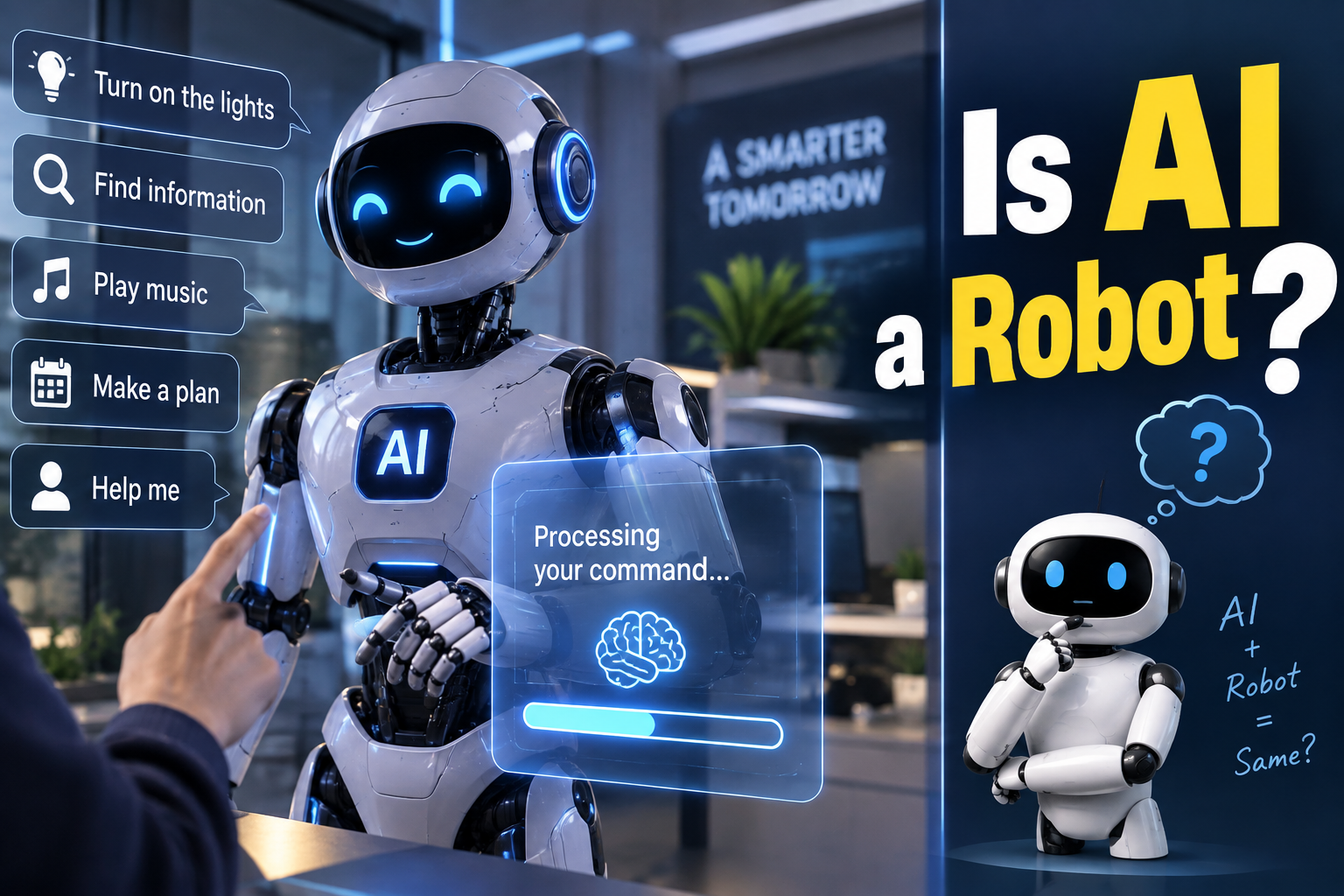
Is AI a Robot? Understanding AI vs. Robots

Is AI a robot? No, not usually. Artificial intelligence and robots are related technologies, but they are not the same thing. AI is primarily a set of computer-based methods that allow machines to perform tasks associated with human intelligence, such as recognizing patterns, understanding language, making predictions, and generating content. A robot, by contrast, is a physical machine designed to sense its environment and perform actions in the real world.
The confusion is understandable because some robots use AI. A warehouse robot may use computer vision to identify objects, while a humanoid robot may use AI to understand spoken instructions. But plenty of AI systems have no physical body at all. Chatbots, recommendation systems, fraud-detection software, image generators, and many other AI applications exist entirely as software.
Understanding this distinction makes it much easier to understand what modern AI can actually do, where robotics fits in, and why an AI assistant such as ChatGPT is not itself a robot.
Is AI a Robot? The Short Answer
AI is not inherently a robot.
Think of the relationship this way:
- AI is the intelligence or decision-making technology.
- A robot is a physical machine that can sense and act in the physical world.
- A robot can use AI, but it does not have to.
- AI can operate without any robot or physical body.
Stanford’s AI definitions describe artificial intelligence as a broad field involving systems that can perform tasks such as understanding language, recognizing images, learning from data, reasoning, and making decisions. Robotics, meanwhile, combines engineering and computer science to create machines capable of physical tasks.
This means an industrial robotic arm following a fixed sequence may be a robot without being particularly intelligent. Conversely, an AI language model can analyze and generate text without having a body, wheels, arms, or sensors.
What Is Artificial Intelligence?
Artificial intelligence is a broad area of computer science focused on building systems capable of performing tasks that normally require aspects of human intelligence.
Depending on the system, those tasks can include:
- Understanding and generating human language
- Recognizing objects or faces in images
- Detecting patterns in large datasets
- Making predictions
- Recommending products or content
- Generating text, images, audio, or video
- Assisting with decision-making
- Controlling autonomous systems
Modern AI commonly relies on machine learning, in which algorithms are trained using data so models can identify patterns and make predictions or decisions on new inputs. Deep learning, a subset of machine learning, uses neural networks to handle complex patterns in areas such as language and computer vision.
For example, when an AI assistant receives a question, it does not need a physical body to process that request. The AI model runs on computing infrastructure and produces an output based on its training, architecture, instructions, and the information available to it.
That is AI without robotics.
What Is a Robot?
A robot is a physical machine capable of carrying out actions in the real world.
Robots can contain components such as:
- Sensors
- Cameras
- Motors
- Actuators
- Processors
- Control systems
- Communication hardware
- Mechanical structures
A simple robot does not necessarily need sophisticated AI. An automated machine on a factory floor, for example, can repeatedly perform a precisely programmed movement without learning or reasoning in the way modern AI systems do.
Stanford’s robotics definition emphasizes the physical nature of robotics: the field combines engineering and computer science to build machines capable of performing physical tasks. When AI is added, robots can perceive their surroundings, make decisions, and adapt to situations more flexibly.
So, robotics is about physical machines and their actions, while AI is about intelligent computational capabilities.
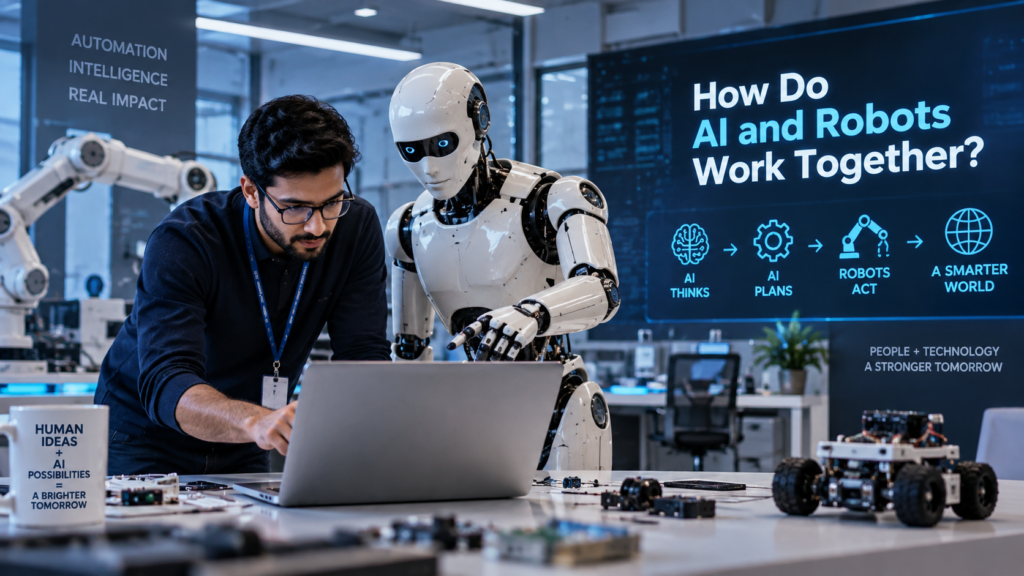
How Do AI and Robots Work Together?
The easiest way to understand their relationship is to imagine a robot as a body and AI as one possible source of sophisticated perception or decision-making.
Consider a hypothetical warehouse robot.
Its sensors and cameras collect information about its surroundings. An AI vision system could analyze that information and identify shelves, packages, people, or obstacles. Another software component could determine an appropriate route. Motors and other hardware then allow the robot to move.
The complete system might therefore involve:
Sensors → AI perception → decision-making → control software → motors and physical movement
However, this does not mean every part of the robot is AI. The motors are not necessarily AI. The battery is not AI. The physical frame is not AI. Even some navigation and control functions may use conventional software rather than machine learning.
NASA similarly describes AI as potentially involving software agents as well as embodied robots that use perception, planning, reasoning, learning, communication, decision-making, and action.
AI vs. Robots: What’s the Difference?
| Feature | Artificial Intelligence | Robot |
|---|---|---|
| Basic nature | Primarily software and computational methods | Physical machine |
| Needs a physical body? | No | Yes |
| Can process information? | Yes | Usually, through onboard or connected computing |
| Can perform physical actions? | Not by itself | Yes |
| Can use machine learning? | Often | Sometimes |
| Can exist without the other? | Yes | Yes |
| Example | AI chatbot | Factory robotic arm |
| Main role | Analyze, predict, generate, decide, or assist | Sense and act in the physical world |
The distinction becomes especially important when discussing modern generative AI.
A large language model can generate an answer to a question, summarize a document, translate text, or help write computer code. None of those activities requires a physical robot.
On the other hand, a robot equipped with cameras and AI software may use a model to understand an instruction and then physically carry out the requested task.
What Are Some Examples of AI That Are Not Robots?
Most people interact with AI without realizing that no robot is involved.
AI chatbots
AI assistants can process natural-language requests and generate responses. The intelligence is implemented through software running on computers rather than inside a humanoid machine.
Recommendation systems
Streaming, shopping, and other online platforms can use machine-learning models to analyze patterns and recommend content or products. Machine learning is widely used for recommendation and personalization systems.
Spam detection
Email systems can use machine learning to distinguish unwanted messages from legitimate communication by identifying patterns in examples of emails.
Computer vision
AI can analyze photographs, video, scans, and other visual information. This can be used for tasks such as object recognition or extracting text from documents. Google Cloud identifies optical character recognition as one practical AI application.
Generative AI
Generative AI systems can create new text, images, audio, code, and other content. They do not require a physical body to perform these tasks.
These examples demonstrate why saying “AI is a robot” is misleading. AI can be completely digital.
What Are Some Examples of Robots That Use AI?
The reverse is also true: physical robots can incorporate AI.
For example, an AI-enabled robot could potentially use:
- Computer vision to interpret camera images
- Machine learning to recognize objects or patterns
- Natural language processing to understand spoken or written commands
- Planning algorithms to determine how to complete a task
- Reinforcement learning for certain control or decision-making problems
A robot operating in an unpredictable environment benefits from technologies that help it interpret changing conditions rather than simply repeat one fixed sequence.
This is one reason AI and robotics are increasingly discussed together. Google Cloud notes that machine learning contributes to areas including autonomous vehicles, drones, and robotics.
Still, AI does not automatically make a robot autonomous or human-like. The robot’s capabilities depend on its sensors, hardware, software, training, environment, safety systems, and the specific task it was designed to perform.
Is ChatGPT a Robot?
No. ChatGPT is an AI system, not a physical robot.
A user can communicate with ChatGPT through a computer or mobile device, but the software itself does not become a robot simply because it can understand language or produce human-like responses.
This distinction also explains why the phrase “AI robot” can be confusing. People sometimes use it casually to describe anything that behaves intelligently. Technically, however, an AI model and a physical robot are different components.
An AI model can provide the computational capability, while a robot can provide the physical platform through which that capability interacts with the world.
In other words, putting an AI system into a physical machine can create an AI-powered robot, but the AI itself is not the robot.
Does a Robot Need AI to Work?
No.
Some robots operate using predetermined instructions, control systems, sensors, or simple programmed logic. They may repeatedly perform a task under controlled conditions without using machine learning.
This distinction is important because “robot” does not automatically mean “intelligent.”
Stanford gives a useful conceptual example: a fully pre-programmed factory robot can be highly accurate and consistent without necessarily being intelligent.
AI becomes more useful when a system needs to interpret complex information, recognize patterns, adapt to variation, or make decisions that would be difficult to specify entirely through fixed rules.
For example, programming a machine to move an object from point A to point B under perfectly controlled conditions may not require AI. Asking a robot to identify an unfamiliar object, navigate a changing environment, and determine how to handle it is a much more demanding problem.
Why People Confuse AI With Robots
Popular culture has strongly influenced the way people think about artificial intelligence.
Movies and science-fiction stories often represent AI as a humanoid machine that talks, thinks, and moves like a person. That image combines two separate concepts: artificial intelligence and robotics.
Modern AI is often much less visible.
A machine-learning model might be running inside a data center while performing a task that users experience through a simple website or smartphone application. There may be no physical machine resembling a human at all.
At the same time, robots can look intelligent because they can move, speak, recognize objects, or respond to their surroundings. But those behaviors generally come from a combination of hardware, software, sensors, algorithms, and sometimes AI models.
The appearance of intelligence and the presence of a physical body are therefore separate questions.
What Are the Limitations of AI-Powered Robots?
Combining AI with robotics is powerful, but it introduces significant engineering and safety challenges.
Physical environments are unpredictable
A software system working with text can often operate without dealing with gravity, friction, collisions, physical obstacles, or mechanical wear. A robot has to handle all of these realities.
AI can make mistakes
Machine-learning systems are not guaranteed to produce correct outputs. A perception model could misidentify an object or interpret an unusual situation incorrectly.
Safety matters more when software controls hardware
An incorrect answer from a chatbot can be inconvenient. A bad decision by a machine controlling physical equipment could potentially cause damage or injury. Robotics therefore requires appropriate safeguards, testing, monitoring, and fail-safe mechanisms.
AI does not automatically equal human understanding
An AI model can produce impressive results without possessing human-like consciousness or understanding. Its capabilities depend on its architecture, training, inputs, and operating environment.
Hardware creates additional constraints
A robot needs power, sensors, mechanical components, computing resources, maintenance, and a suitable physical environment. These requirements do not apply in the same way to purely software-based AI.
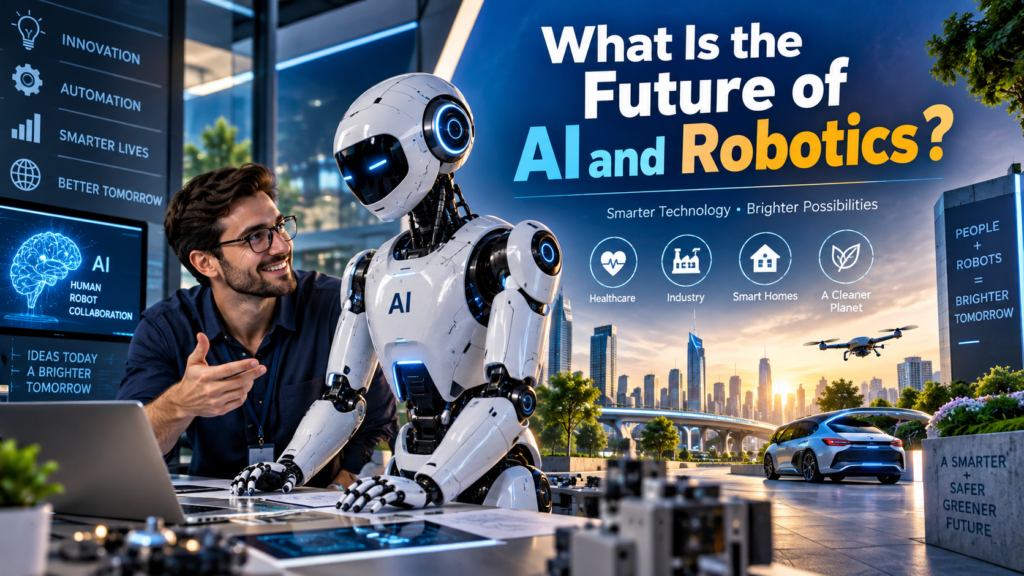
What Is the Future of AI and Robotics?
AI and robotics are likely to become increasingly connected, particularly as AI systems improve at interpreting language, images, and complex environments.
The most important development is not simply making robots look more human. A more useful goal is enabling machines to perform practical tasks more flexibly.
For example, an AI-powered robot might eventually be able to receive a natural-language instruction, interpret its surroundings, plan a sequence of actions, and adjust when conditions change. Research into robotics already combines areas such as computer vision, machine learning, and reinforcement learning for these kinds of capabilities.
However, future capabilities should not be confused with guaranteed outcomes. The performance of a physical AI system depends on much more than the AI model itself. Hardware reliability, safety engineering, training data, environmental complexity, latency, cost, and human oversight all matter.
The practical future of AI robotics will therefore be shaped by the combination of intelligence, physical engineering, and responsible deployment.
Common Misconceptions About AI and Robots
Misconception 1: Every AI is a robot.
False. Many AI systems are purely software.
Misconception 2: Every robot uses AI.
False. Some robots follow fixed instructions or conventional control systems.
Misconception 3: A chatbot is a robot because it talks like a person.
False. Human-like conversation does not require a physical body.
Misconception 4: Adding AI automatically makes a robot intelligent in every situation.
False. AI systems are designed and trained for particular capabilities and can fail outside suitable conditions.
Misconception 5: Robots and AI are completely unrelated.
Also false. AI can provide perception, learning, planning, or decision-making capabilities within robotic systems.
Frequently Asked Questions
Is AI a robot?
No. AI is a broad set of technologies that enable computers to perform tasks associated with intelligence. A robot is a physical machine. A robot can use AI, but AI does not require a robot.
Can AI control a robot?
Yes. AI can be integrated into robotic systems for tasks such as visual recognition, language understanding, planning, navigation, and decision-making. The exact capabilities depend on the robot and software.
Is ChatGPT a robot?
No. ChatGPT is an AI system that operates through computing hardware and software. It does not become a physical robot simply because it can communicate using natural language.
Do all robots have artificial intelligence?
No. Robots can operate using programmed instructions and conventional control systems without machine learning or advanced AI.
What is the difference between AI and robotics?
AI focuses on computational capabilities such as learning, pattern recognition, reasoning, prediction, and language processing. Robotics focuses on building physical machines that can sense and act in the real world.
Can a robot exist without AI?
Yes. Many robots can perform predefined physical tasks using programmed control systems without sophisticated artificial intelligence.
Will AI become a physical robot?
AI itself does not have to become a robot. Instead, AI technologies can be integrated into physical robots, creating systems that combine computational intelligence with the ability to interact with the physical world.
Conclusion
So, is AI a robot? No. The two technologies overlap, but they solve different parts of a problem. AI provides computational capabilities such as recognizing patterns, understanding language, making predictions, and generating responses. Robotics provides a physical platform capable of sensing and acting in the real world.
The distinction is more than a technical detail. It helps explain why an AI chatbot can be highly capable without having a physical body, while a robot can perform useful tasks without sophisticated AI. When the two technologies are combined, however, AI can give robots more flexible ways to perceive their surroundings, interpret instructions, and make decisions.
The most useful way to think about the relationship is simple: AI is not a robot, and a robot is not necessarily AI. But a robot can use AI to become more capable.
[…] AI Agents in Healthcare: Benefits, Uses, and Future Is AI a Robot? Understanding AI vs. Robots OpenAI Models: Complete Guide to GPT-6 and GPT-5.6 Claude Sonnet 4.6: Features, Pricing, […]