


Lightshade AI: Features, Privacy, Pricing, and Alternatives

Lightshade AI is an AI character-chat platform designed for interactive storytelling, personalized conversations, and fictional roleplay. Rather than focusing primarily on answering factual questions, it lets users explore conversations with AI characters, develop fictional personalities, and build stories through ongoing dialogue. Its reported features include customizable personas, lorebooks, interface settings, and options for connecting to AI models.
What makes Lightshade AI interesting is its focus on customization. Users who want more control over their characters and storytelling experience may find this approach appealing. However, understanding its current model availability, potential costs, privacy practices, and technical limitations is important before investing time in the platform.
This guide explains how Lightshade AI works, what its reported features offer, who may benefit from using it, and which alternatives are worth considering. It also distinguishes between documented information and capabilities that should be verified directly, since features and access arrangements can change.
What Is Lightshade AI?
Lightshade AI is an AI-powered roleplay platform that generates conversational responses through virtual characters. Users can interact with existing characters or create their own, depending on the features currently available.
The platform belongs to a broader category of conversational AI applications that use generative language models to produce dialogue based on instructions, character descriptions, and previous messages.
For example, a fantasy writer could create a fictional detective, describe the detective’s personality and background, and then conduct conversations to explore possible storylines. The AI generates responses that follow the supplied character information, although its consistency depends on the underlying model and the quality of the instructions.
Lightshade has also been associated with a successor project called LSAI. Public announcements about the project have described plans for locally hosted AI, offline conversations, customizable interfaces, and continued access to selected cloud models. These are announced plans, not proof that every feature is currently available.
Who Is Lightshade AI Designed For?
The platform may interest several groups:
- Roleplay enthusiasts: People who enjoy interactive conversations with fictional characters.
- Creative writers: Authors exploring dialogue, character development, and alternative plot directions.
- Worldbuilders: Users developing fictional settings, relationships, histories, and rules.
- Character creators: People who want to design personalities and share their creations.
- AI enthusiasts: Users interested in experimenting with different language models and conversation settings.
It is less suitable as a primary research assistant or source of verified information. Roleplay models are designed to generate plausible dialogue, not necessarily to provide fact-checked answers.
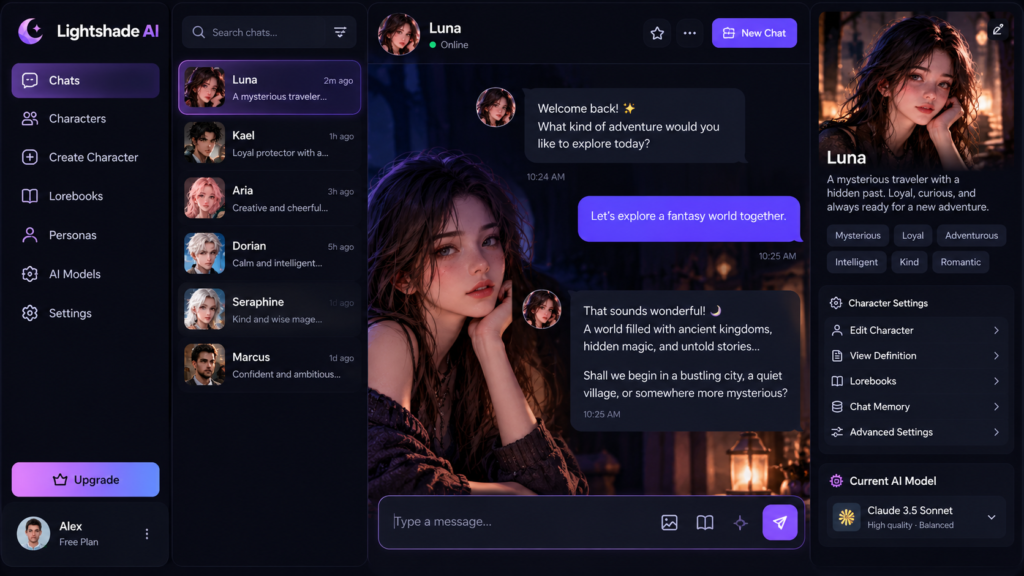
How Does Lightshade AI Work?
Lightshade AI uses a conversational interface to connect users with AI-generated characters. The exact generation process depends on the model being used, but most character-chat systems follow a similar pattern.
1. Character Instructions Establish the Personality
A character description tells the model how a fictional person should behave. It can include personality traits, background information, speaking style, motivations, and relationships.
For example, imagine creating a detective who is observant, skeptical, and reluctant to trust strangers. A detailed character definition gives the model information it can use to produce dialogue consistent with that description.
However, instructions influence behavior rather than guaranteeing it. The character may still contradict its background or respond in an unexpected way.
2. The Language Model Generates a Response
A large language model (LLM) processes the conversation and generates a response based on the information available to it.
That information can include:
- The character’s description and instructions.
- The user’s latest message.
- Relevant conversation history.
- Additional fictional background information.
- System instructions and model settings.
The model generates text based on learned patterns rather than thinking or remembering exactly like a human.
3. Conversation History Provides Context
Previous messages help the model understand what has happened in a conversation. This is essential for interactive storytelling because dialogue often depends on earlier events.
For example, if a character previously agreed to meet someone at a railway station, that detail may influence a later response.
There is a technical limitation, though. Models have finite context windows, which limit how much information they can process in a single request. Long conversations may lose important details when earlier messages are omitted or summarized.
4. Additional Context Can Support Storytelling
Some character-chat platforms use lorebooks to provide relevant background information when specific topics arise.
A fantasy lorebook might describe the political structure of a fictional kingdom. When a conversation mentions its royal family, the relevant information can be added to the model’s prompt.
This resembles a lightweight form of context retrieval. It helps the model use supplied information without including an entire fictional encyclopedia in every request.
Key Lightshade AI Features
Lightshade AI is associated with several customization features that may appeal to users who want more control over interactive conversations. Availability can change, so the following describes reported capabilities rather than guaranteeing that every feature is currently accessible.
Character Creation and Customization
Character creation allows users to define fictional personalities and backgrounds.
Useful character instructions can include:
- Personality: Whether a character is serious, humorous, curious, or reserved.
- Background: Personal history, occupation, and relevant experiences.
- Speaking style: Vocabulary, tone, and typical dialogue patterns.
- Motivations: Goals, fears, and reasons for particular decisions.
- Relationships: How the character knows other fictional people.
The quality of these instructions matters. A character described only as “mysterious and intelligent” gives the model little guidance about how those qualities should appear in dialogue.
A more specific description might explain that the character speaks carefully, avoids discussing their past, and notices inconsistencies in other people’s stories.
Personas for Personalized Interactions
A persona represents the user’s identity or role within a fictional conversation.
For example, someone participating in a fantasy adventure might define their persona as a traveling healer with knowledge of ancient medicine. The character can then respond to the user’s role within the scenario.
Persona settings are especially useful when a user wants to maintain a consistent fictional identity across multiple interactions.
However, a persona should not automatically be treated as permanent AI memory. Its usefulness depends on whether the platform includes that information in the relevant conversation context.
Lorebooks for Fictional Worldbuilding
Lorebooks store information about a fictional setting, including places, organizations, characters, events, and world rules.
Consider a science-fiction story involving three planets. A lorebook could record each planet’s climate, government, technology, and relationship with the others.
When relevant information is supplied to the model, it can help maintain continuity across different scenes.
There is an important distinction between a lorebook and automatic memory. A lorebook stores information for potential use, while automatic memory involves a system that identifies, retains, and retrieves details over time. One does not necessarily provide the other.
Interface Customization
Third-party reviews describe customization options for Lightshade AI’s interface, including themes and chat presentation.
Interface customization can make long writing sessions more comfortable. For example, a user might prefer a dark background, larger text, or a wider conversation area.
These adjustments affect the user experience rather than the underlying intelligence of the model. A different theme will not automatically improve reasoning, character consistency, or memory.
AI Model Configuration
The underlying model has a major influence on conversation quality.
Different language models can vary in their writing style, instruction-following ability, speed, context limits, and operating costs.
A model that performs well for short dialogue may struggle with complex stories involving several characters and detailed fictional histories.
Lightshade AI has been associated with configurable models and Bring Your Own Key (BYOK) access. Because integrations can change, check the current model list and connection requirements before relying on a particular provider.

Practical Uses of Lightshade AI
Lightshade AI’s main appeal is creative interaction. Its potential uses extend beyond casual character conversations, although results depend on the available features and model quality.
Interactive Storytelling
Writers can use character chat to explore scenes before incorporating them into a manuscript.
For example, a writer developing a mystery could simulate a conversation between a detective and a suspicious witness. The exchange might reveal opportunities for better questions, stronger dialogue, or an unexpected plot direction.
The generated conversation is a brainstorming aid, not evidence that the story is logically consistent. The writer still needs to evaluate the results.
Character Development
Creating believable characters requires more than assigning personality traits. Their behavior should also reflect their goals, relationships, and experiences.
A writer could use an AI character to test how a fictional person reacts to conflicting loyalties or a difficult decision.
This can expose weaknesses in the character’s motivation. If the responses repeatedly feel inconsistent, the character description may need clearer instructions.
Fantasy and Science-Fiction Worldbuilding
Worldbuilding often involves managing large amounts of interconnected information.
A creator might establish rules for magic, political alliances, fictional technology, or historical events. These details can then guide conversations and help generate possible scenes.
Lorebooks are particularly useful when a platform supports them because relevant background can be provided when needed.
However, important rules should be written clearly. If the fictional world contains contradictory instructions, the model may produce contradictory responses.
Language Practice
Conversational AI can provide a low-pressure environment for practicing dialogue.
For example, a learner studying English could create a fictional shopkeeper and practice asking questions, negotiating prices, or describing a problem.
The user can request simpler vocabulary or ask the character to respond in a particular style.
One limitation is that roleplay models may produce unnatural expressions or incorrect grammar. Learners should use reliable language-learning resources when accuracy matters.
Creative Brainstorming
Writers and hobbyists can ask characters questions, explore alternative storylines, or generate possible conflicts.
Suppose a writer is unsure why two fictional friends have stopped speaking. A conversation with each character could help explore different motivations.
The model does not discover the one objectively correct explanation. It generates possibilities that the writer can accept, reject, or develop further.
Advantages of Lightshade AI
The platform’s reported features suggest several potential advantages for creative users.
Flexible character design: Users can develop fictional personalities beyond simple names and short descriptions.
Support for detailed fictional settings: Lorebooks can provide background information that helps ground conversations in a particular world.
Personalized interaction: Personas can help establish the user’s role within a fictional scenario.
Model experimentation: Where multiple models are supported, users can compare their writing styles and responses.
Customizable presentation: Interface settings can make extended conversations more comfortable.
These advantages are most relevant to users who enjoy building characters and shaping fictional interactions. They should not be confused with verified performance benchmarks or guarantees of superior AI quality.
Limitations and Privacy Considerations
Lightshade AI should be evaluated on practical reliability, not simply on its advertised features.
Character Consistency Is Imperfect
AI characters can forget details, repeat dialogue, or behave in ways that conflict with their descriptions.
Detailed instructions and well-maintained lorebooks may reduce these problems, but they cannot eliminate them.
For long stories, keep a separate summary of major events, character relationships, and unresolved plot points. Reintroducing that information when necessary can help restore context.
Model Access May Change
A platform that relies on shared models or external providers can experience interruptions when a model becomes unavailable.
An independent project may also have fewer resources for infrastructure and maintenance than a large commercial service.
Before committing to a long-running project, test the platform and check whether conversations or character definitions can be exported.
Privacy Depends on the Actual Data Flow
A conversational AI platform may process messages through its own infrastructure or send them to an external model provider.
The privacy implications depend on how the particular implementation handles conversation storage, logging, account information, and third-party processing.
Before using Lightshade AI, review its current privacy policy and account settings. Avoid sharing passwords, financial details, identification documents, or other sensitive information in fictional conversations.
Local AI Does Not Automatically Guarantee Complete Privacy
Lightshade AI’s announced successor, LSAI, has been described as a project focused on running models locally. In a local setup, inference can take place on a user’s own computer rather than requiring every prompt to be sent to a remote model server.
This can reduce exposure to cloud services, but the complete setup still matters. Cloud backups, synchronization, connected services, and network requests can introduce additional data flows.
The announcement describes the project’s direction; users should verify which local capabilities are actually available before relying on them.
Lightshade AI Pricing: Is It Free?
Lightshade AI’s current pricing and access arrangements should be checked directly because model availability and platform policies can change.
An independent review published in 2026 reported free access to shared models at the time of its testing. That report does not establish the platform’s current pricing or guarantee that the same access remains available.
It is also important to distinguish between platform charges and model usage costs.
- Shared models: The platform may provide access under its own usage arrangements.
- BYOK access: If supported, this lets users connect their own API key to a compatible model provider.
- External API charges: A provider may charge for input and output tokens, depending on its pricing structure.
- Subscriptions or premium features: Any current fees and usage limits should be confirmed before payment.
An API key does not automatically mean unlimited access or free generation. Long conversations can involve more input tokens because the model may receive character instructions and conversation history with each request.
Before using a paid API, check the provider’s pricing information and available spending controls. Never assume that a third-party platform’s free interface covers every external model charge.
Lightshade AI vs. Alternatives
Lightshade AI is one option in a wider category of character-chat and storytelling tools. Two alternatives worth considering are Character.AI and SillyTavern.
| Platform | Main Purpose | Key Advantage | Main Consideration |
|---|---|---|---|
| Lightshade AI | Character chat and interactive roleplay | Reported character and interface customization | Verify current access, models, and privacy terms |
| Character.AI | Character conversations and discovery | Character creation and a community of user-created characters | Features and content policies depend on the service |
| SillyTavern | Customizable interface for AI conversations | Extensive control over prompts and model connections | Requires a separate AI backend and more technical setup |
Character.AI
Character.AI is worth considering if you prefer a managed character-chat service with tools for creating and discovering characters.
Its character creation tools support names, greetings, descriptions, definitions, and visibility settings. These features help users develop interactive stories without managing their own model infrastructure.
The platform may suit beginners who want a relatively straightforward way to explore fictional conversations.
SillyTavern
SillyTavern is an open-source interface for interacting with supported language models and other AI systems.
Its features include character cards, user personas, world information, interface customization, and connections to local or cloud-based model backends. SillyTavern does not itself provide one universal AI model, so users must arrange access to a compatible backend.
This makes it attractive to technically confident users who want more control over their setup. Beginners may find the installation and configuration process more complicated.
Which Platform Should You Choose?
Your priorities should determine the best fit.
- Choose a managed character-chat service if convenience and character discovery are your main concerns.
- Consider Lightshade AI if its currently available customization options match your creative needs.
- Explore SillyTavern if you want extensive control over prompts, character information, and model connections.
Compare the platforms using the same fictional character and a similar conversation. This makes it easier to judge dialogue quality, consistency, speed, and ease of use rather than relying on marketing claims.
How to Get Better Results from Lightshade AI
The quality of a character conversation depends partly on how clearly the character and scenario are defined.
Write Specific Character Instructions
Instead of describing a character as simply intelligent or mysterious, explain how those traits influence behavior.
For example:
Character concept: A cautious detective who speaks precisely, notices inconsistencies, and avoids discussing personal history. The character prefers evidence over assumptions and rarely trusts a stranger immediately.
This gives the model more actionable guidance than a list of vague personality adjectives.
Keep Background Information Organized
Separate essential character details from optional worldbuilding.
Include the character’s identity, motivations, relationships, and important behavioral rules in the main description. Store supporting information about places, organizations, and historical events in a lorebook when that feature is available.
This organization makes it easier to update a fictional world without rewriting every character.
Give the Conversation a Clear Direction
A specific opening scenario often produces more useful dialogue than a broad request.
For example, instead of starting with “Let’s have a mystery story,” establish that a detective has arrived at an abandoned hotel after receiving an anonymous letter.
The model now has a setting, a reason for the interaction, and an immediate situation to develop.
Review Important Details
Do not assume that the model will remember every event correctly.
For long-running stories, periodically summarize what has happened, which relationships have changed, and which questions remain unresolved. Reintroduce that summary when needed.
If the platform supports persistent notes or lorebooks, use them to preserve details that are important to future scenes.
Frequently Asked Questions
1. What Is Lightshade AI?
Lightshade AI is an AI character-chat platform associated with interactive storytelling, fictional roleplay, and customizable conversations.
2. Is Lightshade AI Free?
An independent review reported free shared-model access during its 2026 testing. Check current platform terms and external API costs before using it.
3. Can I Create Custom Characters with Lightshade AI?
The platform has been associated with character creation and customization. Check its current interface for available options and publishing controls.
4. Does Lightshade AI Remember Previous Conversations?
Conversation history and lorebooks can help preserve context, but they do not guarantee perfect long-term memory. Current memory features should be verified directly.
5. Is Lightshade AI Safe to Use?
Review its current privacy policy, data-retention practices, and third-party integrations before sharing personal information. Avoid entering sensitive details into character chats.
6. What Is the Difference Between Lightshade AI and SillyTavern?
Lightshade AI is a character-chat platform, while SillyTavern is an open-source interface that connects to compatible AI backends. SillyTavern generally offers more technical configuration.
7. What Is LSAI?
LSAI is the announced successor project to Lightshade. Its published plans emphasize local AI, offline operation, customization, and optional cloud models. Check the project’s current announcements for availability.
Conclusion
Lightshade AI is worth exploring if you enjoy interactive storytelling and want to experiment with personalized AI characters. Its reported features, including character customization, personas, lorebooks, and model configuration, address practical needs for writers and roleplay enthusiasts.
However, the quality of the experience depends on more than the feature list. Character consistency, model availability, operating costs, and data handling all deserve attention. A well-written character description can improve a conversation, but it cannot eliminate the limitations of generative AI.
Before committing to the platform, test its current features, review its privacy terms, and check whether your preferred models are available. If you are comparing alternatives, evaluate them using the same scenario and consider how much technical setup you are willing to manage.
The best choice is the platform that fits your creative goals, budget, and privacy requirements—not simply the one with the most customization options.
[…] Kindroid AI: Features, Pricing, Privacy, and How It Works Lightshade AI: Features, Privacy, Pricing, and Alternatives JanitorAI: Features, How It Works, Safety and Alternatives Wysa: A Complete Guide to the […]