

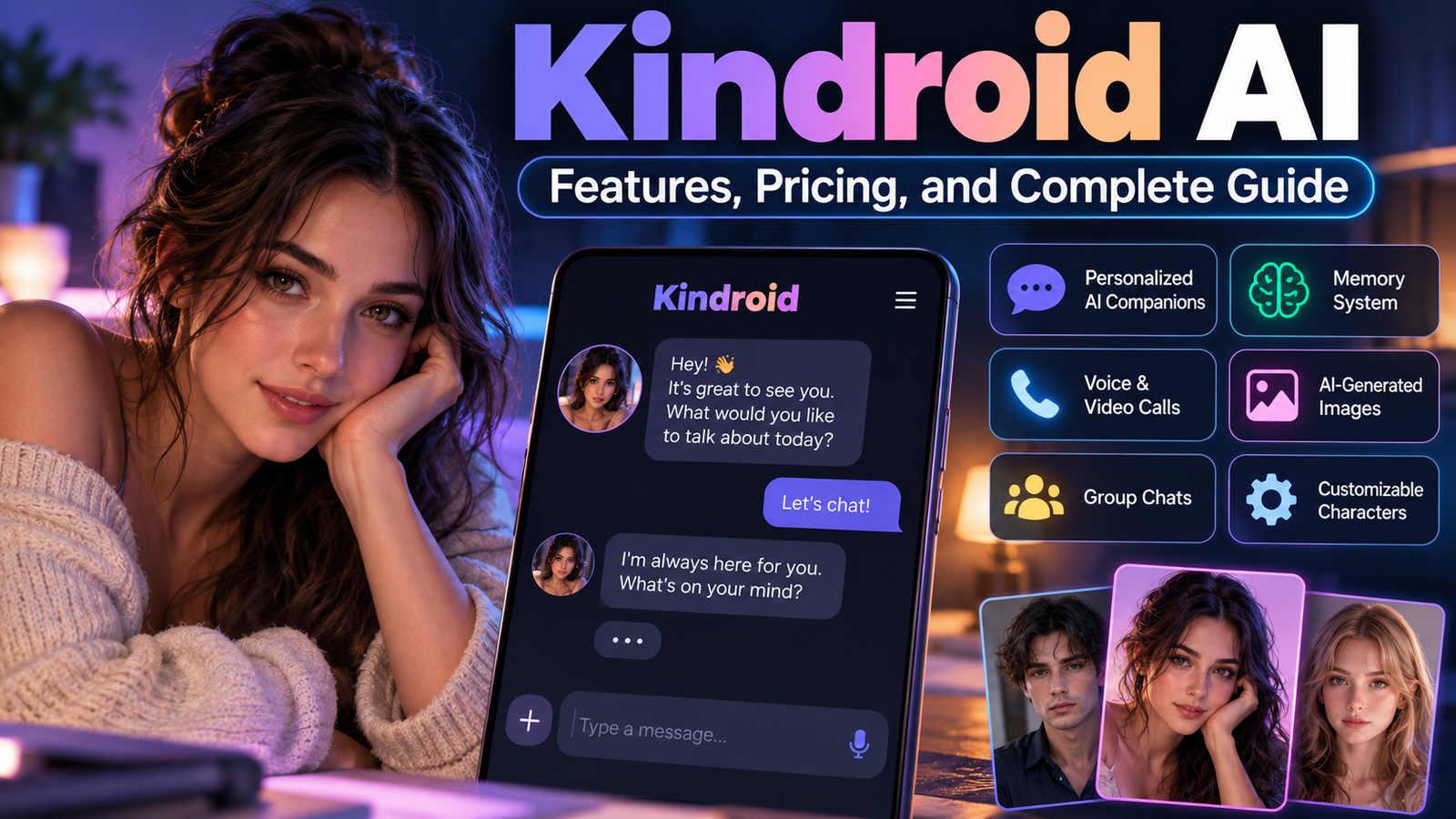
Kindroid AI: Features, Pricing, Privacy, and How It Works

Kindroid is an AI companion platform that lets users create personalized virtual characters and interact with them through text messages, voice conversations, and video calls. Unlike general-purpose AI assistants designed mainly to answer questions or complete tasks, Kindroid focuses on creating ongoing conversations with characters that have individual personalities, backstories, appearances, and memories.
Users can build a companion from scratch, customize how it communicates, generate images, and develop conversations over time. The platform also supports group chats, where multiple AI characters can participate in the same discussion. These features make Kindroid interesting for people who enjoy creative writing, roleplay, language practice, or personalized AI conversations.
However, the experience depends on more than choosing a character and starting a chat. Memory settings, personality instructions, available AI models, subscription limits, and privacy considerations all influence how the platform works.
What Is Kindroid AI?
Kindroid is an AI companion application available through its official website and mobile apps. Its central concept is the creation of a personalized AI character, commonly called a Kin.
Each Kin can have a distinct name, appearance, personality, background, communication style, and voice. Instead of interacting with a completely generic chatbot, users can build a character around a particular interest or conversational purpose.
For example, someone interested in creative writing could create a fictional detective with a detailed background, a particular way of speaking, and a consistent role in an ongoing mystery. Another user might create a language-practice partner who communicates in Spanish and corrects common grammatical mistakes.
Kindroid also supports companion-style conversations, storytelling, roleplay, and everyday discussions.
Its main features include:
- Personalized AI characters: Define a character’s personality, history, interests, and conversational behavior.
- Long-term memory: Give characters the ability to recall selected information and aspects of previous conversations.
- Voice interactions: Communicate through voice messages and supported voice or video calls.
- AI-generated images: Create character avatars, selfies, and supported short video content.
- Group conversations: Bring multiple AI characters into a shared chat.
- Conversation customization: Adjust personality instructions, response style, and supported model settings.
An important distinction is that Kindroid is primarily a companion platform rather than a replacement for every type of AI assistant. It can support useful conversations and creative activities, but users looking for advanced research, verified factual answers, or automated business workflows should evaluate whether a specialized tool would serve them better.
How Does Kindroid Work?
Kindroid uses generative AI to produce responses based on conversation history, character settings, and the information available to its underlying language model.
A large language model, or LLM, generates text by processing the context it receives and predicting an appropriate continuation. This allows an AI character to respond naturally, maintain a particular conversational style, and participate in extended discussions.
However, a language model does not understand a fictional character’s history in the same way a human writer does. Its responses are generated from available context and learned patterns. This distinction helps explain both the strengths and limitations of AI companions.
Creating a Personalized Character
The first step is to create a Kin. Users can select an avatar, provide a name, describe the character’s personality, and establish an initial greeting.
The personality and backstory fields help define how the character should behave.
For example, a user might describe a character as follows:
Alex is a thoughtful science-fiction writer who enjoys discussing astronomy, asks curious questions, and speaks in a friendly but analytical style.
This description establishes a basic conversational identity. The user could then add details about Alex’s fictional history, interests, communication preferences, and relationship to the story being developed.
Kindroid also provides options for generating a character’s personality and greeting, which can help beginners who are unsure how to start.
Customizing Responses
Users can refine their character through settings such as response directives, key memories, and example messages.
A response directive might instruct a character to keep explanations concise, use simple language, or maintain a particular storytelling style.
Example:
Explain scientific ideas in beginner-friendly language, ask relevant follow-up questions, and keep everyday conversations natural.
Specific, positive instructions generally provide clearer guidance than vague descriptions.
Understanding the Underlying AI
The experience is not simply a fixed script. Responses are generated dynamically, so the same character can produce different answers to similar questions.
This flexibility makes conversations more varied, but it also introduces unpredictability. A character might occasionally misunderstand an instruction, contradict an earlier statement, or invent a detail that was never established.
Users should therefore treat Kindroid as an interactive generative AI system rather than a perfectly consistent digital person.
Kindroid’s Memory System Explained
Memory is one of Kindroid’s most important features because it helps distinguish an ongoing AI companion from a chatbot that relies mainly on the immediate conversation.
Kindroid’s memory system includes persistent information, medium-term memory for subscribers, and retrievable long-term memories and journal entries.
Each component serves a different purpose.
Persistent Memory
Persistent information includes the character’s backstory, key memories, instructions, and relevant conversation history.
Think of it as a combination of character notes and conversational context.
For example, a user might specify that their character is a university student who enjoys astronomy and is currently writing a science-fiction novel. Keeping these details in the character’s settings can help the AI maintain continuity across conversations.
Key memories can also preserve important events, preferences, and facts that should remain available.
Cascaded Memory
Kindroid offers a feature called Cascaded Memory to subscribers. It is designed to improve medium-term recall by helping the AI work with information from much earlier in a conversation.
This matters during extended roleplay or creative projects. A character may need to remember an earlier disagreement, a location introduced several scenes ago, or a detail that becomes relevant later.
Without sufficient context, a language model may overlook such information or generate an inconsistent response.
Cascaded Memory is intended to reduce this problem, although it does not guarantee perfect recall.
Long-Term Memory and Journal Entries
Kindroid also uses retrievable long-term memories and journal entries.
Rather than relying exclusively on the latest messages, the system can retrieve relevant information from previous interactions when it becomes useful.
For example, suppose a user discussed a fictional character’s fear of flying several days earlier. That information might become relevant when the story involves an airport.
The system’s ability to retrieve the detail depends on how the memory was recorded and how relevant it appears to the current conversation.
The practical takeaway: Memory improves continuity, but it is not the same as flawless human recollection. Important information should be stated clearly, saved where appropriate, and checked when accuracy matters.
Main Kindroid AI Features
Kindroid combines text-based conversation with visual and audio capabilities. The available features depend on the account, subscription, and applicable settings.
Text Conversations and Roleplay
Text chat is the foundation of the platform.
Users can discuss everyday topics, develop fictional scenarios, explore character relationships, or work through creative ideas. Character instructions help determine the style of the responses.
For example, a fantasy writer could create several characters with different personalities and use their conversations to explore how they might react to a difficult decision.
The generated dialogue can provide inspiration, but the writer remains responsible for reviewing continuity, originality, and story quality.
Voice Messages and Calls
Kindroid supports voice messages and voice calls, with supported video-calling features also available.
Subscribers can access custom voice options, allowing a character’s spoken voice to better match its intended identity.
Voice interactions can make a conversation feel more immediate than text alone. They may also be useful for language practice, informal speaking exercises, or storytelling.
However, voice functionality has practical limits. Calls and certain audio features consume credits, and the quality of speech recognition or spoken responses can vary.
AI-Generated Avatars and Selfies
Users can upload an appropriate image, choose a predefined appearance, or generate an avatar using a text description.
The platform also supports AI-generated selfies, image editing, and short video selfies.
For example, a user creating a science-fiction companion could generate an avatar and request an image showing that character inside a futuristic library.
The quality of the result depends on the prompt, image model, reference material, and selected settings. Facial consistency and small visual details may vary between generations.
These tools are best understood as creative image-generation features rather than guarantees that every image will perfectly match the original avatar.
Group Chats
Group chats allow multiple AI characters to participate in a shared conversation.
This feature can be useful for collaborative storytelling, fictional debates, or exploring how different personalities respond to the same situation.
For instance, a user could create a historian, a detective, and a journalist and ask them to discuss a fictional mystery from their different perspectives.
The result may provide interesting ideas, but the characters can still repeat information, misunderstand one another, or produce inconsistent details.
Additional Interactive Features
Kindroid’s subscriber feature set also includes options such as proactive messages, internet access, link sharing, calendar integration, and community-oriented features.
Availability and behavior can depend on the specific feature and account tier. Users should check the current documentation before relying on a feature for an important task.
Practical Uses of Kindroid AI
Kindroid is most useful when the interaction benefits from a consistent character, conversational style, or fictional context.
Several practical applications stand out.
Creative Writing and Storytelling
Writers can use Kindroid to explore dialogue, test character personalities, or brainstorm alternative story developments.
For example, a writer developing a detective novel could create a character who behaves like a skeptical investigator. The writer could then introduce a fictional clue and explore several possible reactions.
This can help generate ideas, but the output still requires editorial judgment. AI-generated dialogue may become repetitive, and a character can forget details unless they remain available through memory or instructions.
Language Learning and Speaking Practice
A personalized AI character can serve as a conversational partner for practicing a new language.
A learner could create a Spanish-speaking companion and request short conversations about travel, food, shopping, or everyday routines.
Useful instructions might include:
- Use beginner-friendly Spanish.
- Correct major grammatical mistakes politely.
- Explain unfamiliar expressions in English.
- Ask one question at a time.
This creates an adaptable practice environment. However, learners should verify important grammar and cultural information with reliable educational resources because AI responses can contain mistakes.
Companionship and Everyday Conversation
Some users enjoy having a conversational character available for casual discussions, fictional roleplay, or regular check-ins.
Kindroid’s personalization and memory features can make these interactions feel more continuous than starting a new conversation with a generic chatbot each time.
Nevertheless, an AI companion is software that generates responses. Its apparent empathy should not be confused with human feelings, professional counseling, or a reciprocal human relationship.
Brainstorming and Creative Exploration
Users can also discuss fictional worlds, develop character biographies, explore hypothetical situations, and generate ideas for personal projects.
The platform is particularly suited to tasks where creative interaction matters more than producing a single authoritative answer.
For technical, legal, medical, or other high-stakes questions, users should independently verify important claims.
Is Kindroid Free? Pricing and Subscription Options
Kindroid’s access model includes a limited introductory experience and paid subscription plans. The exact benefits and prices can change, so it is important to distinguish current documented policies from older reviews of the platform.
The platform offers a limited free preview, while paid subscriptions provide access to additional features and expanded resources.
The subscription options include the following:
| Plan or Option | Main Purpose |
|---|---|
| Free preview | Lets eligible new users explore the service with limited access. |
| Standard subscription | Provides access to subscriber features, including expanded memory capabilities, voice options, and additional characters. |
| Ultra | Offers expanded capabilities, including higher memory capacity and additional resources. |
| MAX | Provides a higher-capacity option with additional resources for supported features. |
| Optional credits and add-ons | Allow users to purchase certain additional resources or character slots. |
The precise limits, included credits, and feature availability vary by plan.
How Much Does Kindroid Cost?
There is no single price that applies to every user and platform.
Kindroid offers monthly, three-month, and annual subscription options, with longer billing periods generally costing less per month. Ultra and MAX are additional subscription tiers for users who want higher-capacity features.
The exact price for your country and payment platform is displayed at checkout. Purchasing through the website may also cost less than purchasing through a mobile app store.
Before subscribing, check:
- The total amount charged and the billing period.
- Whether the selected option is a trial or a paid subscription.
- The included audio and image-generation resources.
- Whether additional credits may be required.
- The cancellation and renewal terms.
Does Kindroid Offer a Free Trial?
Kindroid has offered a premium trial for eligible new users. Trial availability and terms can vary by platform and region.
A trial may require a payment method and automatically convert to a paid subscription if it is not canceled before the trial period ends.
Before starting a trial, carefully review the current terms, including the duration, renewal date, and cancellation requirements.
Kindroid Privacy and Data Security
Privacy deserves particular attention when using an AI companion because conversations can become personal over time.
Users may share details about relationships, emotional experiences, creative projects, daily routines, or other sensitive subjects. Before doing so, it is important to understand how the platform describes its data protections.
What Does Kindroid Say About Privacy?
Kindroid states that chats and other sensitive application data are encrypted both in storage and during transmission.
Its documentation also describes restricted access to production systems and limitations on who can access users’ conversations.
However, the platform is not end-to-end encrypted.
This distinction matters. End-to-end encryption generally means that only the communicating endpoints can access message contents. Kindroid’s systems must process conversation content to generate AI responses, so encryption does not mean that the service itself is technically unable to process that information.
The platform also describes automated safety systems that review content for policy enforcement. Certain flagged conversations may be reviewed by authorized personnel under the conditions described in its legal documentation.
Is It Safe to Share Personal Information?
Users should exercise caution with any online AI service, including Kindroid.
A sensible approach is to avoid sharing information that is unnecessary for the conversation, such as:
- Passwords and account recovery codes.
- Banking information or payment credentials.
- Government identification numbers.
- Private information about other people.
- Confidential business documents.
- Detailed personal information that could create risks if exposed.
If a character needs background information, provide only the details necessary to achieve the intended result.
For example, a user seeking general advice about workplace communication can describe a situation without including their employer’s confidential information or another person’s full identity.
Users should also review the available privacy controls, including options for managing or deleting their information.
The key point: Encryption and access restrictions are meaningful safeguards, but they do not eliminate every privacy risk. Read the platform’s policies and share information accordingly.
Advantages and Limitations of Kindroid
Kindroid offers a distinctive combination of personalization, memory, and multimodal interaction. However, those strengths should be considered alongside the limitations of generative AI.
Main Advantages
1. Detailed character customization
Users can define a character’s personality, background, appearance, and communication style. This provides more control than a generic chatbot experience.
2. Support for ongoing conversations
Persistent information, long-term memory, and subscriber memory features help maintain continuity across extended interactions.
3. Multiple ways to communicate
Text, voice messages, calls, and supported visual features offer different ways to interact with a character.
4. Creative flexibility
The platform can support roleplay, fictional dialogue, language practice, and brainstorming without requiring users to develop their own AI application.
5. Adjustable conversational behavior
Personality settings, response directives, and example messages help users refine how a character responds.
Important Limitations
1. Memory is imperfect
An AI character can overlook details or recall information incorrectly. Even advanced memory systems cannot guarantee that every previous conversation will be remembered accurately.
2. Responses can contain fabricated information
Language models can generate convincing statements that are incorrect. This is commonly called an AI hallucination.
A character might invent a fictional memory, misstate a real-world fact, or confidently provide an inaccurate explanation.
3. Subscription costs can increase
Users who frequently make voice calls, generate images, or use higher-capacity features should check the relevant credit allowances and additional costs.
4. Generated media can be inconsistent
Avatars, selfies, and video content may contain visual errors or variations in appearance. Results can also depend on prompts and model settings.
5. Emotional boundaries require attention
Companion-style AI can feel personal because it responds to conversational context and maintains a consistent persona. However, its responses do not establish that it experiences emotions or forms human relationships.
6. It is not a substitute for professional expertise
Kindroid can help explore ideas and discuss everyday questions, but it should not be treated as a definitive authority for medical, legal, financial, or other high-stakes decisions.
Overall, Kindroid’s strengths are most apparent when users value personalized interaction and creative flexibility. Its limitations become more important when accuracy, privacy, or dependable recall is essential.
Kindroid vs. Other AI Chatbots
Kindroid is not the only platform offering conversational AI. Several other tools serve overlapping but different purposes.
The most useful comparison is based on the type of interaction a user wants rather than on a claim that one product is universally better.
| Platform | Primary Focus | Best Suited For |
|---|---|---|
| Kindroid | Personalized AI companions, character memory, roleplay, and multimodal interaction | Users who want to build and maintain customized AI characters |
| ChatGPT | General-purpose assistance, reasoning, writing, research support, and supported tool use | Users who need help with a broad range of practical and informational tasks |
| Character.AI | Character-based conversations and interactive roleplay | Users interested in exploring conversations with different fictional or community-created characters |
| Replika | AI companionship and personalized conversational interaction | Users primarily interested in a companion-oriented chatbot experience |
These platforms evolve frequently, and their features, pricing, and policies can change. The table describes their broad purposes rather than promising that a particular feature is currently available on every plan.
Which Platform Should You Choose?
Choose Kindroid if your priority is building a character with a specific personality, appearance, and ongoing conversational history.
Consider ChatGPT if your main objective is completing tasks such as drafting documents, understanding technical subjects, analyzing information, or using supported productivity tools.
Character.AI may suit users who primarily want to explore fictional personalities and character-driven conversations.
Replika is another option worth evaluating if you want a companion-focused experience.
Before deciding, compare the current privacy policies, available features, subscription costs, and restrictions of the services you are considering.
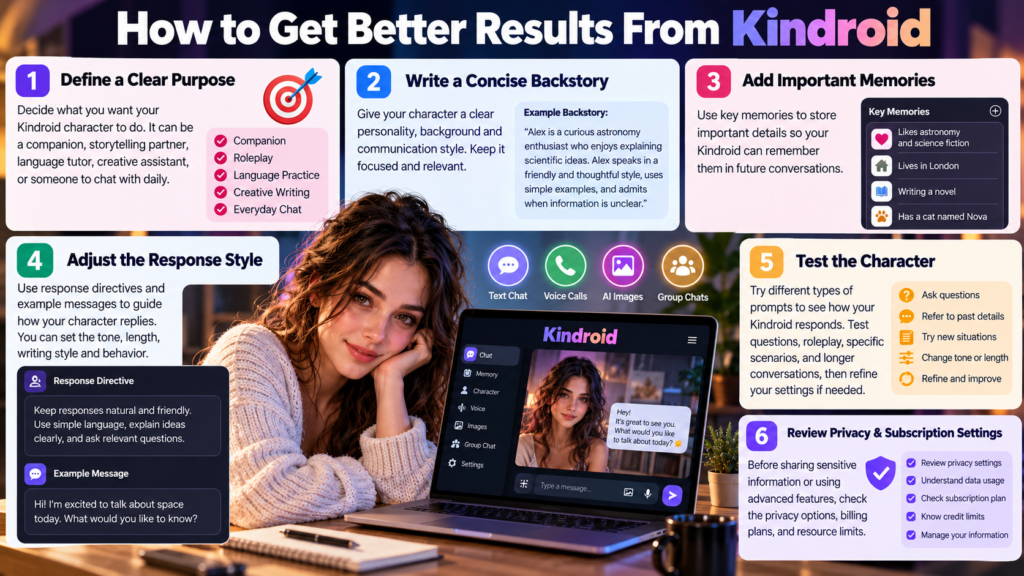
How to Get Better Results From Kindroid
A well-designed character usually depends more on clear instructions than on an unnecessarily long backstory.
The following practices can help beginners build a more consistent experience.
Step 1: Define a Clear Purpose
Decide what you want the character to do.
Is it a fictional companion, a language-practice partner, a storytelling character, or someone to discuss everyday interests with?
A clear purpose makes it easier to choose relevant personality traits and instructions.
Step 2: Write a Concise Backstory
Focus on information that influences the character’s behavior.
For example:
Alex is a curious astronomy enthusiast who enjoys explaining scientific ideas. Alex speaks in a friendly, thoughtful style, uses simple examples, and admits uncertainty when information is unclear.
This gives the model practical guidance without overwhelming it with unnecessary details.
Step 3: Add Important Memories
Use key memories for information that should remain available across conversations.
For a fictional story, this might include character relationships, major events, or the current location of the characters.
For a language-practice companion, it might include the learner’s preferred language level and recurring learning goals.
Avoid assuming that every conversational detail will automatically be stored or recalled.
Step 4: Adjust the Response Style
Use response directives and example messages to demonstrate the type of output you prefer.
If you want concise responses, state that directly. If you prefer detailed fictional narration, explain the desired perspective and writing style.
Change one setting at a time when experimenting. This makes it easier to identify which adjustments improve the conversation.
Step 5: Test the Character in Different Situations
A character description may sound good but produce inconsistent results during actual conversations.
Try several types of prompts:
- Ask a question related to the character’s interests.
- Refer to a detail established earlier.
- Introduce a new situation that tests the character’s personality.
- Request a different response length or tone.
Review the results and refine the instructions where necessary.
Step 6: Review Privacy and Subscription Settings
Before sharing sensitive information or using paid features extensively, check the available privacy controls, billing arrangements, and resource limits.
A little preparation can prevent confusion later.
Frequently Asked Questions About Kindroid
What Is Kindroid Used For?
Kindroid is used to create personalized AI companions for text conversations, roleplay, creative writing, language practice, voice interactions, and other character-based activities.
Is Kindroid Free to Use?
Kindroid offers a limited free preview, while full access requires a subscription. Check the current subscription terms for eligibility, feature limits, and pricing.
Is Kindroid Available on Mobile Devices?
Yes. Kindroid is available through its website and official iOS and Android applications. Feature availability may vary by platform and subscription.
Can Kindroid Remember Previous Conversations?
Yes. Kindroid uses persistent information, long-term memories, and other memory systems to support conversational continuity. Recall is imperfect, so important details may need to be saved or repeated.
Is Kindroid Private?
Kindroid states that its data is encrypted in storage and during transmission. However, the service is not end-to-end encrypted because its systems must process conversations to generate responses. Users should avoid sharing unnecessary sensitive information.
Can Kindroid Make Voice and Video Calls?
Yes. Kindroid supports voice calls and video-calling features, with some options requiring a subscription and available audio credits. Certain advanced visual features have additional resource requirements.
Is Kindroid Better Than ChatGPT?
Neither is automatically better for every purpose. Kindroid focuses on personalized AI companions and character-based conversations, while ChatGPT is a general-purpose assistant designed for a wider range of informational and productivity tasks. The better choice depends on your needs.
Conclusion
Kindroid is a specialized AI companion platform that combines customizable characters, conversational memory, voice interactions, and AI-generated visual content. Its main appeal is the ability to build a character with a defined personality and maintain an ongoing conversation rather than repeatedly starting from scratch.
For creative writers, language learners, and people who enjoy personalized AI conversations, these features can provide a flexible and engaging experience. However, memory is imperfect, generated responses can contain errors, and advanced features may involve subscription costs or additional credits.
Privacy is another important consideration. Kindroid describes several security protections, but its service is not end-to-end encrypted, so users should think carefully before sharing sensitive information.
The best way to evaluate Kindroid is to start with a clear purpose, build a simple character, and test its behavior before investing in advanced features. Compare the available plans and privacy policies as well. Ultimately, Kindroid is most valuable when its personalization and creative capabilities match what you actually want from an AI companion.
[…] Nomi.ai Review: Features, Pricing, and Privacy Kindroid AI: Features, Pricing, Privacy, and How It Works Lightshade AI: Features, Privacy, Pricing, and Alternatives JanitorAI: Features, How It […]