

Gatik: How AI-Powered Driverless Trucks Are Changing Freight

Gatik is an autonomous trucking company that uses artificial intelligence (AI) to transport goods between distribution centers, warehouses, and retail stores. Instead of focusing primarily on long-distance trucking, the company specializes in middle-mile logistics, the part of the supply chain that moves products from larger facilities to regional distribution points and stores.
Founded in 2017, Gatik has developed self-driving trucks designed for commercial freight operations. Its technology combines vehicle sensors, onboard computing, and autonomous driving software to help trucks navigate roads and carry out deliveries with limited or no human involvement, depending on the operation.
Gatik has moved beyond experimental demonstrations into commercial deployments. In January 2026, the company announced that it was operating fully driverless trucks for commercial deliveries at scale in the United States. Partnerships with major retailers and food companies have also helped bring autonomous freight into everyday supply chain operations.
This article explains how Gatik works, the AI technology behind its trucks, its major partnerships, the benefits and limitations of autonomous freight, and what businesses should know about this developing technology.
What Is Gatik?
Gatik is a North American autonomous vehicle company focused on middle-mile freight transportation. Its goal is to help businesses move products between logistics facilities and retail locations using self-driving commercial trucks.
Traditional delivery networks often depend on drivers moving goods between warehouses, distribution centers, and stores. These routes may repeat daily, making them suitable for automation when the roads, operating conditions, and delivery requirements are well understood.
Gatik focuses on this specific part of logistics rather than trying to automate every type of road transportation. Its trucks are designed to work within commercial supply chains, where predictable schedules, repeated deliveries, and efficient vehicle utilization are important.
The company’s approach has attracted interest from large retailers and food producers. Walmart, Kroger, Tyson Foods, Loblaw, and PepsiCo have been associated with Gatik’s commercial activities or partnerships, although the scope and status of individual deployments vary.
Gatik’s business is particularly relevant to companies that need to move large quantities of goods reliably between facilities. Its technology is intended to become part of an existing transportation network rather than replace the entire logistics system.
How Does Gatik’s AI Technology Work?
A driverless truck needs to do much more than follow a route on a map. It must understand its surroundings, predict what other road users might do, select safe driving actions, and respond when conditions change.
Gatik’s autonomous driving system is designed to handle these tasks through a combination of sensing hardware, onboard computing, and driving software.
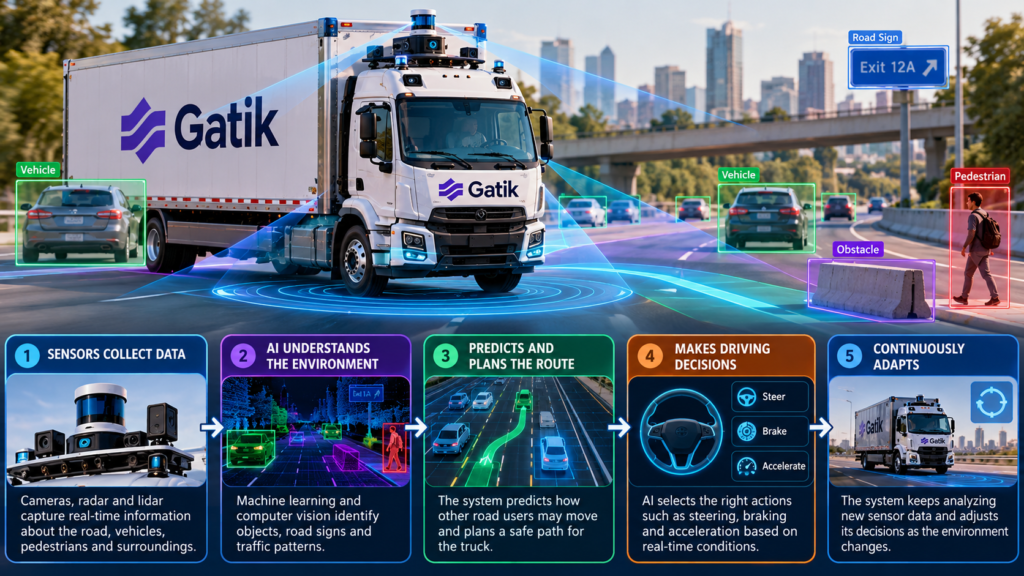
1. Sensors collect information about the road
Autonomous vehicles use sensors to gather information about nearby vehicles, road boundaries, pedestrians, obstacles, and other relevant objects. Depending on the vehicle’s configuration, these systems can include cameras, radar, and lidar.
Each sensor provides a different view of the environment. Cameras capture visual details, radar helps measure the movement and distance of objects, and lidar can provide three-dimensional information about surrounding structures.
The system combines available sensor information to build a representation of the truck’s surroundings. This process is important because no single sensor can reliably capture every detail under all conditions.
2. AI interprets the driving environment
Machine learning and computer vision help autonomous vehicles identify objects and understand road scenes. The software must distinguish between a moving car, a stationary obstacle, a pedestrian, and other elements that may affect the truck’s next action.
For example, when a vehicle ahead slows down, the autonomous system must recognize the change, estimate the potential risk, and determine whether braking or adjusting speed is appropriate.
This is different from a basic navigation application. Navigation provides a route, while autonomous driving software must continually make decisions based on what is happening around the vehicle.
3. The system plans and executes driving actions
After interpreting the environment, the software plans a safe path and calculates suitable driving actions, including steering, acceleration, and braking.
The system must also account for road geometry, traffic behavior, speed limits, and other relevant constraints. These calculations happen repeatedly as new sensor information becomes available.
The overall process can be summarized as:
- Perception: Identify road users, obstacles, and road features.
- Localization: Estimate the truck’s position.
- Prediction: Estimate how nearby road users may move.
- Planning: Select an appropriate route and driving action.
- Control: Execute steering, braking, and acceleration commands.
These are standard building blocks of autonomous driving systems. The precise implementation, models, and internal architecture used by Gatik are proprietary and should not be assumed without specific technical documentation.
What Makes Gatik Different From Other Self-Driving Companies?
Gatik’s main distinction is its focus on commercial middle-mile transportation.
Many autonomous vehicle companies pursue robotaxis, personal vehicles, delivery robots, or long-haul trucking. Gatik concentrates on moving freight between business locations, where routes and operational requirements can be planned around the needs of retailers and suppliers.
This narrower focus has practical advantages. Businesses can identify recurring transportation needs, schedule deliveries, coordinate loading and unloading, and evaluate performance over repeated trips.
For example, a food supplier might need to move packaged products from a distribution center to several retail facilities every day. A suitable autonomous freight network could handle those trips while the supplier’s employees continue managing inventory, loading, unloading, and store operations.
Gatik also uses medium-duty commercial trucks for its freight operations. These vehicles are designed for regional transportation rather than the same use cases as passenger cars or every type of heavy-duty tractor-trailer.
Its strategy does not eliminate the challenges of autonomous driving. Instead, it concentrates engineering and operational resources on a specific market where automation may offer measurable business value.
Gatik’s Major Partnerships and Business Developments
Commercial partnerships provide a useful way to understand how autonomous freight is moving from testing into practical use.
PepsiCo
On June 8, 2026, PepsiCo and Gatik announced a multiyear strategic agreement to deploy autonomous freight across PepsiCo’s North American supply chain. The companies said Gatik was already operating for PepsiCo in Texas, Arizona, and Arkansas.
The partnership focuses on using autonomous trucks to improve transportation capacity, delivery consistency, and flexibility within a large food and beverage distribution network. PepsiCo also described the arrangement as part of its broader effort to strengthen its supply chain.
This is an important example because food and beverage logistics involve frequent deliveries, changing demand, and coordination between distribution facilities and retail locations.
Walmart and other retail customers
Walmart was Gatik’s first disclosed customer, and the company has also been associated with Kroger and Tyson Foods. These relationships illustrate the potential value of autonomous vehicles in retail and food supply chains.
However, a company being identified as a customer does not necessarily mean that every location or delivery route uses driverless vehicles. Deployment details can change, and individual agreements may cover different operating arrangements.
Loblaw in Canada
Gatik has also worked with Canadian retailer Loblaw. In September 2025, the companies announced a five-year expansion agreement involving a planned deployment of 50 autonomous trucks across the Greater Toronto Area.
This agreement demonstrates that the commercial opportunity extends beyond the United States. Canadian deployments also require attention to local road conditions, transportation rules, operational requirements, and safety procedures.
Funding and commercial growth
In August 2026, Gatik announced a $200 million Series D funding round led by the Qatar Investment Authority and Koch Disruptive Technologies, with other investors participating.
The funding is intended to support the company’s growth and expansion of its autonomous freight operations. Investment of this size indicates substantial financial backing, but it does not by itself prove that the technology will be profitable in every market or operating environment.
The key question for the industry is whether companies can expand their fleets while maintaining safety, reliable delivery performance, and competitive costs.
What Are the Main Benefits of Gatik’s Driverless Trucks?
Autonomous freight could improve several parts of commercial logistics, although the results depend on how the technology performs in real operations.
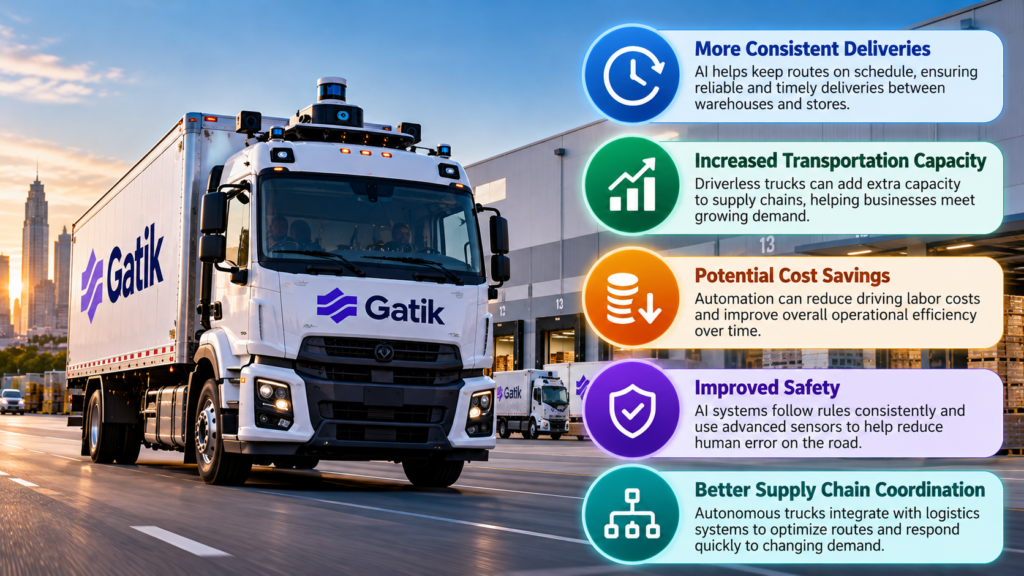
More consistent delivery operations
Businesses that move goods on recurring routes may benefit from more predictable transportation schedules. Autonomous systems can potentially operate for extended periods, subject to maintenance, charging or refueling, loading, legal requirements, and operational constraints.
More consistent transport can help warehouses and stores coordinate inventory and receiving schedules.
Additional transportation capacity
Retailers and manufacturers frequently need dependable capacity to move goods between facilities. Driverless trucks could provide another option when conventional transportation capacity is difficult to secure.
This does not mean that every driver shortage can be solved by automation. The economics depend on route suitability, fleet availability, operating costs, and the amount of human support still required.
Potential long-term cost savings
Autonomous freight may reduce some direct driving labor costs in operations that can safely run without an onboard driver. However, companies must also account for vehicle technology, maintenance, insurance, remote support, fleet supervision, software, and regulatory compliance.
A meaningful comparison should consider the total cost per completed delivery, not simply the cost of employing a driver.
Better coordination across supply chains
When autonomous trucks are integrated with logistics software, dispatchers can coordinate vehicle movements with warehouse schedules and changing demand.
For example, a distributor might adjust a delivery plan when a store needs additional stock. Gatik’s announced PepsiCo partnership specifically highlights dynamic route orchestration, allowing plans to respond to operational requirements.
The potential benefit is not automation alone. It is the ability to coordinate transportation more effectively across an entire network.
What Are the Limitations and Risks of Gatik?
Driverless freight is promising, but it still faces technical, commercial, and regulatory challenges.
Safety in complex environments: Trucks must respond appropriately to unexpected roadworks, emergency vehicles, unusual driver behavior, debris, and other unpredictable events. Performance on a familiar route does not automatically establish equal reliability on every road.
Weather and visibility: Heavy rain, snow, fog, glare, and obscured road markings can affect perception and vehicle behavior. Capabilities vary by system, vehicle generation, and operating conditions.
Regulatory compliance: Autonomous commercial vehicles must meet applicable federal, state, provincial, and local requirements. Permission to operate in one jurisdiction does not guarantee permission to operate everywhere.
Infrastructure and operating costs: Fleets need maintenance facilities, suitable loading locations, reliable communications where required, and processes for responding to incidents or vehicle faults.
Cybersecurity and software reliability: Autonomous vehicles depend on complex software and electronic systems. Companies must manage software updates, access controls, system faults, and potential cyber threats.
Workforce changes: Automation may change the demand for certain driving roles while creating or expanding work in fleet operations, vehicle maintenance, logistics planning, and technical support. The overall effect depends on the scale and pace of deployment.
These issues are not unique to Gatik. They affect the wider autonomous trucking industry and help explain why commercial expansion requires more than a successful technology demonstration.
Frequently Asked Questions About Gatik
1. What is Gatik used for?
Gatik uses autonomous trucks to transport commercial goods between distribution centers, warehouses, and retail stores.
2. Is Gatik a real company?
Yes. Gatik is a commercial autonomous trucking company headquartered in North America, with driverless freight operations in the United States and Canada.
3. Does Gatik use artificial intelligence?
Yes. Its autonomous driving system combines AI software and specialized vehicle hardware to interpret road conditions and control truck movements.
4. Are Gatik trucks fully driverless?
Yes, in its designated driverless commercial operations. Gatik announced in January 2026 that it was conducting commercial deliveries without an onboard driver or safety observer. This does not mean every vehicle or deployment operates under identical conditions.
5. Who are Gatik’s customers?
Gatik has worked with major companies, including Walmart, Kroger, Tyson Foods, Loblaw, and PepsiCo. Specific agreements and deployment arrangements vary.
6. How does Gatik Arena work?
Gatik Arena simulates driving environments to help engineers train and validate autonomous vehicle systems, including scenarios that are difficult to reproduce safely on public roads.
7. Can individuals buy a Gatik truck?
Gatik primarily serves commercial freight customers. It is not marketed as a consumer self-driving vehicle for personal purchase.
Conclusion: What Gatik Means for the Future of AI
Gatik shows how artificial intelligence can move beyond digital applications and become part of physical business operations. Its driverless trucks are designed to address a specific logistics challenge: moving goods reliably between distribution centers, warehouses, and stores.
The company’s commercial deployments, partnership with PepsiCo, and work on simulation technology demonstrate that autonomous freight is progressing beyond small-scale experiments. However, long-term success will depend on more than AI performance. Safety, regulatory approval, operating costs, customer demand, and reliable fleet management will all influence adoption.
For businesses, Gatik is worth examining when recurring regional deliveries create opportunities for automation. For technology readers, it is a practical example of physical AI, where software must interact with real-world conditions and consequences.
The broader lesson is that successful automation often begins with a clearly defined problem. Gatik’s future will depend on how effectively it expands that focused approach while maintaining dependable service and measurable commercial value.
[…] DreamJourney AI: Features, Uses, Pricing, and Limitations Gatik: How AI-Powered Driverless Trucks Are Changing Freight Gemini 2.5: Features, Models, Uses, and Limitations Kalon AI: A Guide to AI Companions, […]