

SwitchROMs: A Safe Guide to Nintendo Switch ROMs

SwitchROMs is a search term commonly used for Nintendo Switch game ROM files and websites that organize information about them. A ROM is a digital copy of game data that can be used with compatible software. Nintendo Switch-related ROMs are commonly discussed in formats such as NSP and XCI. NSP is generally associated with digital game packages, while XCI represents cartridge-based game images. These formats are often mentioned in discussions about emulation, preservation, compatibility, updates, and game backups. However, the file itself does not automatically become legal simply because it is called a ROM. Copyright rules still apply to commercial games.
The term SwitchROMs can also refer to third-party websites that list Nintendo Switch games, versions, file formats, updates, DLC, and emulator information. These websites are generally independent from Nintendo and should not be confused with official Nintendo services. This distinction matters because downloading copyrighted game files from unauthorized sources can create legal risks. It is therefore better to understand what ROM files are before downloading anything. Readers should also check local copyright rules and use legally obtained game data whenever possible. Understanding the technology can help users make safer and more informed decisions.
How SwitchROMs Usually Work
A Nintendo Switch ROM contains digital game data that an emulator or compatible environment may attempt to read. An emulator is software designed to reproduce aspects of another gaming system so compatible software can run on different hardware. This makes emulation technically interesting because the computer or mobile device must reproduce functions normally handled by the original console. Performance can vary considerably between games and devices. Some titles may work well, while others can experience graphical problems, crashes, audio issues, or poor performance. Therefore, having a compatible file does not guarantee a smooth gaming experience on every device.
SwitchROMs are commonly discussed alongside Nintendo Switch emulators and other community projects. However, emulator availability and development can change over time, so older guides may quickly become outdated. Compatibility also depends on hardware, operating system, emulator version, firmware requirements, drivers, and game updates. A useful approach is to check current documentation before changing system settings or downloading additional components. Avoid guides that promise perfect performance for every game. Real-world emulation is more complicated, and performance often differs even between two computers with similar specifications.
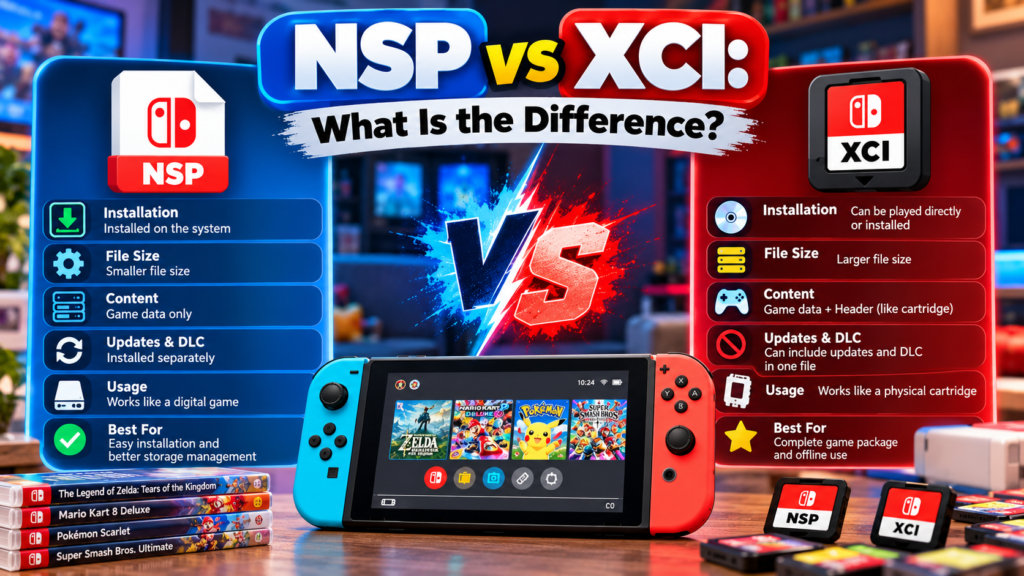
NSP vs XCI: What Is the Difference?
These are two file formats frequently associated with Nintendo Switch game data. NSP stands for Nintendo Submission Package and is commonly connected with digital distribution packages. XCI is generally used for cartridge image files. From a technical perspective, the two formats represent game data differently, and compatibility can depend on the software being used. Beginners may see both formats listed on ROM-related websites and assume that one is always better. That is not necessarily true. The appropriate format depends on the legitimate source, intended use, software compatibility, and the particular game or package involved.
| Format | Common Meaning | Typical Association |
|---|---|---|
| NSP | Nintendo Submission Package | Digital game packages |
| XCI | Cartridge image | Physical cartridge data |
| Update | Game update package | Newer game versions |
| DLC | Additional content | Extra game content |
SwitchROMs websites often display these formats beside game names, versions, sizes, updates, and DLC information. That information can help users understand the technical structure of Switch software, but it should not be interpreted as permission to download copyrighted material. A file format is simply a technical container. It does not determine ownership or copyright status. Users should always distinguish between understanding how these formats work and obtaining commercial game files from unauthorized sources.
Are SwitchROMs Legal to Download?
The legality of SwitchROMs depends heavily on what the file contains, where it came from, and the laws that apply in the user’s country. Commercial Nintendo Switch games are copyrighted works, so downloading an unauthorized copy can raise copyright concerns. Owning the original game does not automatically mean that every downloaded copy from the internet is legally permitted. Rules surrounding personal backups, copying, circumvention, and distribution differ between jurisdictions. Because of these differences, a general statement such as “all ROM downloads are legal if you own the game” can be misleading. Users should check applicable local laws before downloading or sharing copyrighted game files.
The important distinction is between emulation technology and copyrighted game content. Emulator software itself can be lawful, while the unauthorized ROM files used with it may create separate copyright issues. This distinction is important for beginners who may believe that using an emulator automatically makes every game file legal. It does not. A safer approach is to use legitimately obtained software and follow the rules applicable to personal backups and emulation in your region. Readers can also explore related topics such as Nintendo Switch emulation basics and game preservation to better understand the subject.
Is SwitchROMs Safe to Use?
Safety is another major concern when searching for SwitchROMs online. A ROM website may look professional while still redirecting visitors through advertising networks, pop-ups, file hosts, or unfamiliar download pages. Security scanners can sometimes find no malware during a particular scan, but that does not guarantee that every file or future download will remain safe. Some third-party domains associated with Switch ROM searches may also have poor security reputations. This means users should avoid assuming that a clean-looking interface is proof that a website or file is trustworthy.
A sensible safety checklist can reduce unnecessary risks:
- Avoid entering passwords or payment details on unfamiliar ROM websites.
- Do not install unknown browser extensions or executable downloaders.
- Be cautious when a download requires several suspicious redirects.
- Scan unfamiliar files with reputable security software.
- Keep your operating system and browser updated.
- Avoid disabling security protections simply to download a file.
- Never trust claims that guarantee every file is completely safe.
These precautions are useful beyond SwitchROMs because unofficial download websites can change domains, advertisements, file hosts, and download methods without warning. A website that appears safe today may have different content later. Therefore, users should focus on verified software sources, legitimate game ownership, and basic cybersecurity practices rather than relying only on website appearance or user comments.
SwitchROMs and Emulation in 2026
The Switch emulation landscape continues to change, making older SwitchROMs guides less reliable than they may appear. Emulator projects can be updated, discontinued, renamed, or replaced by newer community projects. Compatibility also changes as developers improve graphics handling, controller support, system compatibility, and performance. ROM-related websites may advertise emulator resources alongside game catalogs, but their claims should be treated carefully. A site listing an emulator does not necessarily represent that project’s developers. Always verify software information through legitimate documentation before installing anything.
A simple way to understand the current landscape is to separate three different areas:
Game data → Emulator software → Device hardware
The game data provides the content, the emulator attempts to reproduce console behavior, and the device supplies the processing power. Problems in any one area can affect the final result. A powerful computer cannot guarantee perfect compatibility if an emulator has a software limitation. Likewise, an updated emulator cannot overcome every hardware limitation. This is why SwitchROMs discussions often include firmware, updates, compatibility, and performance.
Latest SwitchROMs Trends and Updates
As of October 2026, websites using SwitchROM-related names continue to promote Nintendo Switch catalogs, including older games, newer releases, updates, DLC, and genre collections. Some catalogs display categories ranging from action and adventure to RPG, racing, sports, strategy, simulation, and survival. They may also show version information and file sizes for individual entries. This shows that the search term has expanded beyond simple ROM downloads. Many users now search for compatibility information, game versions, emulator resources, updates, and technical explanations as well.
The following chart summarizes the main areas users commonly encounter when researching SwitchROMs:
| Search Area | What Users Usually Look For | Main Concern |
|---|---|---|
| Game files | NSP or XCI information | Copyright |
| Emulation | Emulator compatibility | Performance |
| Updates | Version information | Correct compatibility |
| DLC | Additional content | Ownership rights |
| Safety | File and website checks | Malware |
| Preservation | Legal game backups | Local law |
| Guides | Setup information | Outdated instructions |
Current search results can show that similarly named domains may have very different reputations. Therefore, the name “SwitchROMs” alone is not enough to establish that a particular website is safe or legitimate. Users should evaluate the exact domain, software source, download behavior, and legal status independently.
How to Research SwitchROMs Responsibly
If you are researching SwitchROMs for educational or technical reasons, start by identifying exactly what you need. You may be interested in file formats, emulator compatibility, preservation, game updates, or the history of Switch emulation. These are different subjects and require different information. Avoid downloading files simply because a website promises free access. Instead, research the technical terminology first and verify information using reputable documentation. This approach is especially helpful for beginners because many websites mix legitimate technical information with questionable download offers.
For example, someone researching emulation might first learn what an emulator does, then understand NSP and XCI terminology, and finally investigate hardware requirements. Someone interested in preservation may instead research legitimate backup options and applicable copyright rules. This step-by-step approach makes SwitchROMs easier to understand without treating every download website as trustworthy. It also helps users identify misleading claims, fake emulator downloads, suspicious advertisements, and outdated compatibility advice. Related content such as Nintendo Switch game guides, emulator compatibility explanations, and gaming preservation tips can naturally support this topic.
Common Mistakes to Avoid
One common mistake is assuming that every website appearing for the SwitchROMs keyword is connected to Nintendo. Similar names can create confusion, but third-party ROM websites are generally independent platforms. Another mistake is assuming that a ROM is safe simply because antivirus software does not detect anything immediately. Security tools are helpful, but no single scan can guarantee future safety. Users should also avoid downloading unknown executable programs advertised as “special emulators,” “game boosters,” or “unlock tools.” These files can create risks unrelated to normal emulation.
Another mistake is following old setup guides without checking their publication date. Nintendo Switch emulation changes quickly, and emulator projects can change direction or stop development. A guide written several years ago may recommend software, settings, or terminology that is no longer relevant. Current information can also change as ROM websites add newer games and updates. Therefore, SwitchROMs research should always include date awareness. Check recent documentation, verify software sources, and avoid instructions that ask you to weaken device security simply to make a download work.
Frequently Asked Questions About SwitchROMs
What does SwitchROMs mean?
SwitchROMs usually refers to Nintendo Switch ROM files, ROM collections, or websites discussing Switch game files. The term is commonly associated with NSP and XCI formats, emulation, game updates, DLC, and compatibility information. However, the term itself does not establish whether a particular file or website is legal, safe, or officially connected to Nintendo.
What are NSP and XCI files?
NSP and XCI are two formats commonly associated with Nintendo Switch game data. NSP is generally linked with digital distribution packages, while XCI is associated with cartridge images. Their technical purpose differs, but neither format automatically gives someone permission to download or distribute copyrighted games.
Are SwitchROMs websites official Nintendo websites?
Generally, websites using SwitchROM-related names are independent third-party platforms rather than official Nintendo services. Users should verify the exact website and avoid assuming that a ROM catalog has Nintendo’s authorization.
Can Switch ROMs contain malware?
A ROM-related website or download can potentially expose users to security risks, especially through advertisements, redirects, third-party hosts, or unknown installers. Users should avoid unfamiliar executable files, scan downloads, and never disable security protections simply to access a game file.
Is emulation the same as piracy?
No. Emulation and piracy are separate concepts. Emulation describes software that reproduces another platform’s behavior, while piracy generally involves unauthorized copying or distribution of copyrighted material. An emulator can have legitimate uses, while obtaining copyrighted game files from unauthorized sources can raise separate legal concerns.
Final Thoughts on SwitchROMs
SwitchROMs is a broad search term covering Nintendo Switch ROM formats, emulation, game versions, updates, DLC, compatibility, and third-party ROM websites. The subject can be useful for understanding game preservation and emulation technology, but it also involves important safety and copyright considerations. NSP and XCI are simply technical formats, while legality depends on how copyrighted game data is obtained and used. Current information also changes quickly because emulator projects, websites, game versions, and security assessments can change over time. For the safest experience, research carefully, use legitimate software and game sources, protect your device, and check the laws that apply where you live before using ROM files.
[…] ThotChat AI: What Happened and What to Know SwitchROMs: A Safe Guide to Nintendo Switch ROMs Wan2.2 Animate: Complete Guide to AI Video Animation Dippy AI: Everything You Need to Know […]