

Solvely AI: Features, Uses, Accuracy & Limitations

Solvely AI is an AI-powered learning platform designed to help students solve homework problems, understand difficult topics, organize course materials, and prepare for exams. What makes it different from a basic AI question-answering tool is its broader study workflow. Along with step-by-step homework solutions, Solvely offers study guides, flashcards, quizzes, lecture transcription, exam-preparation tools, and other educational utilities.
The platform is available through the web, mobile apps, and browser extensions. Solvely currently says its tools are used by more than 10 million students and that more than 200 million problems have been solved on the platform. Those figures are company-reported rather than independently audited, so they are best understood as Solvely’s own usage claims.
For students, the bigger question is not simply whether Solvely can produce an answer. It is whether the explanation is useful, whether the answer should be trusted, how the tool fits into studying, and what happens to the information uploaded to it. This guide examines those points in practical terms.
What Is Solvely AI?
Solvely AI is an educational AI platform from Aignite Inc. It combines an AI homework solver with a wider collection of study and exam-preparation tools.
At its simplest, a student can enter a question, upload an image or document, or capture a problem through the browser extension. The system then analyzes the material and produces an answer or explanation. Solvely supports subjects beyond mathematics, including areas such as physics, chemistry, statistics, economics, biology, and other academic subjects.
However, describing Solvely as only an AI math solver misses much of the current product. Its website now presents it as an all-in-one AI study platform with tools for homework, class materials, exam preparation, writing, quizzes, flashcards, and note-taking.
That broader approach is important. A student may begin with one algebra problem but later use the same platform to turn lecture notes into flashcards or create a practice quiz from a PDF.
How Does Solvely AI Work?
The exact underlying model architecture used for every Solvely feature is not fully disclosed publicly, so it would be misleading to describe the platform as if it were simply one specific large language model.
Instead, Solvely appears to function as an application layer that combines AI models and specialized processing for different educational tasks. For homework, for example, a submitted image or typed question has to be interpreted before an appropriate solution can be generated.
Its current website specifically highlights a multi-model cross-check approach for homework. Solvely says it can compare results from multiple top AI models and use that process to improve solution reliability, particularly for difficult questions.
A simplified version of the workflow looks like this:
- Input: The student types, uploads, or captures a question.
- Recognition: The system interprets text, mathematical notation, images, or other material.
- Reasoning: AI generates a solution or explanation.
- Cross-checking: For supported homework workflows, Solvely says multiple AI models can be used to check the result.
- Presentation: The student receives a step-by-step explanation or study material.
- Follow-up learning: The answer can become part of a broader study workflow, such as quizzes, notes, or review.
This is different from traditional software such as a calculator. A calculator normally follows explicit mathematical rules. Generative AI systems can interpret natural language and unfamiliar problem descriptions, but they can also make reasoning mistakes. That distinction matters when evaluating any AI homework tool.
Main Solvely AI Features
Solvely’s current feature set is considerably wider than a traditional equation solver.
Step-by-Step Homework Solver
The homework solver is the core use case. Students can submit problems and receive explanations rather than only a final numerical answer.
For example, instead of simply returning x = 12 for an equation, an AI tutor can show the operations used to isolate the variable. This can make the tool more useful for learning, provided the student actually follows the reasoning.
Solvely also supports image-based questions, which is useful when a problem is printed in a textbook or worksheet. Its browser extension adds another way to capture questions without manually copying them between websites.
AI Study Guides and Notes
Students can upload course materials such as PDFs, slides, and other learning content. Solvely can turn these materials into organized notes and study resources.
Its PDF-to-notes tool currently allows users to upload multiple PDFs and says it uses the first 50 pages of each file for focused note generation.
This can be helpful when a student has a long lecture document but needs a structured review before an exam.
Flashcards and Quizzes
Another useful feature is converting existing study material into practice content.
Solvely’s quiz generator can create questions from sources including PDFs, notes, images, slides, audio, and other supported materials. The platform describes question-based, note-based, and objective-based quiz generation modes.
This is educationally more useful than simply asking AI to summarize a chapter because quizzes require the learner to retrieve information.
Exam Preparation
Solvely also promotes exam-focused tools such as mock exams, exam-topic prediction, readiness assessment, review plans, and AI-generated cheat sheets.
The important distinction is that these features should be treated as study aids, not as guaranteed predictions of what a teacher will put on an exam. AI can identify patterns in supplied materials, but it cannot reliably know an instructor’s future questions unless that information has been explicitly provided.
Lecture Transcription and AI Notes
Solvely says students can record lectures and turn them into searchable transcripts and AI-generated notes. It also describes converting lectures into study sets such as flashcards and quizzes.
This can reduce the amount of manual note-taking required, although students should still review AI-generated transcripts because speech recognition and summarization can misinterpret technical terms, names, formulas, or context.
Chrome Extension
Solvely’s Chrome extension is designed to make homework help available directly inside a browser.
The extension currently supports screenshot-based solving and describes a “One-Click Solve” function for solving multiple problems visible on a page. It is listed in the Chrome Web Store under Aignite Inc. and was updated on September 6, 2026, according to the current store listing.
Solvely’s own extension page also says it works with platforms such as Canvas, Blackboard, Moodle, and Google Classroom.
Who Is Solvely AI Best For?
Solvely is primarily aimed at students who want one platform for several parts of the learning process.
It may be particularly useful for:
- Students working through difficult homework: Step-by-step explanations can help identify where a calculation or reasoning process went wrong.
- Students preparing for exams: Notes, quizzes, flashcards, mock exams, and review tools can turn existing material into practice resources.
- Students studying STEM subjects: Image-based problem solving is particularly relevant to mathematics, physics, chemistry, and related subjects.
- Students with large amounts of course material: AI-generated summaries and study guides can make long documents easier to review.
- Students studying independently: An AI tutor can provide immediate assistance when a teacher or tutor is not available.
It is less suitable as a replacement for actually learning the underlying material. Getting an answer quickly is not the same as being able to reproduce the method independently during an exam.
A Practical Example of Using Solvely AI
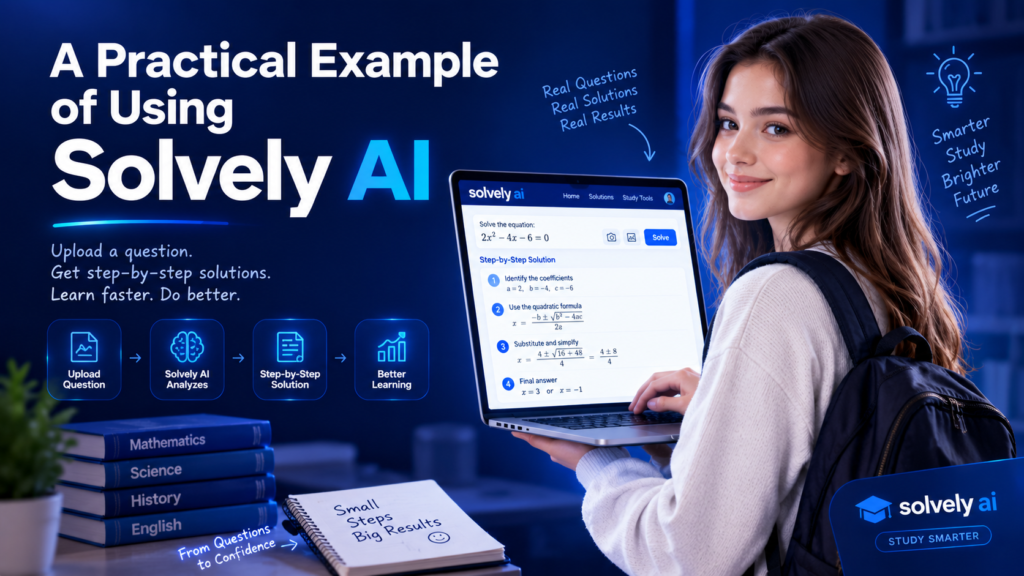
Imagine a student is preparing for a calculus exam and has three lecture PDFs, several practice problems, and a review sheet.
Instead of using AI only to answer individual questions, the student could use a broader workflow:
First, upload the course materials and create organized notes.
Next, use the material to generate flashcards covering definitions, formulas, and important concepts.
Then, create a practice quiz and attempt the questions without looking at the answers.
After that, use the homework solver on problems that caused difficulty and study the reasoning behind the solution.
Finally, repeat the weak topics rather than simply rereading the entire course.
This is a better use of AI than treating it as an answer machine. The goal is to use automation for repetitive preparation while keeping the actual learning process active.
Advantages of Solvely AI
Solvely’s biggest advantage is the breadth of its educational toolkit.
One platform for multiple study tasks
Students do not necessarily have to move between separate tools for solving problems, creating flashcards, making quizzes, and summarizing course materials.
Visual problem solving
The ability to work from screenshots and images can be more convenient than typing complex equations manually. This is particularly useful for handwritten or diagram-based homework, although image recognition is not guaranteed to be perfect.
Step-by-step explanations
A detailed solution can be considerably more useful than a final answer when the objective is learning.
Multiple study formats
Turning the same source material into notes, flashcards, quizzes, and mock exams can support different stages of revision.
Broad device support
Solvely currently advertises access through the web, iOS, Android, and browser extensions.
Limitations and Risks
Solvely AI should not be treated as an infallible tutor.
AI can still make mistakes
Even when an AI system provides a confident explanation, the result can be incorrect. Cross-checking with multiple models may reduce some errors, but it does not make the output mathematically or academically guaranteed.
Solvely itself recommends verifying answers with a textbook or teacher for formal assignments.
For important calculations, compare the result with your textbook, course notes, calculator, or another reliable source.
OCR and image interpretation can fail
A photographed question may contain handwriting, unusual symbols, diagrams, fractions, or poor lighting. If the system reads the original question incorrectly, even a logically consistent solution can produce the wrong answer.
A useful habit is to check that the AI correctly understood the question before trusting its solution.
AI-generated notes can omit context
Summarization is inherently selective. A concise set of notes may leave out a qualification, exception, definition, or example that your instructor considers important.
For exam preparation, the original course material should remain the authoritative source.
Academic integrity matters
The fact that an AI tool can solve an assignment does not mean a student is allowed to submit the generated answer as their own work.
School and university policies vary. Some instructors permit AI for tutoring but prohibit it for graded assignments. Others may require students to disclose AI use.
The safest approach is to understand the rules for each course and use Solvely primarily to learn, practice, and check your work when permitted.
Solvely AI and Privacy: What Should Users Know?
Privacy deserves particular attention because students may upload homework, lecture recordings, personal information, and other educational material.
Solvely’s privacy policy, updated January 14, 2026, says the service may collect information including account data, educational information, user-generated content, questions, photos, videos, audio recordings, and interactions with its services. It also describes the use of data for providing services, analytics, product improvement, and other stated purposes.
The policy also says user inputs may be used to train, fine-tune, or improve AI models where permitted by applicable law and consent requirements. It further states that recorded lecture audio and transcripts are retained until the user deletes them or requests deletion, subject to the policy’s terms.
That does not automatically make Solvely unsafe, but it does mean users should think carefully before uploading sensitive information.
Avoid submitting:
- Passwords or login credentials
- Private personal documents
- Confidential business information
- Sensitive information about other people
- Course material that you are not authorized to share
- Recorded conversations without the required consent
Students should also review their school’s policies before recording lectures or uploading institutional materials.
Is Solvely AI Accurate?
There is no single accuracy number that can meaningfully describe every Solvely response.
Solvely’s homepage currently advertises 97% overall accuracy and says its homework system uses multi-model cross-checking. The company’s extension page separately advertises a 98% accuracy figure. These are company-reported claims, and the pages do not provide enough independent testing methodology to treat either number as a universal accuracy rate for every subject or question type.
In practice, accuracy depends on several factors:
- How clearly the question is written
- Whether an image is correctly interpreted
- The subject and difficulty level
- Whether the problem requires exact computation or open-ended reasoning
- The quality of the supplied study materials
- Whether the generated response is independently checked
For straightforward algebra, an AI solver may be very useful. For advanced mathematics, ambiguous word problems, scientific reasoning, or questions requiring a specific course method, verification becomes more important.
Is Solvely AI Free?
Solvely currently offers free access to some AI study tools and also promotes an Unlimited subscription for broader access. The company says its free offering includes basic homework help and study tools, while the Unlimited plan provides expanded access to homework help, study guides, flashcards, quizzes, AI notes, and exam-preparation features.
Because subscription pricing and limits can change, users should check the current plan information inside Solvely’s official service before purchasing rather than relying on an old price quoted elsewhere.
Solvely AI vs. a Traditional Calculator
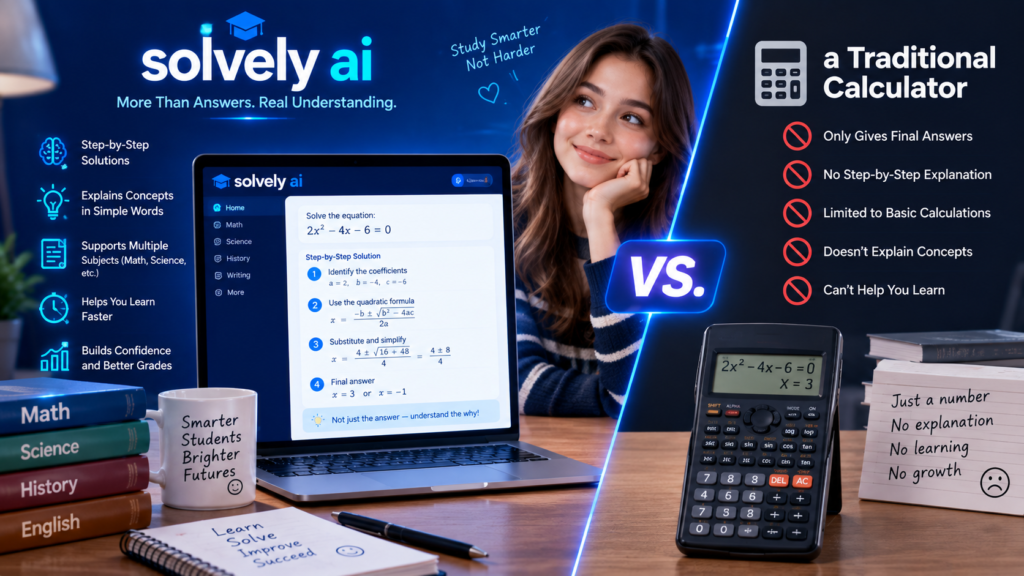
The difference is straightforward.
A calculator is highly reliable for operations it is designed to perform, but it does not normally understand a student’s natural-language question or explain a full learning concept.
Solvely AI can interpret natural-language questions, images, and educational documents and produce explanations or study material. The trade-off is that generative AI can make interpretation or reasoning errors.
For exact numerical calculations, traditional mathematical tools remain valuable. For explanations and educational interaction, AI can be more flexible.
The strongest workflow is often to use both rather than treating either one as universally superior.
How to Use Solvely AI Effectively
The quality of an AI study session depends heavily on how the student uses the tool.
1. Try the problem yourself first
Spend a few minutes attempting the question before asking AI for help. This makes it easier to identify exactly where you are stuck.
2. Ask for reasoning, not just answers
If the tool provides a solution, examine why each step was taken. Ask for a simpler explanation when a step is unclear.
3. Check important answers
For graded work or difficult concepts, compare the response against course notes, textbooks, or your instructor’s method.
4. Turn mistakes into practice
If Solvely solves a question you got wrong, create a similar practice problem and solve it without assistance.
5. Use your own course material
AI explanations become more useful when they are grounded in the terminology, formulas, and methods actually used in your class.
6. Protect private information
Treat uploaded content as data that deserves the same care as any other online service. Review privacy settings and avoid unnecessary sensitive information.
Frequently Asked Questions
What is Solvely AI used for?
Solvely AI is used for homework solving, step-by-step explanations, study notes, quizzes, flashcards, exam preparation, and lecture transcription.
Is Solvely AI only for math?
No. Although mathematics is a major use case, Solvely also supports areas such as physics, chemistry, biology, statistics, economics, and other subjects.
Can Solvely AI solve problems from pictures?
Yes. Solvely supports image-based problem solving, including screenshot workflows through its browser extension and mobile experience.
Is Solvely AI always accurate?
No AI system should be assumed to be perfect. Solvely uses multi-model cross-checking for supported homework workflows, but important answers should still be verified.
Does Solvely AI have a free version?
Yes. Solvely currently offers free study tools, alongside paid Unlimited access with additional features and usage.
Can Solvely AI help with exam preparation?
Yes. Its current feature set includes mock exams, study plans, quizzes, flashcards, notes, and exam-focused tools.
Is Solvely AI safe for private information?
Users should be cautious. Solvely’s privacy policy describes collection and processing of various types of user and educational data, so sensitive or confidential information should not be uploaded unnecessarily.
Conclusion
Solvely AI has developed beyond the basic idea of an AI calculator. Its current platform combines homework solving with study guides, quizzes, flashcards, lecture notes, exam preparation, and browser-based assistance. That makes it potentially useful for students who want one AI-powered workspace rather than a collection of separate tools.
The most important limitation is also the easiest to overlook: an AI-generated answer is not automatically a correct answer. Solvely’s multi-model checking approach can help, but students should still verify important solutions and understand the underlying method.
Used properly, Solvely AI is most valuable as a learning assistant rather than an answer shortcut. Try a problem yourself, use AI to identify gaps, check the explanation against reliable course material, and then practice the concept independently. That approach turns AI from a way to finish homework faster into a tool that can genuinely support better studying.
[…] How Much Energy Does AI Use? A Simple Guide Solvely AI: Features, Uses, Accuracy & Limitations Sakana AI: Research, Models, Founders, and Future VentureBeat: Technology News, AI, and […]