

How Much Energy Does AI Use? A Simple Guide

How much energy does AI use? This is a common question as artificial intelligence becomes part of everyday life. People use AI for writing, studying, searching, creating images, and solving problems. Each request requires computers to process information, which uses electricity. However, the amount of energy depends on the AI model, task, hardware, and data center. A short text question usually needs less energy than creating a detailed image or training a large model. Understanding these differences helps explain AI’s environmental impact. This guide explores AI electricity consumption, practical examples, and ways to use AI more efficiently.
What Determines AI Energy Consumption?
AI energy consumption depends on the work a computer must perform. When you ask an AI question, powerful processors calculate an answer using trained models. These calculations require electricity, and more complicated tasks can require more processing. The energy used also depends on the type of hardware, model size, and how efficiently the system operates. A small AI model running on a personal computer may use less electricity than a large model operating in a data center. Therefore, there is no single energy figure that applies to every AI request.
The number of users also affects total energy consumption. One question may use a small amount of electricity, but millions of questions can create substantial demand. AI systems must also keep servers, cooling equipment, networking devices, and storage systems running. These supporting systems consume electricity alongside the processors performing calculations. For example, a data center handling thousands of requests needs continuous power, even when individual questions are relatively simple. This is why researchers study both energy per request and total electricity used by AI services.
How Much Energy Does One AI Query Use?
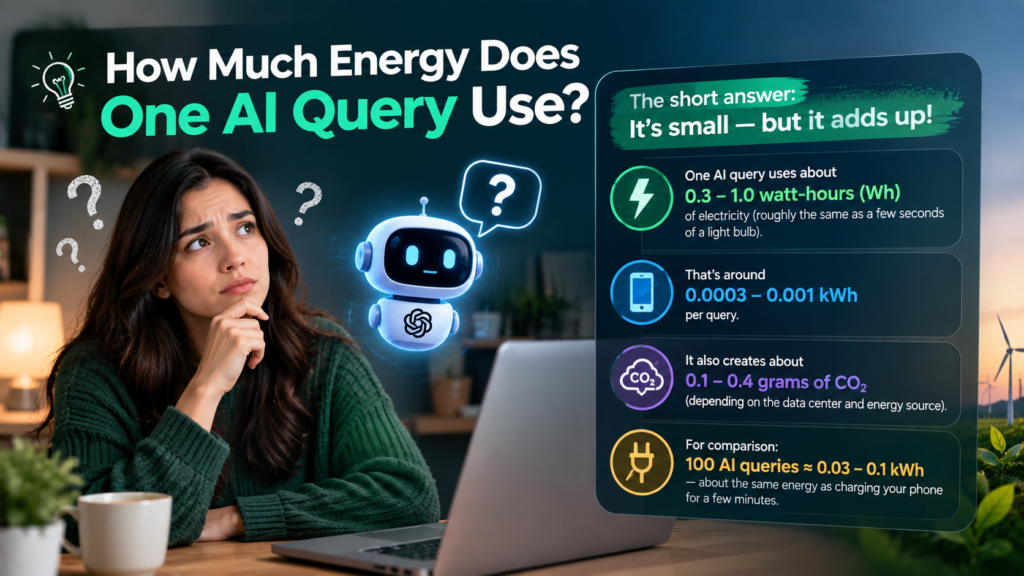
A typical text-based AI query may use a small amount of electricity, but exact measurements vary. A widely cited 2024 estimate suggested that an average ChatGPT query used approximately 0.3 watt-hours of electricity. However, this figure was an estimate, not a universal measurement. Different models, hardware, response lengths, and operating conditions can change the result. Some newer systems may use more energy for complex reasoning, while simpler models may use less. It is important to treat individual query estimates as approximate rather than guaranteed values.
To understand the scale, imagine using an AI chatbot for 20 short questions. If each question used 0.3 watt-hours, the total would be about 6 watt-hours. That is a small amount of electricity compared with many household appliances. However, the calculation is only an illustration, not a measurement of every chatbot. Actual energy use may be higher or lower. The example shows why the question “How much energy does AI use?” needs a clear task, model, and measurement method before anyone can provide a precise answer.
How Much Energy Does ChatGPT Use?
ChatGPT is an AI service that runs on computing infrastructure. Its electricity use depends on the model selected, the length of the conversation, and the complexity of the response. A short question asking for a definition generally requires less processing than a long request involving extensive reasoning. Image generation, file analysis, and other advanced features may also require different amounts of computing power. Because these details are not always publicly available for each interaction, an exact energy figure for every ChatGPT request cannot be confirmed.
Public estimates can still help users understand the general scale. The frequently quoted 0.3 watt-hour estimate for a typical ChatGPT query provides a useful starting point, but it should not be treated as a current official figure for every model. AI systems change over time, and efficiency improvements can affect electricity use. The best approach is to compare estimates carefully and avoid claims that suggest every AI request consumes the same amount of power. Energy consumption is a technical measurement, not a fixed feature of a chatbot.
Does AI Use More Energy Than a Google Search?
AI searches and traditional web searches both require electricity. A traditional search usually retrieves and ranks information from existing web pages. An AI answer may generate new text by performing calculations through a trained model. These different processes can have different energy requirements. However, comparisons between AI queries and Google searches depend on the exact systems being measured. Search engines also use servers, storage, networking, and cooling equipment. Therefore, a simple statement that AI always uses a certain number of times more energy than search can be misleading.
Older comparisons often suggested that AI queries consumed several times more energy than ordinary searches. Such estimates were based on specific models and conditions, and they may not represent current systems. AI hardware and software continue to improve, while search engines also change their technology. A fair comparison should measure similar tasks using the same boundaries. For example, comparing a short factual AI answer with a traditional search result is more useful than comparing unrelated workloads. The important point is that both services require electricity, but their energy needs can differ.
Why AI Data Centers Need So Much Electricity
AI data centers contain specialized computers that process large amounts of information. Many systems use graphics processing units, or GPUs, because they can perform numerous calculations simultaneously. These processors help AI models generate responses, analyze images, and complete other tasks. Running many processors together requires substantial electricity. Large data centers may operate continuously to support users around the world. Their energy demand depends on the number of machines, workload, cooling systems, and operational efficiency.
Cooling is another important part of data center electricity use. Powerful processors produce heat while working, so facilities need systems that keep equipment within safe operating temperatures. Cooling may involve fans, air conditioning, or liquid-based systems. Electricity is also needed for networking, storage, lighting, and backup equipment. When researchers measure AI energy consumption, they may include only computing power or the broader energy used by the entire facility. These different measurement methods explain why published estimates can vary significantly.
How Much Energy Does AI Training Use?
Training an AI model involves processing large datasets and adjusting the model’s internal parameters. This work can require many computers operating for long periods. Large models may need substantial electricity during training because they perform enormous numbers of calculations. The total energy depends on the model size, dataset, training duration, hardware, and software efficiency. Training is different from answering questions after a model has been developed. A model may require considerable energy to train but much less electricity for each individual response.
The energy used during training can be understood through a simple example. Imagine a training system using 1,000 processors, each consuming 500 watts, for 24 hours. The processors alone would use approximately 12,000 kilowatt-hours during that day. This calculation excludes cooling and other supporting equipment. It is an illustration rather than a report about any specific AI model. Real training systems may use different hardware, workloads, and operating schedules. The example shows why training large AI models can create significant electricity demand.
How Much Energy Does AI Image Generation Use?
AI image generation usually requires more computing work than a short text response. The system must create or process many visual details, often through multiple calculation steps. The energy required depends on the image model, resolution, generation method, hardware, and number of images requested. A simple image may require less electricity than a high-resolution image with detailed editing. However, exact energy measurements differ between services. Users should avoid assuming that every generated image has the same energy cost.
For example, creating one basic image may involve less processing than generating several high-resolution images and refining each one. If a user requests four images, the system may perform more work than for a single image. The actual difference depends on how the service handles requests. Some systems reuse calculations or optimize their workflows. This means that counting images alone does not provide a reliable energy estimate. A better comparison considers the complete task, including generation, editing, resolution, and the computing system used.
How AI Energy Consumption Affects the Environment
Electricity generation can produce greenhouse gas emissions, depending on the energy sources used. Data centers powered by coal or natural gas may create more emissions than facilities supplied mainly by renewable energy. Therefore, AI’s environmental impact depends partly on the electricity mix behind its computing infrastructure. Energy consumption and carbon emissions are related, but they are not identical. Two data centers using the same amount of electricity may have different emissions because their power sources differ.
Water use is another environmental concern for some data centers. Certain cooling systems require water to remove heat from computing equipment. The amount depends on climate, cooling technology, facility design, and local conditions. AI can also create environmental impacts through manufacturing hardware and building infrastructure. These effects are separate from electricity used during individual queries. A complete assessment should consider energy, emissions, water, and equipment production. This broader view provides a more accurate understanding of AI’s environmental footprint.
How AI Companies Can Reduce Energy Use
AI companies can improve energy efficiency through better hardware, software, and data center design. More efficient processors can complete calculations using less electricity. Software improvements can reduce unnecessary calculations and improve how workloads are distributed. Smaller models may also perform certain tasks with less computing power. In addition, data centers can improve cooling systems and use electricity from lower-carbon sources. These changes can reduce the energy needed to provide AI services without necessarily reducing their usefulness.
Companies can also improve efficiency by selecting the right model for each task. A simple classification or summarization request may not need the largest available model. Using smaller models for suitable tasks can reduce processing requirements. Better scheduling and workload management may also help data centers operate more efficiently. However, energy savings depend on how these systems are designed and used. Efficiency improvements are valuable, but they do not automatically eliminate the environmental effects of growing AI demand.
How Users Can Use AI More Efficiently
Users can reduce unnecessary AI processing by making clear requests and avoiding repeated generations. A well-written prompt may help produce a useful answer sooner. When appropriate, users can choose smaller models for simple tasks. They can also avoid requesting multiple versions when one answer is sufficient. These habits may reduce the amount of computing needed for individual activities. However, users should not feel that ordinary AI use is automatically harmful. The goal is sensible use, not avoiding useful technology.
Here are practical ways to use AI more efficiently:
- Use a suitable model for the task.
- Write clear prompts to reduce repeated requests.
- Request only the detail you need.
- Avoid unnecessary image generations.
- Reuse useful answers instead of repeating identical questions.
- Choose efficient services when their performance meets your needs.
These steps may reduce unnecessary processing, although the exact savings depend on the service. Users generally cannot measure the electricity used by a specific request without access to technical information. Therefore, these recommendations are best understood as practical efficiency habits rather than precise energy-saving guarantees.
Comparing AI Energy With Everyday Electricity Use
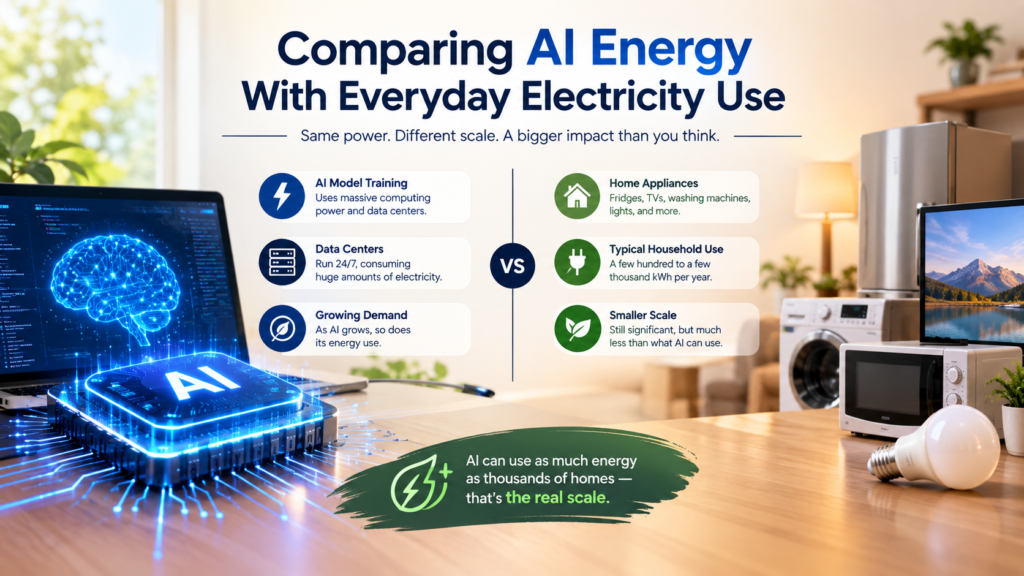
Everyday appliances provide useful context for understanding small energy measurements. A 10-watt LED light running for one hour uses 10 watt-hours of electricity. A 100-watt appliance operating for one hour uses 100 watt-hours. By comparison, a short AI query estimated at 0.3 watt-hours would represent a small amount of electricity. These examples help explain the scale of individual AI requests. However, the estimates should not be treated as exact measurements for every model or service.
A useful comparison chart can make the differences easier to understand:
| Activity | Example electricity use |
|---|---|
| Short AI query | 0.3 watt-hours, based on a widely cited estimate |
| 10-watt LED light for one hour | 10 watt-hours |
| 100-watt appliance for one hour | 100 watt-hours |
| 1,000-watt appliance for one hour | 1,000 watt-hours |
The AI figure is an estimate, while appliance values are simple calculations. Actual AI energy use varies by model and task. The chart shows why individual requests may seem small, even though millions of requests can create substantial total electricity demand.
How Much Energy Does AI Use in the Future?
AI electricity consumption may increase as more people and businesses use AI services. New applications could include education, healthcare, customer support, research, and creative work. At the same time, better hardware and software may reduce energy required for individual tasks. The future result will depend on how quickly AI demand grows compared with efficiency improvements. It is possible for energy use per query to decline while total AI electricity consumption continues increasing.
Researchers and companies are studying ways to measure and reduce AI energy use. Better reporting can help users understand how much electricity different models require. More efficient hardware, improved cooling, and cleaner electricity can also reduce environmental impacts. However, energy efficiency alone does not guarantee lower total demand. If AI becomes much more popular, overall electricity use may still rise. Understanding both efficiency and total demand is essential when considering AI’s future environmental impact.
Frequently Asked Questions
How much electricity does one AI question use?
A widely cited estimate suggests that an average ChatGPT query used approximately 0.3 watt-hours of electricity. However, this is not a universal measurement. Actual consumption depends on the model, response length, hardware, and data center. More complex requests may require more energy than simple questions.
Does AI use more energy than traditional search?
AI may use more electricity than some traditional search tasks, but comparisons depend on the systems and workloads measured. Traditional search also requires data centers and networking equipment. Older estimates may not represent current technology. A fair comparison needs consistent measurement methods and similar tasks.
Does generating images use more energy than text?
Image generation often requires more computing work than a short text response. The exact energy difference depends on the model, resolution, and generation method. Creating several high-resolution images may require more electricity than generating one simple image. However, precise comparisons require measurements from the systems involved.
Why does AI need so much electricity?
AI uses electricity because computers perform large numbers of calculations to process information and generate results. Large models may require powerful processors, storage, networking, and cooling. Training can be especially energy-intensive because it involves processing large datasets over extended periods.
Can AI become more energy-efficient?
Yes, AI systems can become more efficient through improved hardware, software, model design, and data center operations. Smaller models may use less electricity for suitable tasks. Better cooling and cleaner electricity can also reduce environmental impacts. However, total energy use may still rise if AI demand grows quickly.
Conclusion: Understanding AI Energy Consumption
How much energy does AI use? The answer depends on the model, task, hardware, and data center. A short text query may use a small amount of electricity, while training large models or generating complex images can require much more. Public estimates provide useful context, but they should not be treated as universal facts. AI companies are working on efficiency improvements, and users can help by making sensible choices. Understanding energy consumption helps people use AI thoughtfully while appreciating its benefits.
[…] AI vs AGI: Key Differences, Examples, and Future How Much Energy Does AI Use? A Simple Guide Solvely AI: Features, Uses, Accuracy & Limitations Sakana AI: Research, Models, […]