


Rundown AI: Is The Rundown AI Newsletter Worth It?

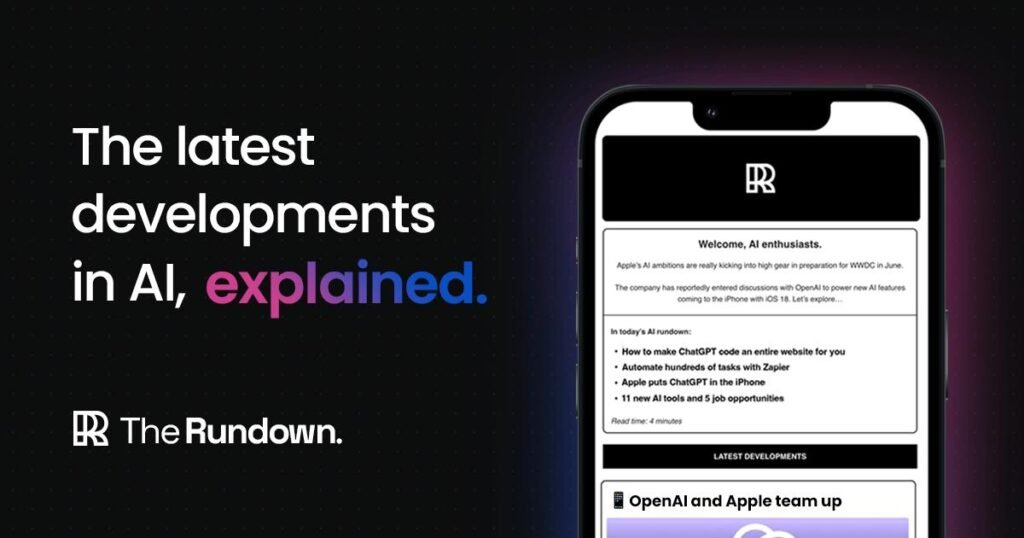
Rundown AI, commonly known as The Rundown AI, is a newsletter and AI news platform that helps readers keep up with artificial intelligence without spending hours browsing technology websites. The Rundown AI newsletter covers important AI developments, emerging tools, industry announcements, and practical ways to use AI at work. It is designed for people who want to understand not only what is happening in artificial intelligence but also why those developments matter.
The publication is particularly useful for professionals, marketers, business owners, developers, students, and anyone exploring AI-powered tools. Instead of requiring readers to follow dozens of sources, it brings selected stories and useful insights into one place. The company describes its main newsletter as a quick read that takes approximately five minutes. But is it worth subscribing to, and what can readers expect from it? This guide explains how Rundown AI works, its main features, its advantages and limitations, and how to decide whether it fits your needs.
What Is Rundown AI?
Rundown AI is an artificial intelligence news publication that delivers curated updates and practical information about the fast-changing AI industry. Its primary product is an email newsletter that summarizes important developments and explains how readers can apply AI in their professional and personal lives.
The publication also features news articles, newsletter editions, practical guides, and educational resources. Its content covers topics such as generative AI, new AI models, automation, business applications, and emerging technology products.
The main idea is straightforward: readers should be able to understand relevant AI developments without researching every announcement themselves.
For example, when a company releases a new AI assistant, a useful newsletter explanation might cover what the assistant can do, who could benefit from it, and which limitations readers should consider before using it.
Rundown AI is therefore best understood as a news and learning resource rather than an AI chatbot or a standalone software tool.
What Is The Rundown AI Newsletter?
The Rundown AI newsletter is the publication’s central offering. It delivers selected artificial intelligence news and insights directly to subscribers’ email inboxes.
The newsletter is designed around a short daily reading experience, with the main AI edition generally sent on weekday mornings. It also promotes practical examples and guidance for applying AI at work.
Typical subjects include:
- AI industry news: Important announcements from AI companies and research organizations.
- New AI tools: Updates about applications that may help with writing, research, coding, design, or productivity.
- Model developments: News about changes to AI systems and their capabilities.
- Business applications: Examples of how organizations can incorporate AI into everyday work.
- Practical insights: Ideas that readers can explore or test in their own workflows.
The precise topics vary by edition because AI news changes quickly.
One useful distinction is that a newsletter is a curated selection, not a complete record of everything happening in AI. Its value depends on whether the selected stories are relevant to the reader’s interests and whether the explanations provide enough context to make the information useful.
How Does Rundown AI Work?
Rundown AI follows a simple process: its editorial team tracks developments in artificial intelligence, selects relevant stories, and presents them in a format that readers can understand quickly.
Here is how the experience works for a typical subscriber.
1. AI News Is Collected and Reviewed
The editorial team follows announcements, product releases, research developments, and other important industry updates. Rather than expecting readers to monitor every AI company individually, the newsletter brings selected developments together.
The publication also describes using AI tools to assist with research, drafting, and automated checks, with an editor reviewing and approving the final article.
2. Important Developments Are Summarized
The newsletter turns selected stories into a more accessible reading experience. This is helpful when an announcement contains technical details that might otherwise require reading a long research paper or product document.
For instance, a story about a new large language model might explain its intended applications, reported capabilities, and potential implications for businesses.
3. Readers Explore the Original Information
When a story matters to your work, you can use it as a starting point for further research. Check the original company announcement, technical documentation, or research paper before making decisions based on the newsletter.
This last step is important because a short summary cannot always communicate every technical limitation, testing condition, or uncertainty.
Key Features of The Rundown AI
The publication offers more than short news summaries. Its website brings together several resources for people interested in artificial intelligence.
Short, Regular AI News Updates
The newsletter is designed for readers with limited time. Instead of spending an hour checking different technology websites, you can begin with a short briefing and investigate the stories most relevant to you.
The publication promotes a roughly five-minute reading experience, although actual reading time varies with the edition and the reader’s interests.
Coverage of AI Tools and Models
The publication reports on AI products, new capabilities, company announcements, and developments across the industry.
This can help readers discover tools they might otherwise miss. However, an announcement does not automatically mean a product is widely available, affordable, or suitable for every task. Readers should check current documentation before adopting a tool.
Practical AI Guides
The Rundown website also features guides that focus on real-world AI applications. These resources are particularly relevant to people who want to move beyond reading news and start experimenting with AI in their work.
Possible applications include:
- Drafting and improving marketing content.
- Summarizing lengthy documents.
- Organizing research findings.
- Exploring AI-assisted coding.
- Improving repetitive administrative workflows.
These are examples of tasks where AI may be useful, not a guarantee that every guide covers each task or that every workflow can be automated safely.
Educational Resources Through The Rundown University
The company also offers The Rundown University, a separate educational platform with courses, guides, and live learning sessions. Its free resources and paid course membership are distinct from simply subscribing to the newsletter.
The Pro membership has been listed at $29 per month, with access to its on-demand course library and additional benefits. Prices and included content can change, so check the current plans before purchasing.
Who Should Use Rundown AI?
Rundown AI is most useful for people who need a regular overview of AI developments but do not want to follow every announcement themselves.
Different readers can use the newsletter in different ways.
Digital Marketers and Content Creators
Marketers can discover AI writing tools, content research methods, and changes in generative AI. They can then test relevant tools for brainstorming, editing, and campaign planning.
Developers and Technical Professionals
Developers can use the newsletter to identify new models, coding assistants, and emerging tools worth investigating. Technical documentation is still necessary for implementation decisions.
Business Owners and Managers
Business readers can follow AI adoption, productivity tools, and automation trends. The information can help them identify opportunities before investing in new software or changing company processes.
Students and AI Beginners
Beginners can learn the terminology used in AI discussions and discover new products. The newsletter can provide a useful starting point, although it is not a substitute for a structured course when learning technical concepts in depth.
People who already follow AI research closely may find some updates familiar. For them, the newsletter’s main value is convenience rather than access to exclusive technical information.
Is Rundown AI Free?
Yes. The core Rundown AI newsletter is available through a free email subscription. Readers can sign up by providing their email address.
However, it is important to distinguish between the newsletter and the company’s educational products.
| Offering | Cost and access |
|---|---|
| The Rundown AI newsletter | Free email subscription |
| Newsletter archive and news articles | Browse available content on the website |
| The Rundown University free resources | Free guides and learning resources are available |
| The Rundown University Pro | Listed at $29 per month, subject to current pricing |
The paid University membership is optional if your main goal is simply to receive AI news. You do not need to purchase a course membership just to start reading the newsletter.
Before paying for additional resources, consider whether you need structured lessons, certifications, and live learning sessions or whether free articles and hands-on experimentation are enough for your current goals.
How to Subscribe to The Rundown AI Newsletter
Signing up is straightforward and does not require advanced technical knowledge.
Step 1: Visit the Official Website
Open The Rundown AI website and find the newsletter subscription form.
Step 2: Enter Your Email Address
Provide the email address where you want to receive the newsletter. Review the information on the signup page before submitting your details.
Step 3: Confirm Your Subscription if Requested
Check your inbox for a welcome or confirmation message. If it does not appear, look in your spam or promotions folder.
Step 4: Read and Explore Useful Stories
Start with the stories related to your job, studies, or business. Save useful announcements and follow the original sources when you need more detail.
Once subscribed, you can use the newsletter as a regular starting point for discovering AI developments.
Advantages of Rundown AI
The newsletter has several practical strengths, particularly for readers who want to stay informed without spending too much time on research.
1. Saves time. Curated updates reduce the need to check multiple websites every morning.
2. Makes AI news easier to understand. Short explanations help readers understand the importance of developments without reading every technical document.
3. Helps readers discover tools. Coverage of new AI applications can provide ideas for improving existing workflows.
4. Connects news with practical applications. The publication aims to explain how readers can use AI, rather than focusing only on company announcements.
5. Offers a low-cost way to stay informed. The core newsletter is free, making it accessible to students, freelancers, professionals, and business owners.
The biggest advantage is the combination of convenience and relevance. Readers can scan the briefing, identify useful stories, and spend additional time only on subjects that matter to them.
Limitations and Things to Consider
Although Rundown AI can be useful, it should not be your only source of information about artificial intelligence.
Summaries Cannot Replace Technical Research
A newsletter has limited space. It may explain a new model’s main capabilities without covering every benchmark, evaluation method, or limitation.
If you are selecting an AI model for a business application, review its official documentation, pricing, privacy terms, and performance on your own tasks.
News Can Become Outdated Quickly
AI products change frequently. Features may move from testing to general availability, prices can change, and companies may revise their product offerings.
A story that was accurate when published may no longer describe the current state of a product. Always check the publication date and verify time-sensitive details.
Some Content May Be Promotional
Like many publications, AI newsletters can include sponsored content or advertising. A sponsored placement should be treated differently from independent reporting.
When evaluating a tool, consider whether the recommendation is supported by meaningful evidence and whether the product meets your requirements. Do not assume that a featured tool is necessarily better than its competitors.
Email Is Not a Complete Learning System
Reading about AI is different from developing practical skills. A newsletter can introduce a concept, but it cannot guarantee that you understand how to implement it correctly.
For meaningful progress, combine regular reading with hands-on testing, structured learning, and small projects.
Privacy Deserves Attention
Subscribing requires sharing an email address. The company’s privacy policy describes the collection of certain website usage and email engagement information. Readers who are concerned about tracking should review the policy and their available communication preferences.
Rundown AI vs. Other Ways to Learn About AI
Rundown AI is one option among several ways to keep up with artificial intelligence. The best choice depends on whether you need quick updates, technical depth, or practical training.
| Resource type | Main strength | Main limitation |
|---|---|---|
| The Rundown AI newsletter | Short, curated AI news | Limited technical depth |
| Official AI company blogs | Direct product announcements and updates | Usually focused on one company |
| Research papers | Detailed technical methods and results | Can require substantial technical knowledge |
| AI tutorials and courses | Structured learning and practical exercises | Require more time |
| General technology news websites | Broader industry and business context | AI may be only one of many subjects |
These options work well together. For example, a marketer could discover a new AI video tool in the newsletter, review the product’s official documentation, and then complete a practical tutorial before using it in a client project.
A developer might use the same newsletter to discover a new model, then read its technical report and run tests before deciding whether to integrate it into an application.
The key is to choose the right source for the task rather than expecting one publication to provide every kind of information.
How to Get More Value From The Rundown AI Newsletter
Simply opening the email every morning is not enough to turn information into useful skills. A small routine can help you make better use of what you read.
Focus on One Relevant Story
Choose an article that relates directly to your work. If you manage a blog, for instance, prioritize AI tools for research, editing, content organization, or analytics rather than trying to investigate every new model.
Verify Important Claims
If a story mentions a product launch or a new capability, check the original source. Look for practical details such as availability, regional restrictions, usage limits, and supported integrations.
This is particularly important when an announcement describes an experimental feature rather than a generally available product.
Test Tools With a Real Task
Suppose you discover an AI research assistant. Instead of deciding whether it is useful based on the announcement alone, give it a small task using non-sensitive information.
You could ask it to summarize a public report, organize its findings into a table, and identify the claims that need verification. Compare its output with the original report before relying on the result.
Keep a Record of Useful Discoveries
Maintain a simple list of tools, links, and ideas worth revisiting. Include a short note explaining what each tool does, its limitations, and whether you have tested it.
This helps you avoid repeatedly exploring the same products and makes it easier to evaluate whether a new tool genuinely improves your workflow.
Frequently Asked Questions
1. What is Rundown AI used for?
Rundown AI helps readers follow artificial intelligence news, discover AI tools, and understand developments that may affect their work or business.
2. Is The Rundown AI newsletter free?
Yes. The core newsletter offers a free email subscription. Separate educational products may require payment.
3. How often does The Rundown AI send emails?
The main AI newsletter is promoted as a weekday publication, generally delivered on weekday mornings. Delivery can vary.
4. Who should subscribe to Rundown AI?
It is useful for AI beginners, marketers, developers, students, entrepreneurs, and professionals who want regular updates without extensive daily research.
5. Does Rundown AI offer AI courses?
Yes. The Rundown University offers educational resources, practical guides, live sessions, and paid on-demand courses. These are separate from the free newsletter.
6. Is Rundown AI a chatbot?
No. Its primary offering is an AI news newsletter and publication, alongside related educational resources. It is not primarily a conversational AI assistant.
7. Can I unsubscribe from The Rundown AI newsletter?
Yes. Subscribers can generally unsubscribe through the link provided in newsletter emails or update their communication preferences.
Conclusion
Rundown AI is a useful option for anyone who wants to follow artificial intelligence without spending hours searching for updates. Its main newsletter combines selected AI news, product developments, and practical insights in a short email format. The free subscription makes it easy to explore, while The Rundown University provides additional learning resources for readers who want to develop practical skills.
However, the newsletter is best treated as a starting point rather than a complete source of technical knowledge. Important product claims, pricing details, and model capabilities should always be checked against current documentation. Readers should also distinguish editorial coverage from promotional content and test new tools before relying on them.
If you want a convenient way to keep up with AI, subscribing to The Rundown AI newsletter is a reasonable place to start. The real benefit comes from turning relevant discoveries into informed decisions and practical experiments.