

Perchance AI Character Generator: Complete Guide

The Perchance AI character generator is a useful option for writers, gamers, artists, and anyone who needs original character ideas without building a character from scratch. Perchance hosts many community-created generators, including character generators that can produce names, personalities, appearances, backgrounds, scenarios, and other creative details.
Some Perchance generators focus on text and randomized character profiles, while others connect character concepts with AI image generation or character-chat experiences. This distinction matters because the term “Perchance AI character generator” can describe several different types of tools rather than one standardized product.
This guide explains what Perchance character generators are, how they work, what you can create with them, their strengths and limitations, and how to get better results from your prompts.
What Is the Perchance AI Character Generator?
The Perchance AI character generator is best understood as a collection of character-creation tools available through the Perchance platform.
Instead of requiring users to manually decide every detail, a generator can combine different attributes to create a new character concept. Depending on the specific generator, those attributes may include:
- Character name
- Age or approximate age
- Appearance
- Personality
- Occupation
- Clothing
- Skills
- Background
- Goals and motivations
- Strengths and weaknesses
- Fantasy or science-fiction traits
- Story settings
- Character scenarios
Perchance has a community-driven structure, meaning different generators can provide very different experiences. Some are designed for quick random character ideas, while others provide more detailed AI-assisted generation.
Is Every Perchance Character Generator Technically AI?
No.
This is an important distinction.
Some Perchance generators are essentially procedural or randomized generators. They select and combine values from predefined lists and rules. Others use AI models or AI image-generation systems to produce more flexible text or visual results.
Therefore, seeing “AI character generator” in a page title does not automatically mean that every part of that particular generator is powered by a large language model.
For users, the practical question is not simply whether a tool is called AI. It is what type of generation it actually performs.
How Does a Perchance Character Generator Work?
The Perchance platform allows creators to build generators using its own syntax and logic. A generator can define variables, lists, choices, and relationships between pieces of content.
A simplified example might look conceptually like this:
Role: warrior, mage, detective, explorer
Personality: calm, curious, stubborn, optimistic
Setting: ancient kingdom, cyberpunk city, desert colony
The generator can select values from those categories and combine them into a character.
More sophisticated generators can add conditional logic, nested choices, weighted options, user input, and additional generation steps.
Random Generation vs. AI Generation
These two approaches produce different results.
Randomized generation is useful when you want controlled variety. For example, a writer could generate hundreds of combinations of professions, personality traits, and backgrounds.
AI generation is more flexible. Instead of choosing only from predefined options, an AI model can interpret a natural-language description and produce a more detailed character concept.
For example:
“Create a quiet detective who works in a flooded coastal city, distrusts authority, collects old photographs, and secretly wants to find his missing brother.”
A generative AI system can turn those requirements into a more coherent character profile.
The exact behavior depends on the specific Perchance generator being used.
What Can You Create With Perchance?
The answer depends heavily on the individual generator, but character-focused Perchance tools can support several common creative tasks.
1. Original Fictional Characters
Writers can generate characters for:
- Novels
- Short stories
- Comics
- Role-playing campaigns
- Fan-fiction concepts
- Interactive fiction
- Screenwriting
For example, a writer developing a fantasy story might generate a merchant with a hidden magical ability, a complicated family history, and a conflicting personal goal.
The generator provides the starting point. The writer can then refine the character manually.
2. Character Concepts for Games
Game designers and tabletop players can use character generators to create non-player characters, or NPCs.
A useful NPC usually needs more than a name. It may require:
- A role in the world
- A personality
- A motivation
- Relationships
- A secret
- Useful information
- A reason to interact with the player
Random generation can be especially useful when a game master needs several minor characters quickly.
3. Character Appearance Ideas
Some Perchance tools focus on visual character design and can help turn an idea into an image-generation prompt or visual concept.
A character description could specify details such as:
- Hair
- Face
- Clothing
- Body type
- Accessories
- Environment
- Lighting
- Art direction
The resulting prompt can then be used with an appropriate image-generation system.
4. Character Chat and Roleplay
Character creation can also lead into interactive storytelling.
Some Perchance-related character experiences allow users to interact with fictional personalities and create custom characters.
This creates a different use case from simple character generation. Instead of producing a static profile, the character becomes part of an ongoing conversation or role-playing scenario.
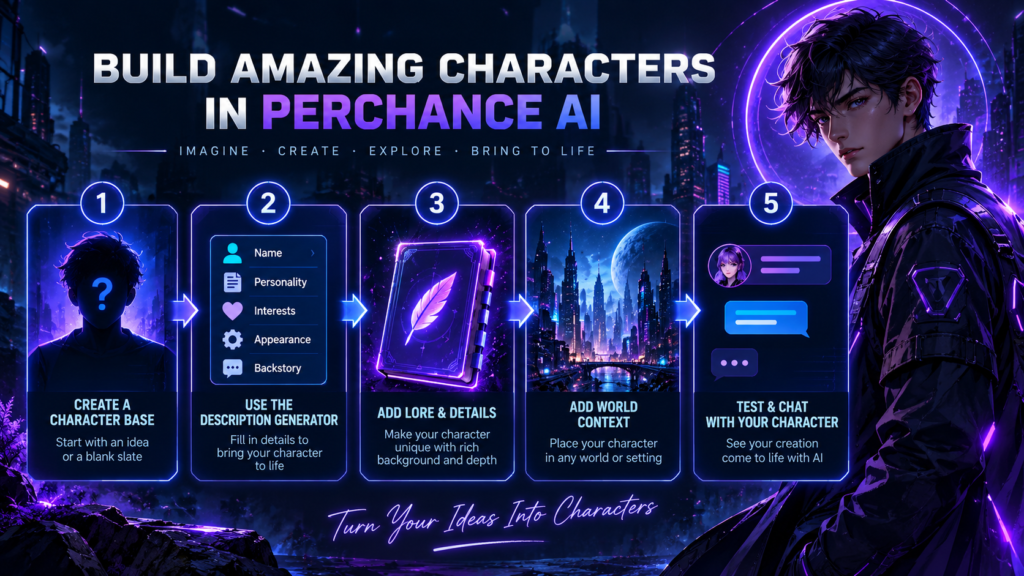
How to Create a Better Character With Perchance
The quality of the result often depends more on the information you provide than on the number of adjectives in your prompt.
Step 1: Start With the Character’s Role
Begin with a clear foundation.
For example:
“A 28-year-old investigative journalist working in a fictional European city.”
This establishes who the character is and what they do.
Step 2: Add Personality
Avoid simply writing “nice” or “interesting.”
Give the character traits that can influence behavior.
For example:
“Highly observant, skeptical of authority, socially awkward, but extremely loyal to close friends.”
Now the character has potential for conflict and development.
Step 3: Add Motivation
Motivation is one of the easiest ways to make a character feel less generic.
Instead of:
“A detective who solves crimes.”
Try:
“A detective who became obsessed with unsolved cases after a childhood friend disappeared.”
The second version provides a reason for the character’s behavior.
Step 4: Add Weaknesses
Perfect characters are usually difficult to write convincingly.
Consider giving the character:
- A fear
- A bad habit
- A personal bias
- A moral conflict
- A physical limitation
- A mistaken belief
- A relationship problem
A weakness also gives future stories somewhere to go.
Step 5: Specify the Setting
A character exists within a world.
Compare:
“A young warrior.”
with:
“A young warrior in a desert kingdom where water is controlled by powerful merchant families.”
The second description immediately provides more narrative possibilities.
Example of a Strong Character Prompt
A practical prompt might look like this:
Create an original fantasy character named Mira Vey. She is a 24-year-old mapmaker living in a city built inside the remains of an ancient giant. She is intelligent, cautious, curious, and uncomfortable around crowds. Her greatest strength is remembering geographical details, while her weakness is that she refuses to trust people easily. She secretly searches for evidence that the city is still alive. Give her a detailed appearance, clothing, personal history, motivation, fears, skills, relationships, and a story hook.
This prompt gives the generator enough direction without dictating every sentence.
The result can then be edited manually. That final editing step is important because AI-generated or randomized characters can contain contradictions or details that do not fit the intended story.
Advantages of the Perchance AI Character Generator
Free and Easy Access
Many Perchance generators are designed to be used directly in a browser, making the platform convenient for experimentation.
Huge Variety of Generators
One of Perchance’s biggest strengths is variety.
Because the platform supports community-created generators, users can find tools designed for very specific creative purposes instead of relying on a single character template.
Fast Idea Generation
If you have writer’s block, a random character generator can provide a useful starting point in seconds.
The goal does not have to be producing a finished character immediately. Sometimes one unexpected combination of traits is enough to inspire an entire story.
Useful for Beginners
You do not need advanced knowledge of machine learning to experiment with character generators.
A beginner can start with a simple concept and gradually learn how prompts, constraints, variables, and generation choices affect the output.
Flexible Creative Workflows
Perchance can be used as part of a broader workflow:
Character idea → detailed profile → visual prompt → character image → story or roleplay
Each stage can be refined separately instead of expecting one AI tool to do everything perfectly.
Limitations You Should Know
Perchance is useful, but it is not a magic character-development system.
Different Generators Behave Differently
This is probably the biggest source of confusion.
There is no single universal “Perchance character generator” experience. Community-created generators can have different designs, logic, prompts, and capabilities.
One tool may generate a short random description, while another may accept detailed user input or combine text generation with visual generation.
Generated Characters May Feel Generic
AI and randomized systems can produce familiar combinations such as:
- Mysterious loner
- Brilliant but troubled detective
- Sarcastic warrior
- Secretly powerful student
- Kind-hearted rogue
These concepts are not automatically bad, but they can become predictable.
The solution is to introduce specific motivations, contradictions, relationships, cultural details, and consequences.
AI Output Can Contain Inconsistencies
Generative AI does not understand fictional continuity in exactly the same way a human writer does.
A character may be described as extremely shy in one section and highly social in another. A character might also receive abilities that conflict with the story’s rules.
Always review the generated result before treating it as final.
Visual Consistency Can Be Difficult
If you use AI image generation for a character, creating one attractive image is easier than maintaining exactly the same character across many scenes.
Changes in clothing, facial features, hairstyle, age, proportions, or accessories can appear between generations.
For comics, games, or long-form visual projects, consistency may require more controlled workflows.
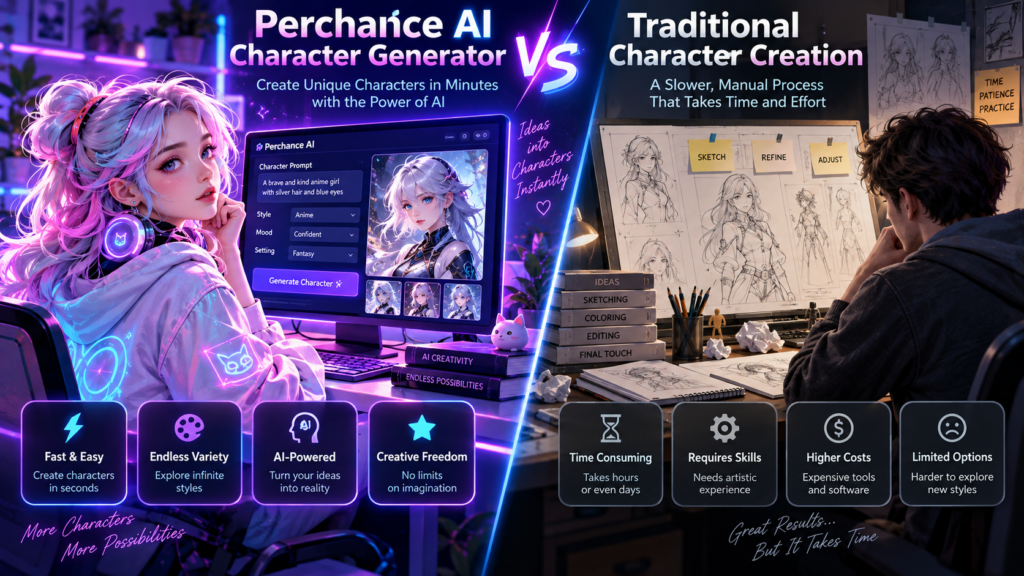
Perchance AI Character Generator vs. Traditional Character Creation
| Approach | Main Strength | Main Limitation |
|---|---|---|
| Manual writing | Maximum creative control | Takes more time |
| Random character generator | Fast inspiration | Can feel unpredictable or generic |
| AI character generator | Flexible natural-language generation | May produce inconsistencies |
| Character-chat tool | Interactive development | Character behavior depends on the underlying system |
| Professional character design workflow | Stronger consistency and control | Usually requires more time and specialized tools |
Perchance is particularly useful when speed and experimentation matter more than complete control.
A novelist developing one main protagonist may prefer to design the character manually and use Perchance for brainstorming. A tabletop game master who needs 20 minor NPCs may benefit much more from random generation.
Is Perchance Good for Writers?
Yes, especially as a brainstorming tool.
It works best when you treat generated characters as creative raw material rather than finished writing.
For example, imagine generating a character with these traits:
- Retired sailor
- Afraid of birds
- Excellent memory
- Hates expensive clothing
- Searching for a lost letter
The combination might initially seem random. But a writer could turn it into a compelling mystery: Why is a retired sailor afraid of birds? What is in the missing letter? Why does the character have such an unusual memory?
That is where random generation becomes valuable. It creates combinations that a writer may not have consciously considered.
Is Perchance Suitable for Game Development?
Perchance ai character generator can be useful during the concept-development stage of game development.
Developers can brainstorm:
- NPC personalities
- Quest concepts
- Character backgrounds
- Enemy concepts
- Dialogue ideas
- Factions
- Locations
- Character relationships
However, a generator should not automatically be treated as a complete game-development pipeline.
A production game normally requires structured data, consistency, localization, testing, art direction, performance considerations, and integration with the game’s engine.
Perchance can help generate ideas, but those ideas still need to be designed and implemented.
Privacy and Ownership Considerations
Privacy should always be considered when using any online creative tool.
There is an important distinction between generated content and personal information. Even when a platform permits certain uses of generated content, users should avoid placing sensitive personal information into public or third-party generators.
For commercial projects, check the terms of the specific platform and any underlying model or service involved. Permission to use generated material does not automatically eliminate other legal considerations, such as trademarks, copyrighted characters, or rights involving real people.
Tips for Getting Better Results
A few practical habits can dramatically improve character generation.
Give the Character a Conflict
A character becomes more interesting when two motivations compete.
For example:
“She wants to become a famous detective but hates being recognized by strangers.”
That contradiction creates story potential.
Avoid Excessive Adjectives
Instead of:
“Beautiful, mysterious, powerful, intelligent, amazing, fearless warrior.”
Give the generator information that affects behavior.
For example:
“She avoids violence whenever possible because she once caused an accidental death.”
That single detail is more useful than several generic adjectives.
Use Constraints
Tell the generator what you do not want.
For example:
“Avoid clichés such as secret royal bloodlines, chosen-one powers, and immortal characters.”
Constraints can help reduce predictable results.
Generate Several Versions
Do not automatically accept the first output.
Generate multiple concepts, identify the strongest elements, and combine them into a final character.
This hybrid approach often works better than expecting one generation to be perfect.
Frequently Asked Questions
What Is the Perchance AI Character Generator?
It refers broadly to character-generation tools available through Perchance. These include randomized character generators and AI-assisted tools that can produce character concepts, descriptions, prompts, or related creative content.
Is the Perchance AI Character Generator Free?
Many Perchance character generators are available free in the browser. However, capabilities and conditions can vary between individual community-created generators, so users should check the specific tool they are using.
Do I Need an Account to Use Perchance Character Generators?
Not necessarily. Many Perchance generator pages can be used without an account. An account is more relevant to people who want to create and manage their own generators.
Can Perchance Create Character Images?
Yes, Perchance includes AI image-generation tools, and some character-focused workflows can be used to develop visual character concepts. The exact image features depend on the specific generator.
Can I Use Perchance for Fictional Characters in a Novel?
Yes. It can be useful for brainstorming characters, personalities, backgrounds, and story hooks. For a finished novel, however, the generated material should be reviewed, edited, and adapted to fit your story.
Can Perchance Characters Be Used for Roleplay?
Yes. Character-focused experiences can be used for interactive fictional conversations and role-playing. The exact experience depends on the particular generator or character system.
Why Does the Same Character Generator Produce Different Results?
Randomized generators deliberately select different combinations from their available options. AI-based generators can also produce different outputs because generative models do not necessarily return identical results for the same creative request.
Conclusion
The Perchance AI character generator is most useful when viewed as a creative starting point rather than a replacement for human character design. Its biggest advantage is flexibility: users can find simple randomized generators, more structured character tools, visual-generation workflows, and character-chat experiences within the wider Perchance ecosystem.
For writers and game creators, the strongest approach is usually collaborative. Let the generator provide unexpected combinations, then use human judgment to select, rewrite, and develop the ideas that actually fit your project.
The technology can save time, but originality still comes from the decisions made after generation. A memorable character needs more than a name and a list of traits. It needs motivation, conflict, flaws, relationships, and a reason to exist within the story. Perchance can help you discover those ingredients; the creative direction remains yours.
[…] Grok Spicy Mode: What It Is and What to Know in 2026 Perchance AI Character Generator: Complete Guide DreamGen AI: Features, Pricing, Uses, and Complete Guide Clever AI Humanizer: Features, […]