

DreamGen AI: Features, Pricing, Uses, and Complete Guide

DreamGen AI is an AI-powered platform designed primarily for interactive storytelling, role-play, and creative writing. Instead of functioning only as a chatbot that answers individual prompts, DreamGen focuses on giving users control over characters, settings, plots, and ongoing scenarios.
The platform supports AI story writing and role-play, allowing users to guide a narrative as it develops or participate directly as a character. It also provides tools for creating scenarios, reusable characters and personas, locations, items, and other story elements.
This guide explains what DreamGen AI is, how it works, what you can use it for, its main features, pricing structure, advantages, limitations, and how it compares with general AI chatbots.
What Is DreamGen AI?
DreamGen is an AI platform focused on story generation and role-playing. Unlike general-purpose AI assistants designed to handle everything from coding to research, DreamGen is built around fictional storytelling and interactive experiences.
Users can start with an existing scenario or create their own. A scenario can include multiple characters, locations, objects, background information, and instructions that influence how the story develops.
The platform also allows users to create reusable characters and user personas. This can be helpful when developing several stories that share characters or elements from the same fictional universe.
In simple terms, DreamGen sits between an AI writing assistant, interactive fiction engine, and role-playing platform.
How Does DreamGen AI Work?
At its core, DreamGen uses generative AI to produce text based on the context supplied by the user. The scenario, characters, previous interactions, instructions, and other story information all help influence the next response.
This is similar to how other large language model applications work. The AI receives contextual information and generates a likely continuation. The difference is that DreamGen organizes this process around storytelling rather than general question answering.
For example, imagine creating a fantasy scenario involving:
- A young mage attempting to restore lost magic
- A skeptical warrior traveling with her
- An ancient city hidden beneath a desert
- A rule that makes magic dangerous after sunset
Instead of repeatedly explaining these details in every prompt, a structured scenario can preserve important information. You can then direct the characters and plot while the AI generates the next part of the experience.
DreamGen also provides tools that can turn a basic story idea into a more developed scenario, helping users establish elements such as characters, setting, and plot.
DreamGen AI Story Writing vs. Role-Play
One of DreamGen’s important distinctions is between story writing and role-play.
With story writing, the AI helps develop a narrative while the user influences its direction. This can be useful when exploring scenes, dialogue, characters, or longer fictional sequences without necessarily playing a character.
Role-play is more interactive. The user can take the role of a character while interacting with AI-controlled characters and influencing what happens next.
This makes DreamGen useful for different creative workflows. A novelist might use it to experiment with scenes and plot ideas, while someone interested in interactive fiction may prefer the role-playing experience.
Key Features of DreamGen AI
DreamGen’s features are centered on giving users control over fictional environments rather than simply generating isolated pieces of text.
Scenario Creation
The scenario creation tools help turn a basic concept into a structured story or role-playing experience.
Instead of starting with a completely blank page, users can begin with a simple premise and develop it into a setting containing characters, conflicts, and other story elements.
This is useful when you have an idea for a story but are unsure how to develop all of its components.
Multiple Characters
DreamGen supports scenarios involving multiple characters.
This is important for stories involving groups, relationships, conflicts, or conversations between several people. For example, a mystery could include a detective, suspect, witness, and antagonist rather than restricting the interaction to a single character.
Reusable Personas and Story Elements
Users can create reusable characters, personas, locations, and items.
A user persona can represent the character participating in a role-play, while other entities can form part of the fictional world.
This approach is particularly useful for creators who develop multiple stories within the same universe.
Story Steering
DreamGen allows users to influence the direction of a narrative through instructions.
For example, a writer might want a character to reveal an important secret, introduce a new conflict, or change the direction of a scene.
This gives the user more editorial control than simply asking an AI to write a story and accepting whatever it produces.
AI Image Generation
DreamGen also includes image-generation capabilities alongside its storytelling and role-playing tools.
This allows users to create visual representations of characters, environments, or scenes connected to their creative projects.
The combination of text generation and visual creation can be useful for writers and role-playing enthusiasts who want both narrative and visual elements in one creative workflow.
What Can You Use DreamGen AI For?
DreamGen is particularly suited to creative applications rather than conventional office automation.
Interactive Fiction
DreamGen can be used to create interactive fictional experiences where the user’s choices influence what happens next.
Fantasy adventures, mysteries, science-fiction missions, and character-driven dramas can all work with this format.
Creative Writing
Writers can use DreamGen to experiment with:
- Story ideas
- Character development
- Dialogue
- Scene creation
- Plot possibilities
- Alternative story directions
It can be especially useful during brainstorming, when the goal is to explore possibilities rather than produce a final polished manuscript.
Worldbuilding
Complex fictional worlds often contain interconnected characters, locations, objects, histories, and rules.
DreamGen’s scenario-based approach can help organize these elements so they can be incorporated into creative projects.
For example, a science-fiction writer could create a fictional planet, several characters, political factions, important locations, and technology rules before beginning an interactive storyline.
Fan Fiction and Alternate Universes
AI storytelling tools can be used to explore fan-fiction concepts and alternative versions of fictional worlds.
However, anyone publishing or commercially distributing derivative content should consider copyright law, licensing, and the rules surrounding the original intellectual property.
Brainstorming
DreamGen can also be useful when you only have a rough premise.
For example:
“A detective discovers that every crime scene contains evidence from a crime that has not happened yet.”
From this simple idea, an AI storytelling tool can help explore possible characters, settings, conflicts, mysteries, and plot developments.
DreamGen AI Pricing
DreamGen offers a free tier alongside paid subscription plans. Its paid options include Starter, Advanced, and Pro.
Pricing and plan limits can change over time, so users should verify the current figures before purchasing. The important differences between plans generally involve usage allowances and context capacity.
| Plan | Monthly cost | Context window | Monthly credits |
|---|---|---|---|
| Free | Free | Limited | Limited |
| Starter | Paid | 5,000 tokens | 375 |
| Advanced | Paid | 15,000 tokens | 2,250 |
| Pro | Paid | 30,000 tokens | 2,250 |
The exact subscription price and promotional offers may change.
For heavy users, the context window is particularly important. A larger context gives the AI more room to work with previous information during generation, although it does not guarantee perfect memory or story consistency.
What Does the Context Window Mean?
A context window refers to the amount of information an AI model can process as part of a particular interaction.
DreamGen’s paid plans provide different context capacities, with higher plans offering substantially larger windows.
For storytelling, this matters because an AI needs access to information about previous events, characters, instructions, and worldbuilding details.
Imagine a story in which a character loses an important artifact many chapters earlier. If the relevant information is no longer available to the model in its active context or stored story information, the AI may fail to use that detail correctly.
A larger context can help with long-running narratives, but it does not completely eliminate AI memory and consistency problems.
Advantages of DreamGen AI
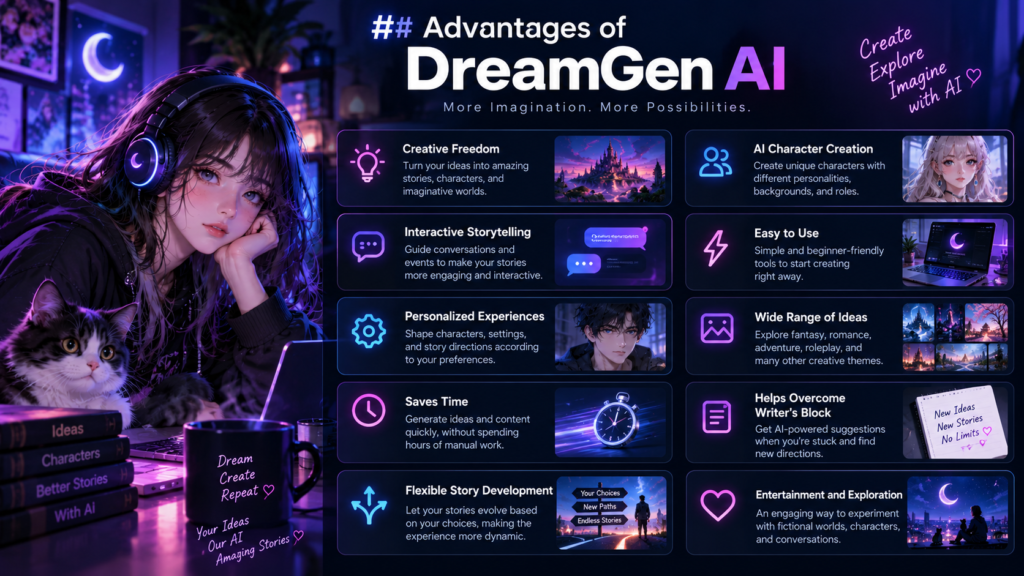
DreamGen has several characteristics that make it appealing to creative users.
Strong storytelling focus: The platform is designed specifically around creative narratives and role-play.
Scenario flexibility: Users can create structured fictional environments instead of relying entirely on one-off prompts.
Multiple characters: Stories can involve several characters, making more complex interactions possible.
Reusable story components: Characters, personas, locations, and other elements can be reused across creative projects.
Narrative control: Users can actively influence the direction of a story instead of leaving every decision to the AI.
Free entry point: A free option allows users to explore the platform before deciding whether a paid plan is worthwhile.
Limitations and Things to Consider
DreamGen is not automatically the best AI tool for every type of writer.
The first major limitation is AI consistency. Even with structured scenarios and larger context windows, generative AI can make mistakes. Characters may behave inconsistently, details can change, and the model may introduce events that conflict with the intended plot.
Another issue is creative control versus unpredictability. Unexpected AI-generated ideas can be useful, but they can also become frustrating when you need strict control over the storyline.
Cost is another consideration for heavy users. While a free tier can be useful for testing, frequent generation may require a paid subscription.
Privacy is also worth considering. Like other online AI platforms, users should understand how their information and prompts are handled before entering sensitive personal information.
For fictional writing, this usually is not a major concern. However, users should avoid putting confidential business information, private documents, passwords, financial information, or other sensitive material into creative prompts.
Is DreamGen AI Good for Beginners?
DreamGen can be a good starting point for people interested in AI-assisted storytelling because users do not need advanced knowledge of machine learning or programming.
You do not need to understand APIs, fine-tuning, retrieval-augmented generation, or model architecture to start creating scenarios.
A beginner-friendly workflow looks like this:
- Start with a simple story idea.
- Develop the premise into a scenario.
- Review the characters and setting.
- Correct details that do not match your idea.
- Begin writing or role-playing.
- Give clear instructions when you want to change the story.
- Save useful characters and world elements for future projects.
The most important lesson is not to assume the AI will automatically understand every detail of your fictional universe. Important rules, character motivations, relationships, and plot constraints should be stated clearly.
DreamGen AI vs. a General AI Chatbot
DreamGen and general-purpose AI assistants can both generate stories, but they are designed for different purposes.
| Aspect | DreamGen AI | General AI Chatbot |
|---|---|---|
| Primary focus | Storytelling and role-play | Broad range of tasks |
| Character scenarios | Core feature | Usually prompt-dependent |
| Worldbuilding | Structured workflow | Often manual |
| Multiple characters | Supported | Depends on the platform |
| Creative steering | Central to the experience | Usually instruction-based |
| Productivity | More limited | Usually broader |
| Interactive fiction | Major use case | Possible but less specialized |
The important difference is specialization.
A general AI chatbot may be better for research, coding, analysis, writing business documents, and productivity. DreamGen is more specifically designed for people who want to build and interact with fictional worlds.
How to Get Better Results From DreamGen AI
The quality of an AI-generated story depends heavily on the information and instructions you provide.
Instead of writing:
“Make a fantasy story.”
you could provide more creative direction:
“Create a dark fantasy story about a young cartographer who discovers that the maps she draws can change the real world. Keep the tone mysterious and character-driven, with gradual reveals rather than immediate explanations.”
The second prompt provides useful constraints involving the genre, protagonist, central idea, tone, and pacing.
For longer projects, define important facts clearly. Character motivations, relationships, setting rules, and major plot constraints are easier for an AI system to follow when they are explicitly stated.
It is also better to correct major continuity problems early. If an AI repeatedly receives incorrect information, later scenes can become increasingly difficult to control.
Is DreamGen AI Worth Using?
DreamGen makes the most sense for people whose main interests are AI-assisted storytelling, role-play, worldbuilding, and interactive fiction.
It is less suitable if your primary objective is business research, programming, document analysis, spreadsheet automation, or general productivity.
For creative users, however, its combination of scenario creation, multiple characters, reusable entities, narrative steering, story writing, role-play, and image generation creates a more specialized experience than a conventional chatbot.
The easiest way to evaluate it is to begin with the free option and test the experience yourself. Pay attention to character consistency, instruction following, scene quality, and how well the platform handles longer narratives.
Frequently Asked Questions About DreamGen AI
Is DreamGen AI free?
DreamGen provides a free tier as well as paid subscription options. Free usage is limited compared with paid plans, and specific allowances can change over time.
What is DreamGen AI mainly used for?
It is mainly designed for AI-assisted storytelling, interactive fiction, role-play, character creation, and worldbuilding.
Can DreamGen AI create characters?
Yes. Character creation is an important part of the platform, and users can create characters for use within their scenarios.
Does DreamGen AI support multiple characters?
Yes. Its scenario-based system can support multiple characters, making it suitable for more complex role-playing and storytelling situations.
Does DreamGen AI generate images?
Yes. Image generation is one of the creative capabilities offered by the platform.
What is a context window?
A context window is the amount of information an AI model can consider when generating a response. Larger context capacity can be helpful for maintaining details in longer stories, although it does not guarantee perfect consistency.
Can DreamGen replace a human writer?
No. DreamGen can assist with ideas, scenes, dialogue, characters, and interactive narratives, but human judgment is still important for originality, characterization, pacing, continuity, and final editing.
Conclusion
DreamGen AI is best understood as a specialized creative AI platform rather than a general-purpose chatbot. Its strongest appeal comes from combining AI-generated writing with structured scenarios, characters, personas, worldbuilding, role-play, and narrative control.
For someone who simply needs an AI assistant for everyday questions, research, coding, or productivity, a general-purpose platform may be a better fit. For interactive fiction and collaborative storytelling, however, DreamGen offers a workflow built specifically around those activities.
The most important thing to remember is that AI remains unpredictable. It can generate engaging scenes and unexpected ideas, but it can also introduce continuity errors or misunderstand instructions. DreamGen’s structured tools can make creative control easier, but the best results still come from users who actively guide, review, and edit the story.
[…] Perchance AI Character Generator: Complete Guide DreamGen AI: Features, Pricing, Uses, and Complete Guide Clever AI Humanizer: Features, Uses, Limits, and How It Works Character Tavern: Create and […]