


Machine Learning Research News: Breakthroughs, Trends, and What Matters

Machine learning research news helps readers understand how artificial intelligence is advancing, from more capable language models to scientific discoveries, robotics, and efficient computing. Researchers are continually exploring better ways to train models, improve accuracy, reduce computing costs, and make AI systems more reliable. However, not every research announcement represents a practical breakthrough. Some developments remain experimental, while others gradually become useful tools for businesses, developers, and everyday users.
Following machine learning research news means looking beyond headlines to understand what researchers actually demonstrated, how their methods compare with existing approaches, and whether independent testing supports their conclusions. Important developments can emerge from university laboratories, research organizations, technology companies, and open-source communities. This article explores the major research areas worth watching, explains how to evaluate new findings, and identifies reliable sources for keeping up with developments in machine learning without getting distracted by exaggerated claims.
What Is Machine Learning Research News?
Machine learning research news covers new methods, experiments, models, datasets, and scientific findings involving systems that learn patterns from data. These developments can improve how computers recognize images, understand language, predict outcomes, generate content, or make decisions.
Unlike ordinary AI product news, research reporting focuses on what has been discovered, how it was tested, and what the results mean.
For example, a technology company might announce an AI assistant with a new feature. A research paper could instead explain a training technique that allows a model to achieve comparable results with less data or computing power. The second development might eventually influence many products, even if it is not immediately available to the public.
Machine learning research news commonly covers:
- Large language models: Improvements in reasoning, language understanding, coding, and information retrieval.
- Deep learning: New neural network architectures and training techniques.
- Computer vision: Advances in image recognition, video analysis, and visual generation.
- Reinforcement learning: Methods that help systems learn through actions and feedback.
- Scientific machine learning: Applications in biology, medicine, climate research, chemistry, and materials science.
- Efficient AI: Techniques that reduce memory requirements, training costs, or inference time.
- AI safety: Research into reliability, robustness, privacy, and the behavior of advanced models.
These areas overlap. A single research project might combine language models, reinforcement learning, and scientific computing to address a complicated problem.
Latest Machine Learning Research News and Developments in 2026
Several current research directions illustrate how machine learning is moving beyond text generation toward scientific discovery, more capable reasoning, and practical systems that interact with the real world.
Research announcements should be evaluated carefully. Some describe early experiments, while others report results that have undergone more extensive testing. An announcement alone does not establish that a new capability is ready for widespread use.
1. AI Agents Are Helping Researchers Investigate Biological Data
Researchers are exploring how distributed AI agents can help investigate large biological datasets, identify patterns, and prioritize promising scientific questions.
This direction matters because biological datasets can contain enormous numbers of relationships that are difficult to investigate manually. Machine learning systems can help researchers search for patterns, organize evidence, and prioritize questions for further investigation.
However, identifying a promising pattern is not the same as proving a biological mechanism. Researchers still need appropriate experiments, statistical validation, and scientific interpretation before treating a computational result as an established discovery.
2. AI Research in Mathematics Is Moving Toward Verifiable Results
AI systems are increasingly being investigated for mathematical reasoning, theorem proving, and assistance with formal proofs.
Formal verification is important because a convincing explanation can still contain a logical error. Proof assistants such as Lean check whether a proof follows the rules of a formal mathematical system.
This approach offers a useful model for other AI applications: instead of relying only on fluent answers, researchers can build systems that produce outputs that independent tools can check. Formal verification does not solve every problem, but it can make certain claims substantially easier to validate.
3. AI-Assisted Healthcare and Scientific Discovery
Machine learning researchers are investigating applications in medical imaging, biological research, geospatial analysis, and technical-document processing.
In healthcare, AI may help interpret medical images or support clinicians in settings with limited specialist access. Geospatial systems can help analyze information about the Earth’s surface, while document-analysis systems can assist with complicated technical material.
The practical value depends on more than model performance. Researchers must also assess whether a system works across different populations, handles uncertain inputs, protects sensitive information, and supports rather than replaces appropriate human judgment.
4. Efficient AI Hardware Remains Important
Hardware research is closely connected to machine learning progress. Training and running advanced models can require substantial computing resources, memory, electricity, and specialized infrastructure.
Researchers therefore investigate more efficient accelerators, memory systems, and computing methods. Improvements in these areas can make larger experiments practical or help organizations run models at lower cost.
Yet a faster chip alone does not guarantee a better AI model. Software optimization, model architecture, data quality, and the nature of the task all influence the final result.
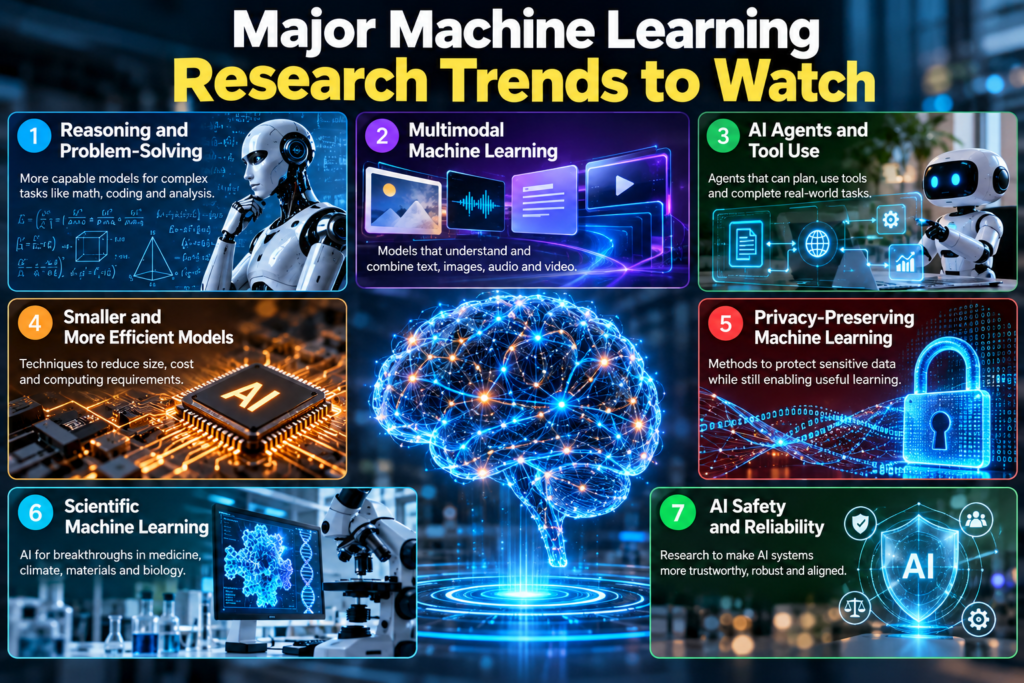
Major Machine Learning Research Trends
Beyond individual announcements, several broader research areas deserve attention because they address persistent technical challenges.
Reasoning and Problem-Solving
Researchers continue to investigate how models approach complex tasks that require multiple steps, such as mathematical proofs, software debugging, and scientific analysis.
One important distinction is between producing an answer that sounds logical and producing a result that is correct. Useful evaluations should test whether a model reaches the right outcome on unfamiliar problems, not simply whether it explains familiar examples convincingly.
Multimodal Machine Learning
Multimodal models process more than one type of information, such as text, images, audio, or video. This allows researchers to explore tasks that require combining several sources of evidence.
For example, a hypothetical industrial inspection system might examine a machine’s image while analyzing recorded operating sounds. Combining these inputs could help identify possible faults, but the system would still need testing against real equipment and known failure conditions.
AI Agents and Tool Use
An AI agent can use tools, retrieve information, or carry out a sequence of actions toward a goal. Research in this area examines how systems plan, recover from errors, maintain context, and interact with software or physical equipment.
The important challenge is reliability. An agent that completes a demonstration successfully may still struggle with unexpected inputs, long workflows, or irreversible actions. Strong research evaluates complete tasks, including mistakes and recovery, rather than focusing only on individual successful steps.
Smaller and More Efficient Models
Large models can perform a broad range of tasks, but they may be expensive to train and operate. Researchers are exploring methods such as quantization, pruning, knowledge distillation, and parameter-efficient fine-tuning.
These techniques address different problems:
- Quantization: Uses lower-precision numerical representations to reduce memory use and potentially speed up computation.
- Pruning: Removes selected model components or connections to make a model smaller.
- Knowledge distillation: Trains a smaller model to reproduce useful behavior from a larger one.
- Parameter-efficient fine-tuning: Adapts a model by training a relatively small set of additional or selected parameters.
Each technique involves trade-offs. A smaller model may be easier to deploy, but compression or adaptation can reduce performance on some tasks. Researchers need to measure accuracy, latency, memory use, and cost together.
Privacy-Preserving Machine Learning
Machine learning often depends on data that can contain personal, medical, or commercially sensitive information. Research into federated learning, differential privacy, and secure computation explores ways to reduce exposure while retaining useful learning capabilities.
Federated learning can allow models to learn from data held across multiple devices or organizations without collecting all raw records in one central location. However, keeping raw data local does not automatically guarantee privacy. The learning process and information shared between participants must also be evaluated for potential leakage.
How Machine Learning Research Works
Machine learning research follows a structured process. The exact method depends on whether researchers are developing a new algorithm, testing an existing model, or applying AI to a scientific problem.
- Define the research question: Researchers identify a specific problem, such as reducing model errors, improving image recognition, or making training more efficient.
- Prepare data and a baseline: They select suitable datasets, check data quality, and establish how existing methods perform before introducing changes.
- Run experiments: Researchers train or adapt models, compare different approaches, and record the results under controlled conditions.
- Evaluate performance: They test accuracy, robustness, computing requirements, and possible failure cases using appropriate metrics.
- Share and validate findings: Results may appear in a research paper, preprint, technical report, or open-source implementation. Other researchers can examine or attempt to reproduce the findings.
Consider a hypothetical research team developing a model to detect defective products on a factory production line. The team might compare a new vision model with an existing baseline, test both on images collected under different lighting conditions, and measure missed defects as well as false alarms.
If the new model performs better only on the original dataset, the improvement may not transfer to real factories. Testing unfamiliar examples is therefore just as important as reporting a high benchmark score.

Best Sources for Machine Learning Research News
Finding reliable information is easier when you follow primary research sources alongside independent reporting. Official announcements explain what an organization claims to have achieved, while research papers and external evaluations help establish how strong the evidence is.
1. arXiv
arXiv is an open-access repository for scientific preprints. It is a useful starting point for new work in machine learning, computer vision, natural language processing, and AI theory.
Researchers often share papers before formal publication, allowing readers to discover emerging methods early. However, preprints are not necessarily peer-reviewed, and their findings may change after further investigation.
2. Google DeepMind
Google DeepMind publishes research covering AI models, robotics, scientific discovery, model development, and AI safety.
Its research announcements can help readers understand what a major AI research organization is investigating. For important claims, it is still worth examining the underlying paper, evaluation methods, and independent evidence.
3. OpenAI
OpenAI publishes research on model capabilities, mathematical reasoning, safety evaluations, scientific applications, and other AI developments.
Technical reports and research papers can help readers understand how AI systems are developed and evaluated. Company announcements should be distinguished from independent assessments, particularly when they compare products or models.
4. Google Research
Google Research covers machine intelligence, privacy, health, computing systems, and scientific applications.
Its work is useful for readers interested in both theoretical advances and practical applications. Research publications can also reveal how machine learning connects with fields outside conventional AI development.
5. Nature
Nature provides scientific publishing and research journalism. Its reporting can help readers understand the significance, limitations, and broader scientific context of AI research.
Other useful sources include NeurIPS, ICML, and ICLR. Their conference papers and proceedings provide a route into peer-reviewed machine learning research.
How to Evaluate a Machine Learning Research Breakthrough
A headline may describe a system as more intelligent, faster, or more accurate. Those descriptions are useful only when you understand the evidence behind them.
Before treating a research announcement as a genuine breakthrough, ask these questions:
- Was the work peer-reviewed? Peer review can improve a paper, but publication alone does not guarantee that every claim is correct.
- What was the baseline? A model’s performance should be compared with an appropriate existing method, not an unnecessarily weak competitor.
- Which benchmark was used? A strong result on one dataset does not prove that a model performs well across different tasks.
- Were the results independently reproduced? Independent confirmation can reveal problems that the original team missed.
- What resources were required? A small performance improvement may be less attractive if it requires substantially more computing power.
- Are the limitations disclosed? Good research explains failure cases, uncertainty, and the conditions under which the findings apply.
Understand the Difference Between a Preprint and a Verified Result
A preprint is a research paper shared publicly before formal journal or conference review. It can provide early access to important work, but its findings may change after feedback or further experiments.
Likewise, an official company blog can be a valuable primary source without being an independent evaluation. When a company reports that its model outperforms competitors, check the methodology, test conditions, and available external evidence before drawing conclusions.
Practical Applications of Machine Learning Research
Research becomes especially valuable when it solves a problem that matters outside a laboratory. The following examples illustrate how findings can translate into practical applications.
| Research area | Potential application | Important limitation |
|---|---|---|
| Natural language processing | Document search, summarization, and translation | Models can misinterpret context or generate incorrect information |
| Computer vision | Quality inspection and image analysis | Performance may decline under unfamiliar conditions |
| Predictive modeling | Demand forecasting and equipment maintenance | Historical patterns may not reflect future conditions |
| Scientific machine learning | Protein analysis and materials discovery | Computational predictions often need experimental validation |
| Reinforcement learning | Robotics and sequential decision-making | Training in simulation may not transfer directly to reality |
| Privacy-preserving AI | Learning from sensitive or distributed data | Privacy guarantees depend on the method and implementation |
For a small business, an important result might be a model that classifies customer-support messages accurately while running on affordable hardware. For a hospital research team, a more relevant breakthrough might be an image-analysis method that performs consistently across different scanners.
The best development is not necessarily the one with the largest model or most impressive demonstration. It is the one that reliably improves a clearly defined task under realistic conditions.
Benefits and Limitations of Machine Learning Research
Following research news helps readers make better decisions about AI adoption, investment, education, and technical development. It also provides insight into the problems that researchers have not yet solved.
Key benefits include:
- Early awareness of new methods and emerging applications.
- Better understanding of AI capabilities and technical limitations.
- Opportunities to discover open-source models, datasets, and research tools.
- More informed decisions about adopting AI in business or scientific work.
- A clearer picture of developments in safety, privacy, and computing efficiency.
There are also important limitations. Research findings can be difficult to reproduce, and some studies rely on narrow benchmarks or expensive infrastructure. Commercial announcements may emphasize impressive results without fully explaining the trade-offs. Even promising methods can take years to become dependable products.
Another challenge is the volume of publications. Reading every new paper is unrealistic for most people. A focused approach—following a few relevant research areas and reviewing high-quality summaries—usually provides more value than constantly checking every announcement.
How to Follow Machine Learning Research News Efficiently
You do not need an advanced degree in mathematics to understand the main developments. A consistent reading routine and a few basic evaluation skills are enough to get started.
- Choose two or three research areas. Start with topics relevant to your work, such as generative AI, computer vision, AI agents, or scientific discovery.
- Check primary sources. Read the original paper or official research announcement whenever a finding could affect an important decision.
- Read the abstract first. Identify the problem, proposed method, main result, and stated limitations before reading the technical details.
- Inspect the evaluation. Look for benchmark definitions, comparison methods, test datasets, and evidence of reproducibility.
- Separate research from product availability. A model or technique described in a paper may not be publicly accessible or ready for commercial deployment.
- Keep brief research notes. Record the paper’s main contribution, evidence, limitations, and potential applications.
- Review developments weekly. A regular summary is more manageable than trying to follow every announcement in real time.
A Simple Research-Reading Example
Suppose you encounter a headline claiming that a new model dramatically improves medical image analysis.
Instead of accepting the headline, investigate the dataset used, the existing methods it was compared against, the number and variety of test cases, and whether the authors assessed false positives and false negatives. Then check whether independent researchers have confirmed the result.
This approach helps you distinguish a promising experiment from a method that may be ready for clinical evaluation. It also prevents a common mistake: assuming that a high benchmark score automatically translates into better outcomes in real-world settings.
The Future of Machine Learning Research
Several questions will shape machine learning research in the coming years: Can models become more reliable at complex reasoning? Can scientific AI accelerate discoveries while preserving rigorous validation? Can useful systems run with less energy and computing power? And can researchers develop better methods for protecting data and measuring model safety?
AI-assisted research itself is also an important area to watch. Systems that search scientific literature, suggest hypotheses, analyze results, or help design experiments may speed up parts of the research process. However, automating individual tasks is not the same as independently conducting reliable science from beginning to end.
Progress will depend on more than larger models. Better datasets, carefully designed experiments, efficient hardware, transparent evaluations, and human expertise will remain essential. The most meaningful advances are likely to be those that demonstrate measurable improvements and withstand independent scrutiny, rather than those that simply attract attention.
For readers tracking machine learning research news, the most useful habit is to follow both the exciting results and the unresolved problems. Together, they offer a more realistic picture of how the field is developing.
Frequently Asked Questions
1. What Is Machine Learning Research News?
It covers new machine learning methods, models, experiments, scientific findings, and technical developments reported by researchers, universities, and AI organizations.
2. Where Can I Read the Latest Machine Learning Research?
Start with arXiv, Google DeepMind, Google Research, OpenAI Research, and established scientific publications.
3. Is Machine Learning Research Always Peer-Reviewed?
No. Many findings appear first as preprints, technical reports, or company announcements. Their publication status should be checked individually.
4. What Are the Biggest Areas of Machine Learning Research?
Major areas include language models, multimodal AI, computer vision, robotics, scientific discovery, model efficiency, and privacy-preserving learning.
5. How Can Beginners Understand AI Research Papers?
Start with the abstract, introduction, main results, and limitations. Learn unfamiliar terms as needed and focus on what the researchers tested and demonstrated.
6. Why Do Machine Learning Research Results Sometimes Fail in Practice?
Research models may perform well on limited datasets but struggle with unfamiliar inputs, changing conditions, biased data, or real-world constraints.
7. How Often Should I Follow Machine Learning Research News?
A weekly review is a practical starting point for most readers. Check urgent developments more frequently only when they directly affect your work.
Conclusion
Machine learning research news is most valuable when it explains not only what researchers have achieved but also how they reached their conclusions and where their methods fall short. Developments in reasoning, scientific discovery, multimodal systems, efficient computing, and privacy-preserving learning are expanding the possibilities for AI across many fields.
However, a promising paper is not automatically a reliable product, and a company announcement is not the same as independent scientific confirmation. Readers should examine benchmarks, research methods, limitations, and reproducibility before judging the importance of a breakthrough.
For beginners, the best starting point is to follow a few trusted research sources, choose topics that match their interests, and review findings consistently. This approach builds a clearer understanding of machine learning while separating meaningful progress from temporary hype.