

Amazon: How It Works, What It Sells, and What to Know

Amazon is one of the world’s best-known technology companies, combining online shopping with digital entertainment, subscription services, logistics, and cloud computing. For most customers, Amazon means buying products through its website or app. However, the company also provides services that businesses, developers, content creators, and software companies use every day.
Understanding Amazon requires looking beyond its product listings. The platform operates as both a retailer and a marketplace where independent sellers offer goods to customers. It also runs services such as Amazon Prime, Kindle, Audible, and Amazon Web Services (AWS), each serving a different purpose.
Whether you want to shop online, start selling products, use digital services, or learn how Amazon makes money, it helps to understand how the business works. This guide explains its main services, ordering process, seller model, advantages, limitations, privacy considerations, and alternatives. It also covers practical steps you can take to shop more confidently and avoid common online marketplace risks.
What Is Amazon?
Amazon is a multinational technology company founded by Jeff Bezos in 1994. It began as an online bookstore and expanded into a broad commercial and technology business. Its online bookstore launched in 1995.
Today, Amazon operates across several major areas:
- E-commerce: Online shopping for electronics, clothing, books, household products, and many other goods.
- Third-party marketplace: A platform where independent businesses and individuals can sell products to customers.
- Subscription services: Amazon Prime offers eligible members a package of benefits that varies by country.
- Digital content: Kindle supports digital reading, while Audible focuses on audiobooks and spoken-word content.
- Entertainment: Prime Video provides streaming entertainment, with availability and subscription arrangements varying by market.
- Cloud computing: Amazon Web Services provides computing, storage, databases, networking, and AI infrastructure to organizations.
- Devices and technology: Products include Kindle e-readers, Fire TV devices, and Echo smart speakers.
Amazon is therefore more than an online shop. It operates a large technology and distribution ecosystem that connects customers, sellers, delivery networks, developers, and businesses.
How Does Amazon Work?
Amazon connects customers with products and services through websites, mobile applications, seller tools, payment systems, and fulfillment networks. The exact process depends on whether a product is sold directly by Amazon or by an independent merchant.
1. Customers Search for Products
A customer enters a product name into Amazon’s search bar or browses a category. The platform displays relevant listings with prices, product descriptions, photographs, delivery estimates, and customer reviews where available.
Search results can depend on several factors, including relevance, availability, customer preferences, and sponsored placements. The first result is not necessarily the cheapest or best product.
2. Customers Compare Listings
Product pages provide information that helps shoppers evaluate different options. Depending on the listing, this may include technical specifications, sizes, colors, return eligibility, seller details, and warranty information.
For example, someone buying a laptop can compare memory, storage, processor specifications, screen size, and delivery options before choosing a model.
3. The Order Is Placed
After adding an item to the cart, the customer proceeds to checkout, confirms the delivery address, selects an available payment method, and reviews the final cost.
The total can include taxes, shipping charges, import duties, or other applicable fees, depending on the product and destination.
4. The Order Is Fulfilled
The product may be shipped by Amazon, dispatched by a third-party seller, or handled through a combination of seller and Amazon logistics services.
Amazon fulfillment centers store and process inventory. Depending on the service and order, warehouse systems, employees, automated equipment, and delivery partners help move products toward customers.
5. Customers Receive Support
Depending on the order and seller arrangement, customers may be able to track deliveries, request eligible returns, report damaged items, or contact customer support.
Important distinction: Amazon does not necessarily manufacture, stock, or ship every product listed on its marketplace. The seller and fulfillment arrangement affect how an order is handled.
Main Amazon Services and What They Offer
Amazon’s services serve different needs. Some focus on shopping, while others provide entertainment, publishing tools, or technology infrastructure.
Amazon Online Store
The main shopping platform offers products across categories such as electronics, fashion, home goods, books, beauty, and groceries in supported markets. Product availability, delivery options, and prices depend on the regional store.
Amazon Prime
Prime is a paid membership that can include eligible delivery benefits, video entertainment, and other perks. Benefits and fees vary by country, and not every item or video is necessarily included.
Kindle
Kindle provides access to digital books through dedicated e-readers and compatible apps. Readers can purchase ebooks and, where available, use subscription reading services.
Amazon Web Services (AWS)
AWS provides cloud infrastructure and managed services for websites, databases, software applications, data analysis, and artificial intelligence. Businesses can rent computing resources instead of operating all their own servers.
Echo and Alexa
Echo devices use Alexa for supported voice interactions, such as playing music, answering questions, setting timers, and controlling compatible smart-home devices. Features depend on the device, software, and region.
Kindle Direct Publishing (KDP)
KDP enables authors and publishers to publish eligible digital books and paperbacks. Authors can distribute their work through Amazon’s bookstore, subject to the platform’s content rules and publishing terms.
These services are connected through Amazon’s wider business, but each has different terms, costs, and eligibility requirements.
How Does Amazon Make Money?
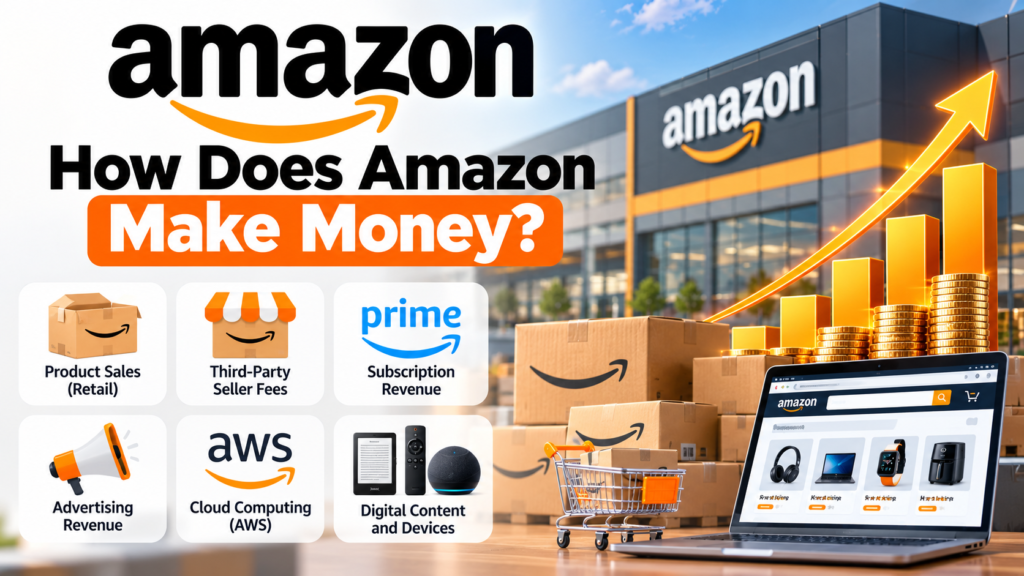
Amazon generates revenue through several business models rather than relying entirely on product sales.
Retail Sales
Amazon purchases products from suppliers and resells them to customers. In these transactions, the company earns revenue from the sale, while the remaining amount after relevant costs contributes to profit or loss.
Third-Party Seller Fees
Independent merchants can list products on Amazon. Depending on their selling plan and business model, they may pay referral fees, subscription fees, fulfillment charges, storage fees, or other applicable costs.
For example, a merchant selling phone accessories might handle storage and shipping independently or use Fulfillment by Amazon. Each approach changes the merchant’s operating costs and responsibilities.
Subscription Revenue
Membership programs and digital subscriptions generate recurring revenue. Amazon Prime is a prominent example, although subscription terms and included benefits vary by market.
Advertising
Businesses can pay for advertising placements that help their products appear in relevant shopping results and other eligible locations. Sponsored listings should be distinguished from ordinary search results.
Cloud Computing
AWS charges customers for cloud services according to applicable pricing models. A company might pay for computing capacity, data storage, database services, or AI infrastructure based on its usage and chosen service configuration.
The important distinction is that revenue is not the same as profit. Warehousing, shipping, technology development, employee costs, customer service, and infrastructure all affect profitability.
How to Shop on Amazon Safely
Amazon provides tools for comparing products and managing orders, but customers should still evaluate sellers and listings carefully. A familiar platform does not guarantee that every third-party product will meet expectations.
Steps for a Safer Purchase
- Check the seller. Review the seller’s profile, ratings, and available feedback. Pay attention to recent reviews as well as the overall score.
- Read the product description. Confirm the model number, dimensions, compatibility, included accessories, and other specifications.
- Evaluate reviews critically. Look for detailed reviews describing actual use. Repeated generic wording or reviews that discuss a different product variation may provide little useful information.
- Compare the total price. Consider delivery fees, taxes, import charges, and possible currency conversion costs.
- Review the return policy. Return windows, conditions, and shipping responsibilities can differ by item and seller.
- Use official payment and messaging channels. Avoid requests to pay outside Amazon or to share passwords, verification codes, or sensitive account information.
- Save order records. Keep receipts, order confirmations, warranty details, and relevant communications until the purchase is resolved.
How to Recognize a Suspicious Listing
Be cautious when a listing has an unusually low price, inconsistent product photographs, vague specifications, or a seller asking you to complete payment elsewhere.
A high rating alone does not establish authenticity. For expensive electronics, branded accessories, cosmetics, or other products where counterfeiting can be a concern, check the exact model, seller information, manufacturer documentation, and return eligibility.
If a seller sends an unexpected link or requests account credentials, do not follow it. Open Amazon directly through its official app or website instead.
Is Amazon Safe and Legitimate?
Amazon is a legitimate, established company, but the safety of an individual transaction depends on the product, seller, payment method, and circumstances. The distinction between the platform and individual marketplace merchants matters.
Amazon’s marketplace includes third-party businesses, so product quality, authenticity, shipping performance, and customer service can vary. Its policies and support processes can help resolve eligible problems, but they do not eliminate every risk.
Before purchasing, consider three questions:
- Is the seller identifiable and reasonably trustworthy?
- Does the listing provide enough detail to confirm the product is suitable?
- Can you return the item or seek help if it arrives damaged or differs materially from its description?
Privacy is another consideration. Amazon collects information needed to operate its services, which may include account details, order history, delivery information, and interactions with its products. The information collected and its uses depend on the service and applicable privacy settings.
Customers should review Amazon’s privacy notice, limit unnecessary permissions, secure their accounts with strong authentication, and avoid sharing sensitive information in reviews or customer-service messages.

Can You Make Money Selling on Amazon?
Yes. Amazon provides tools for businesses and individuals who want to sell physical products, subject to marketplace eligibility and applicable rules. However, selling successfully requires more than listing a product and waiting for orders.
How Selling on Amazon Works
A seller generally follows these steps:
- Choose a product: Research customer demand, competition, pricing, and potential profit.
- Create a seller account: Register through the appropriate Amazon marketplace and complete its verification requirements.
- Create product listings: Add accurate titles, descriptions, photographs, specifications, and relevant product identifiers.
- Set prices: Calculate product costs, marketplace fees, shipping, advertising, and expected returns.
- Fulfill orders: Ship products yourself or use Fulfillment by Amazon (FBA) when available and suitable.
- Monitor performance: Review sales, customer feedback, inventory levels, returns, and account health.
What Does It Cost to Sell?
Amazon’s fees vary by marketplace, product category, selling plan, and fulfillment method.
For example, Amazon’s US pricing structure has listed an Individual selling plan at $0.99 per item sold and a Professional plan at $39.99 per month, alongside applicable selling fees. These are US marketplace figures, not universal prices. Confirm current fees before registering.
Before investing, estimate the profit on each sale:
| Cost or revenue item | Example |
|---|---|
| Selling price | $30.00 |
| Product cost | $10.00 |
| Marketplace and fulfillment fees | $7.00 |
| Advertising and other variable costs | $4.00 |
| Illustrative remaining amount | $9.00 |
This is a hypothetical example, not an Amazon fee quote. Actual fees, shipping, taxes, returns, and other expenses may change the result.
A product that sells frequently can still lose money if its margins are too low. Calculate all costs before committing to inventory.
Amazon vs. Other Online Shopping Platforms
Amazon is not the only option for online shopping. The best alternative depends on the product, country, delivery requirements, and whether you prefer buying from a large marketplace or a specialist retailer.
| Platform | Best suited for | Main consideration |
|---|---|---|
| Amazon | Broad product selection and multiple sellers | Check seller quality and listing details |
| eBay | New, used, collectible, and refurbished items | Condition and seller terms vary |
| Walmart | General merchandise and groceries in supported markets | Availability depends on location |
| Etsy | Handmade items, personalized gifts, and vintage goods | Product selection is more specialized |
| Official brand websites | Buying directly from a manufacturer or brand | Selection, shipping, and prices differ by brand |
These platforms are not interchangeable in every country. For example, a shopper in Pakistan may find that some international marketplaces do not offer direct delivery for a particular product. Import costs, local availability, and warranty coverage can make a domestic retailer a better choice.
Compare the final delivered price and return conditions rather than choosing a platform solely because its advertised price is lower.
Common Amazon Problems and How to Handle Them
Even when an order is placed correctly, issues can arise. Knowing the appropriate response can save time and help protect your money.
An Order Has Not Arrived
Open your order history and review the latest tracking information. Check the estimated delivery date and any carrier updates before contacting customer support or the seller.
The Product Is Damaged or Incorrect
Document the problem with photographs where appropriate. Open the order in your account and follow the available return, replacement, or refund process. Keep the original packaging until you understand the return requirements.
You Cannot Return an Item
Not every product is eligible for return under the same conditions. Check the product page, order history, and applicable marketplace policy. Digital goods, customized products, and certain other categories may have different restrictions.
You Suspect a Fraudulent Seller
Use Amazon’s official reporting and customer-support channels. Keep communications and payments within the platform, and do not send additional money to a seller who asks you to bypass the normal checkout process.
You Are Charged Unexpectedly
Review your order total, subscription settings, and account activity. If a charge remains unexplained, contact Amazon through its official help service and contact your payment provider if necessary.
The Role of Technology and AI at Amazon
Although shoppers primarily see product pages and delivery updates, Amazon’s wider business relies on technology to coordinate many complex operations.
Product Recommendations and Search
Machine learning can help rank relevant products, personalize recommendations, and identify patterns in customer activity. These systems help customers navigate large catalogs, although sponsored placements and commercial considerations can also influence what appears.
Warehouse Automation
Robotics and software help coordinate inventory movement, product handling, and order processing. Automation can improve operational efficiency, but it does not mean every warehouse task is performed entirely by machines.
Cloud Computing and Generative AI
AWS provides infrastructure and services that businesses can use to train, deploy, and run AI applications. These include computing resources, machine learning tools, and generative AI services.
For example, a software company might use cloud-based AI to summarize customer-support conversations or help employees search internal documents. The company would still need to consider accuracy, privacy, security, and human oversight.
Amazon’s use of AI is therefore broader than a shopping chatbot. It spans customer experiences, cloud infrastructure, and operational systems. However, the existence of an AI capability does not mean every Amazon service uses it in the same way.
Frequently Asked Questions About Amazon
1. What Is Amazon Mainly Used For?
Amazon is primarily known for online shopping, but it also provides subscriptions, digital content, devices, self-publishing tools, and cloud computing services.
2. Is Amazon Free to Use?
Creating an account and browsing products is generally free. Customers pay for purchases and any applicable delivery charges or subscriptions. Optional memberships and services may require payment.
3. Is Amazon Available in Pakistan?
People in Pakistan may be able to purchase eligible products through supported international Amazon stores, depending on shipping restrictions. Not every item can be delivered directly to a Pakistani address, and import duties or additional charges may apply.
4. Can Anyone Sell on Amazon?
Not automatically. Sellers must meet account verification, marketplace eligibility, product compliance, and other requirements. Some products and categories require additional approval.
5. Does Amazon Own Every Product It Sells?
No. Amazon sells some products directly and hosts independent third-party sellers who list and sell their own inventory.
6. How Does Amazon Prime Work?
Amazon Prime is a paid membership offering benefits that can include eligible delivery services and entertainment. The price, available benefits, and terms vary by country.
7. Can I Return a Product Purchased on Amazon?
Many eligible products can be returned, but the deadline and conditions depend on the item, seller, and marketplace. Check the return information in your order history before sending anything back.
Conclusion
Amazon has grown from an online bookstore into a broad commercial and technology business. Its marketplace helps customers discover products and gives independent sellers access to online shoppers, while services such as Prime, Kindle, and AWS address different needs beyond traditional retail.
For customers, the main advantages are convenience, product choice, and access to reviews and order-management tools. However, careful shopping still matters. Seller quality, product authenticity, shipping costs, return eligibility, and privacy deserve attention before making a purchase.
For aspiring sellers, Amazon can provide access to a large marketplace, but profitability depends on product selection, pricing, fees, inventory management, and customer satisfaction. Businesses exploring its cloud services should evaluate technical requirements, security, and costs separately.
Ultimately, the best way to use Amazon is to understand which service meets your needs, compare the available options, and review the relevant terms before spending money.
[…] Machine Learning Research News: Breakthroughs, Trends, and What Matters Amazon: How It Works, What It Sells, and What to Know What Is the Free Model of Google Gemini in 2026? Loona Robot: Features, Price, How It […]