

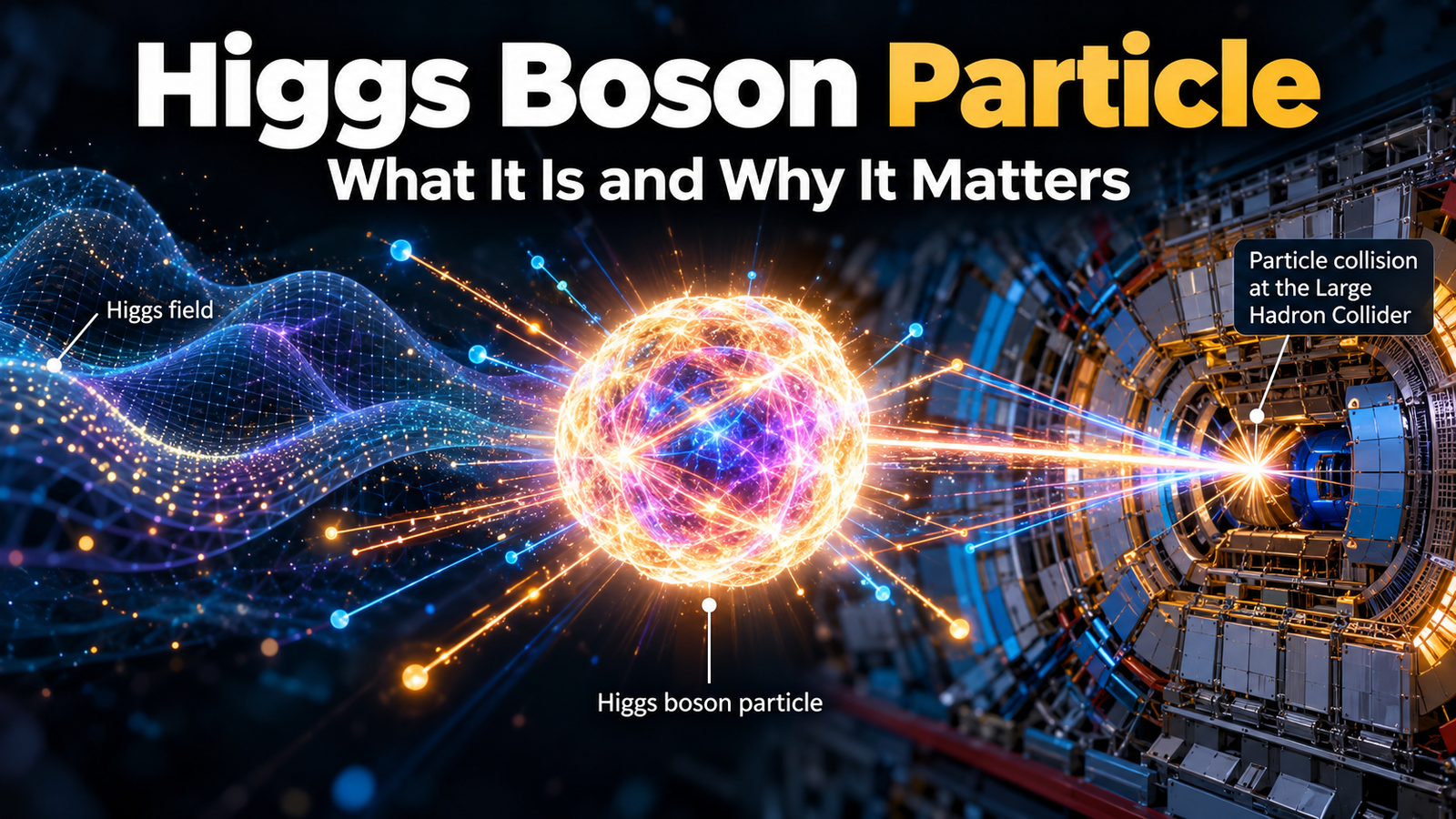
Higgs Boson Particle: What It Is and Why It Matters

The Higgs boson particle is one of the most important discoveries in modern physics. Scientists at CERN announced its discovery on July 4, 2012, providing strong experimental evidence for a mechanism that helps explain why fundamental particles have mass. Often called the “God particle” in popular media, the Higgs boson is a quantum excitation of the Higgs field, which exists throughout space.
The Higgs field has a unique role in the Standard Model, the leading theory describing fundamental particles and three of the four known fundamental forces. However, the Higgs boson does not explain all the mass in the universe, and its discovery did not solve every mystery in physics.
Understanding this particle requires looking at the Higgs field, particle interactions, the Large Hadron Collider, and the experiments that confirmed its existence. This guide explains how the Higgs boson works, why its discovery matters, and what scientists are still trying to learn about it.
What Is the Higgs Boson Particle?
The Higgs boson is an elementary particle associated with the Higgs field, a fundamental field that permeates space. In quantum physics, particles can be understood as excitations of underlying fields. For example, a photon is associated with the electromagnetic field, while the Higgs boson is associated with the Higgs field.
The Higgs field has a special property: even in its lowest-energy state, its value is not zero. This nonzero background value allows certain elementary particles to acquire mass through their interactions with the field.
Without this mechanism, the Standard Model could not explain the observed masses of particles such as the W and Z bosons in its usual formulation. The Higgs mechanism provides a mathematically consistent way to describe those masses while preserving the theory’s underlying structure.
The Higgs boson itself is extremely short-lived. Scientists do not observe it directly as a stable object. Instead, they identify its presence by studying the particles produced when it decays.
What Is the Higgs Field, and How Does It Give Particles Mass?
The Higgs field is more fundamental to the explanation of particle mass than the Higgs boson itself. To understand the difference, imagine a field that exists everywhere in the universe rather than a substance that fills space like an ordinary material.
The field interacts with different elementary particles in different ways. In the Standard Model, these interactions help determine the particles’ masses.
Understanding the Higgs Mechanism
The Higgs mechanism emerged from theoretical work in the 1960s by several physicists, including Peter Higgs, François Englert, and Robert Brout, alongside other researchers who developed related ideas.
Here is how the basic concept works:
- The Higgs field exists throughout space. Its lowest-energy state has a nonzero value.
- Elementary particles interact with the field. Different particles have different interaction strengths.
- These interactions contribute to particle mass. The strength of a particle’s interaction with the Higgs field is related to its mass.
- The Higgs boson represents an excitation of the field. Detecting this particle provides a way to study the field experimentally.
A common analogy compares the Higgs field to a crowd that makes movement more difficult for some people than others. While useful as an introductory illustration, the analogy has limits. The Higgs field does not literally slow particles down through friction, and mass is not simply resistance caused by a physical substance.
The actual explanation comes from quantum field theory and the mathematical structure of the Standard Model.
How Was the Higgs Boson Particle Discovered?
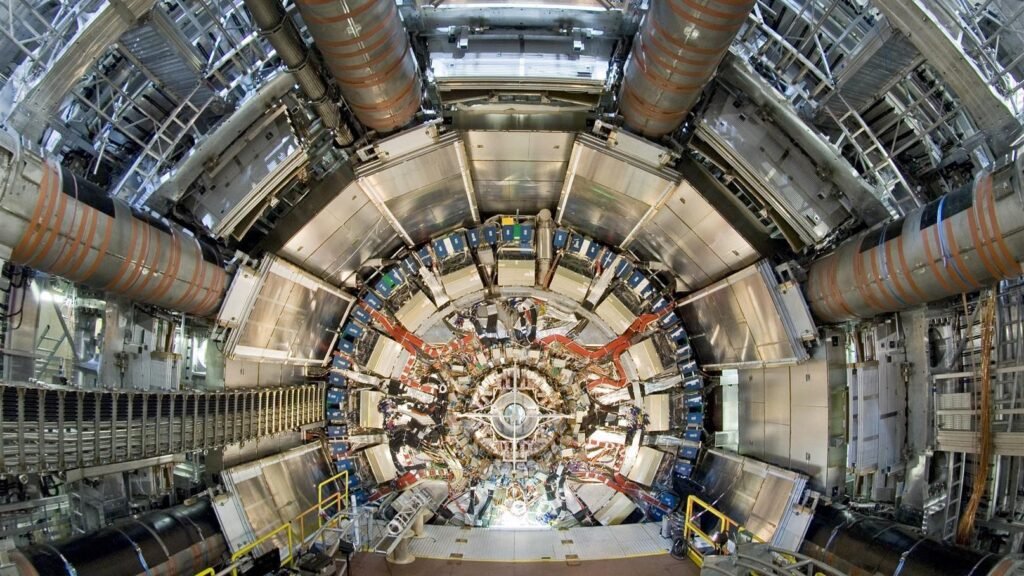
The Higgs boson was discovered at CERN, the European Organization for Nuclear Research, near Geneva, Switzerland. On July 4, 2012, the ATLAS and CMS experimental collaborations announced evidence for a new particle consistent with the Higgs boson. Their findings confirmed a prediction that had remained untested for nearly five decades.
The Role of the Large Hadron Collider
The Large Hadron Collider (LHC) is a powerful particle accelerator that sends beams of protons around a circular tunnel before colliding them at high energies.
These collisions concentrate energy into a tiny region, allowing new particles to be produced under the right conditions. According to the relationship between mass and energy, expressed by Einstein’s equation \(E=mc^2\), collision energy can be converted into the mass of newly created particles.
However, producing a Higgs boson is only the beginning. It decays almost immediately into other particles, leaving no lasting track that researchers can identify as the Higgs itself.
Scientists instead reconstruct its presence from the energies, momenta, and identities of the decay products recorded by detectors. The ATLAS and CMS experiments independently analysed their data and found signals consistent with a particle of approximately 125 giga-electronvolts (GeV).
How Scientists Confirmed the Discovery
Physicists searched for several possible decay patterns, including:
- Two photons, which can produce a relatively clear mass signal.
- Four leptons, often arising through decays involving two Z bosons.
- Other combinations of particles, including products associated with bottom quarks and W bosons.
The difficulty was distinguishing genuine Higgs events from ordinary collisions that could produce similar particles. Researchers compared the observed data with the background expected from known processes.
The discovery reached the conventional five-sigma statistical significance threshold. This corresponds to an extremely small probability of obtaining an excess at least that large from background fluctuations alone under the statistical model used.
The result was not based on a single collision or one unusual event. It emerged from a statistical pattern across many collisions, independently supported by two major experiments.
What Are the Main Properties of the Higgs Boson?
The Higgs boson has several distinctive properties that help scientists understand its place in the Standard Model.
| Property | Explanation |
|---|---|
| Mass | Approximately 125 GeV/c², roughly 133 times the mass of a proton |
| Spin | Zero, making it a scalar particle |
| Electric charge | Zero |
| Lifetime | Approximately \(10^{-22}\) seconds |
| Particle type | Elementary boson associated with the Higgs field |
These properties match the broad expectations for the Standard Model Higgs boson. Measurements of its production and decay also help researchers test whether it behaves as the theory predicts.
Does the Higgs Boson Give Everything Its Mass?
No. This is one of the most important distinctions in particle physics.
The Higgs field helps explain the masses of elementary particles, including electrons and quarks, as well as the W and Z bosons. However, most of the mass of ordinary matter comes from a different source.
Consider a proton. It contains two up quarks and one down quark, but the combined masses of these quarks account for only a small fraction of the proton’s total mass. Most of that mass arises from the energy of the strong nuclear interaction, including the dynamics of quarks and gluons inside the proton.
Einstein’s equation \(E=mc^2\) explains why energy contributes to mass. The energy associated with the strong force is therefore essential to understanding the mass of protons and neutrons.
Since these particles make up most of the mass of ordinary atoms, the Higgs field is not directly responsible for most of the mass of a person, a planet, or a star. Its contribution remains fundamental because it helps establish the properties of the elementary particles that form matter.
Why Is the Higgs Boson Important to Modern Physics?
The Higgs boson matters because it allows scientists to test a central part of the Standard Model experimentally.
Before its discovery, the Higgs mechanism was an important theoretical explanation for how the W and Z bosons could have mass while remaining part of a consistent description of electroweak interactions. Finding the Higgs boson provided strong evidence that the proposed mechanism was physically real.
The discovery also opened a new area of precision research. Scientists can now measure how the Higgs boson interacts with other particles and compare those measurements with theoretical predictions.
Its importance extends to several research questions:
- The Standard Model: Does the Higgs boson behave exactly as predicted?
- Particle masses: Why do elementary particles have such different masses?
- Physics beyond the Standard Model: Could subtle differences in Higgs interactions reveal unknown particles or forces?
- The early universe: What role did the Higgs field play in the universe’s early evolution?
The Higgs boson does not answer all these questions by itself. Rather, it gives physicists a powerful way to investigate them using measurable experimental evidence.
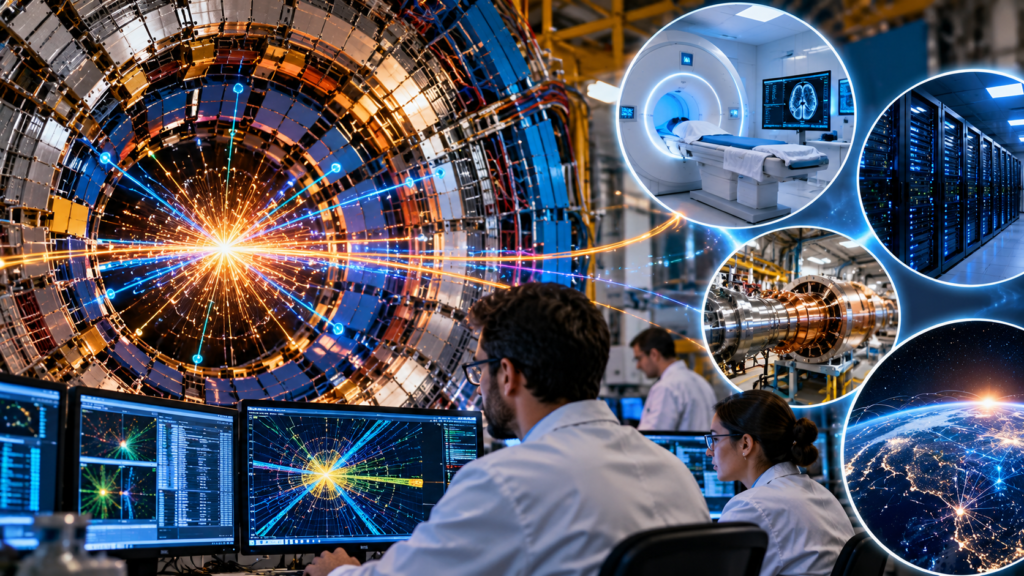
What Are the Real-World Applications of Higgs Boson Research?
Higgs boson research is primarily fundamental science rather than a technology designed for immediate commercial use. There is no established Higgs-based device, energy source, or everyday consumer product.
Nevertheless, the research contributes to scientific and technical capabilities that have broader value.
Particle Detector and Computing Technologies
Experiments at the LHC process enormous amounts of collision data. Researchers rely on sophisticated detectors, fast electronics, statistical methods, distributed computing, and software capable of identifying rare signals among background events.
These systems are developed to meet demanding scientific requirements. Some of the underlying technologies and expertise can also be useful in other fields, although individual applications should be assessed on their own merits.
Medical Imaging and Scientific Instrumentation
Particle physics research has connections to technologies used in medical imaging, radiation detection, and accelerator science. CERN’s broader research environment has contributed to developments in particle-detector technology and computing.
However, it would be misleading to claim that the Higgs boson itself directly produces medical benefits. Such developments arise from wider research programmes, engineering advances, and technology transfer rather than from practical use of Higgs particles.
The most immediate value of Higgs research remains its contribution to understanding the fundamental structure of nature.
What Scientists Still Do Not Know About the Higgs Boson
Discovering the Higgs boson confirmed a major prediction, but important questions remain unresolved.
Why Do Particles Have Such Different Masses?
The Standard Model describes how elementary particles interact with the Higgs field, but it does not explain why their interaction strengths have the particular values observed in nature.
For example, an electron is far lighter than a top quark. The theory accommodates this enormous difference through different couplings to the Higgs field, but it does not provide a deeper explanation for the entire pattern.
Could There Be More Than One Higgs Boson?
Some theories that extend the Standard Model predict additional Higgs-like particles. These could have different masses or interaction properties.
Such particles remain hypothetical unless supported by experimental evidence. Their possible existence is one reason researchers continue searching for deviations from the Standard Model.
What Is the Nature of Dark Matter?
Astronomical observations indicate that the universe contains dark matter, which does not behave like ordinary visible matter. The Standard Model does not provide a complete explanation for this phenomenon.
Scientists investigate whether new particles or interactions could connect dark matter to the Higgs sector. Some theoretical models explore this possibility, but no confirmed discovery has established the Higgs boson as a solution to the dark matter problem.
Common Misconceptions About the Higgs Boson Particle
Several popular descriptions of the Higgs boson can create confusion.
- It is not the source of all mass. The Higgs field explains the masses of certain elementary particles, while most of the mass of protons and neutrons comes from strong-interaction energy.
- It is not a particle that scientists can collect. The Higgs boson decays almost immediately after being produced.
- It does not prove every part of the Standard Model is complete. The discovery confirmed an essential component, but important questions remain about dark matter, neutrino masses, gravity, and other phenomena.
- It is not an AI technology. Unlike artificial intelligence, which involves computational systems that perform tasks, the Higgs boson is a physical particle studied through experimental physics.
- It is not called the “God particle” as a scientific classification. That nickname is popular in media, but it does not describe the particle’s technical role.
Understanding these distinctions helps separate established experimental results from popular interpretations and unresolved scientific questions.
Frequently Asked Questions
1. What is the Higgs boson particle in simple terms?
The Higgs boson is a fundamental particle associated with the Higgs field, which helps explain why certain elementary particles have mass.
2. Who discovered the Higgs boson?
The ATLAS and CMS collaborations at CERN announced its discovery on July 4, 2012. Peter Higgs and François Englert shared the 2013 Nobel Prize in Physics for their theoretical work on the mechanism.
3. Why is the Higgs boson called the God particle?
The name became popular through science communication and media. It is not an official scientific term and does not imply that the particle has a religious or supernatural role.
4. How heavy is the Higgs boson?
Its mass is approximately 125 giga-electronvolts, or about 133 times the mass of a proton.
5. Can the Higgs boson be seen directly?
No. It decays too quickly to be observed as a stable particle. Scientists identify it by reconstructing its decay products and analysing collision data.
6. Does the Higgs boson create mass?
The Higgs boson is evidence for the Higgs field, whose interactions give mass to certain elementary particles. It does not create all the mass in the universe.
7. Is the Higgs boson still being studied?
Yes. Researchers continue to measure its properties, investigate its interactions, and search for evidence that could point beyond the Standard Model.
Conclusion
The Higgs boson particle represents a major achievement in modern physics because its discovery confirmed the existence of the Higgs field and provided strong evidence for a mechanism that explains the masses of certain elementary particles. Its discovery at CERN in 2012 marked the culmination of decades of theoretical work and experimental research.
Yet the Higgs boson is not a complete explanation for the universe. Most of the mass of ordinary matter comes from the energy of the strong nuclear interaction, and mysteries such as dark matter, gravity, and the pattern of elementary particle masses remain unresolved.
For readers interested in science, the key takeaway is that the Higgs boson is both a confirmed discovery and an ongoing research subject. Studying its properties helps physicists test established theories and search for clues about what may lie beyond our current understanding of nature.