

CINAHL Database: Guide to Nursing Research

The CINAHL Database, standing for Cumulative Index to Nursing and Allied Health Literature, is a major research resource for nursing, allied health, and healthcare education. It helps students, nurses, researchers, and healthcare professionals find scholarly articles, clinical research, and professional literature relevant to patient care.
Depending on the version available through a university or library, users may also access full-text articles, evidence-based care sheets, educational materials, and other research resources. Understanding how CINAHL works can make academic assignments, literature reviews, and evidence-based practice projects much easier. This guide explains what the database contains, how to search it effectively, how it compares with other research tools, and what to consider when evaluating the evidence you find.
What Is the CINAHL Database?
CINAHL is a specialized bibliographic database designed to help users discover research and professional literature in nursing and allied health. Unlike a general search engine, it organizes academic records using subject-specific indexing and research-focused search tools.
Its coverage includes nursing practice, nursing education, healthcare management, rehabilitation, nutrition, physical therapy, speech-language pathology, and other related disciplines. Depending on the content collection, records may include journal articles, books, dissertations, conference proceedings, and additional professional resources.
For example, a nursing student researching pressure injury prevention can use CINAHL to locate studies about wound care, nursing interventions, risk assessment, and patient outcomes. A nurse educator might use it to investigate teaching strategies for clinical skills.
The database is particularly valuable when a research question focuses on the nursing perspective of healthcare rather than medicine alone.
Who Uses CINAHL?
The database serves several groups:
- Nursing students: Find scholarly sources for assignments, essays, and dissertations.
- Registered nurses: Investigate clinical practices and patient care interventions.
- Nurse educators: Research teaching methods and professional development.
- Allied health professionals: Explore research relevant to rehabilitation and other healthcare specialties.
- Academic researchers: Identify studies for literature reviews and evidence synthesis.
- Healthcare librarians: Help students and professionals discover relevant research.
Access generally depends on a participating university, hospital, employer, or library subscription. Some institutions provide remote access to authorized users.
Navigating the CINAHL Database Interface and Versions
When accessing the CINAHL Database through your institution, you will typically use the EBSCOhost platform. The interface features a structured search builder where you can input multiple concepts using separate search rows, apply limiters down the sidebar, and view real-time search history. Understanding how to navigate this layout is essential for constructing complex queries efficiently.
Institutions generally subscribe to one of several tiered product versions, most notably CINAHL Plus and CINAHL Complete. While both options provide robust indexing of nursing journals and allied health literature, CINAHL Complete offers a substantially larger collection of full-text articles, streaming videos, evidence-based care sheets, and quick lessons. Knowing which version your library provides ensures you do not waste time searching for full-text links that your specific subscription tier does not cover.

What Information Does CINAHL Contain?
The exact content depends on the CINAHL product licensed by your institution. The basic CINAHL Database primarily provides indexed research records, while full-text versions include additional access to article content.
Common types of material include:
- Nursing and allied health journal articles.
- Peer-reviewed research and clinical studies.
- Literature on nursing education and professional practice.
- Research covering healthcare quality and patient safety.
- Evidence-based care sheets and educational resources in eligible versions.
- Searchable cited references and bibliographic information.
- Selected books, dissertations, conference proceedings, and other professional materials, depending on the collection.
One important distinction is that an indexed record does not automatically mean the complete article is available. You may see an article’s title, abstract, authors, publication details, and subject terms without being able to read the entire text through your current subscription.
If full text is unavailable, check your university library’s journal holdings or document delivery service. The publisher may also offer the article separately.
Key Features of the CINAHL Database
CINAHL offers several features that make research more focused and manageable. The most useful tools help users search by subject, narrow results, and identify relevant academic publications.
CINAHL Subject Headings
CINAHL Subject Headings are standardized terms used to describe the main topics of publications. They follow a structured vocabulary similar to the Medical Subject Headings (MeSH) used in biomedical research.
This feature helps researchers find articles even when authors use different words for the same concept. For example, searching a standardized heading related to patient falls may uncover relevant records that use different expressions in their titles or abstracts.
Researchers can also explore broader and narrower subject categories. Depending on the selected heading, options may include expanding a search to related, more specific concepts or restricting results to a major topic.
Advanced Search and Filters
The advanced search interface allows users to combine different concepts and narrow results using available filters. Common options include publication date, language, age group, publication type, and peer-reviewed status, although the available options depend on the interface and subscription.
Other useful features include:
- Searchable cited references: Find publications through references listed in eligible records.
- Publication-type filters: Focus on relevant source types, such as systematic reviews, where supported.
- Full-text access links: Open available articles or follow links to other access options.
- Search history: Review and refine previous searches during a research session.
These tools help reduce irrelevant results without requiring users to read every record individually.
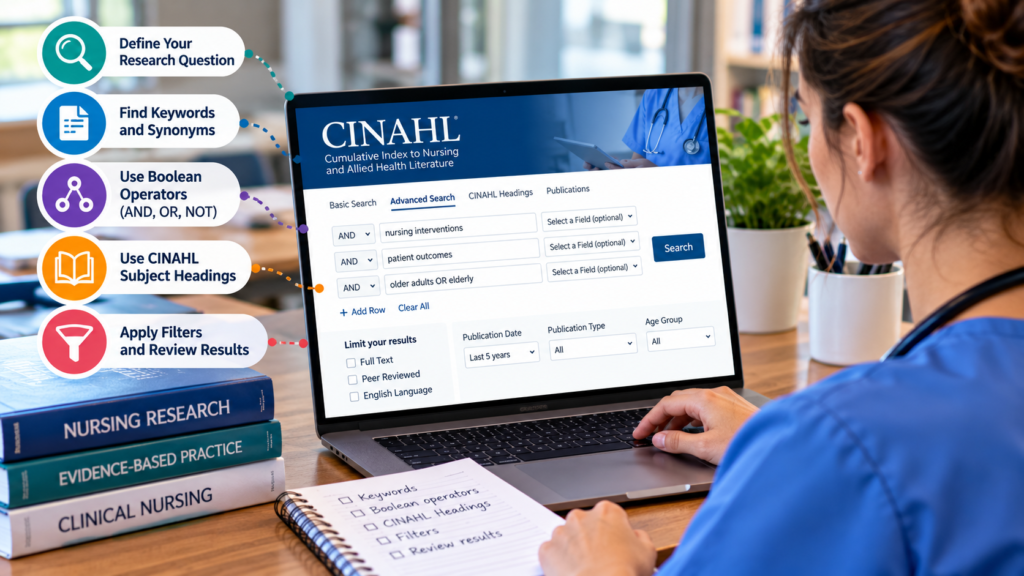
How to Search the CINAHL Database Effectively
A good search strategy starts with a clear research question. Simply typing a broad topic into the search box may produce thousands of results or miss useful studies.
Follow these steps to make your search more precise.
Step 1: Define Your Research Question
Start by identifying the population, intervention or issue, comparison, and outcome when these elements apply.
For example, consider this hypothetical question:
Among older hospital patients, does a nurse-led fall prevention program reduce falls compared with usual care?
The main concepts are older patients, fall prevention, nursing interventions, and falls. Breaking the question into concepts makes it easier to construct a focused search.
Step 2: Identify Keywords and Synonyms
List alternative expressions for each concept before searching.
| Concept | Example search terms |
|---|---|
| Population | older adults OR elderly OR aged |
| Intervention | fall prevention OR fall reduction |
| Care provider | nursing OR nurse-led |
| Outcome | falls OR accidental falls |
These terms are illustrative starting points. You should check the database’s subject headings and adjust the vocabulary to match your actual research question.
Step 3: Combine Terms with Boolean Operators
Boolean operators determine how search concepts work together.
- AND narrows results by requiring both concepts. Example:
nursing AND fall prevention - OR broadens results by including alternative terms. Example:
elderly OR older adults - NOT excludes a concept, but use it carefully because it can remove relevant research.
You can also use quotation marks for phrases, such as "fall prevention", and truncation symbols where supported to retrieve variations of a word. Check the database’s current search guidance for the correct syntax.
Step 4: Use CINAHL Subject Headings
Open the CINAHL Headings or subject-heading search option, depending on the interface. Look up each main concept and select the most appropriate standardized term.
Where available, review the heading’s broader and narrower terms, subheadings, and options for expanding the search. Combining subject headings with free-text keywords often provides better coverage than relying on either approach alone.
Step 5: Apply Filters and Review Results
Once the initial results appear, narrow them according to your question.
For example, a student preparing an assignment on recent nursing interventions might limit publication dates to the last five years, if that period fits the assignment requirements.
Next, examine the titles and abstracts. Check whether the studies involve the right population, intervention, and outcomes before selecting articles for full-text review.
Practical tip: Do not apply every filter immediately. Excessive restrictions can remove useful studies, particularly when research on a specialized topic is limited.
Advanced Query Techniques and Citation Management
Mastering advanced search syntax within the CINAHL Database can dramatically improve your retrieval accuracy. EBSCOhost utilizes specific truncation symbols and wildcards to capture word variations. For example, placing an asterisk (*) at the root of a word like nurs* retrieves nurse, nurses, nursing, and nursery. Additionally, using a question mark (?) as a wildcard can help find alternate spellings, such as wom?n for woman or women.
Once you locate relevant literature, saving and organizing your sources efficiently is critical for academic success. Most database configurations allow users to export citations directly to reference management tools like EndNote, Zotero, or Mendeley. You can select individual records or check multiple items into a folder, then choose the direct export option or download a RIS file. This workflow prevents citation errors and streamlines the bibliography creation process for literature reviews and research papers.
How CINAHL Supports Evidence-Based Practice
Evidence-based practice combines the best available research evidence with professional clinical judgment and the needs and preferences of individual patients.
The CINAHL database supports this process by helping healthcare professionals locate studies relevant to clinical questions. However, finding a study is only the first step. The researcher must still evaluate the evidence before using it to inform practice.
Consider a nurse investigating whether structured discharge education helps patients manage their medication after leaving hospital.
A CINAHL search could identify research on patient education, medication adherence, discharge planning, and nursing interventions. The nurse could then examine study designs, sample characteristics, outcome measurements, and potential limitations.
The findings may help inform a clinical discussion or quality improvement project. They should not automatically determine treatment decisions.
Using CINAHL for Literature Reviews
CINAHL is also useful for systematic and scoping reviews. Researchers can use it to identify nursing-focused literature that may be missed by a search of a broader biomedical database alone.
For a systematic review, a researcher should develop a documented search strategy, record the search date, save the search terms, and report any limits applied. Searches should generally include other relevant databases when the review question requires comprehensive coverage.
CINAHL is an important source of evidence, but it should not automatically be treated as a complete representation of all published research.
CINAHL Database vs. PubMed
Both are valuable healthcare research tools, but they serve somewhat different purposes.
| Feature | CINAHL | PubMed |
|---|---|---|
| Main focus | Nursing and allied health | Biomedical and life sciences literature |
| Subject vocabulary | CINAHL Subject Headings | MeSH for MEDLINE indexing |
| Nursing practice | Particularly useful | Also includes nursing research |
| Medical research | Covers relevant healthcare topics | Broad biomedical coverage |
| Access | Commonly through institutional subscriptions | Searchable free of charge |
| Full-text availability | Depends on subscription and article access | Depends on publisher and available links |
Which Database Should You Choose?
Choose CINAHL when your research focuses on nursing interventions, patient experiences, nursing education, rehabilitation, or allied health practice.
Choose PubMed when your question requires broad biomedical coverage, such as drug therapies, disease mechanisms, laboratory research, or clinical trials.
For a comprehensive literature review, searching both may be appropriate. Their records overlap, but neither database contains every relevant publication indexed by the other.
Other resources, such as Embase, APA PsycINFO, and Scopus, may be useful depending on whether your topic emphasizes pharmacology, psychology, or multidisciplinary research.
Advantages and Limitations of the CINAHL Database
CINAHL is a strong resource for nursing research, but its usefulness depends on the research question, available subscription, and quality of the evidence retrieved.
Main Advantages
- Specialized coverage: Its nursing and allied health focus helps researchers find discipline-specific literature.
- Structured subject indexing: Standardized headings improve the discovery of articles about related concepts.
- Research flexibility: Basic and advanced searches allow users to approach a topic in different ways.
- Educational resources: Eligible versions include additional nursing education and evidence-based care materials.
- Support for literature reviews: Its records can contribute to academic assignments and structured evidence searches.
Important Limitations
- Subscription restrictions: Users may need institutional credentials to access the database.
- Incomplete full-text access: Some records provide citations and abstracts without the complete article.
- Limited subject scope: CINAHL’s specialized focus means it cannot replace every biomedical or multidisciplinary database.
- Search sensitivity: Poor keywords or overly restrictive filters can cause relevant studies to be missed.
- Variable evidence quality: Inclusion in a database does not mean a study is reliable, unbiased, or suitable for clinical decisions.
The last limitation is particularly important. A peer-reviewed article may still have methodological weaknesses, a small sample, or findings that do not apply to a particular patient population. Researchers should assess study quality rather than relying on publication status alone.
How to Access the CINAHL Database
Most users access CINAHL through a university library, hospital library, or another institution that subscribes to an EBSCO research collection.
To find out whether you have access:
- Visit your institution’s library website.
- Open its databases or electronic resources section.
- Search for CINAHL, CINAHL Complete, or the version listed by your institution.
- Sign in using your institutional credentials if required.
- Open the database and begin your search.
Some institutions also support remote access through a library login or authentication service.
Is the CINAHL Database Free?
CINAHL is generally a subscription resource rather than a completely free database for unrestricted access. However, you may be able to use it without paying separately if your university, hospital, employer, or public library provides access.
EBSCO offers different CINAHL products, and access to specific collections depends on the subscription. You should check the relevant product information or ask your librarian about availability and licensing.
Practical Tips for Getting Better Search Results
Small improvements to your search strategy can make a significant difference to the relevance of your results.
- Start broad, then narrow: Run an initial search before applying multiple filters.
- Use synonyms: Include alternative terms commonly used in nursing literature.
- Combine keywords with subject headings: This can improve coverage when authors use different terminology.
- Check the publication date: Match the date range to your research question rather than assuming that only recent studies matter.
- Read abstracts carefully: Confirm that each article actually addresses your question.
- Evaluate study quality: Review the methods, limitations, and relevance of the findings.
- Save your search strategy: Keep a record of search terms, filters, dates, and database versions for future reference.
- Check reference lists: Relevant articles may lead you to additional studies through their cited references.
For academic projects, consider asking a health sciences librarian to review your search strategy. This can be especially helpful when preparing a dissertation, systematic review, or research protocol.
Frequently Asked Questions About the CINAHL Database
What does CINAHL stand for?
CINAHL stands for Cumulative Index to Nursing and Allied Health Literature.
Is CINAHL a reliable research database?
It is a well-established resource for nursing and allied health literature. However, researchers must still assess the quality and relevance of individual studies.
Can students access CINAHL for free?
Students can often access it through their university or college library. Availability depends on the institution’s subscription.
Does CINAHL provide full-text articles?
Some versions provide extensive full-text access, while the basic CINAHL Database primarily indexes and abstracts literature. Access varies by subscription.
What is the difference between CINAHL and PubMed?
CINAHL specializes in nursing and allied health literature. PubMed offers broader coverage of biomedical and life sciences research.
Can I use CINAHL for a systematic review?
Yes. It can contribute important nursing and allied health studies to a systematic review. Researchers should also search other relevant databases when necessary.
What is the best way to search CINAHL?
Combine relevant keywords, Boolean operators, and CINAHL Subject Headings. Then review the results and apply appropriate filters without excluding useful studies.
Conclusion: Why the CINAHL Database Matters
The CINAHL database is a valuable research tool for anyone studying nursing, allied health, or patient-focused healthcare practice. Its specialized indexing, subject headings, and research filters help users locate literature that may be difficult to discover through general search engines alone.
To get the most from CINAHL, begin with a clearly defined research question, use a combination of keywords and standardized subject headings, and evaluate the evidence carefully. Remember that database access, full-text availability, and content coverage depend on the version provided by your institution.
For a major academic project, CINAHL works best as part of a well-planned research strategy. Combining it with other relevant databases can improve coverage and reduce the risk of missing important studies. Ultimately, effective research depends not just on finding articles, but on understanding their quality, relevance, and implications for healthcare practice.
[…] Seduced AI Review: Features, Pricing, Safety and Uses CINAHL Database: Guide to Nursing Research Quote Finder: Find Quotes, Sources, and Meaning Interesting Engineering: Inventions, […]