


DreamJourney AI: Features, Uses, Pricing, and Limitations

DreamJourney AI is an AI-powered platform for character conversations, interactive roleplay, and creative storytelling. Instead of simply asking an AI chatbot questions, users can enter fictional worlds, interact with characters, develop relationships between characters, and influence how a story unfolds. The platform also provides tools such as Lorebooks and Memory Nexus to help maintain continuity across longer conversations.
For writers, roleplay enthusiasts, and people who enjoy interactive fiction, this approach offers a different way to explore ideas. You can start with an existing character or create your own scenario, then guide the narrative through conversation. However, DreamJourney AI is not a replacement for every general-purpose AI assistant, and its responses can still contain inconsistencies. This guide explains how DreamJourney AI works, which features matter most, what to know about its pricing and privacy, and how to decide whether it is the right platform for you.
What Is DreamJourney AI?
DreamJourney AI is an online AI character chat and storytelling platform. It is designed around interactive fictional experiences rather than traditional question-and-answer assistance. Users can explore community-created characters, participate in roleplay scenarios, and build their own fictional personalities and worlds.
The platform covers several genres, including fantasy, romance, science fiction, anime, mystery, horror, comedy, and role-playing games. These options let users choose experiences ranging from casual character conversations to longer adventures with plots, locations, and recurring characters.
The central idea is interactive storytelling. Instead of reading a fixed story from beginning to end, you participate in its development. Your messages influence what a character says, how a scene progresses, and which possibilities the narrative explores next.
Who Is DreamJourney AI For?
DreamJourney AI may be useful for:
- Roleplay enthusiasts: People who enjoy fictional conversations and character-driven scenarios.
- Creative writers: Writers who want to explore dialogue, personalities, conflicts, or possible story directions.
- Fantasy and RPG fans: Users interested in interactive adventures and fictional worlds.
- Character creators: People who want to design original characters with distinctive personalities and backstories.
- Casual users: Anyone looking for an interactive creative activity rather than a conventional productivity chatbot.
It is less suitable as a primary tool for verified research, professional advice, or tasks requiring consistently factual answers. Its main purpose is creative interaction.
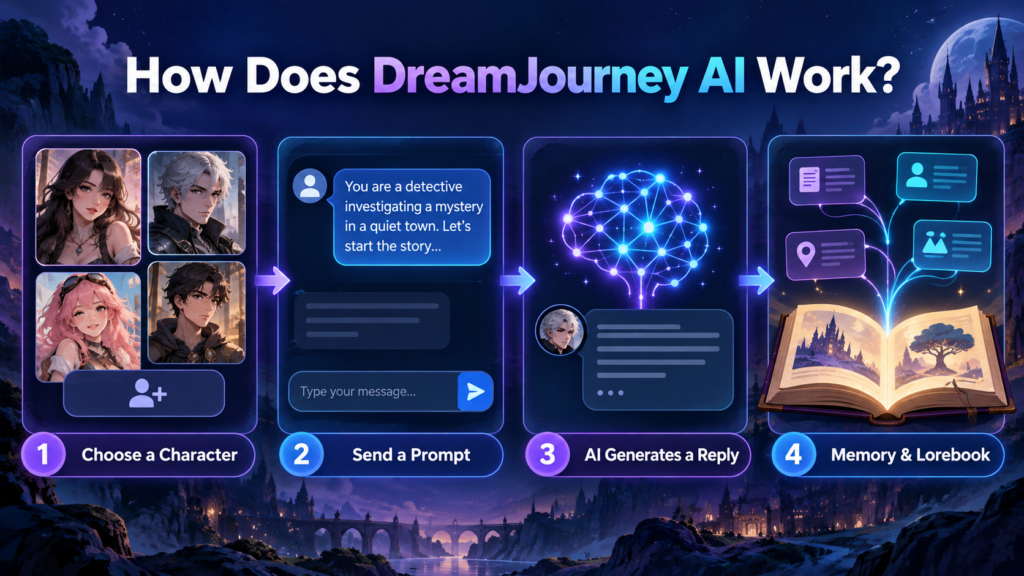
How Does DreamJourney AI Work?
DreamJourney AI uses conversational AI to generate responses based on the ongoing interaction. You provide a message, describe an action, or establish a fictional situation. The system then generates a response that attempts to fit the character, setting, and conversation.
For example, imagine starting a fantasy adventure in which you play a traveler entering a mysterious kingdom. You might ask a royal guard why the city gates are closed. The AI can respond as the guard, reveal a fictional conflict, and introduce a new choice for your character.
The experience develops through repeated exchanges. You can accept the direction of the story, introduce a new event, or ask the character to behave differently.
The Role of Language Models
Large language models, or LLMs, generate text by processing conversational context and predicting suitable continuations. They can produce dialogue, describe scenes, imitate fictional speaking styles, and respond to instructions.
DreamJourney AI advertises multiple AI models and controls for adjusting the roleplay experience. The exact underlying model, its capabilities, and the settings available to an individual account may vary. Public product descriptions should not be treated as proof of a particular model’s technical performance.
This distinction matters because a convincing character response does not necessarily demonstrate genuine understanding, emotion, or independent awareness. The system generates language that fits the interaction; it does not become the fictional character it portrays.
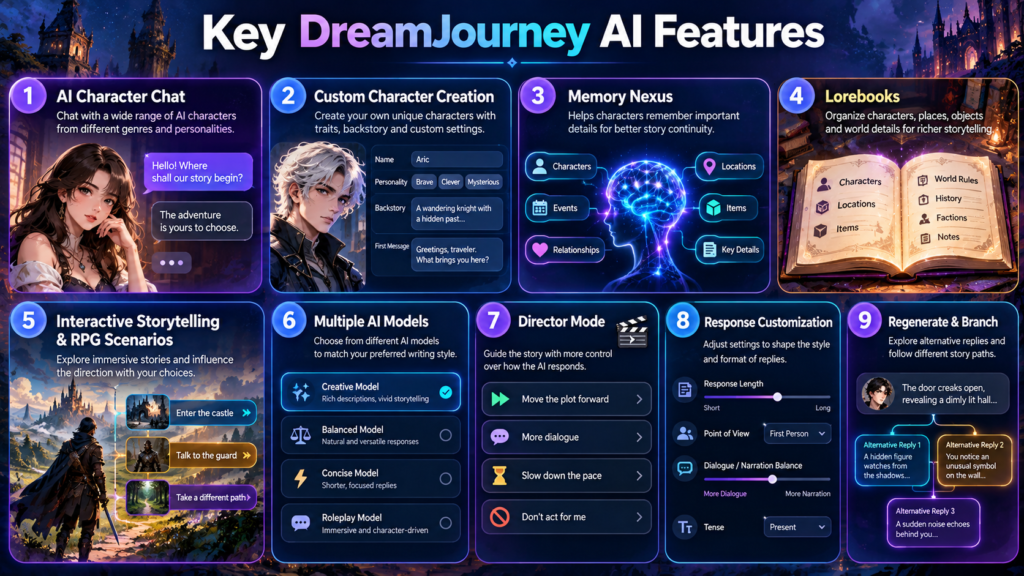
Key DreamJourney AI Features
DreamJourney AI combines character conversations with tools intended to make extended stories easier to manage. The following features are among the most relevant to prospective users.
1. AI Character Chat
The platform offers a collection of AI characters with different backgrounds, personalities, and story premises. You can browse available options and begin a conversation without designing every detail yourself.
A character might be a fantasy companion, a mysterious stranger, a fictional friend, or someone involved in a larger adventure. The character’s description helps establish the tone and direction of the interaction.
For better results, give the conversation a clear starting point. A message such as “You are a cautious detective investigating a missing artifact in a coastal town” provides more useful direction than simply saying “Let’s talk.”
2. Custom AI Characters
Users can create original characters rather than relying exclusively on existing ones. Character design can involve personality traits, background information, motivations, and the way a character responds to other people.
For example, a writer developing a detective story might create a reserved investigator who notices small details but avoids discussing personal matters. Including these traits in the character setup gives the AI a clearer framework for generating dialogue.
However, detailed instructions do not guarantee perfect consistency. A character may occasionally act against its established personality, especially during lengthy or complicated conversations.
3. Memory Nexus
Memory Nexus is presented as a feature for preserving important details from ongoing stories. Its purpose is to help characters retain relevant information, such as names, relationships, events, and promises, rather than treating every new exchange as an unrelated conversation. The platform has also described Memory Nexus as a beta feature in its app interface.
This can be especially helpful in longer roleplay sessions. If a character has already met your fictional companion or learned about an earlier event, remembering that information can make later dialogue feel more connected.
Still, memory features have limits. They should not be assumed to retain every sentence indefinitely or recall every detail perfectly. If a crucial fact affects the plot, restating it or recording it in a Lorebook can help reduce inconsistencies.
4. Lorebooks for Building Fictional Worlds
Lorebooks provide a way to organize important information about a fictional setting. They can contain characters, places, objects, concepts, and other details that help establish the world in which a story takes place.
Consider a fantasy writer building a kingdom with three rival families. A Lorebook could record each family’s history, political alliances, important locations, and relationships with the royal court.
This gives the AI a reference framework for the story. Instead of repeatedly explaining every detail in ordinary messages, the writer can maintain a more organized collection of background information.
Lorebooks are particularly useful when several characters share the same world or when the plot depends on details established much earlier.
5. Interactive Storytelling and RPG Scenarios
DreamJourney AI also supports scenarios in which users influence the direction of a fictional adventure. The platform’s examples include fantasy adventures, alternate-world RPGs, and other character-led narratives.
You might begin as an explorer entering an abandoned city. After encountering a locked gate, you could negotiate with its guardian, search for another entrance, or investigate a nearby building. Each choice gives the conversation a different direction.
This format is useful for brainstorming plots and exploring alternative outcomes. However, it is not the same as a conventional video game with guaranteed rules, balanced mechanics, or a fixed progression system. Unless a scenario explicitly establishes those rules, the AI may improvise or contradict earlier events.
6. Model Selection and Customization
The platform advertises multiple AI models and controls intended to let users adjust their roleplay experience.
Different models may vary in writing style, response length, instruction-following, and consistency. A model that produces vivid descriptions might not always be the best choice for a fast-paced conversation.
The practical approach is to test the available options with the same short scenario. Compare whether each model follows character instructions, maintains the setting, and produces dialogue you enjoy. Do not assume that a model label alone guarantees better results.
Practical Uses of DreamJourney AI
DreamJourney AI is most useful when the desired outcome is an evolving fictional experience. Its tools can support several creative activities.
Creative Writing and Dialogue Development
Writers can use character conversations to explore how two fictional people might respond to a disagreement, unexpected discovery, or emotional turning point.
For example, you could ask the AI to roleplay a skeptical editor reviewing a detective’s theory. The exchange may reveal potential weaknesses in the plot or suggest new dialogue. The result is a brainstorming aid, not a finished manuscript that automatically meets professional writing standards.
Worldbuilding and Character Development
Fantasy and science fiction often require extensive background information. A writer can use a Lorebook to organize fictional geography, political systems, character histories, and important objects.
The AI can then help explore how these details might influence a scene. Human review remains important because generated suggestions may conflict with the established world.
Interactive Entertainment
Users can participate in romance, fantasy, mystery, horror, or everyday-life scenarios. Rather than passively consuming a story, they can influence the conversation through their choices.
The appeal depends heavily on personal preference. Someone who enjoys improvisation may find this format engaging, while a reader who prefers carefully edited, predictable narratives may prefer traditional fiction.
Exploring Alternative Story Outcomes
A writer can replay a scenario with different decisions to see how the fictional events might develop. One version could involve cooperation, while another explores betrayal or rivalry.
These are generated possibilities rather than reliable predictions of human behavior. Their value lies in creative exploration, not in proving what a real person would do.
Advantages of DreamJourney AI
The platform has several potential strengths for people who enjoy character-based AI experiences.
- Interactive storytelling: Conversations can develop into evolving fictional narratives.
- Character variety: Existing characters and scenarios provide starting points for different genres.
- Creative control: Users can guide conversations and develop their own fictional personalities.
- Worldbuilding support: Lorebooks help organize information for complex stories.
- Longer narrative continuity: Memory Nexus is designed to help preserve important conversational details.
- Accessible entry point: The platform advertises free access to get started, allowing new users to explore before deciding whether to pay.
The main advantage is the combination of roleplay and story organization. Users who want to maintain an evolving fictional world may find this more convenient than a basic chatbot that requires frequent reminders.
Limitations and Risks to Consider
DreamJourney AI is a creative tool, but its limitations deserve attention before you invest significant time or money in it.
AI Responses Can Be Inconsistent
The AI may forget an earlier event, change a character’s behavior, or introduce details that contradict the established plot. Memory tools can help, but they do not guarantee flawless continuity.
A useful habit is to keep a short summary of important events, character motivations, and unresolved conflicts. You can use that summary to correct the conversation when necessary.
Fictional Content Is Not Verified Information
A character may confidently describe an event, historical detail, or real-world fact that is inaccurate. Conversational fluency is not evidence of factual correctness.
If you need information for an academic assignment, medical decision, legal question, or professional report, verify it through reliable sources rather than relying on roleplay responses.
Privacy Requires Careful Consideration
DreamJourney AI states that conversations and character creations are private by default. That is a statement from the platform, not an independent guarantee that every type of information is risk-free to share.
Before using the service, review its current privacy policy and terms. Check how conversations are stored, whether content may be processed by service providers, what deletion options are available, and how account information is handled.
Avoid entering passwords, financial information, private messages from other people, confidential business material, or other sensitive personal details.
Emotional Boundaries Matter
AI characters can generate warm, supportive, or affectionate dialogue. However, these responses are produced by software rather than a person with genuine feelings or personal responsibility.
Enjoying fictional interaction is not inherently a problem. It is sensible, though, to maintain boundaries and avoid treating an AI character as a substitute for trusted relationships or qualified professional support.
Availability and Features May Change
AI platforms can change their models, credit systems, subscription options, and feature availability. A feature described in a product announcement may also be experimental or limited to certain accounts.
Check the live interface and official terms before relying on a particular feature or purchasing a subscription.
Is Dreamjourney AI Safe and Private?
Privacy is an important consideration when using any AI character chat service, especially when conversations include personal details or sensitive fictional scenarios.
Dreamjourney AI states on its website that conversations, character creations, and Lorebook entries are private by default. However, this is a statement made by the platform itself, not independent proof of every aspect of its security or data-handling practices.
Before sharing information, users should review the current privacy policy and terms of service. Pay particular attention to how conversations are stored, whether data may be processed by third-party AI providers, how account deletion works, and whether content can be used to improve services.
A few practical precautions are worthwhile:
- Avoid entering passwords, financial details, government identification numbers, or other sensitive personal information.
- Use fictional details when creating characters based on real people.
- Check sharing settings before publishing a character or story.
- Use a unique password and secure your account.
- Review data deletion and account closure options before building a large collection of stories.
The platform’s terms of service state that users must be at least 18 years old. Anyone considering the service should check and follow its current eligibility requirements.
AI roleplay can also become emotionally engaging. It is sensible to maintain a distinction between fictional interactions and real relationships, particularly when a character is designed to act like a close friend or romantic partner.
Dreamjourney AI vs. Other AI Roleplay Platforms
Dreamjourney AI is not the only service offering AI characters and interactive fiction. The right alternative depends on whether someone values character discovery, narrative control, long-form storytelling, or general-purpose AI assistance.
| Platform | Main focus | Best suited for |
|---|---|---|
| Dreamjourney AI | Character chat, memory tools, Lorebooks, and text RPGs | Users who want customizable, ongoing fictional stories |
| Character.AI | Conversations with a broad range of AI characters | Casual character interaction and discovering community creations |
| AI Dungeon | Interactive fiction and AI-driven adventures | Users interested in branching stories and text-based game experiences |
| ChatGPT | General-purpose AI assistance, creative writing, and structured brainstorming | Writers who want help with dialogue, plot ideas, editing, and many non-fiction tasks |
These services overlap, but they are not identical. Their features, content policies, pricing, and available models can change, so the table should be treated as a comparison of their general purposes rather than a guarantee of current feature parity.
Which Alternative Should You Choose?
Choose Dreamjourney AI if your main interest is interacting with fictional characters and maintaining an ongoing story with tools designed for narrative continuity.
Character.AI may be worth exploring if discovering and chatting with community-created characters is your priority. AI Dungeon is another option for people who prefer interactive adventures in which their actions shape the narrative. ChatGPT is more suitable when the same tool needs to handle creative writing alongside research, editing, coding, and everyday questions.
Before moving an established story to another platform, consider whether its character definitions, conversation history, and world-building notes can be exported or transferred. Even if the underlying ideas can be copied, memory systems and model behavior generally will not transfer perfectly.
Common Mistakes to Avoid When Using Dreamjourney AI
The quality of an AI roleplay experience depends partly on how the story is set up. A few small changes can make conversations more coherent.
Giving characters vague personalities: Descriptions such as “smart and interesting” offer little guidance. Instead, specify how the character speaks, what they want, what they fear, and how they behave under pressure.
Putting every world detail into one entry: Large blocks of background information can become difficult to maintain. Organize the setting into focused entries for people, places, objects, and important rules.
Assuming memory guarantees continuity: Check important details instead of assuming the system has recorded everything correctly. A short story summary can help restore context when necessary.
Writing prompts that control everything: If you want an interactive experience, explain the situation and let the AI respond. Writing both sides of every conversation leaves less room for meaningful interaction.
Paying before testing: Try the available free allowance with a few different scenarios. This gives you a better sense of response quality, credit consumption, and whether the platform fits your needs.
These practices are useful beyond Dreamjourney AI. They apply to most generative AI storytelling tools because clear instructions and well-organized context help reduce ambiguity.
Frequently Asked Questions
1. What is Dreamjourney AI used for?
Dreamjourney AI is used for AI character conversations, interactive storytelling, fictional roleplay, and text-based RPG experiences.
2. Is Dreamjourney AI free?
The official website advertises a free starting allowance of 300 credits. Additional usage and paid options may be subject to current pricing and credit rules.
3. Does Dreamjourney AI remember previous conversations?
Its Memory Nexus feature is designed to preserve important story facts, relationships, and events. However, it does not guarantee perfect recall or consistent responses.
4. Can I create my own AI character?
Yes. The platform advertises tools for creating characters with custom personalities, scenarios, and opening messages. Characters can be kept private or shared, depending on the available settings.
5. Is Dreamjourney AI safe to use?
Use it cautiously, review its privacy policy, and avoid sharing sensitive personal information. Its stated privacy practices should not be treated as a substitute for independently verified security information.
6. Does Dreamjourney AI work for creative writing?
Yes. It can help users explore dialogue, character motivations, and alternative plot directions. Its output should still be reviewed and edited before being used in a finished publication.
7. Is Dreamjourney AI suitable for children?
The platform’s published terms state that users must be at least 18 years old. People under that age should not use the service unless its official eligibility requirements change.
Conclusion
Dreamjourney AI is a specialized platform for people who enjoy interactive fiction, character conversations, and AI-assisted roleplaying. Its combination of character creation, Lorebooks, Memory Nexus, and response customization provides useful tools for building stories that develop over time. The platform is particularly interesting for writers and roleplayers who want more control over fictional settings than a basic chatbot typically offers.
However, memory systems cannot eliminate every contradiction, and generated dialogue may still require correction. Free access also has limits, while privacy and account policies deserve careful attention before sharing personal information or paying for additional usage.
The practical approach is to start with a small story, test the available features, and evaluate the results for yourself. If Dreamjourney AI consistently supports the kind of storytelling you enjoy, it may be a worthwhile creative tool. If not, other AI writing and roleplay platforms may suit your needs better.