

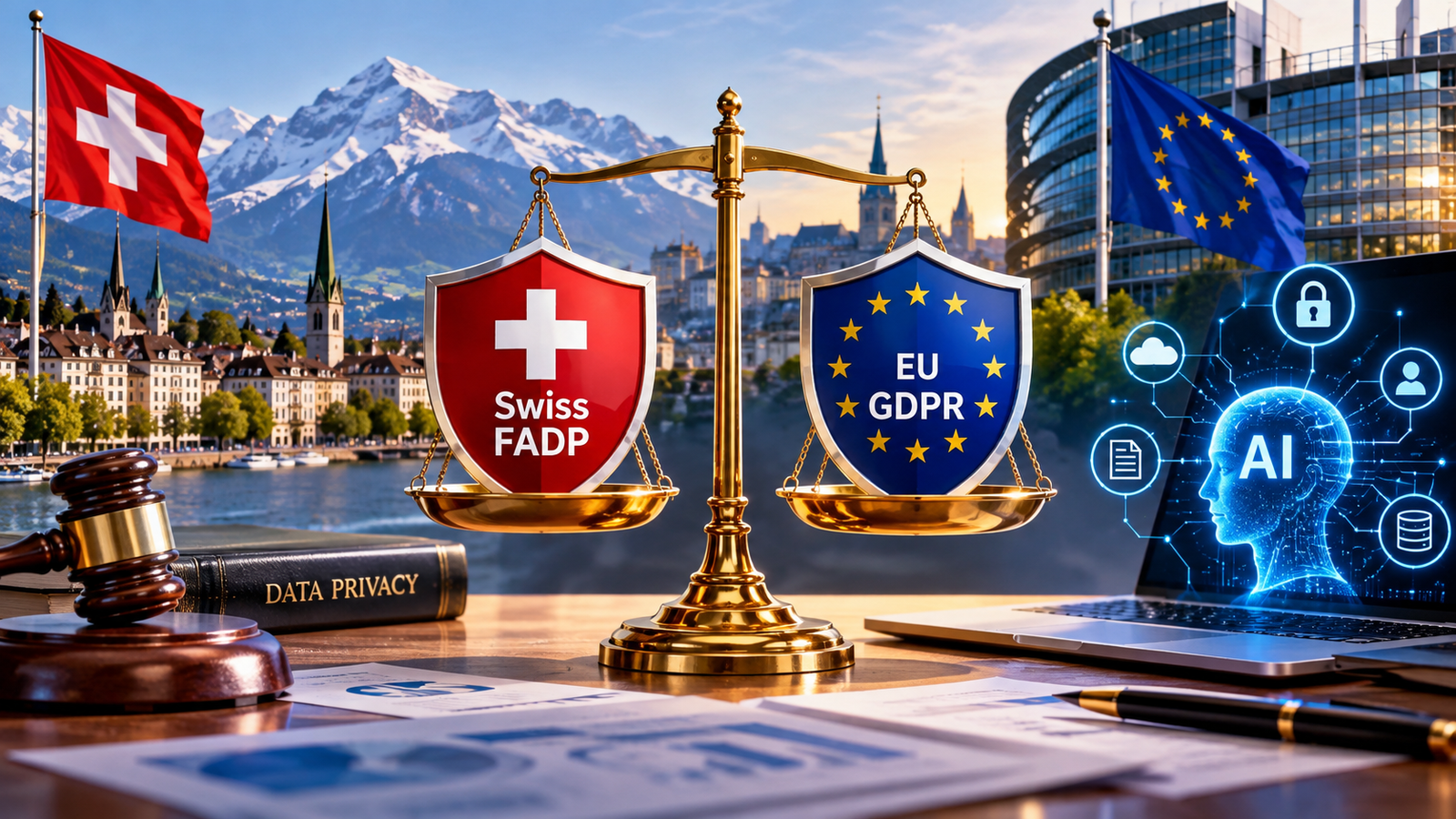
Swiss FADP vs EU GDPR AI Data Privacy Comparison

The swiss fadp vs eu gdpr ai data privacy comparison is increasingly important as businesses use artificial intelligence to process personal information. Switzerland’s revised Federal Act on Data Protection (FADP) has applied since September 1, 2023, while the EU General Data Protection Regulation (GDPR) remains the main privacy framework across the European Union. Both laws are technology-neutral and therefore apply to AI-supported data processing. However, they differ in scope, structure, terminology, and some obligations. Switzerland also follows a developing approach to broader AI regulation. Understanding these differences helps companies design safer AI systems, manage personal data, and reduce privacy compliance risks.
Swiss FADP vs EU GDPR: What Is the Basic Difference?
The Swiss FADP regulates the processing of personal data in Switzerland and was comprehensively revised to address modern technology and international data protection standards. The revised law focuses strongly on transparency, individual control, privacy, and responsible processing. Importantly, the FADP does not contain a separate AI law. Instead, its technology-neutral rules apply directly when artificial intelligence processes personal data. Switzerland is also developing broader AI regulation, with the Federal Office of Justice preparing draft legislation linked to the Council of Europe AI Convention.
The GDPR has a broader EU-wide framework covering personal data processing by organisations established in the European Economic Area and, in certain circumstances, organisations outside the region. Its rules include lawful processing, purpose limitation, data minimisation, storage limitation, accuracy, security, and accountability. The GDPR is also technology-neutral, meaning companies cannot avoid its requirements simply because they use AI instead of traditional software. This makes AI privacy compliance a matter of understanding how personal data is collected, processed, stored, transferred, and used within an AI system.
Scope and Territorial Reach of FADP and GDPR
One major difference concerns where each framework can apply. The Swiss FADP governs relevant processing activities connected with Switzerland, while the GDPR can also apply to organisations outside the EU when they process personal data in connection with offering goods or services to people in the EU or monitoring their behaviour there. Therefore, an international AI company may need to consider both frameworks instead of choosing only one. Territorial scope should always be assessed according to the actual business model, customers, processing activities, and location of the relevant data subjects.
For example, imagine a Swiss software company providing an AI customer-support platform to customers in France, Germany, and Switzerland. Its Swiss activities may fall under the FADP, while processing connected with individuals in the EU may also bring GDPR obligations into the picture. The two laws can therefore overlap. Businesses should map their data flows before deciding which rules apply. A useful first step is creating a record of data categories, processing purposes, users, AI providers, storage locations, and international transfers. This approach also makes future privacy reviews easier.
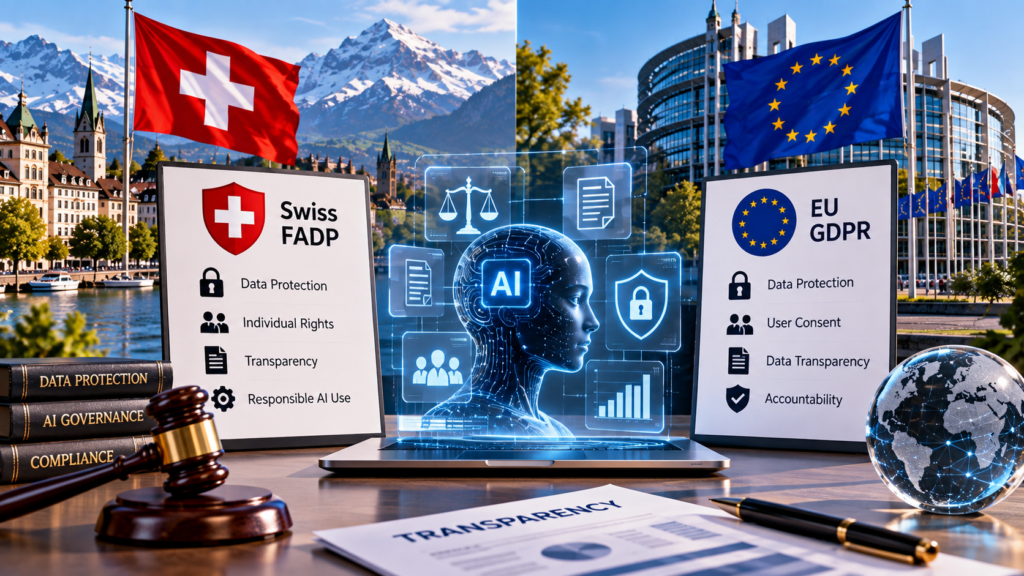
AI Transparency Under Swiss FADP and EU GDPR
Transparency is a central part of both frameworks, but the practical requirements depend on the AI system and processing activity. Swiss data protection guidance emphasises transparency when AI systems process personal information. Businesses should make relevant information about AI-supported processing understandable, including its purpose and how personal data is used. Transparency is especially important when people interact directly with AI systems. Users should not be left confused about how their information is being processed or whether they are communicating with an automated system.
The GDPR also requires organisations to provide clear information about personal data processing. This can include the identity of the organisation, processing purposes, categories of data, legal basis, retention period, recipients, international transfers, individual rights, and certain information about automated decision-making. The information must be understandable and presented in clear language. For an AI application, privacy notices should therefore explain relevant processing without hiding important information behind technical language or vague statements.
Profiling and Automated Decision-Making: Key AI Differences
AI profiling can create privacy concerns because systems may analyse personal information to classify people, predict behaviour, or support important decisions. Under the GDPR, individuals generally have protection against decisions based solely on automated processing when those decisions produce legal effects or similarly significant effects. Certain exceptions exist, including situations involving contracts, applicable law, or explicit consent, but safeguards are required. People may also have rights involving human intervention, expressing their viewpoint, and challenging certain decisions.
Swiss law also addresses automated processing and individual decision-making. Swiss data protection rules include transparency requirements connected with automated processing and rights involving automated individual decisions. This is particularly relevant for AI systems used in areas such as lending, recruitment, insurance, healthcare, or customer evaluation. Businesses should therefore document when algorithms influence individuals and determine whether meaningful human review, explanations, or other safeguards are necessary for the specific processing activity.
High-Risk AI, DPIAs, and Privacy Risk Management
A Data Protection Impact Assessment, commonly called a DPIA, is an important tool for high-risk personal data processing. Under Swiss privacy requirements, AI-supported processing involving high risks can require a data protection impact assessment. This means organisations should identify possible privacy harms before deploying certain AI systems. The assessment can examine data sources, purposes, risks, safeguards, retention, access controls, and international transfers. A careful assessment helps businesses understand privacy risks before they become operational problems.
The GDPR also requires DPIAs where processing is likely to result in a high risk to individuals’ rights and freedoms. AI projects may require careful assessment when they involve extensive profiling, sensitive information, large-scale monitoring, or other high-risk activities. A practical compliance process should begin before deployment rather than after an AI product has reached customers. Businesses can combine privacy reviews with security testing, model governance, vendor checks, and documentation to create a more complete AI risk management process.
Personal Data, Sensitive Information, and AI Training
AI systems can process many types of information, including names, email addresses, images, recordings, behavioural information, location data, and online identifiers. Under the GDPR, pseudonymised information can still remain personal data when a person can be re-identified. Truly anonymous information falls outside the GDPR because the individual is no longer identifiable. These distinctions matter when companies collect datasets for machine learning, analytics, recommendation systems, or generative AI development.
Swiss privacy rules similarly require organisations to consider how personal information is collected and used in AI-supported processing. Companies should identify the source and purpose of training or operational data before using it. They should also consider whether the information is necessary, whether people have been properly informed, and whether the intended processing creates significant privacy risks. For AI projects, data governance should therefore cover both the model and the underlying datasets. This helps prevent privacy problems from being hidden inside otherwise sophisticated technology.
International Data Transfers and Cross-Border AI Services
International transfers are especially important for AI services because cloud platforms, model providers, analytics systems, and data storage may operate across several countries. Switzerland recognises arrangements concerning adequate protection for international data transfers. Switzerland is also recognised by the European Union as providing an adequate level of personal data protection. This can support certain transfers between the EU and Switzerland, although organisations must still consider the specific legal requirements and circumstances surrounding each transfer.
GDPR compliance also requires organisations to pay attention when personal data leaves the European Economic Area. Companies may need appropriate transfer mechanisms and safeguards depending on the destination and circumstances. AI vendors should therefore disclose where information is processed and which subprocessors may receive it. Before adopting an external AI service, businesses should review its data-processing terms, international transfer arrangements, retention policies, security controls, and use of customer information for model improvement.
Practical Compliance Checklist for AI Businesses
A practical privacy program should begin with a clear map of the AI system. Identify what personal data enters the system, why it is processed, where it goes, and who can access it. Next, determine the applicable legal framework based on the organisation, users, locations, and processing activities. Businesses should then review transparency notices, legal bases, retention periods, security measures, international transfers, vendor contracts, and individual rights. High-risk processing should receive additional assessment before deployment. This structured approach can make privacy requirements easier to manage across multiple markets.
For companies operating across Switzerland and the EU, a combined compliance strategy can reduce duplication. However, organisations should not automatically assume that meeting one framework satisfies every requirement under the other. A useful internal review can include:
- Data inventory and processing map
- AI system and vendor assessment
- Privacy notice review
- Automated decision-making assessment
- DPIA where required
- International transfer review
- Security and access-control checks
- Human review procedures
- Data retention and deletion controls
Swiss FADP vs EU GDPR AI Data Privacy Comparison Chart
The following chart provides a simple overview for readers who want to understand the main differences quickly. The frameworks share many principles, but their legal structures are not identical. The FADP directly covers AI-supported data processing through technology-neutral rules, while the GDPR provides a comprehensive EU privacy framework with detailed requirements covering individual rights, accountability, automated decision-making, and international processing. Switzerland is also developing additional AI-related legislation, so businesses should check current requirements when planning new systems or entering new markets.
| Privacy Area | Swiss FADP | EU GDPR |
|---|---|---|
| AI coverage | Technology-neutral and applies to AI processing | Technology-neutral and applies to AI processing |
| Main focus | Swiss personal data protection | EU-wide personal data protection |
| Transparency | Important for AI purpose, functionality, and data sources | Detailed information duties for processing |
| Automated decisions | Transparency, objection, and human review rights apply | Specific safeguards for certain automated decisions |
| High-risk processing | DPIA required in high-risk cases | DPIA required where high risk is likely |
| International transfers | Adequacy and contractual safeguards can apply | GDPR transfer mechanisms apply |
| Broader AI regulation | Additional Swiss AI rules are developing | EU has broader AI regulatory framework |
What Should Businesses Do About AI Privacy?
Businesses should treat AI privacy as an ongoing governance process rather than a one-time legal checklist. Start by identifying every system that processes personal information, including third-party AI tools used by employees. Then document the purpose, data sources, processing locations, vendors, retention periods, and security measures. Review whether users receive sufficient information and whether automated decisions could significantly affect them. For higher-risk applications, perform the required impact assessment before launch. This process is useful for both Swiss and EU operations because it creates a consistent foundation while allowing teams to address differences between the FADP and GDPR.
Companies should also monitor regulatory developments. Switzerland is developing broader AI regulation connected with the Council of Europe AI Convention, while organisations serving EU users must continue monitoring GDPR requirements and related AI rules. Businesses should review AI vendors regularly, update privacy notices when processing changes, and train staff on responsible data handling. Readers can also explore related topics such as AI data privacy best practices, GDPR compliance for businesses, and AI risk management for additional guidance.
FAQ: Swiss FADP vs EU GDPR AI Privacy
Is the Swiss FADP similar to the EU GDPR for AI?
Yes, there are important similarities. Both frameworks are technology-neutral and can apply to AI systems processing personal data. Both emphasise transparency, privacy, individual rights, and responsible processing. However, their detailed requirements, terminology, territorial rules, and regulatory structures are different.
Does the Swiss FADP apply to AI systems?
Yes. The FADP applies to AI-supported data processing when personal information is involved. Organisations using AI must therefore consider transparency, individual rights, security, and risk management when personal information is processed.
Does GDPR apply to AI companies outside Europe?
It can. The GDPR may apply to organisations outside the EU when their processing activities involve offering goods or services to individuals in the EU or monitoring their behaviour. The exact application depends on the organisation and processing circumstances.
Are AI automated decisions restricted under GDPR?
Yes, in certain circumstances. GDPR rules provide protection against certain solely automated decisions that produce legal or similarly significant effects. Exceptions exist, but appropriate safeguards can be required, including human intervention and opportunities to challenge decisions.
Will Switzerland introduce separate AI regulation?
Switzerland is developing broader AI regulation connected with the Council of Europe AI Convention. The FADP already applies to AI-supported personal data processing, while additional rules are being developed for broader artificial intelligence governance.
Conclusion: Understanding AI Privacy Across Switzerland and Europe
The swiss fadp vs eu gdpr ai data privacy comparison shows that both frameworks place strong importance on protecting personal information used by modern technology. Switzerland applies its technology-neutral FADP directly to AI processing, while the GDPR provides a detailed EU-wide privacy framework covering transparency, individual rights, automated decisions, and accountability. Neither framework should be treated as a simple checklist because requirements depend on the actual data, users, processing purpose, and AI system. Businesses operating across both markets should map their data flows, assess risks, review vendors, and monitor regulatory changes. Staying proactive can make AI adoption more transparent, responsible, and easier to manage.
[…] FaceCheckID: Complete Guide to Face Search Swiss FADP vs EU GDPR AI Data Privacy Comparison Broken Keyboard Grok Answer: Easy Python Guide 2026 Old Character AI: What Happened to the […]