

Grok Content Moderated: Why It Happens & How to Fix It in 2026

Seeing “Grok content moderated” usually means Grok has flagged a request, image, video, or generated result for moderation. In simple terms, the system decided that the requested content may conflict with its safety rules or other platform requirements. This message can appear during text, image, or video workflows, so it is not limited to one feature. In 2026, moderation has also become a noticeable topic among Grok users, particularly around Imagine features. Recent product updates have introduced clearer moderation feedback, helping users understand when content has been rejected instead of treating the issue as a normal generation error.
The important point is that Grok content moderated does not automatically mean the user intended to create harmful material. Automated systems can review the wording, uploaded material, requested action, and expected output. Some users have reported receiving moderation messages for prompts they considered harmless, especially with image-to-video and video extension features. These reports show user experiences, rather than proof that every blocked request is a false positive. Understanding how moderation works can therefore help users create clearer prompts while staying within Grok’s rules.
What Does “Grok Content Moderated” Actually Mean?
When Grok displays a moderation message, the platform has identified something in the request or resulting content that requires blocking or restriction. The exact reason is not always shown in detail, which can make the message confusing. Grok uses safety measures to limit certain undesirable outputs, while its terms also acknowledge that generated results can vary depending on prompts, settings, and features. Therefore, a moderation message should generally be understood as a safety or policy decision rather than simply a technical failure.
The same message can appear in different situations. A text prompt may be rejected before generation, while an image or video request may encounter moderation during processing. Recent Imagine updates have also introduced clearer messages for content-moderation rejections. This is useful because it separates moderation feedback from ordinary server problems. If Grok clearly says the content was moderated, changing browsers or repeatedly refreshing the page may not solve the underlying issue. The request itself may need adjustment or review.
Why Is Grok Content Moderated Happening More Often?
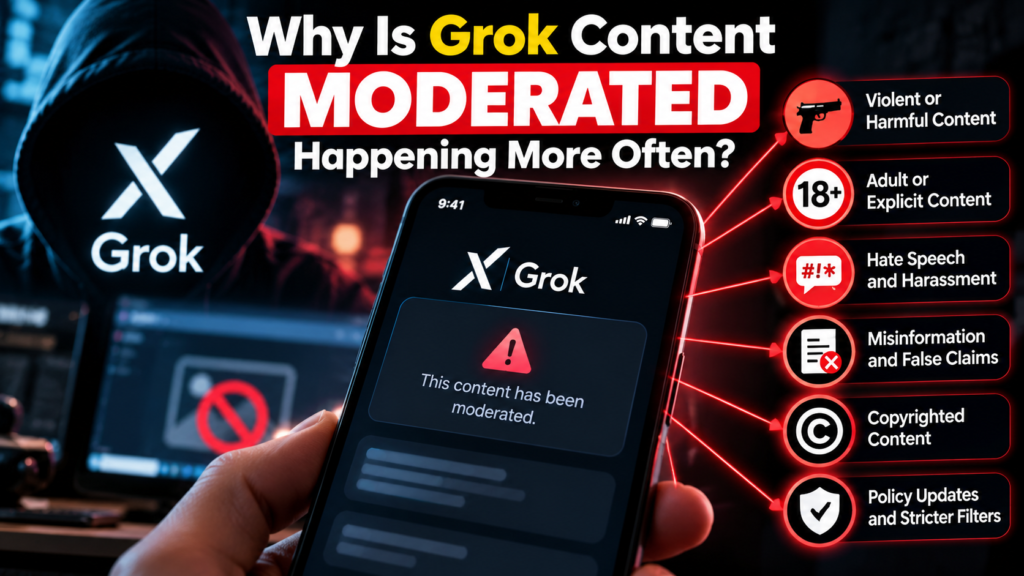
There are several possible reasons why users may encounter moderation more frequently. Grok has rules covering safety, unlawful material, privacy-related risks, and other prohibited uses. Sensitive imagery involving real people can receive additional scrutiny, particularly when requests involve intimate or sexual content without appropriate consent. These protections are important when users upload photographs or request realistic edits involving identifiable individuals. Moderation can therefore become stricter around sensitive subjects, even when a user’s intended context appears different.
User reports also suggest that moderation behavior can change after platform updates. Online discussions during 2026 describe increased blocking for certain image-to-video prompts, video extensions, and visually sensitive requests. However, community reports are anecdotal and should not be treated as official evidence of a permanent policy change. A useful explanation is that moderation systems can be updated independently of the visible Grok interface. This means a prompt that previously worked may later receive a different response without the user changing their account.
Grok Content Moderated in Images and Videos
Image and video generation can involve more moderation checks because the system must evaluate both instructions and visual material. Uploaded images may contain real people, sensitive situations, or other elements that create additional safety concerns. The platform also applies protections against non-consensual intimate imagery. This means moderation can involve the original upload, the requested transformation, or the intended generated result.
Video generation can also produce confusing experiences because users may receive a moderation message after processing has already started. Community discussions during 2026 describe this happening with video extensions and image-to-video requests. These reports do not establish exactly how Grok’s internal classifiers operate, but they demonstrate why users sometimes mistake moderation for a technical error. If a request repeatedly receives the same moderation message, the safest approach is to review the prompt and remove unnecessary sensitive details rather than repeatedly submitting identical requests.
Latest Grok Moderation Update in 2026
One important official change arrived in July 2026, when xAI introduced Imagine 1.5 and added clearer moderation feedback. The update included a dedicated message explaining when content had been rejected because of moderation. This is a practical improvement because users can more easily distinguish a policy rejection from an unrelated generation failure. It does not mean that moderation has been removed. Instead, the interface provides clearer information when moderation prevents content from being produced.
The latest 2026 service information also indicates that moderation remains an active part of Grok rather than a temporary limitation. Safety measures continue to apply across different features, and generated results can depend on the selected tool, settings, and prompt. Taken together, the current information suggests that users should expect safety checks to remain relevant when using text, image, and video features. A moderation message therefore does not necessarily indicate an account problem or a broken feature.
What Can You Do When Grok Blocks a Prompt?
The first useful step is to read the prompt carefully and identify whether it contains unnecessary sensitive wording. If the request is legitimate, simplify it and describe the desired result directly. For example, instead of adding dramatic details that are unrelated to the visual goal, explain the setting, clothing, camera angle, lighting, and general action. Clear prompts can reduce ambiguity and make the intended task easier to understand. However, no wording technique can guarantee approval because moderation decisions depend on the platform’s current policies and safety systems.
You should also avoid trying to disguise prohibited requests through coded language or repeated variations designed specifically to defeat moderation. That approach can create additional problems and does not address the underlying policy issue. If the content is clearly permitted but appears to be incorrectly blocked, use the available feedback or support options instead. For ordinary creative work, keeping prompts clear, specific, and policy-compliant is the most practical approach. You can also read a related AI image prompt guide or Grok AI guide on your site for more general prompting advice.
Grok Moderation Review: What Users Should Expect
| Area | Current situation |
|---|---|
| Text prompts | Moderation can block requests that trigger safety rules |
| Image generation | Sensitive or restricted requests may be rejected |
| Video generation | Moderation can affect generation and extensions |
| Uploaded images | Additional safety concerns may apply |
| Real people | Privacy and consent considerations matter |
| Paid access | Subscription does not mean unrestricted content |
| Feedback | Clearer moderation messaging is being added |
This overview shows why Grok content moderated should not automatically be interpreted as a broken account. The platform has several layers where a request can be evaluated, and different features can behave differently. Current product information confirms that content restrictions remain part of the service. Recent Imagine updates also demonstrate that Grok is working on making moderation feedback more visible. Users should therefore judge a blocked request based on its content and the relevant rules rather than assuming a universal technical problem.
Moderation Experience at a Glance
Grok Moderation Flow — 2026

Prompt / Upload
      │
      ▼
Content Evaluation
      │
 ┌────┴────┐
 ▼         ▼
Allowed   Flagged
 │         │
 ▼         ▼
Generate  Moderation Message
           │
           ▼
     Review the Request
           │
      ┌────┴────┐
      ▼         ▼
  Compliant   Restricted
      │         │
      ▼         ▼
   Retry     Cannot Proceed
Common Reasons for Grok Content Moderation
Moderation decisions can involve several categories, and the exact trigger may not always be visible to users. Sensitive sexual content, non-consensual intimate imagery, illegal activity, harmful instructions, and other restricted material can create limitations. Privacy concerns may also become important when a request involves identifiable people. These protections are especially relevant when users upload photographs or request realistic transformations of real individuals.
Another important factor is context. A harmless word can sometimes appear inside a request involving a sensitive scenario, while an uploaded image may introduce information that the written prompt does not mention. This can make moderation seem unpredictable from the user’s perspective. Community reports during 2026 describe similar experiences, including ordinary-looking image and video prompts being blocked. However, these reports cannot reveal Grok’s private moderation thresholds. Current platform rules remain the stronger reference when determining whether a request is permitted.
How to Reduce Unnecessary Moderation Problems
Start with a clean, direct description of your intended task. Remove unnecessary references to explicit situations, real-person sexualization, illegal behavior, graphic violence, or other sensitive subjects when those details are not required. If you are creating a normal landscape, product image, character scene, or educational illustration, focus on the setting, composition, lighting, clothing, camera perspective, and artistic style. This keeps the request easy to understand and avoids adding unrelated terms that may complicate automated review.
For image and video work, describe legitimate creative goals rather than attempting to work around safety controls. If an uploaded image contains a real person, consider whether your requested transformation could affect privacy or consent. For more practical AI prompting advice, readers can also explore a related AI image generation guide or AI tools guide on your site. These internal resources can help users write clearer requests without encouraging attempts to bypass moderation.
Is Grok Content Moderation Getting Stricter?
There is evidence of strong user concern about moderation during 2026, particularly for Imagine features. Online discussions throughout the year describe users experiencing more frequent moderation or unexpected blocks. However, these discussions represent individual experiences rather than a complete measurement of Grok’s moderation system. They should therefore be treated as user feedback, not as proof that every category has become permanently stricter.
Current product information confirms that moderation remains active and that Grok continues receiving updates. The introduction of clearer moderation feedback for Imagine shows that the platform is improving how users are informed about rejected content. The practical takeaway is that moderation behavior can change as systems are updated. If a previously successful prompt suddenly fails, users should first review the current request and its context rather than assuming their account is permanently restricted.
Grok Content Moderated: Final Review
The current Grok content moderated experience is best understood as an active safety layer rather than a simple error message. Grok continues to moderate text, images, and videos, while newer Imagine features provide clearer feedback when content is rejected. Users may still encounter confusing blocks, and community reports show that this has been frustrating for some creators. However, individual reports cannot establish the exact internal moderation rules or guarantee that a specific prompt will be approved.
For everyday users, the safest strategy is straightforward: write clear prompts, avoid unnecessary sensitive details, respect privacy and consent, and follow Grok’s current rules. When a legitimate request is blocked, review the wording and use available feedback channels instead of attempting to defeat the moderation system. As Grok evolves, moderation messages may also change, making current platform information more useful than older prompt tricks or community assumptions.
Frequently Asked Questions
Why does Grok say content moderated?
Grok displays a moderation message when its systems determine that a request, upload, or generated result may violate applicable safety or platform rules. The exact reason may not always be explained. Moderation can affect text, images, videos, and transformations.
Can I remove Grok content moderation?
Users cannot simply disable Grok’s safety restrictions. If a legitimate request is blocked, review the wording and remove unnecessary sensitive details. If the request remains blocked, use available feedback or support options instead of attempting to bypass moderation.
Why is Grok moderating harmless images?
Automated moderation can sometimes block content that users consider harmless. Image and video systems evaluate both prompts and visual material. A request may therefore receive moderation even when the user believes the intended result is completely ordinary.
Does paying for Grok remove moderation?
No. Paid access should not be treated as a way to disable safety restrictions. Subscription features can provide additional access or capabilities, but moderation rules can still apply to generated text, images, and videos.
Is Grok moderation changing in 2026?
The moderation experience has received updates during 2026. Newer Imagine functionality provides clearer feedback when content is rejected. However, the exact moderation behavior can change as the platform updates its systems and policies.
Conclusion
Grok content moderated is currently a normal part of using Grok’s AI features, especially when working with sensitive text, images, videos, or real-person content. The latest 2026 information shows that Grok continues maintaining moderation while improving how rejection messages are presented. User reports indicate that some creators still experience unexpected blocks, but those reports should not be confused with official platform information. The best approach is to keep prompts simple, legitimate, and privacy-conscious. If moderation appears incorrect, review the request and use available feedback channels. As Grok continues evolving, checking current platform guidance is more reliable than relying on old workarounds or assumptions.
[…] Grok Video Moderated: Latest Update and Review 2026 Grok Content Moderated: Why It Happens & How to Fix It in 2026 SoulGen: AI Image Generator Guide, Features and Uses Snapchat Planets: What They Mean and […]