

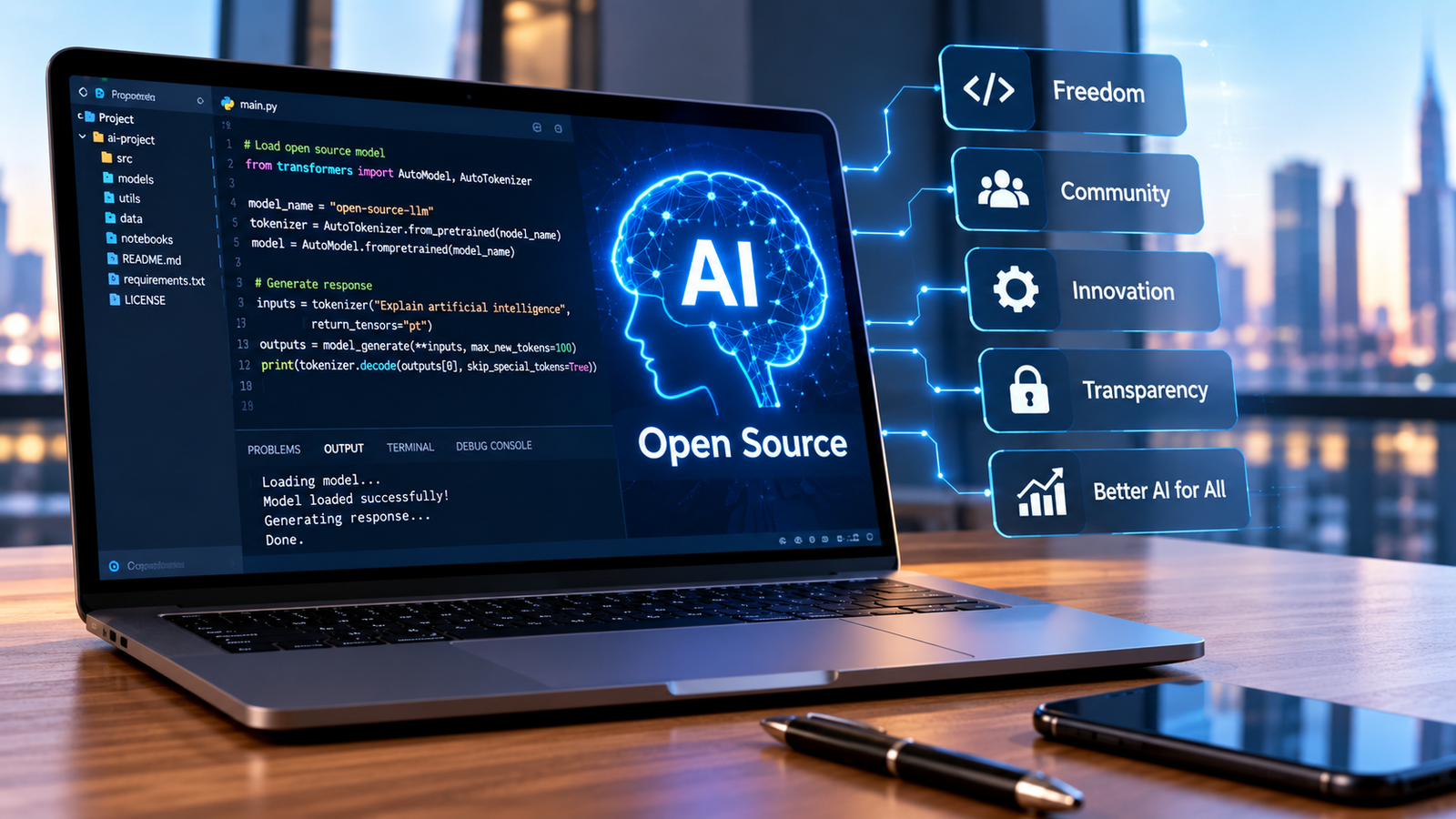
Open Source AI: Guide, Benefits, Models & Latest Updates

Open source AI is changing how people build, study, customize, and use artificial intelligence. Unlike many closed AI services, open systems can provide greater access to important parts of an AI system. However, the phrase open source AI is often used loosely, especially when discussing models that only release their weights. Genuine open-source AI generally involves broader access to the components needed to study, modify, and share an AI system. This guide explains what open source AI means, how it works, its benefits, limitations, examples, and important developments in 2026. It also explains the difference between open-source and open-weight models in simple language.
What Is Open Source AI?
Open source AI refers to artificial intelligence systems made available under terms that allow people to use, study, modify, and share them. The idea comes from open-source software, where users can inspect and improve technology instead of depending completely on one provider. For AI, the concept is more complicated because a model involves code, data processing methods, training procedures, parameters, documentation, and other components. Therefore, simply downloading an AI model does not automatically make it open source. Users should examine the project’s license and available materials before describing a system as genuinely open source.
In simple terms, open source AI gives developers more control over technology. A company might download an eligible model, run it on its own infrastructure, study its behavior, modify it, and create a specialized application. Researchers can also examine available components and reproduce experiments more easily. Students can learn from real systems instead of only using online AI interfaces. However, users should always check the actual license and available components before calling a model open source. Some projects release weights but keep training data, source code, or other important elements unavailable. Such projects are often better described as open-weight rather than fully open source.
How Does Open Source AI Work?
An AI model learns patterns from data during training. Developers prepare data, select an architecture, configure training settings, run the training process, and evaluate the resulting model. The trained model contains parameters, commonly called weights, that influence how it responds to new inputs. In a genuinely open AI project, important information needed to understand and modify the system should be available under appropriate terms. This can include training code, data-processing code, model architecture, inference code, parameters, and relevant settings. The exact materials depend on the project and its licensing conditions.
After a model becomes available, developers can use it in different environments. Someone might run it on a personal computer, while a business could deploy it on private servers or cloud infrastructure. Developers can fine-tune an existing model for tasks such as customer support, document analysis, coding, or translation. They can also connect the model to other software through an application interface. This flexibility is one reason open AI projects attract researchers and startups. At the same time, running advanced models can require substantial computing power, memory, storage, and technical knowledge. Open access does not automatically mean easy or inexpensive deployment.
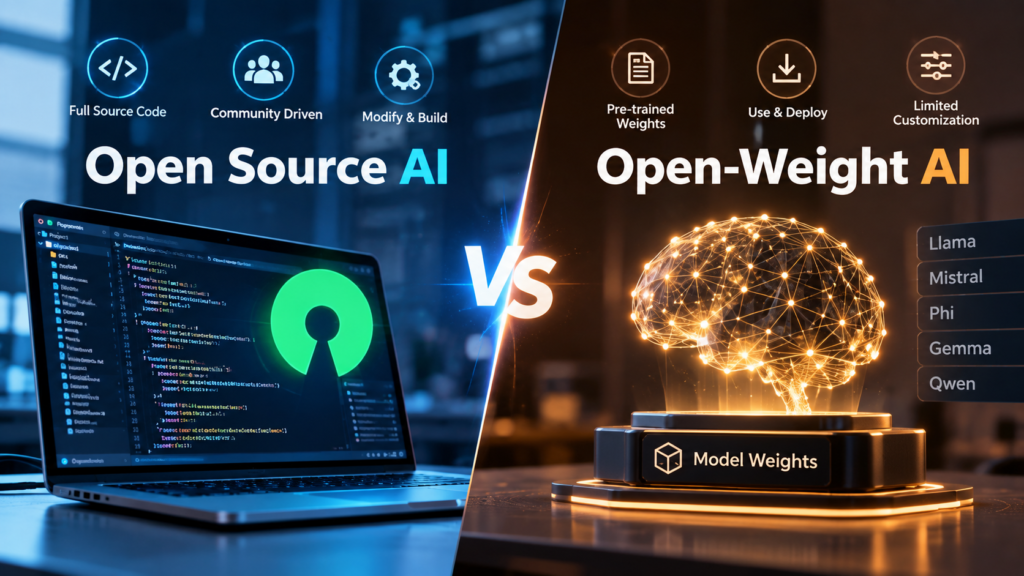
Open Source AI vs Open-Weight AI
The difference between open source AI and open-weight AI is important. An open-weight model generally provides its learned parameters so developers can download and run the model. However, the complete source code, training process, data information, or other components may remain unavailable or restricted. This means an open-weight model can provide significant practical freedom without meeting every requirement associated with the formal open-source definition. Users should therefore avoid assuming that every downloadable model is automatically open source. Checking the license, documentation, model files, and available development materials provides a clearer picture.
This distinction matters when comparing AI models for research, business, or software development. A team that only needs local inference may care mostly about accessible weights and a practical license. A research organization may need training information and source code to reproduce or modify the system properly. Businesses also need to review commercial restrictions, redistribution rules, and other licensing conditions. In 2026, discussions around open AI increasingly focus on this difference because many popular models are described as open even though their availability does not satisfy every requirement of a strict open-source definition.
Benefits of Open Source AI
One major benefit of open source AI is control. Developers are not necessarily tied to a single online service or provider. They may be able to run a model locally, change parts of its behavior, connect it with private applications, or adapt it for specific tasks. This can be particularly useful for organizations with unusual technical requirements. Open systems can also encourage collaboration because researchers and developers can examine available components and contribute improvements. The broader open-source philosophy is built around reducing barriers to learning, using, sharing, and improving technology. These advantages make open AI attractive to developers, researchers, startups, and educational institutions.
Another benefit is experimentation. Students, researchers, startups, and independent developers can explore AI without building every component from scratch. A developer might begin with an existing model and customize it for a narrow application. Businesses can test different models and deployment approaches before committing to a long-term platform. Open ecosystems may also encourage competition because multiple organizations can build services around shared technology. However, the practical benefit depends heavily on licensing, documentation, model quality, hardware requirements, and available community support. Open access creates opportunities, but users still need technical skills and responsible development practices.
Common Uses of Open Source AI
Open source AI can support many practical applications. Developers use accessible models for chatbots, document processing, coding assistants, search systems, summarization, translation, image generation, speech applications, and research projects. A small company could adapt a language model for internal knowledge search, while a university might use an accessible model for research experiments. Developers can also combine models with retrieval systems, databases, automation tools, and traditional software. Because different models have different licenses and capabilities, organizations should evaluate each project carefully before deployment. The right choice depends on the task, hardware, performance requirements, data sensitivity, and legal conditions.
Another important use is education. Students can learn how modern AI systems work by studying accessible models and experimenting with them. Researchers can investigate model behavior, evaluate weaknesses, and develop new techniques. Developers can also create specialized versions for languages, industries, or particular workflows. Open AI projects can therefore become building blocks for new software rather than finished consumer products alone. For example, a developer might connect a language model to a private document database and create a question-answering system. Such projects demonstrate how flexible AI becomes when users can control more of the underlying technology.
Popular Open Source AI Examples
Several projects illustrate different approaches to accessible AI development. Examples from the broader ecosystem include OLMo, Pythia, BLOOM, T5, StarCoder2, and various community-developed language models. However, these projects do not all have identical licenses, components, or levels of openness. Some provide extensive materials for research, while others focus mainly on distributing model weights. This shows why model names alone are not enough when evaluating openness. Users should examine the license, source code, parameters, documentation, and other available components before making a final classification.
The broader open-model ecosystem is much larger than any single list. Developers frequently encounter models described as open, open-weight, community models, or openly available models. These categories can overlap, but they do not always mean the same thing legally or technically. This is especially important for commercial projects. A model may be free to download while imposing conditions on redistribution or commercial use. Another model may provide weights but not enough information for complete modification. Checking the original project documentation and license is therefore more reliable than relying on a marketplace description or social media post.
Latest Open Source AI Update in 2026
The open AI landscape is moving quickly in 2026. Recent industry research indicates that several open-weight AI models are becoming increasingly competitive with leading proprietary systems. Some newer models are also becoming cheaper to operate and easier to deploy on private infrastructure. This trend is increasing interest among startups, developers, researchers, and businesses that want greater control over their AI systems. However, performance comparisons vary depending on the benchmark, model size, hardware, and task. Therefore, users should avoid judging every model based on a single benchmark or headline.
Current developments also show that open AI is becoming an important part of competition between AI providers. More developers are experimenting with local inference, specialized models, and customized AI applications. At the same time, questions around licensing, training data, copyright, safety, and responsible deployment remain significant. The growing availability of AI models does not remove these concerns. Instead, it makes careful evaluation more important. In 2026, organizations increasingly need to consider not only how well a model performs but also where it can run, what its license permits, what data it uses, and how much it costs to operate.
Open Source AI Development Chart
| Area | Earlier Stage | 2026 Direction |
|---|---|---|
| Model access | Limited public access | More downloadable models |
| Model weights | Less common | Increasingly available |
| Local AI | Mostly specialist use | Growing developer interest |
| Model customization | Technical and costly | More accessible tools |
| Open-source definition | Less standardized | Greater focus on clear definitions |
| Competition | Mostly closed providers | Stronger open-model competition |
| Licensing | Often overlooked | Increasingly important |
| AI deployment | Mainly cloud services | More local and private options |
The chart shows a broad movement toward greater access, but it should not be interpreted as evidence that every open model is fully open source. Some projects provide model weights without releasing all the components required for complete modification. Others provide broader technical information but use licenses with specific restrictions. As the industry develops, users are paying more attention to these differences. This is especially important for companies that plan to build commercial products around AI. Before deployment, organizations should review the model’s license, technical documentation, hardware requirements, security considerations, and available support.
How to Choose an Open Source AI Model
Choosing an AI model should begin with the task rather than popularity. First, identify what you need the model to do. A small model may be enough for summarization or basic classification, while demanding reasoning or coding tasks can require larger systems. Next, check hardware requirements, supported languages, context length, performance measurements, and inference speed. Then examine the license carefully. If you plan to sell software using the model, confirm that commercial use and redistribution are permitted. Also check whether the project provides adequate documentation, community support, updates, and security information before adopting it.
It is also useful to test several models with your own representative examples. Public benchmarks can provide useful comparisons, but they do not perfectly predict performance for every real-world application. Create a small evaluation set that reflects your actual users and tasks. Measure accuracy, response quality, latency, memory usage, and operating cost. For sensitive applications, evaluate privacy and security requirements as well. You can also explore related topics through internal resources such as AI tools for businesses, generative AI explained, and how to use AI models locally. Practical testing is usually more valuable than choosing a model based only on popularity.
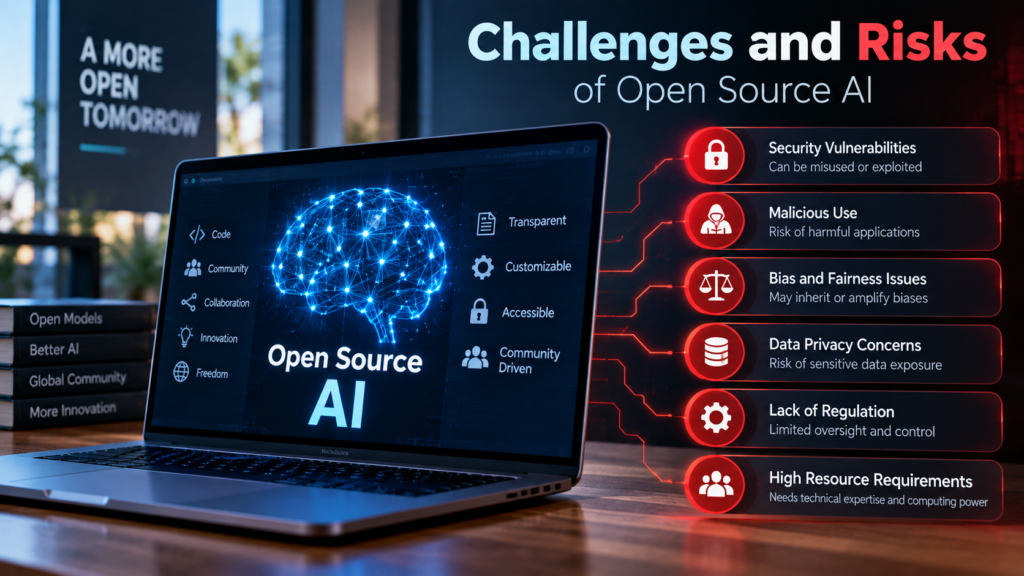
Challenges and Risks of Open Source AI
Open source AI offers flexibility, but it also creates responsibilities. A publicly available model can be used for beneficial applications as well as harmful ones. Developers must therefore consider privacy, security, misinformation, copyright, bias, and misuse. Open availability itself does not guarantee that an AI system is accurate, safe, ethical, or responsible. Different models can produce incorrect information, unwanted content, or biased results. Developers should test systems before deployment and continue monitoring them afterward. Responsible implementation requires technical safeguards, appropriate data handling, clear policies, and human oversight.
There are also practical challenges. Large AI models can require powerful GPUs, significant memory, and considerable energy. Maintaining a customized model can demand experienced developers and ongoing testing. Documentation may be incomplete, while licenses can be complicated. Model outputs can also contain errors or reflect unwanted patterns from training data. For businesses, these issues can increase operational and legal risk. A responsible deployment should therefore include testing, monitoring, access controls, data protection, and clear human oversight. Open technology gives users more control, but that control comes with a greater need to understand what the system actually does.
Future of Open Source AI
The future of open source AI will likely depend on several factors working together. Better hardware efficiency can make advanced models easier to run locally. Smaller models can also bring useful AI capabilities to laptops, phones, private servers, and specialized devices. Improvements in fine-tuning and model compression may further reduce the technical barrier for developers. At the same time, clearer licensing can help businesses understand which models they can legally use. Better documentation and evaluation tools could also make it easier for developers to compare models based on real-world requirements.
Collaboration will remain another important factor. Open AI projects allow researchers and developers from different organizations to build on shared work instead of starting completely from zero. This can accelerate experimentation and create new applications. However, future progress will also require better documentation, evaluation, security practices, and responsible deployment. The most useful open AI systems will not simply be those that are available for download. They will need clear licenses, practical tools, reliable performance, strong documentation, and transparent information about their limitations. As the AI industry develops, these factors will help determine how useful open ecosystems become.
Frequently Asked Questions
What does open source AI mean?
Open source AI describes AI systems that provide users with freedoms to use, study, modify, and share them under appropriate terms. It generally involves access to important technical components needed to understand and modify the system. Therefore, a model being downloadable or free does not automatically make it fully open source.
Is open source AI free to use?
Some open source AI projects can be used without paying a model provider, but “free” depends on the specific license and deployment method. Running a model locally can still involve hardware, electricity, storage, and technical costs. Always review the project’s license before using it commercially.
What is the difference between open source and open-weight AI?
Open-weight AI usually means that model weights are available for download. Full open source involves broader access and freedoms. A project may therefore be highly accessible while still not meeting every requirement associated with a strict open-source definition.
Can businesses use open source AI?
Businesses can use many openly available AI models, but commercial rights vary by license. Companies should check whether commercial use, modification, redistribution, and hosting are permitted. They should also review privacy, security, copyright, and compliance requirements before putting a model into production.
Is open source AI better than closed AI?
There is no single answer for every situation. Open systems can provide more control, customization, and local deployment, while closed services may offer convenient hosting and managed infrastructure. The right choice depends on the application’s requirements, budget, technical resources, license, privacy needs, and performance expectations.
Conclusion
Open source AI is becoming an important part of the modern artificial intelligence ecosystem. It can give developers greater control, encourage collaboration, support research, and make model customization more accessible. However, users should understand that open source and open-weight are not identical terms. The availability of model weights alone does not necessarily provide everything needed to study or modify an AI system. As AI develops through 2026, licensing, performance, hardware efficiency, safety, and transparency will remain important considerations. If you are exploring AI technology, compare models carefully and test them against your real requirements before choosing one. This practical approach can help you make smarter technology decisions.
[…] Perchance NSFW: What It Is and How It Works Open Source AI: Guide, Benefits, Models & Latest Updates AI Robotics News: Latest Developments in 2026 Xoul AI: Complete Guide, Features, and […]