

AI Robotics News: Latest Developments in 2026

AI robotics news is moving quickly as artificial intelligence becomes more closely connected with physical machines. In September 2026, humanoid robots, physical AI systems, autonomous machines, and intelligent factory equipment are receiving major attention. Companies are moving beyond laboratory demonstrations and focusing more on real-world production and commercial use. Recent developments include XPeng starting production of its IRON humanoid robot, Agility Robotics introducing Digit 5, and Chinese startup Spirit AI reporting progress with robot intelligence. These developments show an important shift: robotics is increasingly becoming about teaching machines how to understand environments, make decisions, and complete physical tasks.
For readers following AI robotics news, the biggest change is the move from simple automation toward adaptable machines. Traditional industrial robots usually repeat carefully programmed movements in controlled spaces. Newer systems combine cameras, sensors, machine learning, language models, and physical control. This allows robots to respond to changing objects and environments. However, many technologies remain under development, and impressive demonstrations do not always mean mass deployment is ready. Recent industry commentary also highlights the gap between public excitement and everyday commercial use. Understanding that difference is important when evaluating robotics headlines, company announcements, and future predictions.
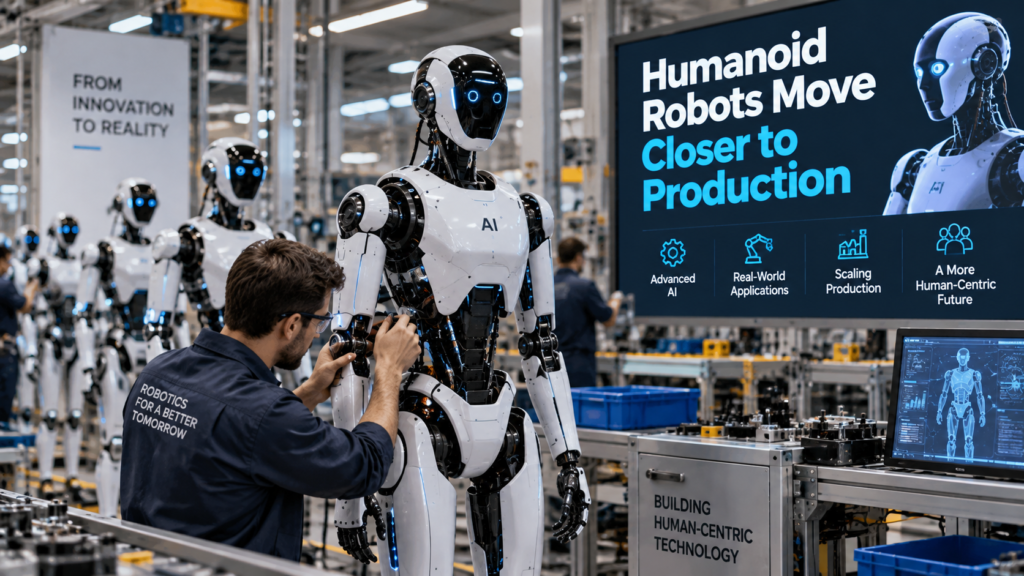
Humanoid Robots Move Closer to Production
One of the biggest stories in current AI robotics news is the growing focus on humanoid manufacturing. XPeng announced on September 8 that its humanoid robot production lines had started operating. The company said its IRON robot autonomously walked off the production line after completing manufacturing. XPeng described the milestone as a step from research and development toward volume production. The development matters because manufacturing robots at scale requires more than a successful prototype. Companies need reliable components, production systems, software, testing procedures, maintenance plans, and safe operating environments. Moving these pieces together could determine how quickly humanoid robots become practical commercial products.
China is also seeing wider activity across the physical AI sector. Spirit AI is developing robot intelligence designed to understand verbal instructions and perform complex physical tasks. The company has reported a 90% success rate for simple tasks in structured environments and says dozens of its Moz1 humanoid robots are already working on production lines at CATL and JD.com. These developments are important for anyone following AI robotics news because they show how companies are testing embodied intelligence outside research laboratories. At the same time, household robotics remains considerably more difficult because homes contain unpredictable objects, layouts, people, and tasks.
Agility Robotics Introduces Digit 5
Another major development in AI robotics news involves Agility Robotics and its new Digit 5 humanoid. The company has designed the robot with stronger safety features for environments where people and robots work close together. Reports say Digit 5 can detect nearby humans and respond by slowing down, stopping, or shutting off to reduce collision risks. The robot is intended for commercial environments and builds on experience from earlier deployments involving companies such as Amazon and Toyota. Safety is becoming increasingly important because humanoid robots can move through spaces designed for humans while carrying substantial loads.
Digit 5 also illustrates how the commercial robotics market is changing. Rather than focusing only on impressive movement, manufacturers are paying greater attention to reliability, operating time, modular hardware, and workplace integration. Reports indicate that Digit 5 can lift up to 50 pounds and is designed for long operating periods with rapid recharging. However, these specifications should be considered alongside actual deployment results, costs, maintenance requirements, and availability. The robot is expected to become available in North America in 2027. This is a useful reminder that a product announcement does not necessarily mean immediate widespread availability.
Physical AI Is Changing Robotics
Physical AI is becoming one of the most important themes in AI robotics news. The idea is simple: instead of AI only producing text, images, or digital decisions, it can interact with the physical world. A physical AI system may use cameras to understand surroundings, sensors to detect objects, and learned models to decide how a robot should move. This approach is attracting attention from robotics companies, automobile manufacturers, research organizations, and technology firms. Mistral has introduced a model focused on embodied navigation that was designed to help robots move through complex environments using a single camera.
The development of physical AI could make robots more flexible than traditional automation systems. A factory robot might eventually identify different objects without requiring every possible position to be manually programmed. A mobile robot could potentially understand instructions and adjust its route when conditions change. However, physical environments are difficult because small errors can have real consequences. Robots must handle uncertainty, unexpected movement, lighting changes, fragile objects, and human interaction. AI robotics news increasingly focuses on sensors, training data, simulation, navigation, and manipulation instead of movement alone. These areas will likely remain central to robotics development as companies work toward more general-purpose machines.
AI Robotics News From Europe
Europe is also expanding its work in intelligent robotics. On September 2, the German Aerospace Center presented advanced AI-based robots at the European Parliament in Brussels. The demonstration included humanoid robots, quadrupeds, drones, and industrial robotic systems. DLR showcased Rollin’ Justin, a humanoid platform designed for tasks including household assistance. These demonstrations highlight the variety of robotic systems being developed across Europe. The region is not focused solely on humanoid machines. Researchers are also exploring autonomous mobility, industrial automation, aerial robotics, and systems that combine artificial intelligence with physical machines.
Spain is another country receiving attention in recent AI robotics news. On September 8, research organization TECNALIA announced the ÁNIMA association, which aims to accelerate humanoid robotics and physical AI development in Spain. Such initiatives show that robotics development increasingly depends on cooperation between research institutions, technology companies, manufacturers, and policymakers. Building useful robots requires expertise across mechanical engineering, artificial intelligence, electronics, software, materials, safety, and manufacturing. Europe’s growing focus on physical AI therefore reflects a broader effort to develop complete robotics ecosystems rather than isolated experimental machines. The long-term impact will depend on how effectively these technologies move from demonstrations into reliable commercial applications.
Smarter Robots Need Better Sensors
Sensors are a major part of modern AI robotics news because intelligent machines need accurate information about their surroundings. Cameras can provide visual information, while depth sensors, inertial measurement units, force sensors, microphones, and lidar can provide additional details. Lidar technology is increasingly being positioned as part of the physical AI infrastructure used by robots and autonomous vehicles. These sensing systems can help machines understand physical environments more accurately. The combination of different sensors can help robots recognize objects, estimate distances, detect movement, and respond to changing conditions.
Better sensors alone, however, do not automatically create intelligent robots. The machine also needs software capable of interpreting sensor information and turning it into useful actions. This is why modern robotics combines perception, artificial intelligence, motion planning, control systems, and hardware. A robot may recognize a box but still need to calculate how to safely pick it up. It may detect a person but also need to determine how quickly it should move. AI robotics news increasingly reflects this complete-system approach. Future progress will likely depend on improving the connection between perception, reasoning, movement, and safety rather than improving only one component.
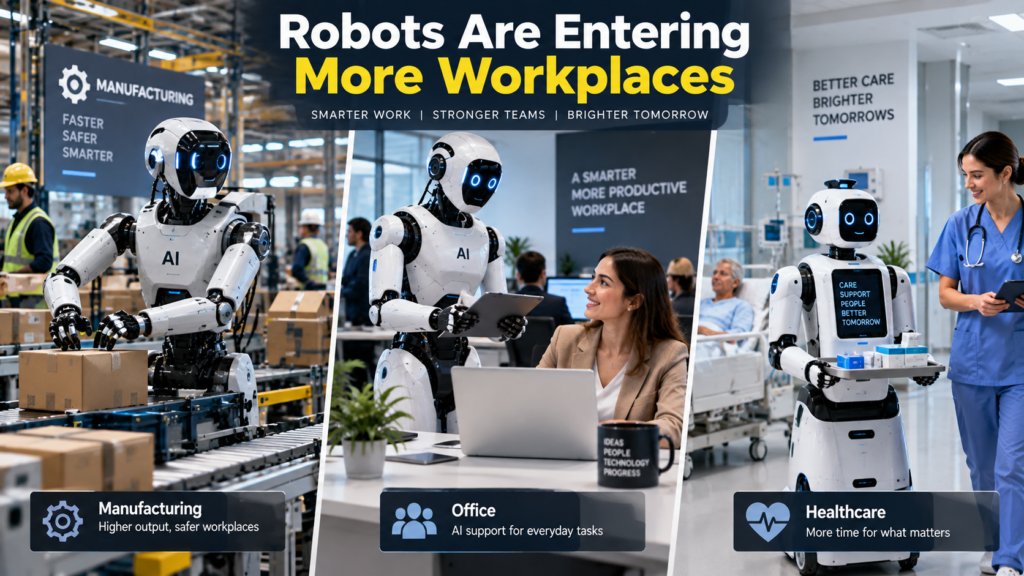
Robots Are Entering More Workplaces
Industrial workplaces remain an important area for AI robotics news because factories provide structured environments where robots can perform repeatable tasks. Companies are experimenting with humanoid robots, autonomous mobile robots, robotic arms, and systems that coordinate multiple machines. Richtech Robotics, for example, has demonstrated an AI-enabled humanoid robot working alongside an autonomous mobile robot to coordinate industrial tasks. The system was designed to combine manipulation with material transportation. Such systems could eventually help businesses automate different parts of a workflow instead of using one machine for every individual task.
The workplace impact of robotics will depend on the specific job and environment. Robots can be useful for repetitive, physically demanding, hazardous, or highly structured tasks. Human workers may still be needed for supervision, maintenance, problem-solving, quality control, and activities requiring flexible judgment. Research into AI and robotics also emphasizes that automation can change workplace skills and collaboration rather than simply removing every human role. For readers following AI robotics news, this distinction matters. Automation is not one single process, and its effects can vary significantly between industries, companies, occupations, and individual workplaces.
What to Watch in Future AI Robotics News
Several developments deserve attention as the robotics industry moves through 2026. First, watch whether humanoid robots move from pilot projects toward repeatable commercial deployments. Second, follow improvements in robot training data because physical machines require information about real-world actions. Third, monitor safety standards and certification as robots operate closer to people. Fourth, pay attention to battery technology, actuators, sensors, computing hardware, and manufacturing costs. These components can influence whether advanced robots become economically practical. Recent developments involving Spirit AI, XPeng, and Agility show that companies are increasingly focusing on real-world deployment rather than demonstrations alone.
Another important trend is the competition to develop general-purpose robot intelligence. Current machines can perform impressive tasks, but many remain limited by their training environments and specific applications. Companies want robots that can understand instructions, adapt to unfamiliar situations, manipulate different objects, and safely work around people. The latest AI robotics news suggests that progress is happening across hardware and software simultaneously. However, readers should separate verified deployments from future promises. Company announcements can describe ambitious plans, while independent testing may provide a different perspective. Following technical demonstrations, customer deployments, production milestones, and safety results can provide a clearer picture of actual progress.
Frequently Asked Questions
What is AI robotics?
AI robotics combines artificial intelligence with physical robotic machines. It allows robots to perceive environments, process information, learn from data, and perform actions. Modern systems may use cameras, sensors, machine learning, navigation software, and language-based models. The goal is to make robots more adaptable instead of limiting them to fixed, repetitive movements.
Why are humanoid robots receiving so much attention?
Humanoid robots are designed around a body shape that can work in environments built for humans. They may potentially use existing doors, shelves, tools, workstations, and pathways. Current development focuses heavily on factories and logistics. However, widespread household use remains technically challenging because homes are less predictable than controlled industrial spaces.
What is physical AI?
Physical AI refers to artificial intelligence that interacts with the physical world through machines such as robots, autonomous vehicles, and drones. These systems combine perception, reasoning, and physical control. Instead of producing only digital information, physical AI can help machines understand environments and perform actions within them.
Are AI robots already being used in factories?
Yes. Some companies are already testing or deploying AI-enabled robots in industrial environments. Spirit AI, for example, has reported that dozens of its humanoid robots are working on production lines at CATL and JD.com. However, deployments vary significantly in scale, capability, and task complexity.
What should readers follow in AI robotics news?
Readers should watch verified production milestones, real-world deployments, safety testing, robot training methods, sensor improvements, battery technology, and manufacturing costs. It is also useful to distinguish company announcements from independently confirmed results. These factors provide a better understanding of whether a robotics technology is moving toward practical, large-scale use.
Conclusion: Following the Future of Robotics
The latest AI robotics news shows an industry moving from experimental demonstrations toward practical deployment. XPeng has begun producing its IRON humanoid robot, Agility Robotics has introduced Digit 5 with enhanced workplace safety features, and Spirit AI is developing systems designed for more capable physical tasks. At the same time, Europe and other regions are investing in physical AI, advanced sensors, autonomous machines, and robotics research. The technology still faces important challenges involving safety, cost, reliability, training data, and real-world adaptability.
[…] Open Source AI: Guide, Benefits, Models & Latest Updates AI Robotics News: Latest Developments in 2026 Xoul AI: Complete Guide, Features, and Review Backyard AI: Complete Review and Guide 2026 […]