

Machine Learning: A Simple Guide for Beginners

Machine learning is a technology that helps computers learn from data and improve their performance. Instead of following only fixed instructions, these systems find patterns and use them to make predictions or decisions. Today, machine learning supports many tools people use every day, including search engines, online shopping, and voice assistants. It also helps businesses understand customers and solve practical problems. Learning how this technology works can make modern digital tools easier to understand. This guide explains the basic concepts, common types, benefits, limitations, and real-world applications of machine learning in simple English, with examples that beginners can follow.
Machine learning is part of artificial intelligence, often called AI. However, the two terms do not mean exactly the same thing. Artificial intelligence is the broader field of creating systems that perform tasks requiring human-like intelligence. Machine learning is one way to build those systems. For example, a computer can learn to recognize cats by studying many pictures. Over time, it identifies useful features, such as ears, eyes, and body shapes. The system does not need someone to write a separate rule for every picture. Instead, it learns from examples and applies that knowledge to new images.
What Is Machine Learning?
Machine learning is a method that allows computers to learn patterns from data. A traditional computer program usually follows instructions written by a person. A machine learning model, however, can discover relationships within examples and use them to produce an answer. For instance, a model can study previous house prices and learn how location, size, and age affect value. When it receives information about another house, it estimates a possible price. The model does not understand property value like a human expert. It calculates patterns based on the information and training process it received.
The main purpose of machine learning is to make useful predictions, classifications, or decisions. A prediction estimates something, such as tomorrow’s sales. A classification places information into a group, such as spam or normal email. A recommendation system suggests products based on previous activity. These tasks depend on data quality and the way a model is trained. More data does not always produce better results. Incorrect, incomplete, or biased information can lead to poor predictions. Therefore, successful machine learning requires suitable data, careful testing, and regular improvement.
How Machine Learning Works
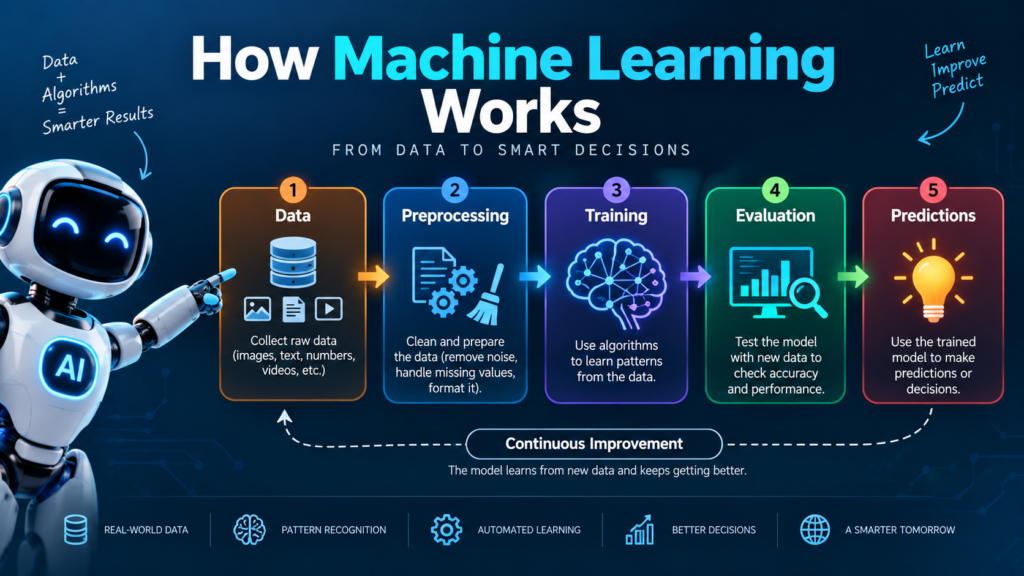
Machine learning begins with a problem that needs a useful answer. A developer or data scientist collects relevant information and prepares it for training. The data may include numbers, text, pictures, sounds, or other records. Next, a learning algorithm studies the examples and searches for patterns. During training, the model adjusts its internal settings to reduce errors. Once training finishes, the model is tested using information it has not seen before. This helps measure whether it can work beyond the examples used during learning.
The process usually includes several important stages. First, the problem and desired result are clearly defined. Second, suitable data is collected, cleaned, and organized. Third, a model is trained using an appropriate algorithm. Fourth, its performance is checked with separate test data. Finally, the model is used in a real application and monitored over time. A model may become less accurate when real-world conditions change. For example, customer buying habits can shift during holidays or economic changes. Regular evaluation helps identify when a model needs new data or adjustment.
Simple Machine Learning Process Chart
The following chart shows how information moves through a typical machine learning project.
| Stage | What happens | Example |
|---|---|---|
| 1. Collect data | Gather useful examples | Previous house prices |
| 2. Prepare data | Clean and organize information | Remove incorrect records |
| 3. Train model | Learn patterns from examples | Connect size with price |
| 4. Test model | Check performance on new data | Estimate unseen house prices |
| 5. Make predictions | Use the trained model | Predict a property’s value |
| 6. Improve model | Review errors and update training | Add newer market data |
This process is repeated when better performance is needed. The chart also shows why machine learning is not simply a matter of pressing a button. Each stage affects the final result. If the training information is incomplete, the model may learn misleading patterns. If testing is weak, problems can remain hidden until the system is used. Good results require careful preparation and evaluation. In practical projects, teams may also monitor speed, cost, fairness, security, and how easily people can understand the model’s decisions.
Types of Machine Learning
Machine learning has three widely discussed types: supervised learning, unsupervised learning, and reinforcement learning. Each type uses information differently. Supervised learning trains a model with examples that include known answers. Unsupervised learning searches for patterns in data without supplied answers. Reinforcement learning allows an agent to learn through actions, feedback, and rewards. These approaches can solve different problems, so choosing the right one matters. A business predicting sales may use supervised learning. A company grouping customers by behavior may use unsupervised learning. A robot learning movement may use reinforcement learning.
Supervised Learning
Supervised learning uses labeled training data. A label is the answer connected to an example. For instance, a collection of emails may be marked as spam or not spam. The model studies these examples and learns patterns associated with each label. After training, it can classify new messages. Supervised learning is also used for numerical predictions. A model may learn from past weather records and estimate future temperatures. Its performance depends on how accurate the labels are and how well the training examples represent real situations.
Unsupervised Learning
Unsupervised learning works with data that does not include predefined answers. The model searches for useful structures, similarities, or groups. For example, a shop may analyze customer purchases and discover several buying patterns. One group may prefer affordable products, while another may often purchase premium items. These groups are not always obvious before analysis begins. Unsupervised learning can help businesses explore large datasets and identify relationships. However, the groups found by a model may not always have a clear meaning. Human experts must review the results before using them for important decisions.
Reinforcement Learning
Reinforcement learning involves an agent that learns by interacting with an environment. The agent takes an action, receives feedback, and adjusts its behavior. For example, a computer program learning a game may receive points for successful moves and lose points for mistakes. Over many attempts, it learns which actions are useful. This approach is also studied for robotics, resource management, and other tasks involving repeated decisions. Reinforcement learning can require many training attempts and careful reward design. A poorly designed reward may encourage behavior that achieves points but does not meet the real goal.
Machine Learning vs. Traditional Programming
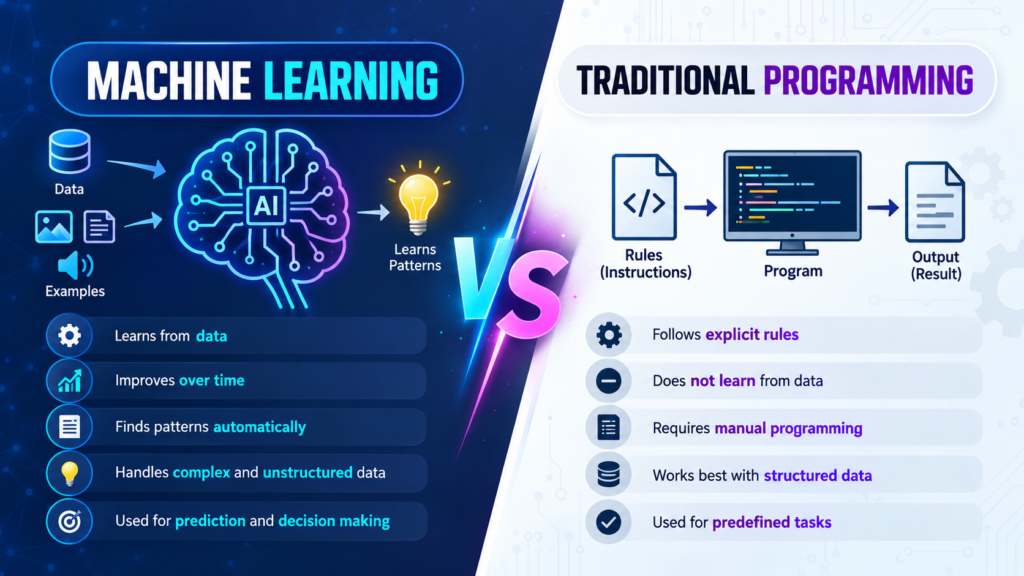
Traditional programming and machine learning both use computers to solve problems, but they follow different approaches. In traditional programming, a developer writes rules that explain how inputs should produce outputs. For example, a program can calculate a discount using a fixed percentage. In machine learning, a model learns relationships from examples. A developer may provide product prices and discount results, allowing the model to learn a pattern. This difference makes machine learning useful for problems where writing every rule would be difficult or impossible.
| Feature | Traditional Programming | Machine Learning |
|---|---|---|
| Main approach | Follow written rules | Learn patterns from data |
| Human role | Define logic directly | Select data, model, and goals |
| Best suited for | Clear, predictable rules | Complex patterns and predictions |
| Example | Calculate sales tax | Predict customer demand |
| Improvement | Change the program | Retrain or adjust the model |
Neither approach is always better. Traditional programming is often easier to understand when the rules are clear and stable. It can be useful when patterns are complicated or change over time. Many modern applications combine both methods. A shopping website may use ordinary programming for payment rules and machine learning for product recommendations. This combination allows developers to use predictable instructions where appropriate while applying learned patterns to tasks involving uncertainty.
Real-World Uses of Machine Learning
Machine learning appears in many services that people use regularly. Email providers use it to identify suspicious messages. Streaming platforms analyze viewing behavior to suggest content. Banks may use models to detect unusual transactions. Hospitals and researchers study machine learning for medical image analysis and other healthcare tasks. Transport companies use predictive models to estimate demand and improve planning. These applications do not all work in the same way. Each requires different data, goals, testing methods, and safeguards. The value of machine learning depends on whether it solves a real problem accurately and responsibly.
Everyday Examples
A voice assistant can use machine learning to recognize spoken words and understand common requests. A phone camera may identify objects, improve image quality, or organize pictures. Search engines use learned systems to understand queries and return relevant information. Online stores can recommend products based on browsing and purchase patterns. These features often combine machine learning with other software components. They may also use human-designed rules to improve safety and reliability. Users usually see only the final result, while the learning process happens behind the scenes.
Business and Industry
Businesses use machine learning to study customer behavior, forecast demand, and identify operational problems. A factory may analyze equipment readings to detect signs of possible failure. A retailer may estimate how many products it should order for the next month. A marketing team may use customer data to understand which messages receive attention. These applications can reduce manual work and support better planning. However, predictions are not guarantees. Managers should consider other evidence, review unusual results, and avoid treating a model’s output as an unquestionable decision.
Benefits and Limitations of Machine Learning
Machine learning can help people process large amounts of information and identify patterns more quickly. It can automate repetitive tasks, support predictions, and improve services that depend on data. For example, a company may use a model to sort thousands of customer messages before employees review them. This can save time and allow staff to focus on more complex work. Machine learning may also discover relationships that are difficult to notice manually. However, these benefits depend on good implementation. A model that learns from poor data can create unreliable results.
Main Benefits
- Automation: Helps complete repetitive tasks with less manual effort.
- Pattern detection: Finds relationships in large datasets.
- Prediction: Estimates future events using historical information.
- Personalization: Supports recommendations based on user behavior.
- Efficiency: Can improve planning, sorting, and resource use.
- Adaptability: Models can be updated when new data becomes available.
Machine learning can support many useful outcomes, but it does not remove the need for human judgment. A model may perform well in testing and still struggle in real situations. Its results can also reflect unfair patterns found in training data. Privacy is another important concern when personal information is collected or analyzed. Businesses should protect sensitive data, explain important decisions when possible, and check performance across different groups. Responsible use combines technical testing with clear policies, human oversight, and attention to the people affected by automated decisions.
Machine Learning and Artificial Intelligence
Artificial intelligence is a broad field that includes systems designed to perform tasks associated with human intelligence. These tasks may include reasoning, planning, language understanding, perception, and decision-making. Machine learning is one major approach used to create AI systems. Other approaches include rule-based systems, search methods, and combinations of different techniques. For example, an AI application may use machine learning to understand language and traditional programming to control its interface. Understanding this relationship helps explain why AI and machine learning are often discussed together, even though they describe different ideas.
Modern AI systems frequently combine several technologies. A language application may use machine learning to process text, software rules to manage user requests, and databases to retrieve information. A self-driving research system may combine learned perception models with mapping, planning, and safety controls. These systems are more complex than a single prediction model. Their reliability depends on how the different parts work together. Machine learning provides powerful capabilities, but it is only one component of many practical AI solutions.
How to Start Learning Machine Learning
Beginners can start learning machine learning by understanding basic mathematics, programming, and data concepts. Familiarity with percentages, averages, graphs, and simple statistics is helpful. Python is commonly used for learning because it has many tools for working with data and building models. Start with small projects rather than trying to understand every advanced method immediately. A simple project could predict house prices, classify flowers, or analyze customer reviews. The goal is to understand how data becomes a model and how the model produces a result.
A practical learning path begins with programming basics, followed by data preparation and simple statistics. Next, study supervised learning methods such as linear regression and decision trees. After that, explore classification, model evaluation, and unsupervised learning. Once these foundations are clear, learners can study neural networks and more advanced methods. Practice is important because machine learning involves many decisions about data and testing. Reading explanations, experimenting with small datasets, and reviewing mistakes can build understanding more effectively than memorizing technical term.
Frequently Asked Questions
What is machine learning in simple words?
Machine learning is a way for computers to learn patterns from examples. Instead of receiving every instruction directly, a model studies data and uses what it learns to make predictions or decisions. For example, it can learn to recognize spam emails by studying messages that people have already marked as spam.
Is machine learning the same as AI?
No, they are related but different. Artificial intelligence is the broader field of creating systems that perform tasks associated with human intelligence. Machine learning is one approach used to build AI systems. Some AI applications also use rules, search methods, or other techniques alongside machine learning.
Do I need advanced mathematics to learn machine learning?
You can begin with basic mathematics, including averages, percentages, graphs, and simple statistics. Advanced topics may require more mathematics later. Beginners should focus first on understanding data, programming, and model evaluation. As your skills grow, you can gradually learn probability, linear algebra, and other mathematical concepts.
Where is machine learning used in daily life?
Machine learning supports many everyday services. It helps email providers detect spam, streaming platforms recommend content, and search engines understand queries. It can also help phone cameras organize pictures and voice assistants recognize speech. These systems usually combine machine learning with other software technologies.
Can machine learning make mistakes?
Yes, machine learning models can make incorrect predictions. Their results depend on training data, model design, and real-world conditions. A model may learn biased patterns or struggle with information that differs from its training examples. Testing, monitoring, and human review can help identify and reduce these problems.
Conclusion
Machine learning helps computers learn patterns from data and use those patterns to produce useful results. It supports many applications, from spam detection and recommendations to business forecasting and scientific research. Understanding its basic types, training process, benefits, and limitations makes the technology easier to use responsibly. Beginners can start with programming, simple statistics, and small practical projects. With regular practice, complex ideas become easier to understand.
[…] Anthropic vs OpenAI: Which AI Is Right for You? Machine Learning: A Simple Guide for Beginners Multimodal: Meaning, Examples, Benefits, and Uses Decentralized AI Movement: The Future of […]