

Anthropic vs OpenAI: Which AI Is Right for You?

Anthropic vs OpenAI is a common search for people exploring artificial intelligence. Both companies develop powerful AI models and tools for everyday users, businesses, and developers. Their products can answer questions, write content, analyze information, and help with coding. However, they have different approaches to AI development and product design. Anthropic is known for Claude, while OpenAI develops ChatGPT and other AI systems. Understanding their differences can help you choose a suitable tool. This guide explains their main features, strengths, limitations, and practical uses in simple English. It also covers important factors to consider before selecting an AI assistant.
Artificial intelligence is changing how people work, study, and communicate. Students use AI to understand difficult topics, while businesses use it to improve daily tasks. Developers also use AI tools to write and review code. However, not every AI assistant works the same way. Some are better suited to certain tasks, while others offer different features and integrations. The right choice depends on your needs, budget, and preferred workflow. By comparing Anthropic and OpenAI, you can understand what each company offers. This information can also help you explore related topics, such as [how artificial intelligence works] and [the benefits of generative AI].
What Are Anthropic and OpenAI?
Anthropic is an artificial intelligence company that develops AI models and assistants. Its best-known product is Claude, which is designed to help users with writing, analysis, coding, and other tasks. Anthropic places strong emphasis on AI safety and responsible development. Its research includes methods intended to make AI systems more reliable and aligned with human instructions. Claude is available through consumer products and developer services. The company also provides tools for organizations that want to use AI in their work. Like other AI providers, Anthropic continues developing new models and features for different user needs.
OpenAI is an artificial intelligence research and technology company known for ChatGPT. Its products support tasks such as writing, learning, coding, brainstorming, and information analysis. OpenAI also develops models and services for developers and businesses. ChatGPT is available through different plans, depending on the features and usage limits offered. The company has introduced tools for working with text, images, files, and other forms of information. Its services are used by individuals, schools, and organizations. When comparing Anthropic vs OpenAI, it is useful to remember that both companies offer several products rather than just one AI model.
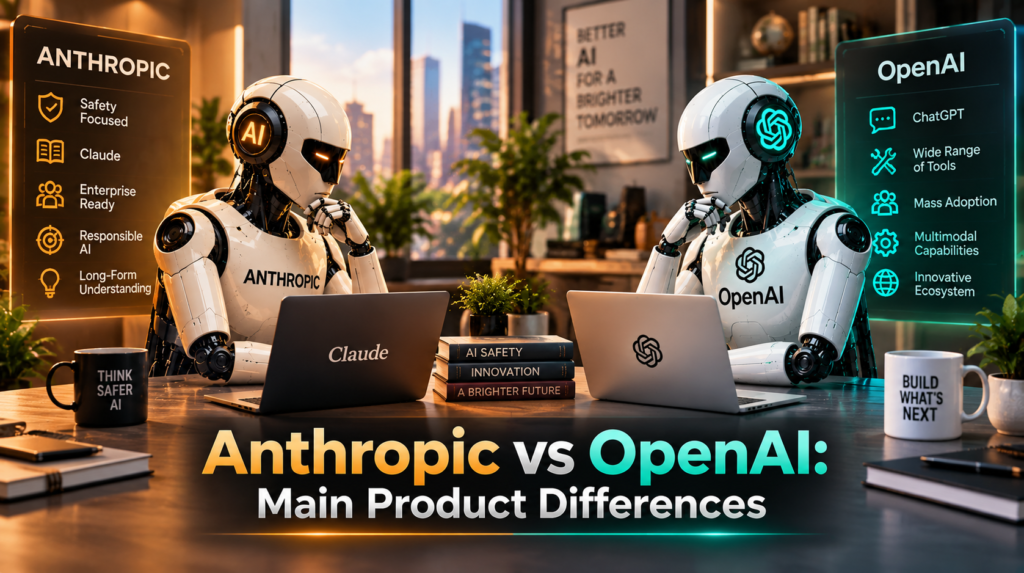
Anthropic vs OpenAI: Main Product Differences
Claude and ChatGPT are the main products people compare when researching AI assistants. Claude is developed by Anthropic, while ChatGPT is developed by OpenAI. Both can help with writing, summarizing, explaining ideas, and solving problems. Their responses may differ because they use different models, training methods, and product features. The experience can also change as companies release updates. Therefore, a single comparison may not remain accurate forever. Instead of assuming one assistant is always better, users should consider which tool fits their particular task. Testing both can provide useful information about their differences.
ChatGPT offers a broad range of features through its application and related services. Depending on the plan and available tools, users may work with documents, images, coding tasks, and other content. Claude also provides features for writing, analysis, coding, and working with information. The exact tools available can depend on the model, subscription, region, and product version. Some features may also require additional setup. This means users should check current product information before making a decision. For beginners, the most important question is simple: which assistant helps you complete your everyday tasks more effectively?
Claude vs ChatGPT for Writing and Learning
Claude and ChatGPT can both help people write articles, emails, reports, and study notes. They can explain difficult ideas using simpler language and suggest ways to improve writing. For example, a student might ask either assistant to explain photosynthesis using everyday examples. A blogger might request an outline for an article about technology. Both tools can also help correct grammar and organize information. However, the quality of the response depends on the instructions, topic, and model being used. Clear prompts usually produce more useful results than short or unclear requests.
For longer writing projects, users may care about tone, structure, and consistency. Claude can help organize large amounts of text and develop drafts. ChatGPT can also support writing projects, brainstorming, and editing through its available tools. Neither assistant should be treated as a perfect editor or fact-checker. AI may produce incorrect information, repeated ideas, or unsupported claims. Writers should review important details before publishing. If you are creating website content, it is also helpful to understand [Google Helpful Content guidelines] and [basic on-page SEO practices]. These resources can help you focus on useful content rather than AI-generated text alone.
Anthropic vs OpenAI for Coding and Business
AI assistants are increasingly used by developers and businesses. They can explain programming concepts, suggest code, identify possible errors, and help users understand technical documentation. Claude and ChatGPT both support coding-related tasks, although their performance can vary by model and programming language. Developers should test the tools with realistic examples before choosing one for important work. AI-generated code may contain security problems or mistakes. Human review remains necessary, especially when software handles payments, personal information, or other sensitive data.
Businesses may use AI to draft documents, summarize meetings, organize information, and support customer service. ChatGPT and Claude can both help with these tasks, depending on their available features and integrations. Companies should also consider privacy, access controls, data handling, and administrative tools. A tool that works well for an individual may not meet an organization’s requirements. When comparing Anthropic vs OpenAI for business use, examine the complete service rather than only the chatbot. Pricing, security features, support, and compatibility with existing systems can all affect the final decision.
Pricing, Access, and Available Features
Pricing is an important part of choosing an AI assistant. Both Anthropic and OpenAI offer different ways to access their products, including options for individual users and organizations. Plans may include different usage limits, model access, and additional features. Prices and plan details can change, so users should check the official websites before subscribing. A free option may be enough for occasional questions, while frequent users may need more access. Businesses should compare the total cost of using AI rather than focusing only on the monthly subscription.
The available features also depend on the specific product and plan. Some users may need file analysis, coding support, or tools that connect with other services. Others may only want help writing emails or learning new subjects. ChatGPT and Claude may offer different capabilities at different times. It is important to confirm whether a feature is available in your country and plan. Users should also review any usage limits before relying on AI for regular work. Comparing Anthropic vs OpenAI becomes easier when you make a short list of the features you actually need.
AI Safety, Privacy, and Reliability
AI safety is an important part of the discussion about Anthropic and OpenAI. Both companies conduct research and develop systems intended to make AI more useful and reliable. Anthropic is particularly associated with its Constitutional AI approach, which uses written principles to guide model behavior. OpenAI also researches AI alignment, safety, and responsible deployment. These approaches are not identical, and their effectiveness can depend on the model and situation. Users should understand that safety features do not guarantee perfect answers or eliminate every possible risk.
Privacy is another important consideration when using AI tools. Users should avoid sharing passwords, financial details, private documents, or other sensitive information unless they understand how the service handles it. Businesses may need additional agreements and security controls. AI assistants can also make mistakes, misunderstand instructions, or provide outdated information. Important decisions should be checked against trustworthy sources. When comparing Anthropic vs OpenAI, reliability should be measured against your own needs. A tool that performs well for writing may not be suitable for medical, legal, or financial decisions without careful human review.
How to Choose Between Claude and ChatGPT
Choosing between Claude and ChatGPT depends on what you want to accomplish. If you mainly need writing help, test both with the same article or editing task. If you work with code, compare their responses to a real programming problem. If you need file analysis or other advanced features, check which product offers the tools you require. The best choice may also depend on the applications you already use. Trying both assistants can help you understand their response styles, limitations, and practical value.
You should also consider cost, ease of use, and the importance of your tasks. A student may prefer a simple assistant for explanations and homework practice. A business owner may need stronger organization, privacy controls, or integration with existing software. A developer may care more about coding performance and API access. There is no single answer for every user. The Anthropic vs OpenAI comparison is most useful when it helps you identify your own requirements. Start with a few common tasks, compare the results, and choose the service that fits your workflow.
Frequently Asked Questions
Is Anthropic the same company as OpenAI?
No. Anthropic and OpenAI are separate artificial intelligence companies. Anthropic develops Claude, while OpenAI develops ChatGPT. Both companies research AI and provide products for individuals, developers, and businesses. Their models, product features, and development approaches can differ. Users should compare the specific services they plan to use.
Which is better for writing, Claude or ChatGPT?
Both Claude and ChatGPT can help with writing, editing, summaries, and brainstorming. Their results may vary depending on the model, prompt, and type of writing. Some users may prefer one assistant’s writing style, while others may prefer the available editing tools. Testing both with your own content is useful.
Can Claude and ChatGPT write code?
Yes. Both Claude and ChatGPT can assist with programming tasks. They can explain code, suggest solutions, identify possible errors, and help with documentation. However, AI-generated code may contain mistakes or security problems. Developers should test and review code before using it in real applications.
Are Claude and ChatGPT free to use?
Both services have offered free access options, along with paid plans that provide different features and usage limits. Pricing and availability can change over time. Check the official Anthropic and OpenAI websites for current details. Your choice may depend on how often you use AI and which features you need.
Can AI assistants replace human writers and developers?
AI assistants can support writers and developers by helping with drafts, explanations, coding, and repetitive tasks. However, they do not remove the need for human judgment, creativity, or review. Their output can contain errors and may require substantial editing. AI is best used as a practical tool that supports human work.
Conclusion
Anthropic vs OpenAI is a useful comparison for anyone exploring modern AI assistants. Claude and ChatGPT both support writing, learning, coding, and business tasks. Their differences may appear in model behavior, available features, pricing, and product design. However, the right choice depends on your personal or professional requirements. Consider the tasks you perform most often, the features you need, and your budget. Try both tools with realistic examples before making a decision. AI technology continues to change, so checking current product information is important.
[…] Perplexity Browser: Features, Download, and Latest Updates Anthropic vs OpenAI: Which AI Is Right for You? Machine Learning: A Simple Guide for Beginners Multimodal: Meaning, Examples, Benefits, […]