

Fireworks AI: A Complete Guide to Features, Pricing, and Uses

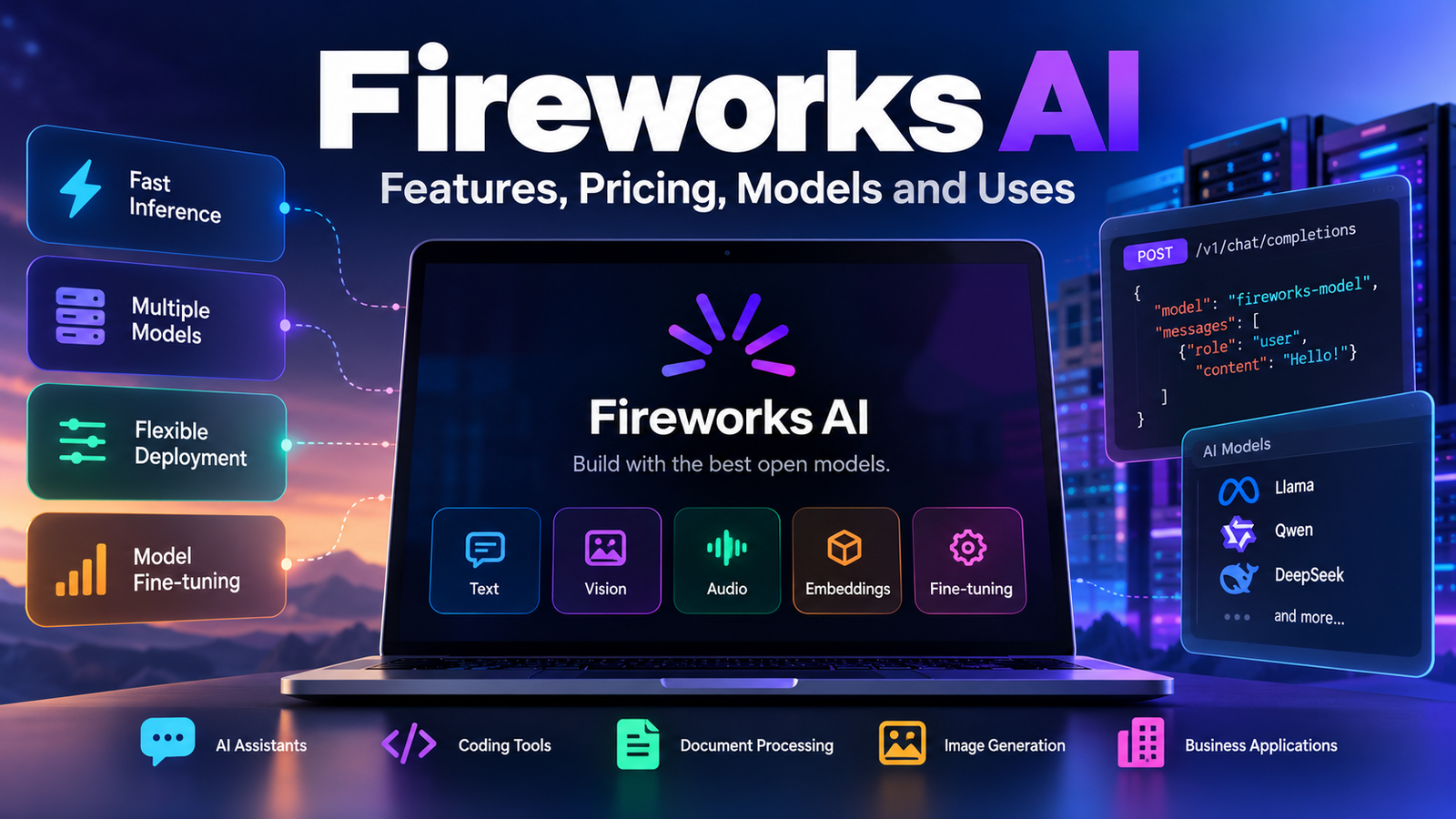
Fireworks AI is a powerful infrastructure platform designed to help developers build, customize, and deploy generative AI models without the complexity of managing GPU servers. Instead of training models from scratch, you can access top-tier open-weight models via a streamlined API. This guide explores how the platform works, its pricing models, and whether it is the right choice for your next AI project.
What makes Fireworks AI interesting is its focus on inference, the process through which a trained AI model generates responses to new inputs. Fast inference matters when an application must answer customer questions, summarize documents, generate code, or support an AI agent in real time. However, speed is only one part of the decision. Model quality, operating costs, privacy, and reliability also matter.
This guide explains how Fireworks AI works, what developers can do with it, how its pricing models operate, and where its limitations become important. It also compares Fireworks AI with other approaches to running AI models so you can decide whether it fits your project.
What Is Fireworks AI?
Fireworks AI is a developer platform for running and customizing generative AI models, particularly open-weight models. It provides managed infrastructure for model inference, along with tools for fine-tuning, deployment, and building AI-powered applications. Its model catalog includes capabilities for text, vision, audio, image generation, embeddings, and other tasks, depending on the selected model.
To understand its purpose, consider what happens when a company wants to add an AI assistant to its website. The company needs a suitable model, computing resources, an API connection, and a way to handle requests reliably. Running the model independently can require GPU expertise, performance tuning, monitoring, and infrastructure management.
Fireworks AI manages much of the model-serving infrastructure. Developers can send requests to hosted models rather than building the entire serving system themselves.
The platform is particularly relevant to:
- Software developers building AI-powered applications.
- Startups testing AI products without managing their own GPU servers.
- Businesses adding AI features to existing software.
- AI engineering teams optimizing model speed, cost, and output quality.
- Researchers and technical teams experimenting with supported models and fine-tuning methods.
An important distinction is that Fireworks AI is not simply a chatbot for everyday conversations. Its main purpose is to provide infrastructure and tools that developers can use to build their own AI products.
How Does Fireworks AI Work?
Fireworks AI connects an application to a hosted AI model through an API. The model processes the input, generates an output, and returns the result to the application. The developer does not need to operate the underlying model-serving infrastructure directly.
The process generally follows these steps:
- User input: A question, document, image, or other supported input reaches your application.
- API request: Your backend sends the request to a selected model using the Fireworks API.
- Model inference: The hosted model processes the input and generates a response.
- Application response: Your software displays the answer or uses it in another workflow.
Understanding AI inference
Inference is the computation required to use an already-trained model. When a language model answers a question, it predicts and generates tokens, which are small units of text. Images and audio use different processing methods depending on the model.
Fireworks AI focuses on making this process efficient. Its inference infrastructure uses techniques such as caching, quantization, and specialized GPU execution to improve performance.
For example, caching can reduce repeated computation when requests share relevant context. Quantization represents model values using lower numerical precision, which can reduce memory requirements and improve execution speed, although the effect on output quality depends on the model and implementation.
These optimizations matter when an application handles many simultaneous users. A response that arrives quickly for one test request may behave differently under heavy traffic, so production systems should be benchmarked under realistic conditions.
Fireworks AI versus training a model from scratch
Training a foundation model from scratch requires substantial data, computing resources, expertise, and evaluation. Fireworks AI lets developers start with supported pretrained models and run inference without building that infrastructure themselves.
Teams can also fine-tune eligible models using their own training examples. Fine-tuning adjusts a model’s behavior for a particular task; it is different from creating an entirely new foundation model.
This approach can make AI development more accessible, but it does not eliminate the need for good data, testing, or application engineering.
Key Features of Fireworks AI
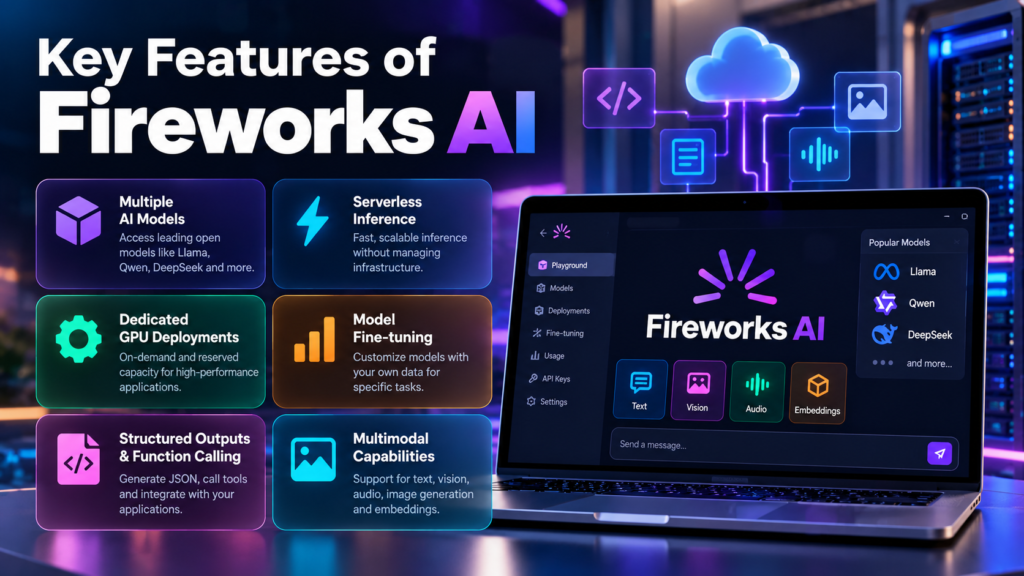
Fireworks AI offers several capabilities that serve different stages of AI product development. The exact options depend on the model, deployment type, and current platform support.
1. Access to multiple AI models
Developers can select from a catalog of hosted models rather than committing to a single model provider. The catalog includes open-weight model families such as Llama, Qwen, and DeepSeek, with availability changing as the platform evolves.
This flexibility is useful because different models perform differently on reasoning, coding, summarization, multilingual tasks, and image understanding.
A small model might be sufficient for classifying customer messages. A more capable reasoning model may be better for analyzing complicated technical documents. The best option depends on actual performance, not just the model’s size or reputation.
2. Serverless inference
Serverless inference lets developers call supported models without provisioning and maintaining their own GPU servers. Billing is generally based on token usage for this deployment option.
It is a practical starting point for prototypes, early-stage products, and applications with changing workloads. Developers can test model quality and measure request volume before investing in dedicated infrastructure.
Serverless does not mean unlimited usage or guaranteed zero latency. Rate limits, account quotas, model availability, and request complexity can affect the experience.
3. Dedicated GPU deployments
For applications that need more control over capacity and performance, Fireworks AI offers on-demand deployments and reserved-capacity options.
Dedicated infrastructure can help teams manage predictable traffic, demanding workloads, or specialized model configurations. However, it also introduces decisions about GPU capacity, scaling, utilization, and cost.
A team with irregular traffic may prefer serverless billing. A business with continuous, high-volume inference should compare the total cost of serverless requests against dedicated deployment expenses.
4. Model fine-tuning
Fine-tuning adapts a pretrained model using task-specific examples. Fireworks AI supports training approaches that include supervised fine-tuning and other supported optimization methods.
Consider a company that processes insurance documents. A general model may understand the documents but produce inconsistent summaries. Fine-tuning with carefully prepared examples could help it follow the company’s preferred structure and terminology.
Fine-tuning is not always the right solution. If the model needs access to frequently changing company information, retrieval-augmented generation (RAG) may be more appropriate. RAG supplies relevant information at request time instead of trying to store every fact in the model’s learned parameters.
5. Structured outputs and function calling
AI applications often need more than readable text. They may need valid JSON, a database query, or a request to another software service.
Fireworks AI supports structured-output capabilities and function calling for compatible models and configurations. These features help applications connect model responses to software workflows.
For example, a customer-support assistant might identify a customer’s order number and request an order-status lookup from an internal API. The model can help decide which tool to call, but the application should verify permissions and validate the returned data before presenting it.
Function calling is not the same as giving a model unrestricted access to a computer system. Developers must define the available tools and enforce appropriate security controls.
6. Vision, audio, and image capabilities
Fireworks AI’s catalog includes models and APIs for tasks beyond text, including vision-language processing, audio transcription, and image generation. The available functions vary by model and endpoint.
Potential uses include:
- Extracting information from scanned documents.
- Describing or classifying images.
- Transcribing recorded conversations.
- Generating images from written prompts.
- Combining document analysis with language-model reasoning.
A developer should check the exact model’s capabilities before designing a workflow. Support for image input does not automatically mean a model can generate images, and image-generation endpoints may have different parameters and limitations from chat endpoints.
What Can You Build With Fireworks AI?
Fireworks AI is most useful when an application needs model capabilities through a programmable interface. Here are practical examples of how developers could apply it.

AI customer support
A business could use a language model to classify incoming questions, draft replies, and retrieve relevant order information. Human review can remain part of the process for refunds, complaints, and sensitive cases.
AI coding assistants
A development team could integrate a supported code model into an editor or internal tool to explain functions, suggest changes, or generate test cases. The resulting code still needs testing and security review.

Document processing
A company could extract fields from invoices, summarize reports, or categorize incoming forms. Structured outputs make it easier to pass the results to databases and business applications.

Content and research tools
Developers could build systems that summarize source material, organize research notes, generate article outlines, or answer questions about a private document collection. Source checking remains essential when factual accuracy matters.
These are illustrative applications, not claims that a particular company uses Fireworks AI for each workflow. In every case, the results depend on the chosen model, the quality of the input, and the safeguards built into the application.
Implementing Retrieval-Augmented Generation (RAG)
RAG is essential for grounding AI models in your private data, ensuring responses are accurate and relevant to your specific business context. With fireworks ai, developers can combine embedding models with generative models to create context-aware applications. The workflow typically involves three stages: embedding, retrieval, and generation. First, you use an embedding model to convert your internal documents into vector representations stored in a database. When a user asks a question, your application retrieves the most relevant document chunks. Finally, you send these chunks alongside the user query to a fireworks ai endpoint. This ensures the model answers based on your specific data rather than relying solely on its training set. This approach is highly effective for internal wikis, legal document analysis, and customer support bots that need to reference specific company policies. For businesses looking to scale these operations, integrating with data analytics platforms can further enhance the insights derived from these AI-driven workflows.
Fireworks AI Pricing: How Much Does It Cost?
Fireworks AI uses usage-based pricing for serverless inference, while dedicated deployments are charged according to GPU usage. Training and fine-tuning have separate pricing structures. The total cost depends on the model, the amount of input and output processed, and the deployment configuration.
| Service | How billing works | Best suited for |
|---|---|---|
| Serverless inference | Based on token usage | Prototypes and variable workloads |
| On-demand deployments | Based on GPU usage time | Production workloads needing dedicated resources |
| Reserved capacity | Based on an agreed capacity arrangement | Businesses requiring predictable capacity |
| Fine-tuning | Based on training method and usage | Adapting supported models to specific tasks |
Is Fireworks AI free?
Check the current account terms and model pricing before assuming you can use the platform without charge. Available credits, promotions, and model rates can change.
How to estimate your AI costs
Suppose an application processes 100,000 requests in a month. If each request averages 1,000 input tokens and generates 300 output tokens, the workload would involve approximately:
- Input: 100 million tokens.
- Output: 30 million tokens.
This is a hypothetical workload, not a Fireworks AI usage statistic. To estimate the bill, multiply the input and output token totals by the selected model’s respective rates, then account for any applicable cached-token charges, minimums, or additional services.
For dedicated deployments, estimate GPU usage time and the number and type of GPUs required. An inexpensive model can still become costly if it generates unnecessarily long responses or requires repeated retries.
Practical tip: Set a spending limit where available, monitor token consumption, and test representative requests before launching an application to a large audience.
Fireworks AI vs. OpenAI, Together AI, and Self-Hosting
Choosing an AI platform involves more than comparing advertised speed. You need to consider model access, integration requirements, operational effort, customization, and total cost.
These options serve overlapping purposes, but they are not identical products.
| Option | Main strength | Main trade-off |
|---|---|---|
| Fireworks AI | Managed inference and customization for supported open models | Performance and pricing depend on the model and deployment |
| OpenAI API | Access to OpenAI’s hosted models and API ecosystem | Model selection and customization depend on the services offered |
| Together AI | Hosted inference and tools for working with open models | Available models, features, and pricing differ by service |
| Self-hosted models | Greater control over infrastructure and deployment | Requires GPU management, optimization, monitoring, and maintenance |
Fireworks AI vs. OpenAI
OpenAI and Fireworks AI can both provide APIs for integrating models into applications, but their model offerings and infrastructure approaches differ.
Fireworks AI is particularly relevant when developers want to experiment with supported open-weight models, fine-tune eligible models, or control how inference resources are deployed. OpenAI is worth evaluating when its own models and associated tools best match the application.
Fireworks AI also supports compatibility with OpenAI’s API format for supported inference workflows. This can make migration easier, although developers still need to check model identifiers, parameters, tool-calling behavior, and output differences.
Fireworks AI vs. Together AI
Both platforms target developers who want to run AI models without operating all the underlying infrastructure themselves. The meaningful differences are their current model catalogs, serving options, fine-tuning tools, supported integrations, and measured performance.
Rather than assuming one platform is universally faster or cheaper, test the same prompts, output limits, and traffic patterns on both. Compare the quality of the answers as well as latency and cost.
Fireworks AI vs. self-hosting
Self-hosting can be attractive when an organization needs extensive infrastructure control, specialized networking, or a particular deployment environment. It can also introduce significant operational work.
Fireworks AI reduces that burden by managing supported model-serving infrastructure. However, a managed platform does not automatically satisfy every company’s data-residency, regulatory, or network-isolation requirements. Those must be checked against the actual service configuration and contractual terms.
Comparing AI Inference Platforms
Choosing the right infrastructure provider requires balancing latency, model availability, and cost. While fireworks ai is optimized for high-throughput inference and flexible deployment, other providers like Together AI and Groq offer different strengths. Together AI focuses heavily on a wide catalog of open-source models and research-grade optimizations. Groq is known for its specialized LPU (Language Processing Unit) hardware, which offers extremely low latency for specific text-generation tasks. When comparing models, developers should also keep an eye on emerging standards like Gemini 2.5 to see how they stack up against open-weight alternatives.
| Feature | Fireworks AI | Together AI | Groq |
|---|---|---|---|
| Primary Focus | Managed Inference | Open Model Catalog | Ultra-Low Latency |
| Hardware | GPU-based | GPU-based | LPU-based |
| Best For | Production Apps | Research & Scale | Real-time Chat |
When selecting between these platforms, consider your specific latency requirements and the model families you need to support. Testing your actual workload on each platform is the only way to determine which provider offers the best price-to-performance ratio for your specific use case.
How to Get Started With Fireworks AI
You do not need to build a complete AI product before trying the platform. A small test application is enough to evaluate a model’s quality, response speed, and integration requirements.
Step 1: Create an account and API key
Start by creating an account with Fireworks AI and following its developer setup instructions. Generate an API key and store it securely.
Never place a private API key in public JavaScript, a mobile application distributed to users, or a public source-code repository. Keep it on a backend or in a suitable secrets manager.
Step 2: Select a model
Browse the model catalog and choose one that fits your task. Check its supported inputs, context length, output limits, pricing, and tool-calling capabilities.
For example, a summarization application may not need the same model as a complex coding assistant. Testing several candidates is often more useful than choosing the largest available model.
Step 3: Make a test API request
Fireworks AI supports OpenAI-compatible inference endpoints. A simplified Python example using the OpenAI client library looks like this:
import os
from openai import OpenAI

client = OpenAI(
    base_url="https://api.fireworks.ai/inference/v1",
    api_key=os.environ["FIREWORKS_API_KEY"],
)

response = client.chat.completions.create(
    model="YOUR_FIREWORKS_MODEL_ID",
    messages=[
        {
            "role": "user",
            "content": "Summarize the benefits of solar energy in three points."
        }
    ],
    max_tokens=200,
)

print(response.choices[0].message.content)
Replace YOUR_FIREWORKS_MODEL_ID with the exact supported model identifier from your account or model catalog. Install the required Python package before running the example, and set the API key as an environment variable.
The example demonstrates the basic request pattern. Different models may support different parameters, and image, audio, or image-generation tasks can require separate endpoints.
Step 4: Evaluate the response
Do not judge a model from a single successful request. Test it using a representative set of questions, including difficult and ambiguous examples.
Check whether it follows instructions, produces accurate answers, handles missing information appropriately, and returns valid output formats. For a business application, also test failure cases such as unavailable data and API errors.
Step 5: Measure production performance
Record response latency, token usage, error rates, and output quality. Test with realistic concurrency rather than relying only on occasional manual requests.
Once the application works reliably, decide whether serverless inference remains suitable or whether a dedicated deployment would offer a better balance of performance, capacity, and cost.
Benefits and Limitations of Fireworks AI
Fireworks AI can simplify AI development, but it is not a substitute for sound engineering and model evaluation.
Main advantages
- Simpler infrastructure: Developers can use supported hosted models without managing every GPU-serving component.
- Model flexibility: Teams can compare multiple model families and change models as requirements evolve.
- Customization: Supported fine-tuning options can adapt model behavior to specialized tasks.
- Deployment choices: Serverless, on-demand, and reserved-capacity options suit different workload patterns.
- Developer integrations: API compatibility and structured-output features can reduce integration work.
- Multimodal options: Supported models and endpoints cover several types of data beyond ordinary text.
The practical value of these capabilities depends on the specific model and workload.
Important limitations
Model quality still varies. A fast response is not necessarily a correct one. Some models perform well on coding but less well on nuanced reasoning, specialized knowledge, or particular languages.
Costs can be difficult to predict. Long prompts, large outputs, repeated agent calls, and high traffic can increase spending. Dedicated GPUs may also incur substantial costs when utilization is low.
Fine-tuning requires preparation. Poor-quality examples can reinforce unwanted behavior. Training also requires evaluation to determine whether the customized model actually improves on the original.
API dependence introduces operational risks. Rate limits, outages, model updates, and changes in supported parameters can affect an application. Production systems need sensible timeouts, error handling, monitoring, and fallback behavior.
Generated content needs verification. Like other generative AI systems, supported models can hallucinate, meaning they produce plausible but incorrect information. Important decisions should not rely on unverified model output.
For these reasons, Fireworks AI is best treated as one component of an AI system, not as a guarantee of application quality.
Privacy, Security, and Responsible AI Use
Before sending business data to Fireworks AI, understand what information your application transmits and how the service handles it.
The platform publishes security and compliance information, including details about its security posture and data handling. Businesses should review the applicable documentation, account settings, and contractual commitments before processing sensitive information.
Important precautions include:
- Protect API keys: Keep credentials on the server and rotate them when necessary.
- Minimize sensitive data: Send only the information required to complete the task.
- Validate model outputs: Check important facts and enforce data formats before using responses.
- Control tool access: Require authorization checks before an AI agent can access databases, send emails, or perform transactions.
- Review compliance requirements: Confirm whether the specific deployment meets your organization’s privacy, retention, and data-residency obligations.
- Monitor usage: Track unusual request patterns, errors, and unexpected spending.
An API provider’s security measures do not automatically make an application secure. Developers remain responsible for their own access controls, data handling, and application logic.
Enterprise Security and Compliance
For businesses handling sensitive information, security is paramount. When evaluating fireworks ai for enterprise-grade applications, it is important to review the platform’s compliance posture, such as SOC2 certification and data handling policies. Enterprise deployments often require features like Virtual Private Cloud (VPC) support to ensure network isolation and private connectivity. These configurations allow teams to keep traffic within a secure perimeter, reducing the risk of data exposure. Furthermore, robust API key management and role-based access control are critical for maintaining a secure development environment. By leveraging these enterprise features, organizations can confidently scale their AI operations while adhering to strict regulatory requirements and internal security standards. Always ensure that your implementation includes logging and monitoring to track data access and model usage patterns, which is a best practice for any production-grade AI system.
Frequently Asked Questions About Fireworks AI
1. What is Fireworks AI used for?
Fireworks AI helps developers run, customize, and deploy generative AI models. Common applications include chatbots, coding assistants, document processing, semantic search, and AI agents.
2. Is Fireworks AI free to use?
Pricing depends on the service, model, and account terms. Serverless inference uses usage-based billing, and dedicated deployments have separate charges. Check current rates and any available credits before using the platform.
3. Does Fireworks AI offer an API?
Yes. It provides APIs for supported model inference, along with additional interfaces for training and other capabilities. Developers can integrate these services into their applications.
4. Can Fireworks AI run open-source models?
It supports numerous open-weight models, including models from families such as Llama, Qwen, and DeepSeek. Availability and supported configurations vary.
5. Can I use Fireworks AI without coding?
The platform is primarily designed for developers. Browser-based tools and playgrounds can help with experimentation, but building a custom application generally requires programming or an integration tool.
6. Is Fireworks AI better than OpenAI?
Neither is universally better. Fireworks AI is worth evaluating for open-model inference and deployment flexibility, while OpenAI may be preferable for applications built around its own models and tools.
7. Is Fireworks AI suitable for businesses?
Yes, it can support business applications that need hosted AI inference and model customization. Businesses should evaluate reliability, cost, security, compliance, and output quality before deploying it for important workflows.
Conclusion
Fireworks AI offers a practical way to build AI-powered applications without managing every part of the underlying model-serving infrastructure. Its combination of hosted inference, model selection, fine-tuning, and flexible deployment options makes it worth considering for startups, developers, and businesses that need more control over their AI workflows.
However, the right choice depends on the application. A small chatbot has different requirements from a high-volume coding assistant or an enterprise document-processing system. Before committing, compare model quality, benchmark response times, estimate total costs, and review data-handling requirements.
The best approach is to start with a small, measurable use case. Test the available models, monitor their performance, and scale only when the results justify the investment. Fireworks AI can provide the infrastructure, but reliable results still depend on thoughtful engineering and ongoing evaluation.