

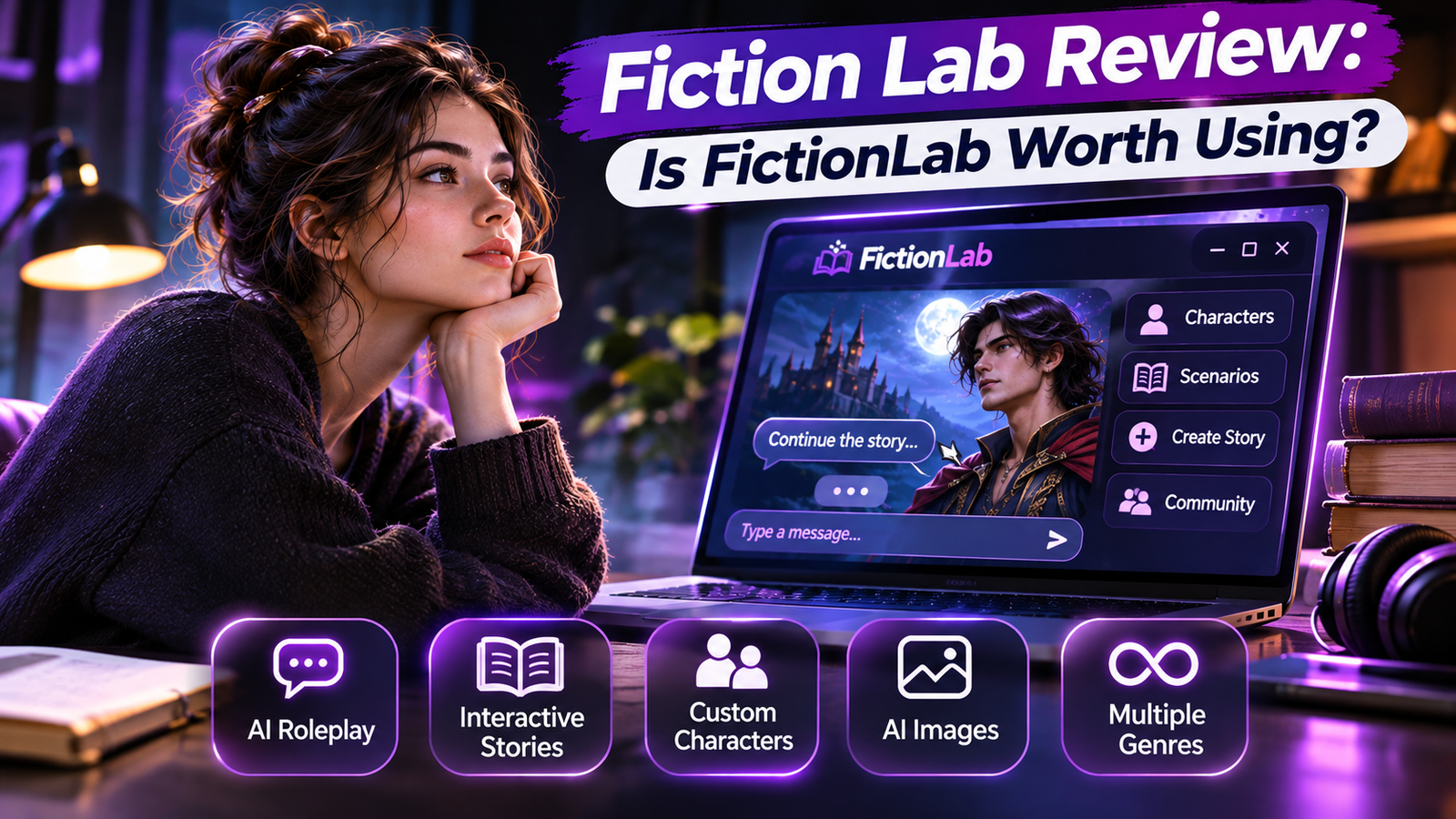
Fiction Lab Review: Is FictionLab Worth Using?

Fiction Lab is an AI-powered storytelling and roleplay platform designed for people who want to create fictional characters, explore interactive scenarios, and develop stories through conversations with artificial intelligence. Instead of simply asking a chatbot to write a story, users can participate in an evolving narrative, influence character decisions, and explore different outcomes through ongoing interactions.
The platform, available at FictionLab.ai, combines character-based conversations with customizable scenarios and community-created stories. It is primarily aimed at creative writers, roleplay enthusiasts, and users who enjoy interactive fiction. However, its usefulness depends on what someone expects from an AI writing tool. It is better suited to immersive storytelling than conventional tasks such as producing SEO articles, researching factual topics, or drafting professional documents. In this FictionLab review, we examine its main features, practical uses, advantages, limitations, pricing considerations, and privacy implications to help you decide whether it fits your needs.
What Is Fiction Lab?
Fiction Lab, commonly written as FictionLab, is an AI roleplay and interactive storytelling platform. It allows users to explore existing fictional scenarios or create their own, then interact with AI characters as the story develops.
The experience differs from a traditional AI writing assistant. With a general-purpose chatbot, you might request a complete fantasy chapter and receive a finished piece of text. FictionLab instead emphasizes an ongoing exchange in which your choices, dialogue, and actions influence what happens next.
For example, imagine creating a detective character investigating a mysterious disappearance in a fictional city. You could question witnesses, examine clues, challenge another character, or take the investigation in an unexpected direction. The AI generates responses based on the scenario and conversation, allowing the narrative to evolve interactively.
FictionLab also provides community-created scenarios, giving users a way to explore stories without building every character and setting from scratch.
The key distinction: FictionLab is primarily an interactive fiction and AI roleplay platform, not a dedicated AI article generator or professional content management tool.
Who Is FictionLab Designed For?
The platform may appeal to several types of users:
- Roleplay enthusiasts: People who enjoy ongoing conversations with fictional characters.
- Creative writers: Authors looking for inspiration, dialogue ideas, or alternative plot directions.
- Fantasy and science-fiction fans: Readers who want to participate in fictional worlds rather than simply read about them.
- Interactive storytelling fans: Users who prefer making decisions that influence a narrative.
- Character creators: People interested in developing original personalities, backgrounds, motivations, and relationships.
It is less suitable for users whose main objective is to produce fact-checked articles, optimize website content, or conduct reliable academic research.
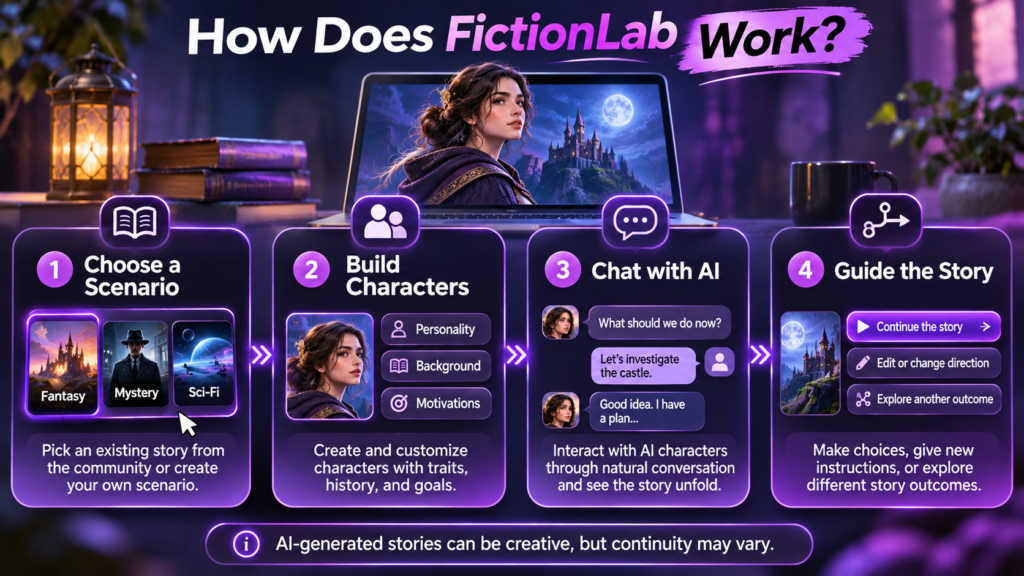
How Does FictionLab Work?
FictionLab uses generative AI to produce responses based on the scenario, character information, conversation history, and instructions available to the model. Generative AI creates new text from learned patterns rather than retrieving a guaranteed, predetermined answer for every situation.
The platform’s interactive format can be understood through four main steps.
1. Choose an Existing Scenario or Create Your Own
Users can explore community-created scenarios or use the platform’s scenario-creation tools to develop a new experience.
A scenario might establish a fantasy kingdom, a detective mystery, a futuristic city, or a fictional relationship between characters. The setting gives the AI a starting point for generating relevant dialogue and events.
2. Establish Characters and Their Backgrounds
Characters become more convincing when their personalities, motivations, relationships, and histories are clearly defined.
For instance, a character might be a cautious investigator who distrusts authority but feels responsible for protecting vulnerable people. Those details provide behavioral guidance that can influence the AI’s responses.
However, a detailed character description does not guarantee perfect consistency. The model may occasionally behave outside the intended personality or overlook information introduced earlier.
3. Interact Through Conversation
Once a scenario begins, users communicate with AI-controlled characters through messages. The AI generates dialogue, reactions, and narrative developments in response to the conversation.
Users can influence the direction of the story by asking questions, making decisions, introducing new events, or changing how their character behaves.
This creates a more participatory experience than reading a conventional short story.
4. Continue, Adjust, or Redirect the Story
As a conversation develops, users may want to correct a response, clarify a character’s behavior, or steer the plot in a different direction.
Clear instructions can help. For example, a user might ask the AI to maintain a serious detective-fiction tone, avoid introducing new characters without a reason, and preserve established facts about the mystery.
These instructions can improve consistency, although they cannot eliminate every mistake. Long conversations may also become harder for a language model to manage when earlier details are no longer available in its active context or are not adequately preserved by the platform’s memory features.
Key Features of FictionLab
FictionLab focuses on interactive storytelling rather than conventional productivity tasks. Its features are designed to give users more control over fictional worlds, character behavior, and the direction of a conversation.
1. Custom Scenario Creation
One of the platform’s central features is the ability to create personalized scenarios. Users can establish a setting, define the characters involved, and provide instructions that influence how the AI develops the story.
For example, a writer developing a science-fiction mystery could create a scenario involving a damaged spacecraft, a missing crew member, and an AI system hiding information. The resulting conversation could explore different investigative paths depending on the user’s decisions.
The platform offers guided and advanced scenario-creation options, allowing users to approach the process with different levels of detail. However, the quality of the resulting experience depends on the clarity of the instructions and the AI’s ability to follow them.
2. AI Character Interactions
FictionLab allows users to interact with fictional characters through AI-generated dialogue. These interactions can support different personalities, relationships, and narrative situations.
A character’s background and instructions help establish how it should behave. A reserved detective, for instance, should respond differently from an impulsive adventurer or a humorous sidekick.
This flexibility can make roleplay more engaging, particularly when users invest time in developing a coherent scenario. Nevertheless, an AI character is not a person with genuine emotions or independent experiences. Its apparent personality emerges from generated responses and the information available to the model.
3. Community-Created Stories
Users can browse scenarios created by other members of the FictionLab community. The platform organizes content through discovery features that include popularity, relevance, ratings, and different genres.
Available scenario themes include fantasy, romance, mystery, horror, science fiction, anime-inspired adventures, historical fiction, and role-playing games.
Community content is useful for beginners because it provides ready-made experiences without requiring them to design an entire fictional world.
However, scenario quality can vary considerably. A popular scenario is not necessarily well written, logically consistent, or suitable for every reader. Reviewing the premise and content details before starting is a sensible approach.
4. Image Generation
FictionLab’s interface also includes an image-generation option. This can be useful for users who want visual elements alongside their interactive storytelling experience.
For example, a creator might want a visual representation of a fictional character or an atmospheric image associated with a fantasy setting.
The exact capabilities, usage limits, and availability of image generation may depend on the current platform configuration and account plan. Users should check the live interface rather than assume that every feature is available without restrictions.
5. Conversation History and Story Continuity
Long-running roleplay depends on continuity. Characters should remember important events, relationships should develop logically, and earlier decisions should influence later scenes.
FictionLab provides a conversation-based storytelling environment, while platform documentation and community material discuss memory-related tools and techniques for managing longer scenarios.
However, conversation history and reliable memory are not the same thing.
An AI model can lose track of details even when a conversation remains visible to the user. This happens partly because models operate within a limited context window, which determines how much information can be processed during a response.
For longer stories, users can improve continuity by:
- Keeping character descriptions clear and consistent.
- Recording important events and decisions.
- Summarizing major developments periodically.
- Correcting contradictions when they appear.
- Preserving important story notes outside the platform.
These habits are useful across AI storytelling platforms, not just FictionLab.
What Can You Use FictionLab For?
The platform’s strongest use cases involve creative exploration, interactive entertainment, and story development.
Interactive Fiction and Roleplay
Interactive fiction is a natural fit for FictionLab. Rather than deciding how every scene unfolds in advance, users can respond to situations and allow the AI to generate new developments.
A user exploring a fantasy adventure might negotiate with a suspicious merchant, investigate an abandoned castle, or decide whether to trust a mysterious traveler.
The story changes according to the interaction, although the AI may occasionally introduce inconsistencies or unexpected developments.
Creative Writing and Plot Development
Writers can use AI roleplay to experiment with dialogue, explore character conflicts, and discover possible directions for a story.
Suppose a novelist is writing a mystery featuring two investigators who disagree about a suspect. An interactive scenario could help the writer explore how different personalities might argue about the available evidence.
The generated conversation would be a source of ideas, not a substitute for the writer’s judgment. Dialogue may need substantial editing, and factual or historical details should be verified independently.
Fantasy and Role-Playing Adventures
Users interested in role-playing games can explore fictional quests, character interactions, and branching adventures.
A scenario might involve a traveler searching for a lost artifact while navigating political tensions between rival kingdoms. The user could negotiate, investigate, explore, or take risks that influence the unfolding narrative.
This format can provide creative entertainment without requiring the user to write every event manually.
Exploring Alternative Story Outcomes
FictionLab can also help users experiment with hypothetical narrative situations.
For example, a writer might explore what happens if a protagonist refuses an alliance, reveals a secret too early, or chooses to negotiate instead of fighting.
These interactions can expose alternative possibilities that the writer may not have considered. However, the results are generated possibilities rather than evidence that a particular storyline is objectively better.
Advantages and Limitations of FictionLab
Whether FictionLab is worth using depends on how well its interactive features match your expectations.
Advantages
Interactive storytelling: Users can influence the story through dialogue and decisions instead of receiving only a completed piece of writing.
Custom scenarios: Personalized settings and character instructions provide more control over the experience.
Community content: Existing scenarios make it easier to begin without building everything from scratch.
Genre flexibility: Users can explore different fictional styles, including fantasy, mystery, romance, horror, and science fiction.
Creative experimentation: The platform can help writers explore dialogue, character conflicts, and alternative plot developments.
Browser access: The website provides a way to explore the platform without depending entirely on a dedicated mobile application.
Limitations
Inconsistent character behavior: Characters may act against their established personalities or forget earlier events.
Continuity problems: Long conversations can become inconsistent when important details are not retained or recalled correctly.
Variable response quality: Some generated replies may feel repetitive, overly dramatic, or disconnected from the scene.
Limited factual reliability: Fictional responses should not be treated as trustworthy sources for historical, scientific, medical, or other factual information.
Changing feature availability: Models, account limits, and subscription benefits may change over time.
Privacy considerations: Conversations are processed through an online service, so users should understand the applicable privacy policy before sharing personal information.
The most important limitation is that FictionLab can generate convincing dialogue without maintaining perfect continuity. Users who expect a completely reliable simulation may need to correct the AI regularly.
Is FictionLab Free? Pricing and Subscription Options
FictionLab has been associated with a freemium model, offering access to basic functionality alongside paid subscription options. However, the exact benefits and prices can change, and historical subscription information should not be treated as a guaranteed current offer.
The safest approach is to check the official FictionLab website and its account or subscription pages before paying.
When evaluating a plan, consider the following:
- Free access: Check which models, scenarios, and conversation limits are available without payment.
- Premium models: Determine whether paid access provides a meaningful improvement in response quality for your intended use.
- Usage limits: Review any restrictions on messages, image generation, or other resource-intensive features.
- Memory capabilities: Check whether the subscription changes available memory tools or the size of supported scenarios.
- Renewal and cancellation: Understand the billing period, renewal terms, and cancellation procedure before subscribing.
Do not assume that a higher-priced plan guarantees perfect memory, faster responses in every situation, or better storytelling in every conversation.
My recommendation: Test the available free functionality first, if offered. Upgrade only if the paid features address a specific limitation you have encountered.
Is FictionLab Safe to Use?
Safety involves more than whether a website opens correctly or whether an application is available in an app store. Users should consider privacy, content suitability, account security, and subscription transparency separately.
Privacy and Personal Information
AI roleplay can involve highly personal conversations, especially when users explore emotional situations or relationship-based fictional scenarios.
Before using FictionLab, review its official privacy policy. Pay attention to what information the service collects, how conversations are processed, how long information may be retained, and what options are available for deleting account data.
Avoid entering information that does not belong in an entertainment platform, including:
- Passwords and authentication codes.
- Banking details and payment credentials.
- Government identification numbers.
- Confidential business documents.
- Private information about other people.
Deleting a conversation from an interface does not necessarily establish that every associated copy has been immediately erased from all systems. The service’s privacy policy should explain the applicable data-handling practices.
Mature Content and Age Suitability
FictionLab has been associated with adult-oriented roleplay and mature fictional content. Its Android application was listed with an Adults Only 18+ content rating in the Google Play information available for review.
Parents should not assume that an AI roleplay platform is suitable for children simply because it uses text conversations. Mature themes and user-created scenarios can make content suitability difficult to predict.
Adults should also review the platform’s current content rules and avoid assuming that every community-created scenario follows the same standards.
Is FictionLab Legitimate?
The official website provides an identifiable platform interface, scenario discovery, account functionality, and links to service information. These are useful signs of an operating service, but they do not independently establish that every feature works reliably or that every subscription offers good value.
There is also an important availability consideration: a third-party app-tracking service reported that the FictionLab AI Android application was removed from Google Play on October 15, 2026. Its website was still accessible in the information reviewed for this article.
That distinction matters. The website and Android application should not be assumed to have identical availability.
If you want to use FictionLab on Android, check the current official listing before downloading anything. Avoid unofficial installation files unless you can independently establish their authenticity and security.
Overall, use the official website, review the terms and privacy policy, and evaluate the actual service before committing money or sharing personal information.
FictionLab vs. Other AI Writing and Roleplay Tools
FictionLab is not the only option for people who want AI-assisted storytelling. The best alternative depends on whether you prioritize interactive characters, long-form fiction, or general-purpose writing.
| Tool | Primary purpose | Best suited for | Main consideration |
|---|---|---|---|
| FictionLab | Interactive fiction and character roleplay | Users who want evolving scenarios and character interactions | Continuity and response quality can vary |
| Character.AI | Character-based AI conversations | Users interested in interacting with fictional or community-created characters | Content rules and character behavior may differ |
| NovelAI | AI-assisted creative writing | Writers developing prose, stories, and fictional worlds | Features and subscription costs should be checked before choosing a plan |
| ChatGPT | General-purpose AI assistance and creative writing | Users who need brainstorming, drafting, editing, and broader writing support | It is not exclusively designed for roleplay |
These tools serve overlapping but different purposes. FictionLab emphasizes interactive scenarios, while a general-purpose assistant may be more practical for producing structured articles, editing manuscripts, or organizing research.
When Should You Choose FictionLab?
FictionLab is worth considering if you want to participate in a fictional story, interact with AI characters, or experiment with different narrative outcomes.
If your primary goal is to write a polished novel, you may prefer a dedicated writing tool or a general-purpose assistant that can help organize chapters, revise prose, and maintain a consistent writing style.
For factual research or professional content, use tools that support source verification and check important claims against reliable references.
The right choice is the platform that fits your workflow, not necessarily the one with the largest feature list.
Practical Tips for Getting Better Results With FictionLab
The quality of an interactive story depends partly on how clearly the user establishes the scenario and guides the conversation.
Start With a Clear Premise
Give the scenario a specific setting, central conflict, and purpose.
Instead of writing, “Create a fantasy adventure,” try a more detailed premise:
“A young cartographer enters a mountain kingdom where maps are considered state secrets. She must discover why several villages have disappeared, but the royal archivist refuses to share historical records.”
This example is hypothetical. Its purpose is to show how a defined conflict gives the AI more useful material to work with.
Define Character Motivations
Character instructions should explain what a character wants, what they fear, and how they typically respond to conflict.
A short, consistent description is often more useful than a long collection of unrelated personality traits.
For example, a cautious investigator might prioritize evidence, avoid unnecessary risks, and distrust unsupported accusations.
Give Specific Feedback
If the AI changes a character’s personality or contradicts an established event, explain the problem directly.
You might write: “The investigator has already established that she distrusts the witness. Continue the scene without making her accept his explanation immediately.”
Specific corrections give the model a clearer direction than simply saying that the response is wrong.
Maintain a Separate Story Record
For a long-running scenario, keep a simple document containing important facts:
- Character names and defining traits.
- Relationships and unresolved conflicts.
- Major events in chronological order.
- Important discoveries and decisions.
- Current locations and objectives.
This record can help restore continuity if the AI begins forgetting earlier developments.
Evaluate the Results Before Paying
Test a scenario long enough to see how well the platform handles character consistency, dialogue, and narrative progression.
If possible, compare the available models using the same scenario. This makes it easier to identify whether a more expensive option offers a meaningful improvement.
Do not judge a subscription solely by its advertised features. The quality of actual conversations is more relevant to your decision.
Frequently Asked Questions
What is FictionLab used for?
FictionLab is used for AI character conversations, interactive storytelling, roleplay, and creating fictional scenarios.
Is FictionLab free?
FictionLab has offered free access alongside paid options, but current pricing and usage limits should be verified on the official website.
Can I create my own characters on FictionLab?
The platform supports custom scenario creation and character-based storytelling. The available creation options may depend on its current interface and features.
Is FictionLab available on Android?
FictionLab has had an Android application, but a third-party tracker reported its removal from Google Play in October 2026. Check the current official listing for availability.
Does FictionLab remember previous conversations?
The platform has been associated with memory-related tools, but AI recall is not perfect. Important events may need to be summarized or restated to preserve continuity.
Is FictionLab safe for children?
It should not be treated as a child-friendly platform by default. Its Android application has carried an Adults Only 18+ content rating, and mature themes may appear in roleplay scenarios.
Is FictionLab good for writing novels?
It can help writers explore character interactions, dialogue, and plot possibilities. However, writers may prefer a dedicated writing assistant for chapter organization, editing, and long-form manuscript development.
Conclusion: Is FictionLab Worth Trying?
FictionLab is an interesting option for users who enjoy interactive fiction, AI character conversations, and scenarios that develop through their decisions. Its focus on customizable storytelling and community-created content makes it different from conventional AI writing assistants.
However, its usefulness depends on the quality of the generated responses, the consistency of the characters, and the features available to your account. Long conversations may require occasional corrections, while privacy and mature-content considerations deserve attention before signing up.
For casual roleplay and creative experimentation, FictionLab is worth exploring if its current free access meets your needs. Writers seeking structured manuscripts or professional content may find a general-purpose AI assistant more practical.
Before purchasing a subscription, check the latest pricing, supported features, and service terms. Ultimately, the best choice is the tool that reliably supports the kind of storytelling or writing you actually want to do.
[…] InferKit AI: Why It Was Discontinued and What Happened? Fiction Lab Review: Is FictionLab Worth Using? NovelAI: Features, Pricing, and How It Works Replika AI: Features, Privacy, Benefits and […]