

Grok Moderation: How It Works and What Users Should Know

Grok moderation refers to the systems and rules used to manage content on Grok, the artificial intelligence assistant developed by xAI. These systems help identify prohibited content, limit harmful requests, and respond to reports about unsafe material. They also influence how Grok handles sensitive topics, generated images, and conversations. In 2026, understanding Grok moderation is useful for anyone using the assistant for writing, research, coding, or creative work. The rules are not simply about blocking words. They also consider the type of request, possible harm, applicable laws, and the platform’s acceptable use requirements.
Grok moderation matters because artificial intelligence can produce useful information and potentially harmful material. A moderation system helps create boundaries around those uses. However, moderation does not guarantee that every response will be correct or that every harmful result will be prevented. Users should understand the difference between a platform’s rules and its actual performance. xAI publishes safety information, model cards, and policies explaining its approach. These resources provide a starting point for understanding the service. They also help users identify where to report concerns, review restrictions, and make more informed decisions about using Grok.
How Does Grok Moderation Work?
Grok moderation combines several parts of an AI safety process. These include model instructions, acceptable use rules, safety evaluations, and systems designed to identify problematic requests. The exact technical details of every moderation component are not publicly described. Therefore, it would be inaccurate to claim that Grok uses one specific filter for every conversation. Instead, users should think of moderation as a set of safeguards working together. xAI’s published safety materials describe evaluations for harmful use, including cybersecurity, manipulation, and other risk areas. These evaluations help assess how models behave under different conditions.
A moderation decision can depend on the user’s request and its likely purpose. For example, asking how phishing works for educational reasons is different from requesting a message designed to steal someone’s password. Similarly, discussing a dangerous activity historically differs from asking for instructions to carry it out. Grok’s safety instructions distinguish between questions that discuss harmful activities and requests that show clear intent to carry them out. This distinction helps explain why similar questions can receive different answers. The exact moderation process may vary by product and model version.
Grok Moderation Rules and Prohibited Content
Grok’s acceptable use rules set boundaries for how people may use the service. They prohibit activities such as serious harm to people, developing weapons of mass destruction, and certain illegal activities. The rules also address unlawful content, misleading uses of AI, and attempts to bypass safeguards. These requirements apply to people using the service for personal or professional purposes. Violations may lead to actions against an account, including suspension or termination. Users should review the current policy rather than rely on older screenshots or social media discussions about Grok’s restrictions.
The rules also cover content that may violate applicable laws. This includes restrictions involving child sexual abuse material and other serious illegal activities. In addition, the service prohibits using AI to mislead people about the origin of content or to perform unauthorized actions on their behalf. These rules are important because an AI assistant can generate text, images, and other outputs quickly. A request that appears harmless at first may still create risks when used in the real world. Responsible use means considering both the request and its possible consequences.
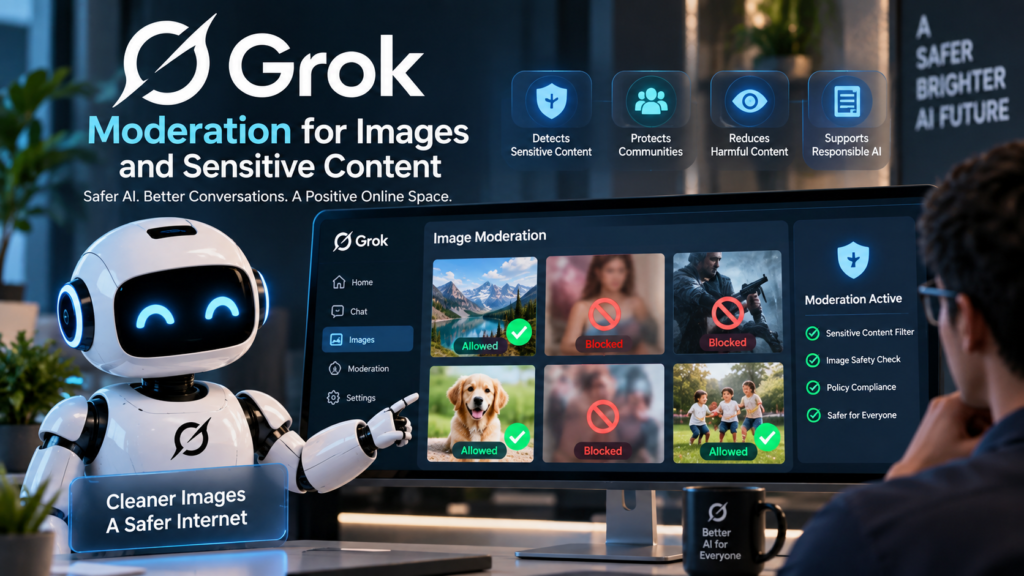
Grok Moderation for Images and Sensitive Content
Image moderation is an important part of the wider Grok safety discussion. AI image tools can create realistic pictures, alter existing photographs, and generate fictional scenes. However, some image requests can violate privacy, consent, or other legal protections. In 2026, xAI introduced reporting guidance for non-consensual intimate content. The process covers real and synthetic images or videos showing identifiable people in intimate or sexual situations without consent. This means users can report certain generated images, not only photographs taken with a camera.
The same concerns apply to content appearing in conversations, generated images, and other parts of the Grok platform. This is relevant for people who discover that their image has been used without permission. It is also a reminder that creating an image does not remove a person’s privacy rights. Users should avoid uploading private photographs without permission and should not request intimate alterations of identifiable people. When a problem occurs, the platform’s reporting process provides a way to raise the concern. Users should preserve relevant evidence and follow the available instructions carefully.
Why Does Grok Refuse Some Requests?
A refusal usually means that Grok has identified a request as conflicting with its rules, safety instructions, or other restrictions. The exact reason may not always be obvious from the response. For instance, a request involving malware could be educational, but a request for code that steals credentials may create a direct risk. Grok’s safety instructions distinguish between questions that discuss harmful activities and requests that show clear intent to carry them out. This distinction helps explain why similar questions can receive different answers.
Refusals can also happen when a request is unclear or combines legitimate and prohibited elements. A user may be able to receive a safe explanation of a topic without receiving instructions that enable harm. For example, a cybersecurity learner can ask about common attack methods, defensive practices, and ways to secure a system. A request for a working attack against a real target is different. When a response is refused, users can often improve clarity by explaining the legitimate goal and asking for a safe alternative. This does not guarantee that the request will be accepted.
How to Report a Moderation Problem
If Grok produces content that appears harmful or violates its rules, users can report the issue through the available reporting options. The platform provides ways to report problematic content from within the service. A report should explain what happened and include relevant details that help the service understand the problem. Users should avoid sharing unnecessary private information when submitting a report. Reporting is useful because it gives the platform information about problems that automated systems may not detect correctly.
A useful report should identify the platform, describe the concerning output, and explain why it may violate the rules. If the issue involves an image or conversation, users should preserve the relevant content where appropriate. However, users should not share private information publicly just to prove that a moderation problem occurred. The official reporting channel is generally the most appropriate place to submit sensitive details. Users should also review the current help information because reporting instructions can change over time.
Grok Moderation and Privacy
Moderation and privacy are connected because safety systems may need information about conversations or generated content. Grok’s privacy policy explains how the company handles personal information when people use its websites and applications. Different services may have different privacy arrangements. For example, data processed through third-party services may be subject to the relevant third party’s privacy policy. Users should understand which service they are using before sharing personal or confidential information. This is especially important when conversations contain private documents, business details, or information about other people.
Users should also review their available data-sharing settings. Interactions, inputs, and results may be used to train and improve generative AI models, depending on the product and account settings. Controls related to public data and interactions with Grok may also vary. Therefore, users should not assume that every version of Grok handles data in exactly the same way. Checking the current privacy policy and account settings is a practical step before using Grok for sensitive work.
How to Use Grok Responsibly
Responsible use starts with understanding what an AI assistant can and cannot do. Grok can help explain topics, organize information, draft content, and support many creative tasks. However, its responses may contain mistakes or incomplete information. Users should verify important claims before relying on them for medical, legal, financial, or other serious decisions. They should also avoid entering confidential information unless they understand the applicable privacy settings. Clear prompts and careful review can reduce misunderstandings. Still, no prompt can guarantee that an AI system will produce a perfect or completely safe response.
For everyday use, users can follow a few simple habits:
- Ask clear questions and explain the legitimate purpose.
- Avoid requests that could harm people or violate privacy.
- Check important facts against reliable sources.
- Do not share passwords, private keys, or unnecessary personal details.
- Report harmful or prohibited content through official channels.
- Review current terms and privacy settings before sensitive work.
These habits support safer use without treating moderation as a substitute for human judgment.
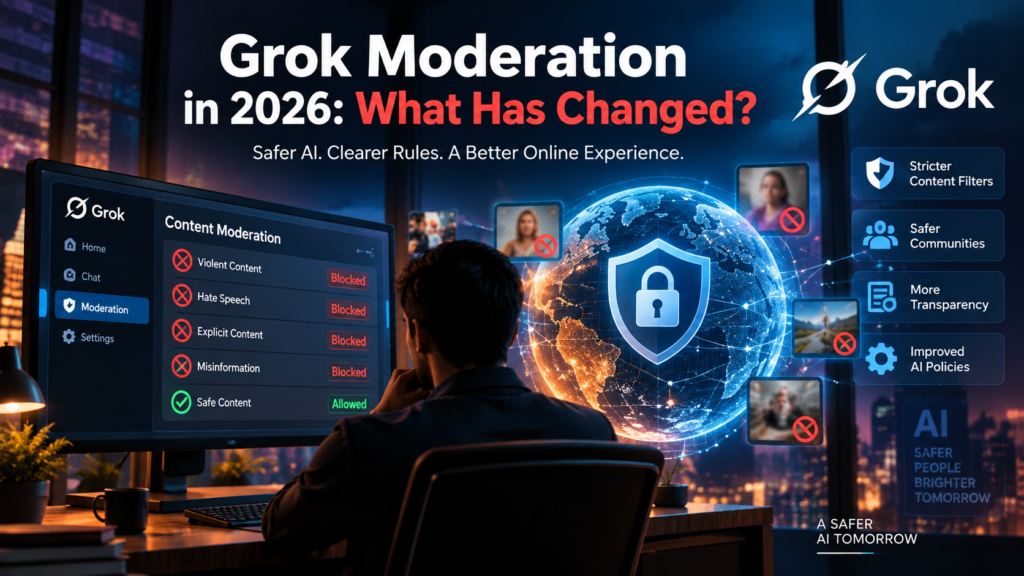
Grok Moderation in 2026: What Has Changed?
Grok moderation continues to develop as AI models and products change. In 2026, xAI published updated safety materials, acceptable use rules, and information about its newer models. The company also expanded its documentation around Grok products. These updates show that moderation is not a fixed feature that remains identical across every version. Rules, controls, and available reporting options may change as products develop. Users should therefore check current information when they need precise details about a particular feature or restriction.
The most important point is that public documentation does not reveal every internal moderation decision. It explains the general rules, safety goals, and reporting processes. It does not provide a complete list of every prompt that will be accepted or rejected. This matters when users compare experiences online. A refusal reported by one person may depend on the exact wording, product version, or context. For accurate information, users should compare the current policy with the specific behavior they observed. This approach is more reliable than assuming that one example represents all Grok users.
Frequently Asked Questions About Grok Moderation
What is Grok moderation?
Grok moderation refers to the rules and safety systems used to manage harmful or prohibited content. It helps guide responses, restrict certain requests, and handle reports about unsafe material.
Why does Grok refuse my prompt?
Grok may refuse a request when it conflicts with safety instructions, acceptable use rules, or applicable restrictions. The exact reason depends on the request and context.
Can I report harmful content on Grok?
Yes. Users can report problematic content through the available reporting options within the Grok service.
Does Grok moderation cover generated images?
Yes. Moderation concerns can include generated images and videos, especially content involving privacy violations or non-consensual intimate material.
Can Grok moderation make mistakes?
Yes. AI systems can make errors, including incorrect refusals or unsafe outputs. Users should review important responses and report problems through official channels.
Conclusion
Grok moderation helps establish boundaries for using artificial intelligence responsibly. It covers harmful requests, prohibited activities, sensitive images, privacy concerns, and reporting procedures. The system is designed to reduce risks, but it does not replace human judgment or guarantee perfect results. Users should understand the current acceptable use rules, review privacy settings, and verify important information before acting on Grok’s responses. When a moderation problem occurs, available reporting channels provide a way to raise concerns. For more helpful AI guidance, readers can explore our articles on AI tools, ChatGPT features, and generative AI safety. These resources can support clearer and more responsible AI use.
[…] Backyard AI: Complete Review and Guide 2026 Grok Moderation: How It Works and What Users Should Know Nectar AI: Complete Guide to Features, Pricing and Safety in 2026 Vidqu AI: Features, […]