

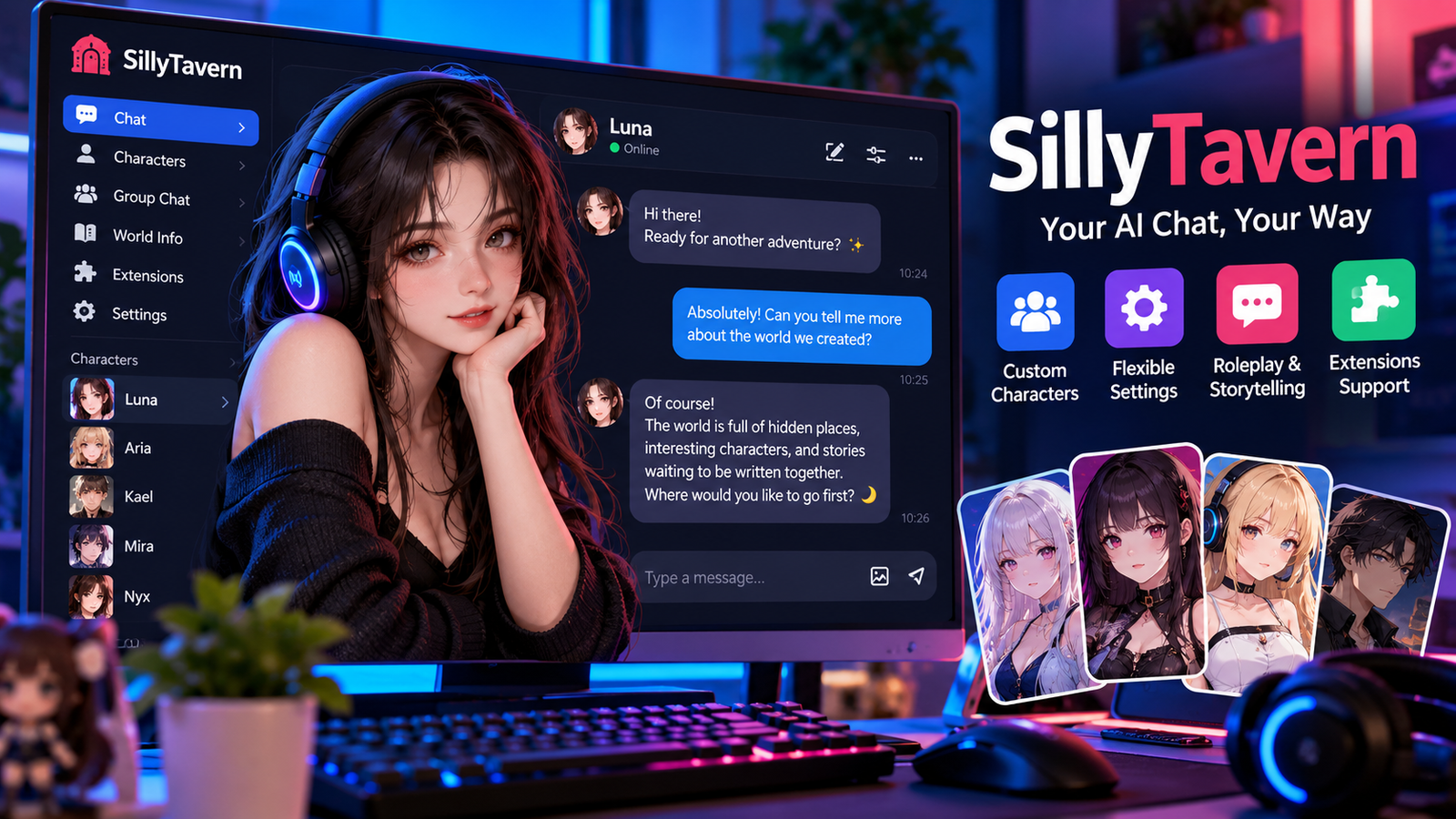
Silly Tavern Guide: How It Works and What to Know

Silly Tavern is a popular open-source interface for chatting with AI characters. It lets users connect different language models and create custom conversations. Instead of offering only a simple chatbot screen, it provides tools for character cards, prompts, memory, chat history, and roleplay settings. This makes it useful for people who want more control over AI conversations. Silly Tavern can work with several AI backends, depending on the setup and provider. Beginners may need time to understand its settings, but the basic idea is simple: choose a character, connect a model, and start chatting. This guide explains what Silly Tavern does, how it works, and what users should know.
What Is Silly Tavern?
Silly Tavern is a frontend designed for interactive conversations with language models. It does not function as a standalone AI model by itself. Instead, it provides an interface that can connect to compatible model services or local systems. Users can then build conversations around characters, personalities, scenarios, and instructions. The project is especially popular among people interested in roleplay and customized AI chats. Its open-source nature also allows the community to improve features and documentation. Because the software is flexible, the experience can differ greatly between users. Your connected model, settings, character definition, and available hardware all influence the quality of responses.
For a simple example, imagine creating a character who acts like a friendly tutor. You can define the character’s personality, background, speaking style, and goals. During the conversation, the interface sends relevant context to the connected model, which generates a reply. You can also adjust prompts, generation settings, and conversation information. This approach gives users more control than many basic chatbot websites provide. However, more control also means more settings to learn. Silly Tavern is therefore best understood as a flexible conversation workspace rather than an AI brain. The software manages the chat experience while another model usually produces the actual responses.
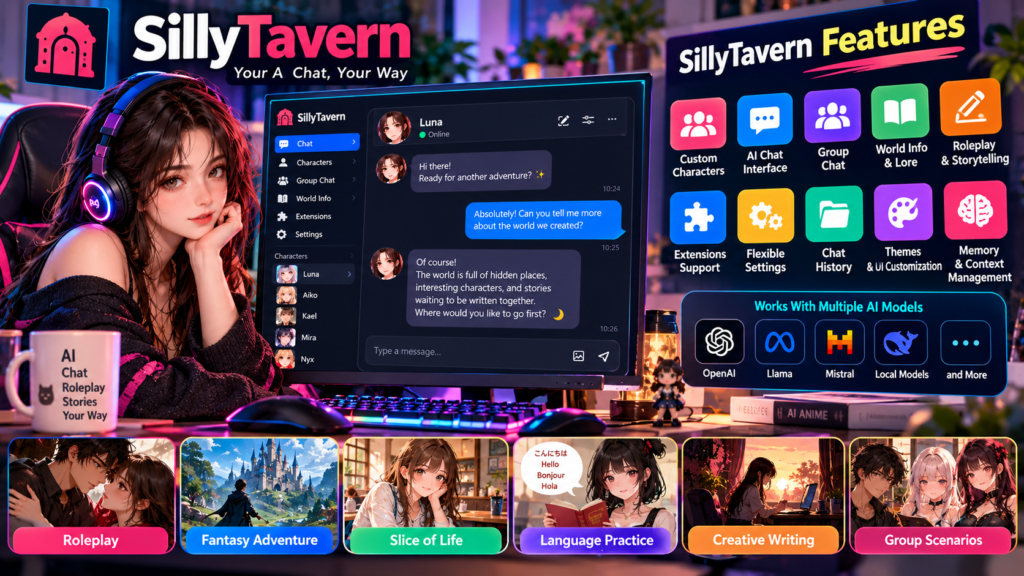
Silly Tavern Features
One major reason people use Silly Tavern is its support for detailed character setup. Users can create or import character cards containing personality traits, descriptions, example messages, and scenario information. These details help guide the model toward a consistent conversation style. The interface can also store chat histories, allowing users to return to earlier conversations. Depending on the connected model and configuration, users may have additional options for context management and memory. This makes the platform useful for long-form roleplay, creative writing, interactive storytelling, and character experiments. Still, character instructions cannot guarantee perfect consistency because the connected model controls the generated text.
Another useful area is customization. Users can change prompts, generation parameters, formatting, and other conversation controls to match their preferred style. Advanced users may connect local models or external services, while beginners can start with a simpler setup. The exact choices depend on available integrations and the model provider being used. It is important to check each provider’s rules, pricing, privacy terms, and technical requirements before connecting an account. A good setup is not necessarily the most complicated one. Many users get better results by changing one setting at a time, testing the conversation, and keeping notes about what improves response quality.
How to Use Silly Tavern
Getting started with Silly Tavern usually involves installing the interface, choosing a suitable connection method, and configuring a model. The precise installation process can change as the project develops, so users should follow the project’s current documentation. A local setup may require more technical knowledge, while an online model connection can involve an account, API credentials, and usage costs. After connecting a model, users can select or create a character and begin testing conversations. Start with basic settings before changing advanced options. This makes troubleshooting easier because you can identify which change caused a problem instead of adjusting many settings at once.
A practical beginner workflow is to create one simple character and test short conversations first. Check whether the model follows the character description, remembers important details, and responds in the expected tone. If responses feel inconsistent, review the character card and system instructions before changing everything else. Context limits also matter because long conversations can become difficult for a model to handle. Different models have different strengths, costs, and context capabilities. For this reason, there is no single best Silly Tavern configuration for everyone. The right setup depends on your goals, technical comfort, preferred model, available hardware, and desired conversation length.
Silly Tavern and AI Models
Silly Tavern can be used with different kinds of language models through supported connection methods. Some users prefer cloud-based models because they can avoid managing local hardware. Others choose local models for greater control over files, settings, and data handling. Local operation may require a capable computer, especially when running larger models. Cloud services can be easier to start with, but they may charge based on usage and have their own policies. Before choosing a model, consider response quality, context length, speed, cost, privacy, and hardware requirements. The best option is the one that fits your actual needs rather than the most powerful option available.
Model choice can strongly affect the Silly Tavern experience. A model with strong instruction following may handle detailed characters more reliably. A smaller model may respond faster and use fewer resources, but it can lose context or produce less consistent replies. Temperature and other generation controls can also change how predictable or creative responses feel. Users should experiment carefully because extreme settings may create unwanted results. If privacy matters, read the provider’s data policy and understand where prompts and conversation content are processed. For local models, also protect stored chat files and access credentials. Good security habits are important whenever personal or private information is involved.
Silly Tavern Use Cases
Silly Tavern is often associated with AI roleplay, but its uses can extend beyond fictional characters. Writers can use character conversations to explore dialogue, test story ideas, or develop personalities. Students might create practice scenarios for language learning, although important educational facts should still be checked independently. Users can also experiment with interactive storytelling, brainstorming, and simulated conversations. The quality of these activities depends on the connected model and the instructions provided. Silly Tavern should not be treated as an authority for medical, legal, financial, or other high-stakes decisions. Its main value comes from flexible interaction, not guaranteed factual accuracy or professional advice.
For creative projects, a clear character definition can make conversations easier to manage. Describe the character’s goals, personality, speaking habits, and relationship to the user. Then provide a simple scenario that explains what is happening. Avoid adding unnecessary instructions that compete with each other. When a conversation changes direction, update the relevant context instead of repeatedly rewriting everything. This can make responses more stable and easier to understand. Users should also remember that generated content can contain errors, stereotypes, or unexpected material. Reviewing outputs before publishing or relying on them is always sensible, especially when conversations are used as part of a larger creative project.
Silly Tavern Privacy and Safety
Privacy deserves attention when using Silly Tavern because the interface may connect to external model services. The software itself does not automatically make every conversation private. Where your messages go depends on the model connection, provider, network setup, and configuration. Users should avoid entering passwords, financial details, private documents, or other sensitive information unless they fully understand how the system handles that data. API keys should also be protected and never shared publicly. If you use a local model, review where chat histories and configuration files are stored. A private computer setup can reduce some external exposure, but it still requires sensible account and device security.
Safety also depends on the content and connections users choose. Community-made character cards, extensions, scripts, and model files should be treated carefully, especially when their source is unfamiliar. Read project documentation and inspect permissions before installing additional software. Keep the interface and related components updated when practical, and use strong credentials for connected services. It is also wise to maintain backups of important character cards and chats. Remember that an open-source project can provide transparency and flexibility, but it does not remove every security risk. Users remain responsible for their own configuration, connected accounts, downloaded files, and the information they choose to send through the system.
Silly Tavern vs Traditional Chatbots
Compared with a basic chatbot website, Silly Tavern focuses more heavily on customization and conversation control. A typical chatbot may provide a polished experience with fewer settings, while this interface gives users more freedom to shape characters, prompts, models, and chat behavior. That flexibility can be valuable for experienced users, but it can also create a steeper learning curve. Someone who only wants quick answers may prefer a simpler chatbot. Someone who wants detailed roleplay or model choice may appreciate the extra controls. Neither approach is automatically better. The right choice depends on whether convenience or customization matters more for your particular use case.
| Feature | Silly Tavern | Basic Chatbot |
|---|---|---|
| Character customization | High | Usually limited |
| Model flexibility | Often high | Usually limited |
| Setup difficulty | Moderate to advanced | Usually easy |
| Roleplay controls | Extensive | Varies |
| Local model options | Available with suitable setup | Usually limited |
| Beginner friendliness | Requires learning | Usually very easy |
A useful way to compare options is to look beyond the interface itself. Consider model access, privacy, pricing, setup effort, context handling, customization, and ongoing maintenance. Silly Tavern may be attractive when you want to combine a flexible interface with different model choices. However, users who prefer a managed service may value automatic updates and simpler account management. Your technical skills also matter because troubleshooting connections can take time. Before switching platforms, test a small project first. This helps you understand the workflow without moving a large collection of characters or conversations. A short trial can reveal whether the extra flexibility is genuinely useful for you.
Silly Tavern for Beginners
Beginners can make Silly Tavern easier to learn by starting small. First, understand the difference between the interface, the character definition, and the connected language model. Next, create one basic character and run a short conversation. Learn how context works before adding complex memory or advanced extensions. If something goes wrong, change one setting at a time and test again. This method makes errors easier to identify. It also helps you understand which features actually improve your experience. You do not need every advanced option immediately. A simple, stable configuration is often better than a complicated setup that you cannot troubleshoot confidently.
It is also helpful to keep your setup organized. Give characters clear names, save important cards, and document useful settings. If you test several models, record which ones work well for your preferred style. Read official project documentation for installation and configuration details because community advice can become outdated. When downloading extensions or files, use trusted sources and understand what you are installing. If you encounter an error, search the exact message and compare your configuration with current documentation. Learning gradually makes the platform much less confusing. Over time, you can add advanced features when you have a clear reason to use them.
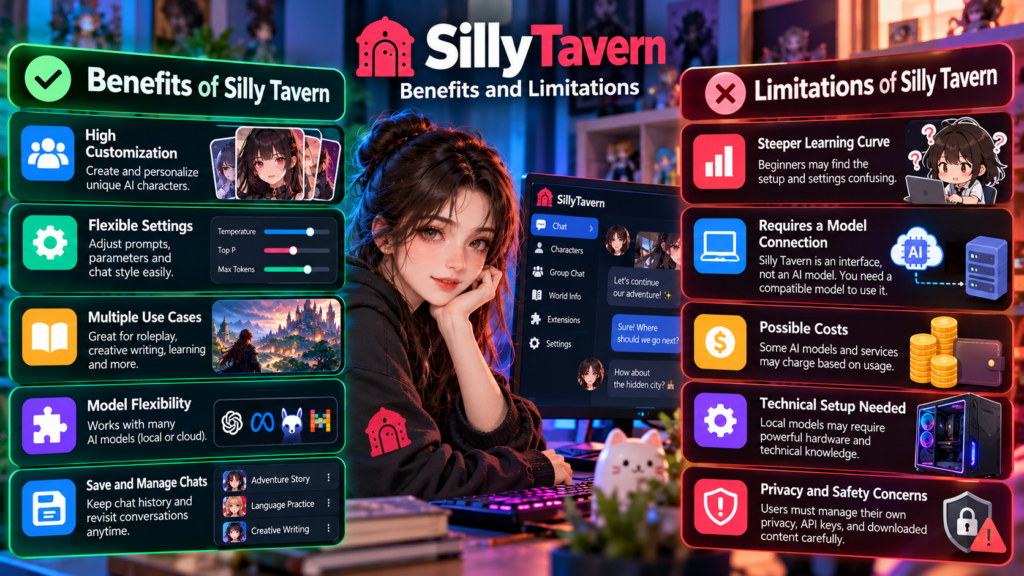
Benefits and Limitations of Silly Tavern
The biggest benefit of Silly Tavern is flexibility. Users can build experiences around their own characters, stories, models, and preferences instead of relying on one fixed chatbot format. It can support creative experimentation and detailed roleplay while giving experienced users more control over technical settings. The open-source approach can also encourage community development and customization. However, flexibility comes with responsibility. Users may need to manage installations, model connections, updates, privacy settings, and troubleshooting themselves. That tradeoff is important to understand before getting started. If you want maximum control, the extra effort may be worthwhile. If you want simplicity, another chatbot may suit you better.
Another advantage is experimentation. You can compare models, character prompts, conversation styles, and generation settings in a single interface. This can help users discover what works best for creative writing or interactive storytelling. The platform can also be useful for people who enjoy building customized AI experiences rather than simply consuming a ready-made service. Still, results will vary because language models behave differently. A carefully written character card cannot completely control an unpredictable model. Users should therefore judge the platform by their own workflow and goals. A thoughtful setup, realistic expectations, and regular testing usually produce a better experience than simply adding more features.
Frequently Asked Questions
Is Silly Tavern free to use?
Silly Tavern is open-source software, so the interface itself can be used without purchasing a traditional subscription. However, connected AI models may have separate costs. Some providers charge for API usage, while local models may require suitable computer hardware. Always check the current provider terms before choosing a connection method.
Does Silly Tavern have its own AI model?
No. Silly Tavern primarily acts as an interface for connecting and managing AI conversations. The actual responses generally come from a connected language model or service. This separation gives users flexibility because they can choose different supported models instead of being locked into one AI system.
Can beginners use Silly Tavern?
Yes, beginners can use it, but the learning curve may be higher than ordinary chatbot apps. Start with a simple character and basic model connection. Learn the main settings gradually. Once the basic workflow becomes familiar, you can explore advanced prompts, memory features, local models, and other customization options.
Is Silly Tavern safe?
Silly Tavern can be used safely with sensible security practices, but safety depends on your configuration and connected services. Avoid sharing sensitive information, protect API keys, and download extensions or files only from trusted sources. Also review the privacy policies of any external AI provider you connect to.
What is Silly Tavern mainly used for?
Silly Tavern is mainly used for customizable AI conversations, character roleplay, interactive storytelling, and creative experimentation. Some users also use it for brainstorming or dialogue practice. Its strongest advantage is control over characters, prompts, models, and conversation settings rather than providing a simple question-and-answer chatbot experience.
Conclusion
Silly Tavern offers a flexible way to create customized AI conversations. Its open-source design, character tools, model connections, and conversation controls make it especially interesting for roleplay and creative projects. However, that flexibility also means users must learn more settings and take responsibility for privacy, security, and configuration. Beginners should start with a simple setup and gradually explore advanced features. Choosing the right language model is equally important because response quality depends heavily on the connected system. If you enjoy experimenting with AI and want more control than a standard chatbot provides, Silly Tavern can be worth exploring. Start slowly, test different options, and build a setup that matches your needs.
[…] Cave Duck: AI Chat, Characters, Features and Guide Silly Tavern Guide: How It Works and What to Know KoboldCpp: A Complete Guide for Beginners Gening: A Simple Guide to Gening AI Who […]