

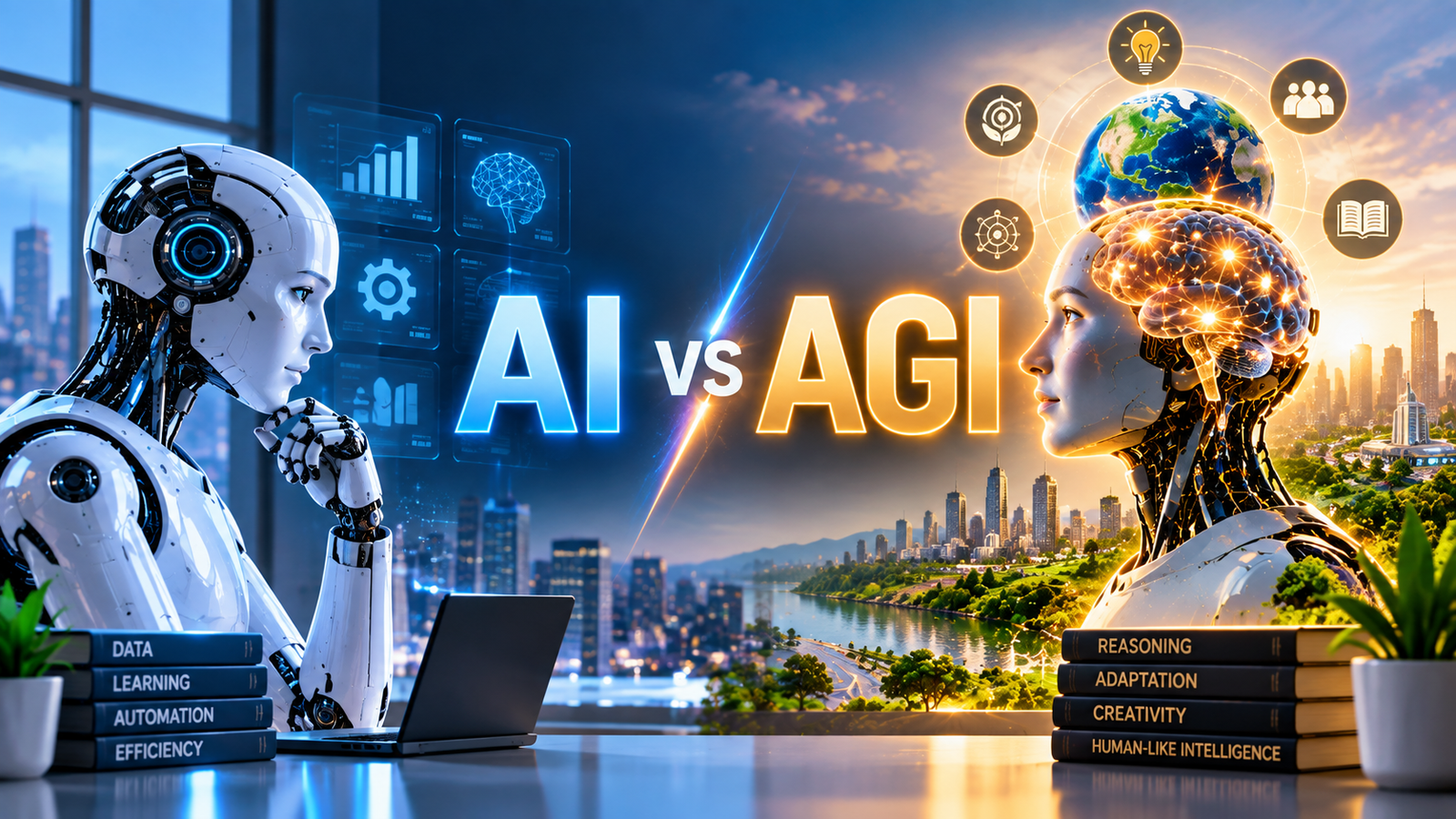
AI vs AGI: Key Differences, Examples, and Future

AI vs AGI is an important topic for anyone interested in artificial intelligence. AI already helps people write emails, translate languages, recommend videos, and solve problems. AGI, however, describes a more advanced idea: a machine that can learn and perform many different intellectual tasks like a human. Although these terms sound similar, they describe different levels of capability. Understanding the difference helps beginners, students, and business owners make better decisions about AI technology. This guide explains AI and AGI in simple language, compares their abilities, and explores how each could affect everyday life, education, business, and the future of technology.
Artificial intelligence is already part of many tools people use daily. Search engines, voice assistants, recommendation systems, and customer service chatbots rely on AI to complete specific tasks. Artificial general intelligence remains a research goal rather than an established technology with an agreed testing standard. Some modern AI systems can perform a wide range of tasks, but that does not automatically make them AGI. The difference involves flexibility, learning, reasoning, and the ability to handle unfamiliar problems. By comparing these ideas carefully, readers can understand what current AI can do and what researchers hope to achieve with future intelligent systems.
What Is Artificial Intelligence?
Artificial intelligence, commonly called AI, is technology that allows computers to perform tasks that normally require human intelligence. These tasks include recognizing images, understanding language, finding patterns, making predictions, and generating content. AI systems use algorithms, data, and computing power to produce useful results. Some systems follow carefully designed rules, while others learn patterns from large datasets. Machine learning and deep learning are important parts of modern AI. For example, a spam filter can learn which messages look suspicious and move them away from your inbox. This simple example shows how AI can solve a practical problem without human review.
AI can be narrow or broad in its practical applications. A navigation system may calculate routes, while a medical imaging tool may help identify unusual patterns in scans. A language model can summarize documents, answer questions, and create drafts. These systems may appear intelligent because they produce helpful results quickly. However, their abilities depend on training, system design, available tools, and the quality of information they receive. AI does not need to understand the world exactly as humans do to be useful. It needs to perform a particular task accurately enough for the intended purpose.
What Is Artificial General Intelligence?
Artificial general intelligence, or AGI, refers to a hypothetical form of AI with broad intellectual abilities. The idea is that an AGI system could learn, reason, solve problems, and adapt across many different areas. Instead of being designed mainly for one task, it would handle unfamiliar challenges with greater flexibility. For example, an AGI system might study a new subject, learn how to use an unfamiliar tool, plan a project, and apply knowledge from one field to another. Researchers disagree about the exact definition of AGI. There is no universally accepted test that proves a system has achieved it.
The main idea behind AGI is general-purpose intelligence rather than one specialized skill. A person can learn cooking, mathematics, music, and business management throughout life. AGI research aims to create systems with similarly broad learning and problem-solving abilities. However, human intelligence includes more than answering questions or completing tasks. It also involves social understanding, practical judgment, emotional experiences, and knowledge gained through real-world interaction. Whether AGI must reproduce every human ability remains an open question. For this reason, claims about AGI should be evaluated carefully instead of accepted based on impressive demonstrations alone.
AI vs AGI: Main Differences
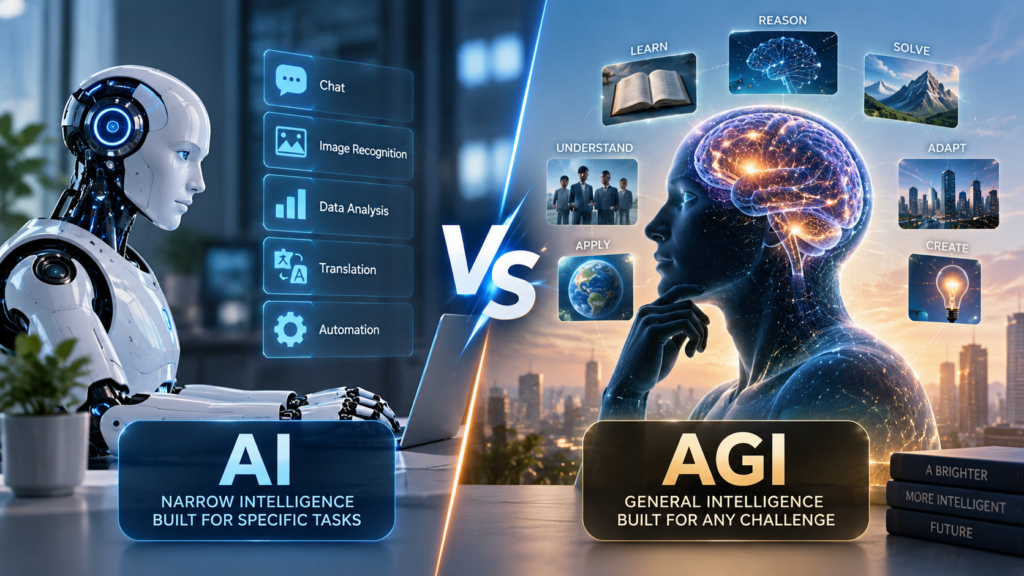
The difference between AI and AGI becomes clearer when we compare their purpose, flexibility, and learning abilities. Traditional AI is usually developed to perform particular tasks or groups of related tasks. AGI is intended to work across many areas without needing a separate system for every new problem. Current AI can already perform several different tasks through one application, but broad performance alone does not establish general intelligence. AGI would need to demonstrate reliable understanding, adaptation, and problem-solving across unfamiliar situations. The distinction is therefore about the depth and generality of capability, not simply the number of available features.
| Feature | AI | AGI |
|---|---|---|
| Full name | Artificial Intelligence | Artificial General Intelligence |
| Main purpose | Solve specific or practical problems | Handle broad intellectual tasks |
| Current status | Widely used today | Research goal and debated concept |
| Learning ability | Depends on training and system design | Expected to learn across many fields |
| Flexibility | Often limited by its design | Intended to adapt to unfamiliar tasks |
| Examples | Chatbots, recommendation systems, image recognition | Hypothetical general-purpose intelligent system |
| Human-like reasoning | May perform selected reasoning tasks | Intended to show broad reasoning ability |
| Business use | Already common across industries | Future potential remains uncertain |
This chart provides a simple overview, but it should not be treated as a strict division between every AI system and AGI. Some current models perform many tasks, use external tools, and adapt to new instructions. These capabilities make the boundary less obvious. Still, broad functionality is not the same as proven general intelligence. A useful way to understand the comparison is to ask whether a system can reliably transfer knowledge, learn unfamiliar skills, and solve new problems without extensive task-specific preparation. Those abilities are central to most discussions about AGI.
How AI and AGI Learn
Modern AI systems learn in different ways depending on their design. Machine learning models identify patterns in training data and use those patterns to make predictions or generate outputs. A language model, for example, learns statistical relationships between words and other information during training. Some systems can also improve through feedback, additional training, or carefully designed evaluation. However, many deployed AI tools do not continuously learn from every conversation. Their abilities depend on the model, its settings, and the information available during use. This is why a powerful AI tool can still make mistakes when facing unfamiliar questions.
AGI is expected to have a more flexible learning process. Ideally, it would learn new subjects, understand changing environments, and apply previous knowledge to new challenges. Imagine a system that learns basic engineering, then uses that knowledge to understand a new machine it has never seen. Such behavior would require more than recognizing familiar patterns. It would involve adapting knowledge, planning actions, and checking whether its conclusions are correct. Researchers are exploring methods that may support these abilities, but no agreed approach has demonstrated all the capabilities commonly associated with AGI. The idea remains an active area of research.
Real-World Examples of AI and AGI
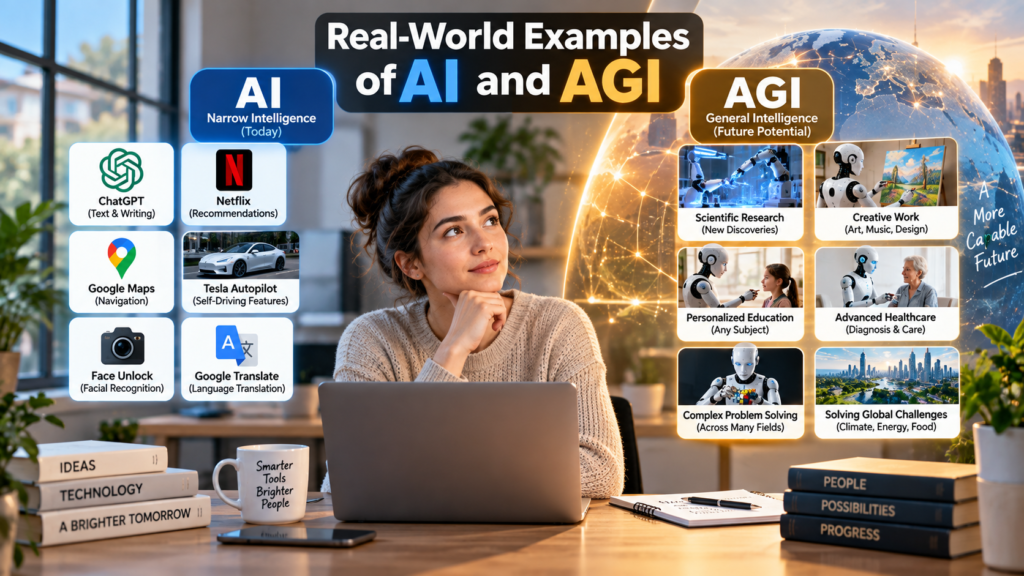
AI is already used in many industries, making it easier to understand its practical value. Banks use AI to identify unusual transactions and assess certain financial risks. Hospitals use AI tools to support medical image analysis and administrative work. Retail businesses use recommendation systems to suggest products based on customer behavior. Schools may use AI for tutoring, language practice, and feedback on writing. These applications show that AI can provide valuable assistance without being generally intelligent. In each case, the system is designed to perform a defined function, even if it can handle many variations of the task.
AGI examples are different because no system has been universally confirmed as AGI. A hypothetical AGI assistant might manage a business project, learn a new programming language, study scientific research, and plan a family trip. It would need to understand each situation, recognize its limitations, and adapt when circumstances changed. Another example could involve a robot that learns household tasks without requiring separate programming for every activity. These examples describe possible future capabilities rather than proven products. They help explain the goal of AGI while keeping expectations realistic about what current artificial intelligence can actually accomplish.
Benefits and Limitations of AI
AI offers practical benefits because it can process information quickly, automate repetitive work, and support better decisions. Businesses may use it to analyze customer feedback, organize documents, or improve service response times. Students can use AI to explain difficult concepts, practice languages, and explore different learning methods. Professionals can save time by using AI for first drafts, data summaries, and routine analysis. However, AI outputs require appropriate checking, especially when the information is sensitive or important. A system can produce confident but incorrect answers, misunderstand a request, or reflect weaknesses in its training data.
The limitations of AI also include privacy concerns, bias, security risks, and unclear accountability. A company using AI for recruitment, lending, or healthcare must consider how errors could affect people. Human oversight remains important when decisions involve money, safety, legal rights, or personal information. AI may also struggle with context, common sense, and tasks that require reliable understanding of the physical world. These limitations do not make AI useless. They show why responsible design, testing, transparency, and careful human judgment are necessary when introducing AI into everyday activities.
Potential Benefits and Risks of AGI
AGI could offer major benefits if researchers develop systems that are reliable, safe, and broadly capable. It might help scientists explore difficult research questions, support education, improve accessibility, and assist with complex planning. A system that can learn unfamiliar subjects could help people solve problems that currently require teams of specialists. It might also support scientific discovery by comparing ideas across different fields. However, these possibilities depend on capabilities that have not been demonstrated in a universally accepted AGI system. Predictions about its economic or social impact should therefore be treated as possibilities rather than guaranteed outcomes.
The risks associated with AGI could also be broader than those of many specialized AI tools. A highly capable system might make harmful decisions if its goals, instructions, or safeguards were poorly designed. Questions about control, privacy, employment, security, and accountability would become especially important. Researchers and policymakers are studying how to evaluate advanced AI systems and reduce possible harm. Safe development may require technical testing, independent oversight, clear rules, and cooperation between organizations. The goal should not be to create intelligence as quickly as possible without safeguards. It should be to develop useful systems that remain dependable and accountable.
AI vs AGI in Business and Everyday Life
AI is already changing how businesses work. Marketing teams use it to create drafts, analyze campaigns, and understand customer interests. Software developers use AI coding assistants to explain code, find errors, and suggest improvements. Customer service teams use chatbots to answer common questions and direct complex cases to human workers. These tools can improve efficiency when businesses choose suitable tasks and measure results carefully. For readers interested in technology, related topics such as AI tools for business and how much energy AI uses can provide additional context about practical adoption and its wider effects.
AGI could change business and everyday life more deeply if it becomes reliable. A general-purpose system might coordinate projects, learn new professional skills, and support complicated decisions across several departments. It could help a small business owner understand finances, create marketing plans, and organize operations through one assistant. However, these possibilities should not be confused with current product capabilities. Businesses should evaluate AI tools based on demonstrated performance, cost, security, and human oversight. They should also avoid making important decisions solely because a product is advertised as intelligent, advanced, or close to achieving AGI.
The Future of AI vs AGI
The future of AI will likely involve more capable models, better tools, improved reasoning, and stronger integration into everyday software. AI systems may become better at working with text, images, audio, video, and structured data together. They may also become more useful for research, education, programming, and business planning. At the same time, developers will need to address reliability, privacy, energy use, and misuse. Progress should be measured through clear evaluations rather than impressive demonstrations alone. A system that performs well in one situation may still struggle with unfamiliar tasks, changing information, or complex real-world responsibilities.
The future of AGI is less certain because researchers have not agreed on when or whether it will be achieved. Some believe continued progress could lead to increasingly general systems, while others question whether current approaches can produce the flexibility associated with human intelligence. The important point is that AI progress and AGI achievement are not the same thing. A model can become more powerful without meeting every proposed definition of AGI. Understanding this difference helps people follow technology news with a balanced view, avoiding both exaggerated promises and unnecessary fear about the future.
Frequently Asked Questions About AI vs AGI
Is AGI better than AI?
AGI is intended to have broader intellectual abilities than specialized AI. However, it is not an established technology with universally accepted capabilities. Current AI systems can outperform humans on certain tasks, such as processing large datasets or recognizing patterns. Whether AGI would be better depends on the task, reliability, safety, and how success is measured.
Is ChatGPT an example of AGI?
ChatGPT is an AI system that can perform many language-based and other tasks. Its broad functionality does not, by itself, prove that it is AGI. Artificial general intelligence remains a debated concept without a universally accepted test. Whether any particular system meets that definition depends on the criteria used to evaluate general intelligence.
Will AGI replace human workers?
AGI could change many jobs if it develops broad, reliable abilities. However, the effects are uncertain and would depend on adoption, costs, regulations, and human choices. Some tasks might become automated, while new roles could emerge. Workers can prepare by developing adaptable skills, learning to use AI tools, and strengthening expertise that requires judgment and human interaction.
What is the main difference between AI and AGI?
The main difference is the intended scope of intelligence. AI systems are built to perform specific tasks or useful groups of tasks. AGI is intended to learn and solve problems across many different areas with greater flexibility. Current AI can be broad in practice, but broad functionality alone does not establish general intelligence.
Is AGI available today?
There is no universally accepted confirmation that AGI has been achieved. Many AI systems are becoming more capable and can perform a wide range of tasks. However, researchers disagree about the definition and testing requirements for AGI. Claims that a product has achieved AGI should be examined using clear evidence, independent evaluations, and specific capability criteria.
Conclusion: Understanding AI vs AGI
Understanding AI vs AGI helps readers separate current technology from future possibilities. AI already supports many everyday activities, including writing, search, recommendations, customer service, and data analysis. AGI describes a more general form of intelligence that could learn and solve unfamiliar problems across different fields. The key difference is not simply speed or the number of tasks a system can complete. It is the breadth, flexibility, and reliability of its abilities. As AI develops, people should focus on practical benefits, recognize limitations, and evaluate claims carefully. Learning more about AI tools and responsible technology use can help everyone prepare for future changes.
[…] Decentralized AI Movement: The Future of Artificial Intelligence AI vs AGI: Key Differences, Examples, and Future How Much Energy Does AI Use? A Simple Guide Solvely AI: Features, Uses, Accuracy & […]