

Sakana AI: Research, Models, Founders, and Future

Sakana AI is a Japanese artificial intelligence company developing new ways to build intelligent systems. Founded in Tokyo in 2023, the company explores ideas inspired by nature, evolution, and collective intelligence. Its research focuses on making AI more efficient, adaptable, and useful for real-world problems. Unlike companies that focus mainly on building larger models, Sakana AI studies how different models and intelligent agents can work together. Its projects include The AI Scientist, Japanese language models, and autonomous research systems. This article explains Sakana AI’s founders, technology, products, research, and future goals in simple, clear language.
What Is Sakana AI?
Sakana AI is a Tokyo-based frontier artificial intelligence research and development company. It was established in 2023 by David Ha, Llion Jones, and Ren Ito. The company aims to develop AI systems using ideas from natural processes, including evolution and collective intelligence. Its name refers to fish, reflecting the founders’ interest in how groups of simple organisms can work together. Sakana AI works on foundational models, autonomous agents, and practical AI solutions. The company also works with Japanese businesses and public organizations to develop useful AI technologies.
The company’s approach is different from traditional AI development. Many laboratories improve models by increasing their size and training them with more computing power. Sakana AI also investigates methods that combine smaller models, improve algorithms, and use multiple agents. This approach may help researchers create capable systems with fewer resources. However, smaller models are not automatically better, and performance depends on the task, data, and system design. Sakana AI’s work focuses on finding practical ways to improve intelligence rather than simply increasing model size. This makes the company interesting to people studying efficient AI development.
Who Founded Sakana AI?
David Ha
David Ha is one of Sakana AI’s co-founders and serves as its chief executive officer. Before starting the company, he worked at Google Brain, where he led research involving machine learning and world models. His work explored how artificial intelligence can learn patterns about environments and use those patterns to make decisions. These interests helped shape Sakana AI’s focus on adaptive intelligence and systems inspired by nature. Ha’s background combines research experience with an interest in developing new approaches to AI. At Sakana AI, he helps guide the company’s research direction and broader mission.
Llion Jones and Ren Ito
Llion Jones is Sakana AI’s co-founder and chief technology officer. He is known for co-authoring the influential research paper “Attention Is All You Need,” which introduced the Transformer architecture. Transformers later became an important foundation for modern language models. Ren Ito is another co-founder and serves as chairman. His background includes diplomatic and government-related work, which supports the company’s interest in public-sector and national AI development. Together, the founders bring research, engineering, and organizational experience. Their different backgrounds help Sakana AI connect advanced research with practical applications in Japan.
How Sakana AI’s Technology Works
Sakana AI studies artificial intelligence through ideas found in nature. One important example is collective intelligence, where many simple individuals work together to produce complex behavior. A school of fish can move as one group without a single fish controlling every movement. Sakana AI applies similar ideas to AI systems by exploring how multiple models or agents can cooperate. Another important idea is evolution, where useful changes are tested and improved over time. These concepts may help create AI systems that adapt to different tasks instead of relying on one fixed model.
The company also investigates model merging, which combines the capabilities of existing AI models. Instead of training one massive model from the beginning, researchers can explore how different models contribute useful skills. This may reduce development costs and create systems with broader abilities. However, combining models does not guarantee better results. Researchers must test accuracy, reliability, safety, and performance for each application. Sakana AI’s research examines these challenges through experiments and published work. Its goal is to discover better methods for building AI while making advanced technology more accessible to organizations with limited computing resources.
Sakana AI Models and Products
Japanese Language Models
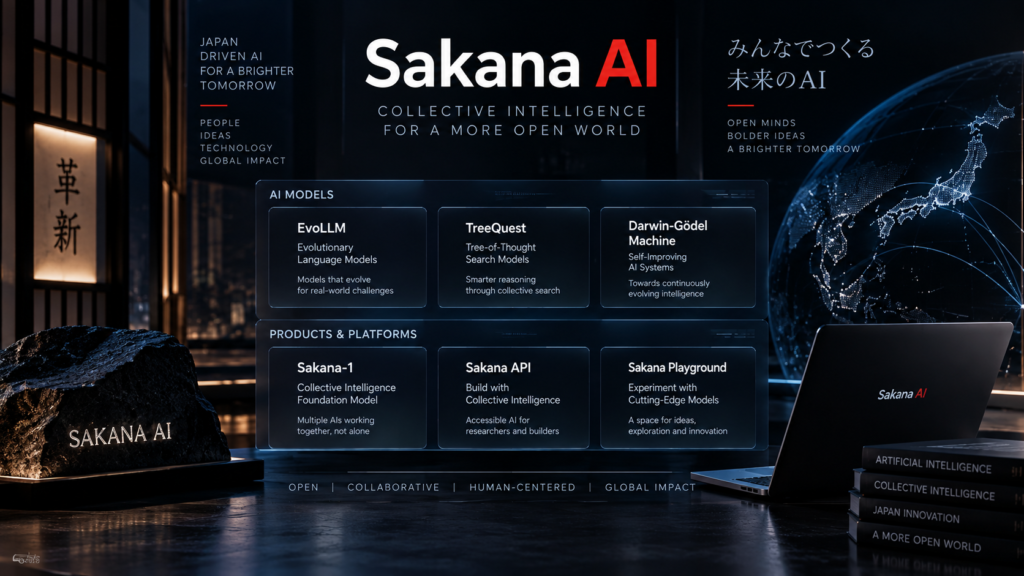
Sakana AI has developed Japanese-focused language models under its Namazu research and product work. These models aim to improve how AI understands Japanese language, culture, and local needs. Japanese users may benefit from systems that better understand local expressions, business practices, and social context. The company has also worked on Sakana Chat, a chat service designed for Japanese users. These projects show its interest in creating AI that serves specific communities rather than treating every language and culture the same. Model quality still requires careful testing, especially for factual accuracy, reasoning, and professional tasks.
Sakana Chat
Sakana Chat is a conversational AI service associated with the company’s Japanese AI development efforts. It is designed to provide users with a way to interact with language models through natural conversation. Like other AI chat tools, it may help with writing, research, explanations, and everyday information tasks. Its value depends on the model behind the service and the features available to users. People should check the official product information before relying on it for important decisions. Sakana AI’s broader goal is to create useful AI systems that fit Japanese language and social requirements.
The AI Scientist Explained
What Is The AI Scientist?
The AI Scientist is one of Sakana AI’s best-known research projects. It is designed to automate parts of scientific research, including generating ideas, planning experiments, running tests, and preparing research papers. Traditional scientific work requires researchers to move through these steps manually. An AI system that supports several stages could help scientists explore more ideas in less time. However, automated research still needs human review, careful experiment design, and independent verification. A generated paper is not automatically correct or valuable. Sakana AI’s project is important because it explores how AI can support scientific discovery itself.
The AI Scientist demonstrates a move from AI as a simple assistant toward AI as a research partner. For example, a system might suggest a machine learning experiment, write code, analyze results, and prepare a draft. Researchers can then review the work, repeat important tests, and decide whether the findings are useful. This process could help reduce repetitive tasks and support faster experimentation. However, scientific quality depends on sound methods and honest reporting. AI-generated results can contain errors, so human oversight remains essential. Sakana AI continues developing this research direction as part of its broader mission.
Sakana AI and Recursive Self-Improvement
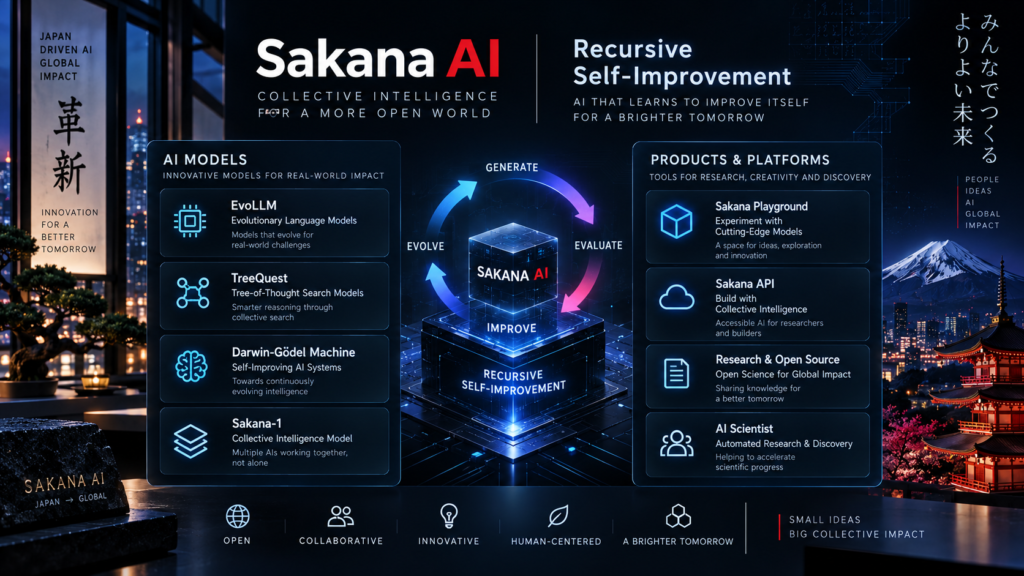
Recursive self-improvement is another important research direction at Sakana AI. It describes systems that use AI to improve parts of their own design or development process. For example, an AI system might write a new algorithm, test it, and compare the results with an earlier version. If the new approach performs better, researchers can study why it worked. Sakana AI established a Recursive Self-Improvement Lab to investigate this area. The company connects this work with its earlier research on automated discovery, evolutionary optimization, and intelligent agents.
Self-improving AI creates both opportunities and challenges. It could help researchers discover better algorithms and reduce the time needed to improve models. However, systems may also make changes that pass a benchmark but fail in real situations. They might exploit weaknesses in evaluation methods or produce unreliable results. Sakana AI recognizes these risks and emphasizes testing, safeguards, and responsible development. The company’s research suggests that self-improvement should be treated as an engineering problem, not simply a promise of unlimited intelligence. Reliable evaluation is necessary before such systems can be trusted in important applications.
Sakana AI Research and Open Innovation
Sakana AI shares research through papers, technical announcements, and open-source projects. This allows other researchers to study its methods and build on its findings. Open research can help improve transparency and encourage collaboration across universities, companies, and independent developers. It also allows the wider AI community to examine claims rather than relying only on promotional descriptions. Sakana AI’s published work includes research on automated scientific discovery, model combinations, and evolutionary approaches to AI. These projects reflect the company’s interest in creating new research methods rather than focusing only on commercial software.
For readers who want to understand AI research, Sakana AI offers several useful starting points. Its official research pages explain the company’s projects and technical goals. The AI Scientist provides an example of automated scientific workflows, while its model research shows how different approaches can be combined. Readers can also explore artificial intelligence explained and machine learning basics to understand the concepts behind these projects. Learning the fundamentals makes advanced research easier to follow. It is also important to compare company announcements with independent evaluations when judging AI performance.
Sakana AI Funding and Business Growth
Sakana AI attracted major attention from investors because of its research team and unusual approach to AI development. In September 2024, the company announced approximately $200 million in Series A funding. The round included New Enterprise Associates, Khosla Ventures, Lux Capital, Translink Capital, 500 Global, and NVIDIA. This investment supported the company’s research and development plans. Funding can help an AI laboratory hire researchers, purchase computing resources, and develop products. However, investment does not guarantee commercial success. Companies must still prove that their technology works reliably and provides value to customers.
Sakana AI later announced a Series B funding round in November 2025. The company described its progress in developing products and building a foundation for growth in Japan. Its business strategy includes working with enterprises and public-sector organizations. These partnerships may help turn research into practical solutions for finance, manufacturing, and other industries. The company also seeks to support Japan’s AI ecosystem through collaboration and local development. Its long-term success will depend on research quality, product adoption, responsible deployment, and its ability to compete in a rapidly changing AI market.
Practical Uses of Sakana AI
Sakana AI’s technology may support several practical areas. Japanese language models could help organizations create better local-language applications. Automated research systems may assist scientists with experiment planning and technical writing. Multi-agent systems could help businesses divide complex tasks among specialized AI tools. For example, one agent might gather information, another could analyze it, and a third could prepare a report. These examples describe possible uses rather than guaranteed product capabilities. Any organization considering AI should test accuracy, privacy, security, and cost before using a system in important work.
The company’s applied work focuses on connecting AI research with real business needs. Its public information highlights areas such as finance, defense, intelligence, and manufacturing. These industries often require systems that can handle complex information and support professional decisions. AI may help employees analyze documents, identify patterns, or automate routine processes. However, high-stakes applications require strict safeguards and human responsibility. Organizations should evaluate whether AI improves a specific workflow instead of adopting it simply because it is new. Sakana AI’s research provides ideas for this process, while real-world testing determines whether those ideas are useful.
Sakana AI’s Future Goals
Sakana AI aims to develop advanced AI systems that are efficient, adaptable, and useful in the real world. Its research includes autonomous agents, Japanese language models, automated scientific discovery, and recursive self-improvement. These areas could influence how future AI systems are trained and used. The company also wants to support Japan’s position in global AI research. Its focus on nature-inspired methods may help it discover approaches that differ from the largest AI laboratories. However, the future remains uncertain because technical challenges, competition, and safety requirements continue to shape the industry.
The company’s future progress will depend on how well it turns research into reliable systems. Strong ideas must be supported by clear evaluations, useful products, and responsible deployment. Sakana AI’s work on self-improving systems makes careful testing especially important. AI models can produce mistakes, misunderstand instructions, or behave differently outside controlled experiments. Therefore, future developments should be judged through independent evidence and practical results. Readers interested in AI can follow the company’s official announcements to learn about new models, research papers, and product releases. This is the best way to separate confirmed progress from speculation.
Frequently Asked Questions
What is Sakana AI known for?
Sakana AI is known for nature-inspired AI research, model merging, autonomous scientific discovery, and Japanese language models. Its AI Scientist project explores how artificial intelligence can support research tasks. The company also investigates recursive self-improvement and multi-agent systems. These projects make it an interesting participant in modern AI research.
Who founded Sakana AI?
Sakana AI was founded in 2023 by David Ha, Llion Jones, and Ren Ito. David Ha serves as CEO, while Llion Jones is CTO and Ren Ito is chairman. Their backgrounds include AI research, engineering, and government-related work. Together, they established the company in Tokyo.
Is Sakana AI a Japanese company?
Yes, Sakana AI is based in Tokyo, Japan. The company focuses on developing advanced AI technologies while supporting Japan’s AI ecosystem. Its work includes Japanese language models, local business applications, and collaboration with public-sector organizations. It also has an international research outlook and works with people from different backgrounds.
What is The AI Scientist?
The AI Scientist is a Sakana AI research project designed to automate parts of scientific discovery. It can help generate research ideas, plan experiments, run tests, and prepare papers. Human researchers still need to review results carefully. The project explores how AI can support scientific work and accelerate experimentation.
Does Sakana AI offer a chat service?
Yes, Sakana AI has developed Sakana Chat as part of its Japanese AI product work. It is intended to provide conversational access to AI models. Available features and access conditions may change over time. Users should consult the company’s official website for current product information and availability.
Conclusion
Sakana AI is an important Japanese AI company exploring new approaches to artificial intelligence. Its founders bring experience from research, engineering, and public service. The company studies collective intelligence, evolution, model merging, and automated scientific discovery. Projects such as The AI Scientist and Sakana Chat show its interest in practical AI applications. Its recursive self-improvement research also explores how future systems might improve their own development processes. However, advanced AI still requires careful testing, transparency, and human oversight. Readers interested in AI can follow Sakana AI’s research and product announcements to understand its progress. Learning the basics of machine learning can also help explain its work.
[…] Solvely AI: Features, Uses, Accuracy & Limitations Sakana AI: Research, Models, Founders, and Future VentureBeat: Technology News, AI, and Business Insights Codex: Complete Guide to […]