

AI Agents in Healthcare: Benefits, Uses, and Future

AI agents in healthcare are changing how doctors, nurses, and hospitals manage medical services. These intelligent software systems can understand instructions, analyze information, and complete tasks with limited human guidance. From scheduling appointments to supporting clinical decisions, AI agents help healthcare professionals save time and improve patient experiences. However, their role goes beyond simple automation. They can connect information from different systems, identify important patterns, and support better decisions. As healthcare organizations explore digital solutions, understanding how AI agents work, where they help, and what risks they create is becoming increasingly important for patients and medical professionals.
What Are AI Agents in Healthcare?
AI agents in healthcare are software systems designed to perform healthcare-related tasks by using artificial intelligence. Unlike basic programs that follow fixed instructions, these agents can interpret requests, gather information, and choose suitable actions within defined limits. Some agents use language models to understand questions, while others analyze medical images, patient records, or monitoring data. Their capabilities depend on the technology, available information, and permissions provided by healthcare organizations. For example, an appointment agent may understand a patient’s request, check available times, and prepare a booking for confirmation. This makes healthcare services more responsive and easier to manage.
These agents can operate across several areas of medical care. A patient-facing agent may answer general health questions, explain preparation instructions, or guide someone toward appropriate services. A hospital-based agent may organize records, summarize information, or help staff coordinate appointments. Clinical agents can support doctors by highlighting relevant information for review. However, not every AI agent has the same abilities or level of independence. Some only recommend actions, while others complete approved administrative tasks. Understanding these differences helps healthcare organizations choose technology that matches their needs, staff responsibilities, and patient safety requirements.
How AI Agents Work in Healthcare
AI agents typically combine artificial intelligence, information retrieval, and software tools to complete tasks. First, an agent receives a request, such as finding a patient’s appointment details. It then interprets the request and identifies the information needed. If permitted, the system retrieves relevant data from an electronic health record or scheduling platform. Next, it processes the information and prepares a response or recommended action. Some agents can also use approved tools to update records or send notifications. These steps allow the technology to handle connected tasks instead of simply producing a written answer.
The way an agent works depends on its design and the healthcare environment. A clinical agent may compare patient information with approved medical guidelines, while an administrative agent may organize insurance documents. More advanced systems can complete several related tasks, but they still require clear instructions and appropriate controls. Healthcare organizations should define what each agent can access, which actions require approval, and how mistakes are reported. They should also test the system using realistic examples before introducing it into daily operations. These safeguards help ensure that AI supports healthcare workers rather than creating additional risks.
Common Uses of AI Agents in Healthcare
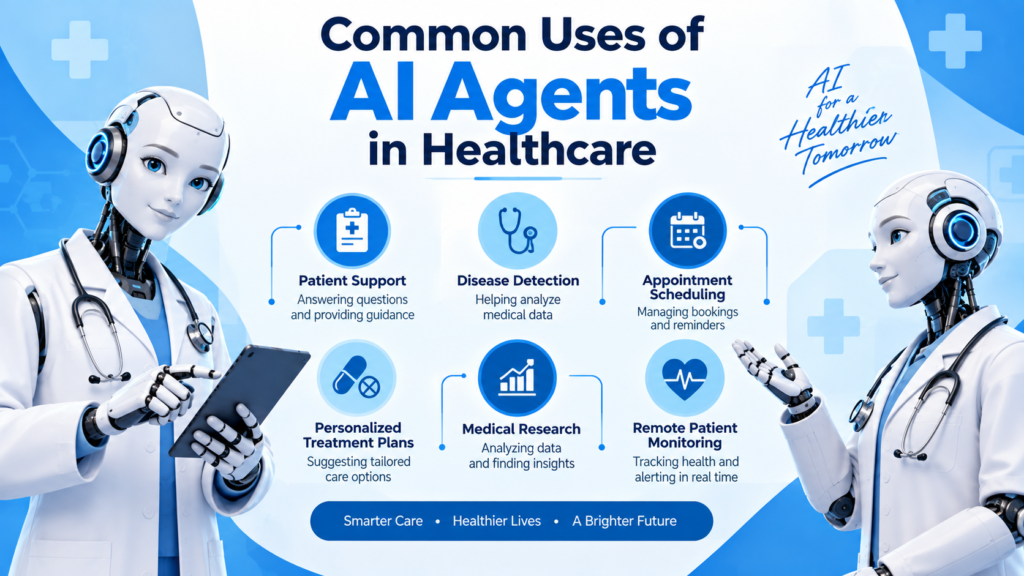
AI agents are being developed for many healthcare activities, including administrative support, patient communication, and clinical assistance. Their usefulness depends on the quality of available data and the specific problem they are designed to solve. For example, an agent may help a patient find a suitable appointment, remind someone about a scheduled visit, or explain general preparation instructions. In hospitals, agents may organize incoming requests, summarize documents, or route information to the correct department. These tasks can reduce repetitive work and allow staff to focus more attention on patients who need personal assistance.
Clinical support is another important area for AI agents in healthcare. Some systems can help doctors review patient histories, identify relevant test results, or compare information with established clinical guidelines. Others may support medical imaging workflows by highlighting areas that require further examination. These tools do not automatically replace professional judgment. Instead, they provide information that qualified healthcare workers can evaluate. For instance, an agent might summarize a patient’s previous medications before a consultation. The doctor remains responsible for checking the summary, considering the patient’s condition, and deciding whether any treatment changes are appropriate.
Benefits of AI Agents in Healthcare
One major benefit of AI agents in healthcare is improved efficiency. Healthcare workers spend considerable time managing appointments, searching records, preparing documents, and answering routine questions. Agents can assist with these activities, helping staff complete work more consistently. They may also reduce delays when patients need information outside normal office hours. For example, a scheduling agent can guide patients through available appointment options without requiring staff to answer every basic question manually. When used correctly, this support can improve service organization and give healthcare professionals more time for tasks that require communication, empathy, and clinical expertise.
AI agents may also improve access to healthcare information and support more personalized services. Patients can receive clearer explanations of routine instructions, reminders, and administrative processes. Healthcare workers may benefit from summaries that make relevant information easier to find. However, these benefits are not guaranteed. Poorly designed systems can provide incorrect answers, create confusion, or make services harder to use. Organizations should measure whether an agent actually improves patient experiences and staff performance. They should also collect feedback from users and update the system when problems appear. Careful evaluation helps ensure that efficiency does not come at the expense of quality.
AI Agents and Patient Care
AI agents can support patient care by helping people understand healthcare processes and communicate with medical teams. For example, a patient may ask an agent how to prepare for a routine appointment or where to find a laboratory report. The agent can provide approved information in simple language and direct the patient to the appropriate service. Some systems may also help collect basic information before a consultation. This can make appointments more organized and reduce repeated questions. Nevertheless, patients should understand that an AI response is not the same as advice from a qualified healthcare professional.
In clinical settings, AI agents may assist with monitoring and information management. An agent could review approved patient data, identify a change that requires attention, and notify the responsible healthcare worker. Other systems may help coordinate follow-up appointments or remind patients about care instructions. These applications require careful testing because missing an important detail can affect patient safety. Human oversight is especially important when an agent handles urgent symptoms, medication information, or treatment decisions. Patients should have a clear way to contact a healthcare professional whenever an automated system cannot provide a safe or appropriate response.
AI Agents in Hospitals and Medical Organizations
Hospitals manage large amounts of information across departments, including patient records, appointment schedules, laboratory results, and billing documents. AI agents can help organize this information and support communication between teams. For example, an administrative agent may identify incomplete forms, prepare appointment reminders, or direct requests to the correct department. A records agent may help staff locate relevant documents more quickly. These applications can improve workflow organization, but they require secure connections to hospital systems. Access should be limited according to each employee’s responsibilities, and sensitive information should be protected throughout the process.
Medical organizations can also use AI agents to support operational planning. An agent might help identify appointment bottlenecks, summarize department reports, or organize staff requests. This information can help managers understand where additional resources may be needed. However, an agent should not make important staffing or clinical decisions without appropriate review. Healthcare leaders must consider the reliability of the information, the effect on employees, and the needs of patients. They should also establish clear responsibilities when an agent produces an incorrect result. A well-managed system supports staff and improves coordination without removing accountability from the organization.
Challenges and Risks of AI Agents in Healthcare
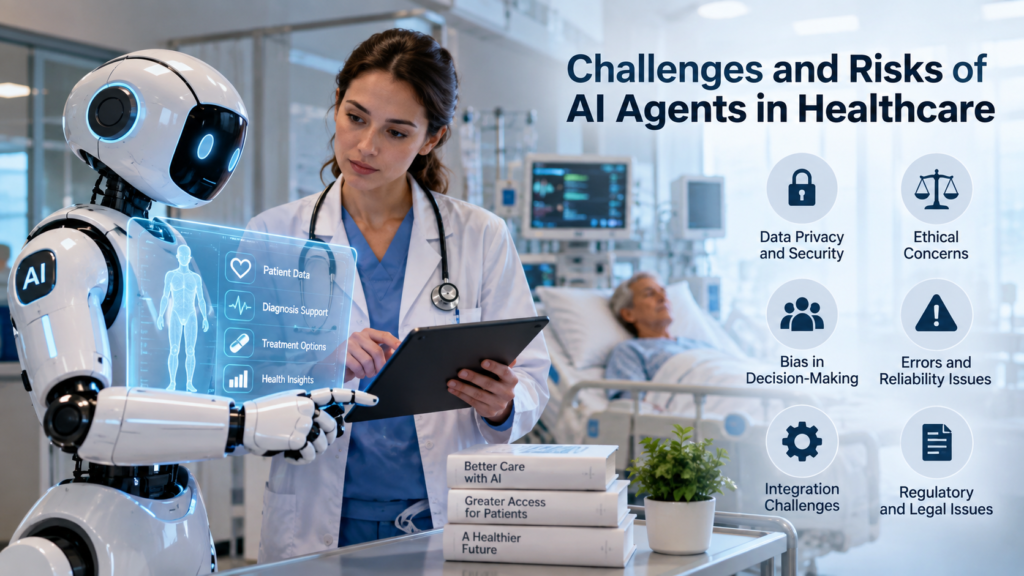
Despite their potential, AI agents in healthcare create several important challenges. One concern is inaccurate information. An agent may misunderstand a question, produce an incorrect summary, or recommend an unsuitable action. In medical settings, even a small error can have serious consequences. Privacy is another concern because healthcare systems contain sensitive personal information. Unauthorized access, weak security, or improper data handling can expose patients to harm. Healthcare organizations must therefore evaluate an agent’s accuracy, security, and reliability before using it. They should also monitor performance after deployment because problems may appear when the system encounters unfamiliar situations.
Another challenge involves accountability and trust. Patients and healthcare workers need to understand when they are interacting with an AI system and what the system can do. If an agent makes a mistake, organizations must know who is responsible for correcting it. Staff should receive training on how to review AI-generated information and recognize unreliable outputs. Patients should also have access to human support when needed. In addition, organizations must consider whether the technology works fairly for people with different languages, disabilities, and healthcare needs. Responsible implementation requires technical testing, ethical review, and ongoing human oversight.
How to Implement AI Agents Safely
Healthcare organizations should begin by identifying a specific problem that an AI agent can address. Suitable starting points include appointment scheduling, routine document organization, or answering approved administrative questions. The organization should then define the agent’s responsibilities, information access, and limits. Before launch, the system needs testing with realistic examples, including unusual requests and possible errors. Staff should understand how to review results and report problems. Patients should receive clear information about the system’s purpose and limitations. Starting with a focused task makes it easier to measure performance and improve the technology safely.
After implementation, healthcare organizations should monitor the agent’s performance regularly. Useful measures may include response accuracy, staff workload, patient satisfaction, and the number of errors requiring correction. Security checks should also confirm that sensitive information is accessed only when necessary. Organizations should update the agent when policies, clinical guidelines, or software systems change. Human review remains essential for medical decisions and other high-risk tasks. If the system performs poorly, the organization should be able to restrict or pause its use. This ongoing process helps ensure that AI technology remains useful, reliable, and aligned with patient needs.
The Future of AI Agents in Healthcare
The future of AI agents in healthcare will likely involve closer integration with electronic health records, hospital software, and patient communication tools. As these systems improve, agents may become better at handling connected administrative tasks and supporting healthcare professionals with organized information. For example, one agent might help prepare a consultation, while another supports follow-up scheduling. However, greater capability does not automatically mean greater safety. Healthcare organizations will need reliable testing, clear policies, and strong data protection. The most useful systems will likely combine automation with human judgment rather than attempting to replace medical professionals.
Future developments may also focus on more accessible and personalized healthcare services. AI agents could help patients navigate complex healthcare systems, understand routine instructions, and communicate with providers in different languages. They may also support medical research by organizing information and helping researchers identify relevant studies. However, these possibilities depend on responsible development and appropriate regulation. Healthcare professionals, technology developers, and patients should all have a role in evaluating new systems. By focusing on practical benefits, transparent design, and patient safety, healthcare organizations can explore AI agents while maintaining trust and professional accountability.
Frequently Asked Questions
What are AI agents in healthcare used for?
AI agents in healthcare help with tasks such as appointment scheduling, patient communication, record organization, and clinical information support. Their exact capabilities depend on the system’s design and permissions. Some agents only provide information, while others can complete approved administrative actions. Medical decisions should remain under qualified professional supervision.
Can AI agents replace doctors and nurses?
AI agents are not a complete replacement for doctors and nurses. They can support administrative work, information review, and routine communication. However, healthcare professionals provide clinical judgment, physical examination, empathy, and accountability. These responsibilities require human involvement, especially when patients have complex conditions or urgent medical needs.
Are AI agents safe for patient information?
AI agents can be used safely when healthcare organizations apply strong security and privacy controls. These include limited access, secure data handling, regular testing, and clear accountability. However, no technology is completely risk-free. Organizations should evaluate how patient information is collected, stored, processed, and shared.
How do hospitals benefit from AI agents?
Hospitals can use AI agents to organize records, support scheduling, answer routine questions, and improve communication between departments. These applications may reduce repetitive work and help staff find information more efficiently. Benefits depend on proper implementation, reliable data, staff training, and regular monitoring of system performance.
What should patients know about AI healthcare tools?
Patients should understand whether they are interacting with an AI system and what information it can provide. AI tools may help with routine questions, but they should not replace professional medical advice. Patients should contact a qualified healthcare professional for urgent symptoms, diagnosis, or treatment decisions.
Conclusion
AI agents in healthcare offer practical ways to improve medical services, support healthcare workers, and make routine processes easier for patients. They can assist with scheduling, communication, information management, and selected clinical tasks. However, their benefits depend on reliable technology, secure data handling, and appropriate human oversight. Healthcare organizations should introduce these systems carefully, measure their performance, and address problems quickly. Patients should also understand the limitations of automated healthcare tools. As artificial intelligence develops, responsible implementation will remain essential. By combining intelligent software with professional judgment, healthcare providers can explore better services while keeping patient safety and trust at the center.
[…] Humanity’s Last Exam: A Complete Guide to the AI Benchmark AI Agents in Healthcare: Benefits, Uses, and Future Is AI a Robot? Understanding AI vs. Robots OpenAI Models: Complete Guide to GPT-6 and […]