

Claude Sonnet 4.6: Features, Pricing, and Capabilities

Claude Sonnet 4.6 is Anthropic’s February 2026 Sonnet model, designed to combine strong reasoning with speed and relatively efficient API costs. It was released as a major upgrade to Claude Sonnet 4.5, with improvements spanning coding, computer use, long-context reasoning, agent planning, knowledge work, and design. Anthropic also introduced a 1-million-token context window in beta, making the model particularly interesting for large codebases, long documents, and extended agent workflows.
There is an important current-status detail, however: Anthropic released Claude Sonnet 5 in June 2026, so Sonnet 4.6 is no longer the newest Sonnet model. Even so, Sonnet 4.6 remains an active API model, with Anthropic listing it as available until at least February 2027.
This guide explains what Claude Sonnet 4.6 actually offers, how its reasoning and context capabilities work, what it costs, where it performs well, and when choosing a newer Claude model makes more sense.
What Is Claude Sonnet 4.6?
Claude Sonnet 4.6 is a hybrid reasoning large language model (LLM) developed by Anthropic. It belongs to the Sonnet tier of the Claude model family, positioned between the company’s faster, more lightweight models and its higher-end Opus models.
Anthropic introduced Sonnet 4.6 on February 17, 2026, describing it as a broad upgrade rather than a narrowly focused improvement. The release targeted several areas at once:
- Software development
- Computer use
- Agentic workflows
- Long-context reasoning
- Professional knowledge work
- Document and data tasks
- Design and frontend development
- Instruction following
- Multistep problem solving
When it launched, Sonnet 4.6 became the default model for Free and Pro Claude users. Its API pricing was also kept at the same level as Sonnet 4.5.
The distinction between Sonnet 4.6 and Sonnet 5 matters today. Sonnet 5 is the newer model and is positioned as Anthropic’s more capable agentic Sonnet. Nevertheless, Sonnet 4.6 remains an active model for developers who need compatibility with an established model generation.
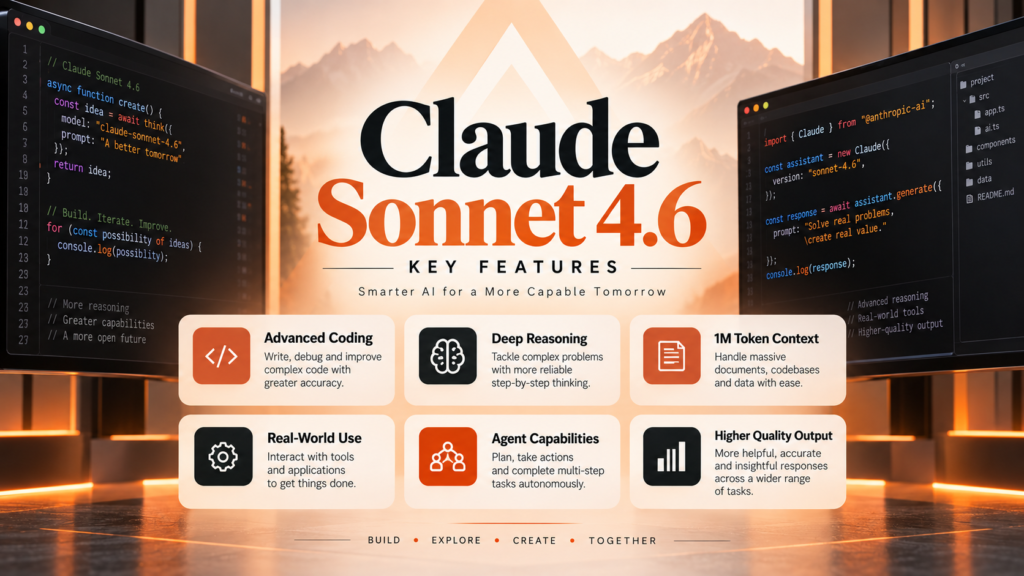
Claude Sonnet 4.6 Key Features
Several features make Sonnet 4.6 particularly useful for professional and developer workloads.
1. Strong Coding Performance
Coding is one of Sonnet 4.6’s most important strengths.
The model can generate code, explain existing programs, identify bugs, modify files, reason about software architecture, and work through larger programming tasks. Its improvements were particularly focused on complex codebases rather than only producing short code snippets.
Anthropic’s published evaluation results reported 79.6% on SWE-bench Verified for Sonnet 4.6, compared with 77.2% for Sonnet 4.5 in the same evaluation. On Terminal-Bench 2.0, Sonnet 4.6 scored 59.1% under the reported default-thinking configuration.
These benchmarks should not be interpreted as a guarantee that the model will correctly solve every programming problem. Software engineering involves requirements, environment configuration, testing, dependencies, security, and human judgment that benchmarks cannot fully reproduce.
2. Computer Use
Computer use is another major focus of Claude Sonnet 4.6.
Instead of limiting an AI system to text responses or conventional APIs, computer-use systems can interact with graphical software in ways that resemble how a person uses a computer.
This can be valuable when a company has older or specialized software that does not expose a convenient API.
For example, a hypothetical workflow could involve an AI agent:
- Opening a business application.
- Reading information from a dashboard.
- Moving information between systems.
- Checking the result.
- Reporting any problem to a human.
Sonnet 4.6 showed a substantial improvement over Sonnet 4.5 on Anthropic’s OSWorld-Verified evaluation, scoring 72.5% compared with 61.4% for Sonnet 4.5.
That does not mean computer automation is error-free. Real-world computer use is more complicated and ambiguous than controlled benchmark environments.
3. A 1-Million-Token Context Window
One of Sonnet 4.6’s most notable technical capabilities is its 1-million-token context window, available in beta on the API.
A context window is essentially the amount of information a model can work with within a particular interaction.
For comparison, imagine asking an AI to analyze:
- A very large software repository
- Hundreds of pages of contracts
- Multiple technical reports
- Extensive research material
- A large collection of project documentation
A larger context window can reduce the need to repeatedly split that material into small pieces.
However, a larger context window does not automatically mean perfect understanding of every piece of information inside it. The model can still misunderstand instructions, overlook relevant details, or make incorrect conclusions.
That distinction is important when evaluating long-context AI.
How Claude Sonnet 4.6 Handles Reasoning
Sonnet 4.6 supports reasoning capabilities designed for tasks that require more than straightforward text generation.
Anthropic’s developer documentation distinguishes between normal generation and thinking capabilities. For Sonnet 4.6, thinking is not automatically enabled when the thinking parameter is omitted; developers can configure thinking behavior according to their application.
This matters because deeper reasoning can be useful for problems such as:
- Debugging complicated code
- Planning a multistep workflow
- Comparing several business options
- Analyzing a large document
- Working through a difficult mathematical problem
- Deciding how an AI agent should use tools
There is a practical trade-off. More reasoning can consume additional resources and increase latency or cost. For simple tasks, spending extra computation may provide little benefit.
A good AI application therefore does not necessarily use maximum reasoning for every request.
Agentic AI and Tool Use
Sonnet 4.6 was designed with agentic AI in mind.
An ordinary chatbot might receive a question and immediately generate an answer. An AI agent can instead break a task into steps, use tools, inspect results, adjust its approach, and continue toward a goal.
A simplified example looks like this:
User request:
“Analyze these sales reports and prepare a summary.”
An agent could potentially:
- Read the supplied files.
- Extract relevant numbers.
- Run calculations.
- Identify unusual changes.
- Compare different periods.
- Produce a structured report.
This is considerably different from simply asking an LLM to summarize a paragraph.
Sonnet 4.6 supports capabilities including code execution, memory, programmatic tool calling, tool search, and tool-use functionality through Anthropic’s platform.
For developers, this makes the model particularly relevant to applications where the AI needs to do something, not merely produce text.
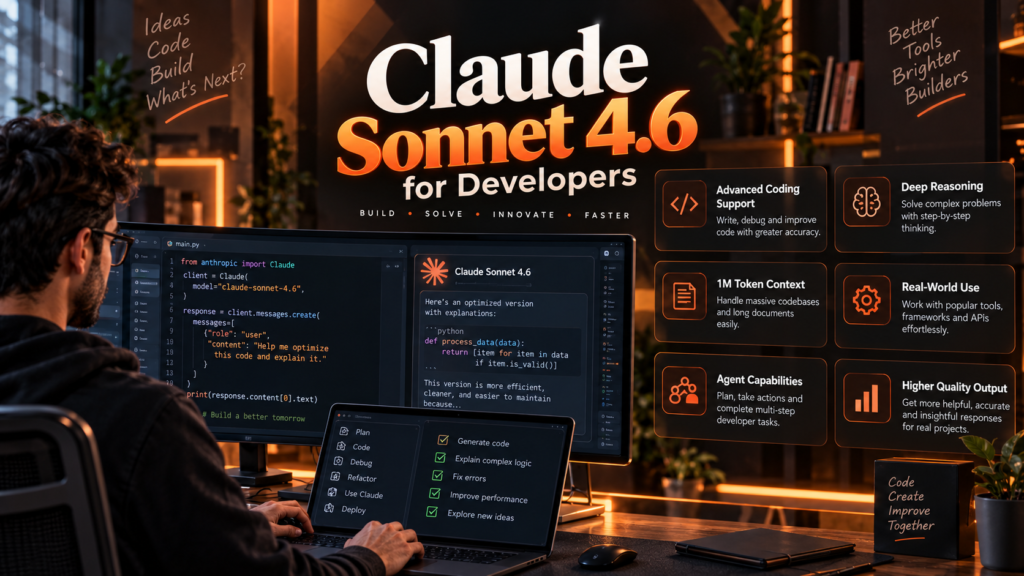
Claude Sonnet 4.6 for Developers
Developers can access Sonnet 4.6 through Anthropic’s API as well as major cloud platforms.
Anthropic lists access through:
- Claude.ai
- Anthropic’s API
- Amazon Bedrock
- Google Vertex AI
- Microsoft Azure AI Foundry
The API model identifier is:
claude-sonnet-4-6
Anthropic currently lists the model as active, with a tentative retirement date no sooner than February 17, 2027.
This is useful for organizations that have applications built around Sonnet 4.6 and need a predictable period before migration.
A Practical API Use Case
Suppose a software company wants to build an AI coding assistant.
The application could provide Sonnet 4.6 with:
- The user’s programming request
- Relevant project files
- Error messages
- Documentation
- Tool access for running tests
The model could then propose a change, inspect the result, and revise its solution.
The important engineering principle is that the model should not automatically be given unlimited authority. Production systems should use permissions, validation, logging, testing, and appropriate human approval for consequential operations.
Claude Sonnet 4.6 Pricing
When Sonnet 4.6 launched, Anthropic priced it at $3 per million input tokens and $15 per million output tokens. The company stated that this pricing was the same as Sonnet 4.5.
The pricing model is important because API costs depend on both what you send to the model and what the model generates.
| Pricing element | Claude Sonnet 4.6 |
|---|---|
| Input tokens | $3 per million |
| Output tokens | $15 per million |
| 1M context | Available in beta |
| API model ID | claude-sonnet-4-6 |
For large applications, additional features can affect the final cost. Anthropic supports prompt caching and batch processing, which can reduce costs for appropriate workloads.
Developers should calculate costs using their actual workload rather than assuming the headline per-million-token rate represents the total cost of an application.
Claude Sonnet 4.6 Benchmark Performance
Benchmarks can help establish where a model is strong, but they need context.
Anthropic’s published Sonnet 4.6 system card reports results across coding, computer use, reasoning, professional work, multimodal tasks, and agent evaluations. Some notable results include:
| Evaluation | Claude Sonnet 4.6 |
|---|---|
| SWE-bench Verified | 79.6% |
| Terminal-Bench 2.0 | 59.1% |
| OSWorld-Verified | 72.5% |
| ARC-AGI-2 Verified | 58.3% |
| GPQA Diamond | 89.9% |
| GDPval-AA | 1633 |
The exact evaluation configuration differs between tests, and Anthropic reports that most Sonnet 4.6 results were averaged over 10 trials, while SWE-bench results were averaged over 25 trials.
The numbers are useful for comparison, but they should not be treated as a single “intelligence score.” Different benchmarks measure different abilities, and real applications often behave differently from controlled evaluations.
Real-World Uses for Claude Sonnet 4.6
Sonnet 4.6 is broad enough to support many types of work.
Software Development
Developers can use it for:
- Code generation
- Bug investigation
- Refactoring
- Test generation
- Code explanation
- Documentation
- Repository analysis
- Architecture discussions
It is especially interesting for tasks where the model needs to understand relationships between many files rather than generate an isolated function.
Research and Document Analysis
A researcher could provide a large collection of documents and ask the model to:
- Extract key findings
- Compare arguments
- Identify contradictions
- Create structured notes
- Answer questions using the supplied material
The large context window can be useful here, although retrieval and careful source handling remain important for very large knowledge bases.
Business Operations
Businesses can use models like Sonnet 4.6 to assist with:
- Document processing
- Customer support
- Internal knowledge systems
- Workflow automation
- Report generation
- Data interpretation
- Administrative tasks
For sensitive operations, AI output should be reviewed and validated rather than blindly treated as authoritative.
Design and Frontend Development
Sonnet 4.6 also targets design-related work. Anthropic highlighted improvements in design and frontend tasks alongside coding and professional knowledge work.
For example, a developer could describe a dashboard’s requirements and ask the model to produce an initial frontend implementation. A human developer would still need to test accessibility, responsiveness, security, performance, and compatibility.
What Are the Limitations of Claude Sonnet 4.6?
Strong benchmark performance does not remove the fundamental limitations of generative AI.
It Can Still Make Mistakes
Claude Sonnet 4.6 can produce incorrect information or flawed reasoning. A confident answer is not proof that the answer is correct.
This is particularly important for:
- Medical decisions
- Legal matters
- Financial decisions
- Security-sensitive code
- Production infrastructure
- High-impact business decisions
Human review and independent verification remain necessary for consequential tasks.
The Knowledge Cutoff Matters
Anthropic’s transparency information gives Sonnet 4.6 a May 2025 knowledge cutoff.
That means the model’s built-in knowledge should not be assumed to include events after that point.
Tools such as web search can change the practical situation because an application can retrieve newer information, but that is different from the model’s underlying training knowledge.
A Huge Context Window Is Not Unlimited Understanding
One million tokens sounds enormous, but context capacity and comprehension are different things.
A model can technically receive a huge amount of information while still failing to identify the most important detail.
For long-document systems, good information organization, retrieval, careful prompting, citations, and evaluation can remain important even when a model supports very large contexts.
Newer Models May Be Better Choices
The biggest consideration in 2026 is that Sonnet 4.6 is no longer Anthropic’s newest Sonnet.
Anthropic introduced Claude Sonnet 5 on June 30, 2026, describing it as a significant improvement over Sonnet 4.6 in areas including reasoning, tool use, coding, and knowledge work.
Therefore, someone starting a completely new project should evaluate Sonnet 5 alongside Sonnet 4.6 rather than assuming the older model is automatically the best option.
Claude Sonnet 4.6 vs. Claude Sonnet 5
The distinction is straightforward: Sonnet 4.6 is the earlier model, while Sonnet 5 is the newer generation.
| Feature | Claude Sonnet 4.6 | Claude Sonnet 5 |
|---|---|---|
| Generation | 4.x | 5 |
| Release | February 2026 | June 2026 |
| 1M-token context | Yes | Yes |
| Agentic capabilities | Strong | Improved |
| Coding | Strong | Improved |
| API status | Active | Active |
| Best reason to choose | Existing 4.6 workloads and compatibility | New projects seeking newer Sonnet capabilities |
Anthropic’s migration information also identifies technical differences between the models, including a newer tokenizer for Sonnet 5 and different default thinking behavior.
For an existing application, compatibility and regression testing may matter more than simply choosing the newest model.
Is Claude Sonnet 4.6 Still Worth Using?
Yes, depending on the situation.
If you are maintaining an application already built around Sonnet 4.6, there may be little reason to migrate immediately without testing the newer model. Anthropic currently lists Sonnet 4.6 as an active API model, with retirement not expected before February 2027.
Sonnet 4.6 can also make sense when:
- Your application has already been tuned for it.
- You need its established behavior.
- Your evaluation suite performs well with it.
- You are migrating from an older Claude model.
- You need a model with its specific API characteristics.
- The newer model does not justify migration costs for your workload.
For a new application, however, Sonnet 5 deserves serious consideration.
The best approach is to test both models against your own tasks instead of relying entirely on public benchmarks.
How to Get Better Results From Claude Sonnet 4.6
Model quality is only part of the equation. Prompt and system design can have a major effect on results.
Give the Model a Clear Objective
Instead of:
“Analyze this.”
Try:
“Analyze this report for revenue changes, identify the three largest drivers, and present the findings in a table. Separate confirmed figures from assumptions.”
The second instruction defines the expected result much more clearly.
Provide Relevant Context
If the task depends on company terminology, project requirements, coding conventions, or document structure, include that information.
Define Constraints
Tell the model:
- What it should do
- What it should not do
- What format to use
- What sources it should rely on
- When it should ask for clarification
- What assumptions it must identify
Use Tools Carefully
For agentic applications, give the model only the tools and permissions it actually needs.
A system that can read a database is fundamentally different from one that can modify production records.
Evaluate Before Deployment
Create a test set based on real tasks from your application. Measure:
- Accuracy
- Reliability
- Latency
- Token consumption
- Failure rates
- Tool-use errors
- Human correction requirements
This provides a much more useful picture than a benchmark score alone.
Frequently Asked Questions
What is Claude Sonnet 4.6?
Claude Sonnet 4.6 is Anthropic’s February 2026 hybrid reasoning model, designed for coding, computer use, agentic workflows, long-context reasoning, professional work, and related AI tasks.
Is Claude Sonnet 4.6 free?
Sonnet 4.6 was made available through Claude’s free tier when it launched. API usage is separately billed according to token consumption, with launch pricing of $3 per million input tokens and $15 per million output tokens.
Does Claude Sonnet 4.6 have a 1M context window?
Yes. Anthropic introduced a 1-million-token context window for Sonnet 4.6, with availability depending on the platform and configuration.
Is Claude Sonnet 4.6 good for coding?
Yes. Coding is one of its strongest use cases. Anthropic reported a 79.6% result on SWE-bench Verified and significant improvements over Sonnet 4.5 on several coding-related evaluations.
Is Claude Sonnet 4.6 better than Sonnet 4.5?
Sonnet 4.6 was released as a broad improvement over Sonnet 4.5, particularly in coding, computer use, reasoning, agent planning, and professional work. Anthropic’s published evaluations show higher results for Sonnet 4.6 on several benchmarks.
Is Claude Sonnet 4.6 better than Claude Sonnet 5?
Not generally. Sonnet 5 is the newer model and Anthropic describes it as a substantial improvement over Sonnet 4.6 in important agentic areas. However, Sonnet 4.6 remains active and may be preferable for applications where compatibility, established behavior, or existing evaluations matter.
Conclusion
Claude Sonnet 4.6 remains an important model in Anthropic’s recent Claude lineup, particularly because it pushed strong coding, computer-use, reasoning, and agentic capabilities into the Sonnet tier. Its 1-million-token context option also makes it useful for applications involving large documents, codebases, and extended workflows.
But its position has changed. Since Anthropic launched Claude Sonnet 5 in June 2026, Sonnet 4.6 is no longer the newest Sonnet model. That does not make it obsolete: Anthropic still lists it as an active API model, and existing applications may have good reasons to keep using it.
For developers choosing a model today, the sensible approach is to compare Sonnet 4.6 with newer options using real workloads, not just benchmark tables. The right model is the one that delivers the required accuracy, speed, reliability, tool performance, and cost for the specific application.
[…] OpenAI Models: Complete Guide to GPT-6 and GPT-5.6 Claude Sonnet 4.6: Features, Pricing, and Capabilities DeepSeek V3: Features, Architecture, Uses, and Limitations How to Make Money With AI: 10 […]