


How to Make Money With AI: 10 Practical Ways in 2026

Artificial intelligence has created new ways to earn money—not simply by building AI models, but by using existing AI systems to solve problems faster and more efficiently. If you are wondering how to make money with AI, the most realistic answer is to combine AI with a skill people already pay for.
That could mean using an AI assistant to speed up research, offering AI-powered content services, building automations for small businesses, developing AI applications, creating digital products, or helping companies adopt AI in their existing workflows.
The opportunity is real, but so is the competition. The important distinction is that AI itself is not the business model. The value comes from what you can accomplish with it.
This guide explains practical ways to make money with AI, which approaches are suitable for beginners, where technical skills create an advantage, what can go wrong, and how to turn AI from a productivity tool into a genuine source of income.
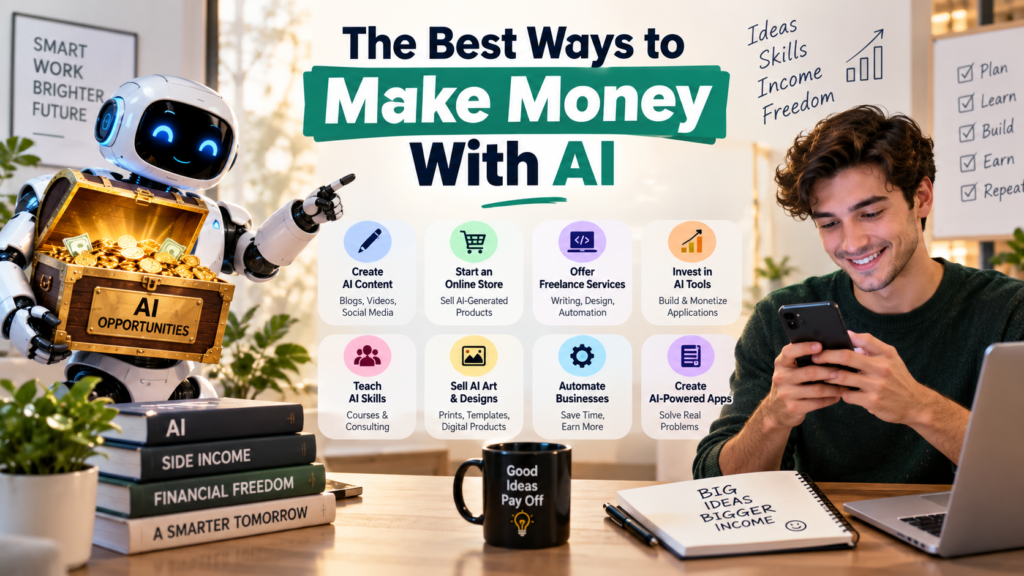
The Best Ways to Make Money With AI
There is no single AI money-making method. The strongest opportunities generally fall into several groups:
| Method | Skill Level | How You Earn | Best For |
|---|---|---|---|
| AI-assisted freelancing | Beginner–Intermediate | Client fees | Writers, designers, marketers |
| AI automation services | Intermediate | Project or monthly fees | Business-minded users |
| AI development | Advanced | Projects, products, retainers | Developers |
| AI digital products | Beginner–Intermediate | Product sales | Creators and educators |
| AI content businesses | Beginner–Intermediate | Ads, affiliates, products | Publishers and creators |
| AI consulting and training | Intermediate–Advanced | Consulting fees | Industry specialists |
| AI-enhanced ecommerce | Intermediate | Product margins | Online sellers |
| AI research services | Intermediate | Client/project fees | Researchers and analysts |
| AI-powered agencies | Intermediate | Recurring client revenue | Entrepreneurs |
| AI SaaS products | Advanced | Subscriptions or usage | Developers and founders |
The best choice depends less on the AI tool you use and more on what you already know, who you can help, and whether customers have a reason to pay.
1. Offer AI-Assisted Freelance Services
For many beginners, freelancing is one of the easiest places to start because you don’t need to build an AI company from scratch.
Instead, use AI to deliver an existing service more efficiently.
For example, a freelance writer might use an AI assistant to brainstorm article structures and identify research gaps, then perform the fact-checking, editing, positioning, and final writing themselves. A designer might use generative AI for initial concepts while handling composition, branding, revisions, and client requirements personally.
Potential services include:
- Blog and website content
- Copywriting and editing
- Social media content
- Video scripting
- Presentation creation
- Image editing
- Research assistance
- Data analysis
- SEO content optimization
- Email marketing
- Customer-support documentation
- Translation and localization
- AI-assisted coding
- Chatbot development
The client is paying for the finished result, not for the number of prompts you entered.
A Better Freelancing Strategy
Don’t advertise yourself as:
“I use AI to write articles.”
That sounds like a commodity.
Instead, sell a specific outcome:
“I create SEO-ready product content for ecommerce stores using AI-assisted research, writing, and human editing.”
The second offer tells a potential customer what problem you solve.
2. Build AI Automation Services for Businesses
One of the more interesting opportunities is helping businesses automate repetitive work.
An automation can connect several systems so that information moves between them without someone manually performing every step.
For example:
Customer inquiry → Form submission → AI classification → CRM entry → Personalized email → Human review
The AI might classify the inquiry, summarize it, extract important details, or draft a response. Traditional automation software can then move that information between applications.
This is different from simply installing a chatbot. Good automation begins with understanding the company’s workflow.
Examples of AI Automation Services
You could help a business:
- Categorize incoming customer messages
- Summarize sales calls
- Extract information from documents
- Draft responses to common inquiries
- Turn meeting transcripts into action items
- Organize research
- Generate internal reports
- Route leads to the appropriate employee
- Create first drafts of marketing material
- Search internal knowledge bases
A well-designed workflow often keeps a human checkpoint for important decisions.
That matters because AI can make mistakes, misunderstand context, or produce information that sounds convincing but is incorrect.
3. Develop AI-Powered Applications
If you can program, the opportunity becomes much broader.
Modern AI APIs allow developers to incorporate language, vision, audio, reasoning, and other capabilities into software rather than training a foundation model themselves.
That means a developer can build a product around a specific problem.
Examples include:
- Document-processing software
- Customer-support assistants
- Research tools
- Internal company knowledge systems
- Meeting-analysis applications
- AI writing workflows
- Developer tools
- Educational applications
- Image or audio processing services
Where RAG Fits In
Suppose a company wants an assistant that answers questions about its internal documents.
Simply asking a general-purpose LLM to answer may produce unreliable results because the model may not know the company’s private information.
A Retrieval-Augmented Generation (RAG) system approaches the problem differently:
- Company documents are stored and indexed.
- A user asks a question.
- The system retrieves relevant information.
- That information is supplied to the model.
- The model generates an answer based on the retrieved material.
This can be a useful commercial service because companies often care less about having the “smartest AI” and more about having an AI system that works with their data and workflow.
4. Create and Sell Digital Products With AI
AI can reduce the time required to create certain digital products.
Possible products include:
- Templates
- Study materials
- Business documents
- Presentation templates
- Spreadsheet systems
- Design assets
- Educational resources
- Research frameworks
- Workflow guides
- Prompt libraries
- Industry-specific checklists
But generating hundreds of generic files with AI does not automatically create a valuable business.
The product needs a reason to exist.
For example, a generic collection of AI prompts is easy to reproduce. A carefully designed workflow kit for a particular profession can be much more useful because it addresses a specific problem.
A Simple Product Development Process
Find a problem → Validate demand → Create a useful solution → Test it with users → Improve it → Sell it
AI can speed up research, drafting, formatting, and iteration, but the human still needs to determine whether the product is actually useful.
5. Build an AI-Powered Content Business
AI can help publishers and creators produce content more efficiently, but simply publishing large quantities of machine-generated articles is a weak strategy.
A stronger model combines AI with human research and editorial judgment.
For example, a niche publisher could use AI to:
- Generate research questions
- Organize notes
- Create content outlines
- Analyze large amounts of text
- Produce first drafts
- Repurpose articles into social posts
- Create video scripts
- Summarize source material
The human contribution remains important for:
- Fact-checking
- Original analysis
- Interviews
- First-hand experience
- Editorial decisions
- Accuracy
- Brand voice
- Updating outdated information
The goal should be to use AI to improve the publishing process, not simply to increase the number of pages you produce.
6. Provide AI Research and Data Services
Another practical opportunity is helping businesses turn unstructured information into something useful.
Imagine a company has hundreds of customer reviews. Reading every review manually could take significant time.
An AI-assisted workflow could:
- Collect the reviews.
- Classify them by topic.
- Identify recurring complaints.
- Detect common feature requests.
- Analyze patterns.
- Produce a report for management.
The AI handles much of the repetitive processing, while the analyst interprets what the findings actually mean.
Similar services can be offered for:
- Competitor research
- Market research
- Customer feedback
- Survey analysis
- Document classification
- Literature reviews
- Sales-call analysis
- Product feedback
- Internal knowledge management
This is especially useful for people who already understand research, spreadsheets, statistics, or a particular industry.
7. Help Companies Adopt AI
Not every company needs someone to build a new AI model.
Many need someone who can answer much simpler questions:
- Which tasks should we automate?
- Which AI tools fit our workflow?
- What information should employees avoid putting into external AI systems?
- Where should humans review AI output?
- How should we measure whether AI actually saves time?
- How can employees use AI consistently?
This creates an opportunity for AI training and implementation services.
Someone with strong knowledge of marketing, accounting, education, customer support, or another profession can combine that domain knowledge with AI expertise.
The advantage is that domain knowledge gives you something generic AI tutorials cannot easily provide: an understanding of how work is actually performed.
8. Use AI to Improve an Existing Business
You do not necessarily need a separate “AI business.”
Sometimes the most profitable use of AI is improving a business you already operate.
For example, an ecommerce business could use AI to assist with:
- Product descriptions
- Customer-service drafts
- Product categorization
- Review analysis
- Marketing ideas
- Image variations
- Email campaigns
- Inventory analysis
A marketing agency could use AI for research, campaign ideation, reporting, and content repurposing.
A consultant could use AI to organize research and prepare customized client materials.
The financial benefit comes from the difference between revenue generated and costs saved, not from AI being impressive by itself.
9. Build AI Agents for Specific Workflows
AI agents are another emerging commercial area.
An agent generally goes beyond generating a single response. Depending on the system, it can use tools, retrieve information, perform actions, and work through multiple steps toward a goal.
For example, a sales-support agent might:
- Receive a lead.
- Look up information in a CRM.
- Classify the lead.
- Research relevant company information.
- Draft a response.
- Ask a salesperson for approval.
- Record the result.
The exact capabilities vary considerably between platforms, so “AI agent” should not be treated as a magic term for a fully autonomous employee.
In practice, reliable agents require careful instructions, tool permissions, error handling, monitoring, and human oversight.
10. Build a Specialized AI SaaS Product
The most scalable approach is potentially an AI-powered software product sold repeatedly through subscriptions or usage-based pricing.
But it is also one of the hardest.
A common mistake is:
“I’ll build a chatbot and charge people monthly.”
The difficult part isn’t necessarily connecting an API. The difficult part is finding a problem customers care enough about to pay for repeatedly.
A stronger SaaS idea usually has:
- A clearly defined customer
- A recurring problem
- A measurable benefit
- A workflow people already perform
- A reason to use your product instead of a general AI assistant
- Reasonable AI operating costs
- A distribution strategy
Watch Your AI Costs
AI applications have operating expenses. Depending on the provider and model, developers may pay based on tokens or other usage measures.
This means a product can become unprofitable if customers consume significantly more model capacity than expected.
A simple business calculation is:
Revenue per customer − AI costs − infrastructure − payment fees − support − other expenses = Contribution margin
Don’t skip this calculation when building an AI product.
How to Choose the Right AI Money-Making Method
The best opportunity depends on your existing skills.
If You’re a Beginner
Start with an existing skill and use AI to make it more valuable.
Good starting points include:
- Writing
- Social media
- Basic design
- Research
- Virtual assistance
- Customer support
- Presentation creation
You don’t need to become an AI engineer before earning your first income.
If You’re a Freelancer
Look for repetitive parts of your existing service that AI can accelerate.
For example:
Before: 5 hours of research + writing + editing
After: 1 hour of AI-assisted research + 2 hours of writing/editing + human fact-checking
If quality remains high, your effective productivity has improved.
If You’re a Developer
Consider:
- AI integrations
- RAG systems
- AI agents
- AI SaaS
- Internal business tools
- API-based applications
- Data-processing pipelines
Technical skills become particularly valuable when AI must connect to existing databases, APIs, authentication systems, or business software.
If You’re an Industry Specialist
This may be your biggest advantage.
Someone who understands real estate, accounting, logistics, education, marketing, or another specialized field can identify problems that a general AI enthusiast may never notice.
The strongest positioning is often:
AI + domain expertise
rather than simply:
AI enthusiast
What You Should Not Do
The AI economy also attracts plenty of low-quality schemes.
Be cautious about promises such as:
- “Make thousands of dollars overnight with one prompt”
- “Fully automated passive income”
- “Copy this exact AI business and get rich”
- “Publish thousands of AI articles and earn automatically”
- “Build an AI agent that replaces an entire company”
- “No skills required”
AI can reduce the time required for certain tasks, but it does not remove the need for product-market fit, customers, distribution, quality control, or business judgment.
The more sustainable opportunity is usually to use AI to make a valuable service faster, better, or more scalable.
The Biggest Risks When Making Money With AI
1. Hallucinations
AI models can produce confident but incorrect information.
This is particularly important for:
- Legal work
- Medical information
- Financial analysis
- Technical documentation
- Research
- News
- Compliance
Important outputs should be verified against reliable sources.
2. Privacy
Don’t casually upload confidential customer information, trade secrets, personal data, or proprietary documents into an AI service.
Before using AI with business data, understand the provider’s data-handling policies and the permissions of the tools you’re using.
3. Copyright and Ownership
AI-generated material can raise questions around copyright, licensing, training data, trademarks, and ownership depending on the jurisdiction and how the material is produced.
If you sell creative work, understand the rules relevant to your market rather than assuming “AI-generated” automatically means “free to use.”
4. Quality Degradation
AI makes it easy to produce more work.
That doesn’t mean the work becomes better.
If you use AI to increase output without increasing quality control, you can simply produce bad work faster.
5. Tool Dependency
AI products change quickly. A workflow built around one model or platform may become more expensive, less capable, or unavailable.
Whenever possible, design important workflows so that they can be adapted when tools change.
A Practical 30-Day Plan to Start Making Money With AI
If you’re starting from zero, don’t try ten strategies simultaneously.
Week 1: Pick One Marketable Skill
Choose something people already pay for.
Examples:
- Content writing
- Video editing
- Graphic design
- Research
- Data analysis
- Automation
- Customer support
- Coding
Then learn how AI can improve that particular workflow.
Week 2: Build Three Examples
Create three portfolio pieces demonstrating a specific result.
For example:
- An AI-assisted content workflow
- A customer-support automation
- A market-research report
If the examples are hypothetical, clearly label them as samples rather than pretending they are client projects.
Week 3: Create a Specific Offer
Avoid:
“I provide AI services.”
Try:
“I help small ecommerce stores turn product information into search-friendly product pages and customer-support content.”
Specific offers are easier for customers to understand.
Week 4: Start Selling
Approach potential customers through appropriate channels:
- Freelance marketplaces
- Your existing network
- Professional communities
- Direct outreach
- Your own website
- Industry groups
Don’t lead with the technology.
Lead with the problem you solve.
How Much Does It Cost to Start?
You can begin relatively cheaply if you’re offering services rather than developing a large software product.
Your initial costs might include:
- An AI subscription
- Software for your workflow
- Website and domain expenses
- Automation tools
- Design or editing software
- API usage
- Payment processing
For developers, API costs are typically usage-dependent.
The more important question is not:
“Can I start for free?”
It’s:
“Can the value I create exceed the cost of producing it?”
That is the basic economics behind every sustainable AI business.
AI vs. Traditional Freelancing: What Has Changed?
AI hasn’t made every traditional skill worthless.
Instead, the economics of some services are changing.
A freelancer who manually performs every repetitive step may struggle to compete with someone who combines expertise with automation.
But a freelancer who understands the client’s business, produces better work, communicates clearly, and uses AI intelligently can become significantly more productive.
The competitive advantage is therefore shifting toward people who can combine:
Domain knowledge + AI tools + judgment + communication
That combination is harder to commoditize than access to an AI chatbot.
Common Mistakes Beginners Make
Using Too Many Tools
You don’t need 25 AI applications.
Learn one or two tools deeply enough to solve a real problem.
Selling the Technology Instead of the Outcome
Customers rarely care that you used an LLM, RAG pipeline, or AI agent.
They care about:
- More leads
- Faster research
- Lower operating costs
- Better customer service
- More content
- Faster development
- Better decisions
Skipping Quality Control
Never assume that an AI-generated result is automatically correct.
Trying to Automate Everything
Some tasks need judgment, empathy, creativity, or accountability.
Automation should remove unnecessary work, not remove necessary human oversight.
Competing Only on Price
If your entire advantage is “I can generate this cheaply with AI,” someone else can probably do the same.
Build differentiation through expertise, specialization, quality, speed, or customer experience.
FAQs About How to Make Money With AI
Can beginners make money with AI?
Yes. Beginners can use AI to improve services such as writing, research, design, customer support, or administrative work. However, learning a useful skill and understanding a customer’s problem is more valuable than simply knowing how to write prompts.
What is the easiest way to make money with AI?
For many beginners, AI-assisted freelancing is one of the simplest starting points because you can sell an existing service instead of building software. The easiest option for you will depend on your existing skills.
Can I make money with ChatGPT?
Yes, but ChatGPT itself is not a business model. You can use an AI assistant to research, draft, analyze, brainstorm, code, or automate parts of a service and then sell the resulting value to customers.
Is AI automation profitable?
It can be. Businesses may pay for automation when it saves meaningful time, reduces repetitive work, improves response speed, or increases revenue. Profitability depends on the value delivered, implementation costs, maintenance, and ongoing software or API expenses.
Can I make money with AI without coding?
Yes. You can use AI for content services, research, design, marketing, digital products, consulting, and other non-development work. Coding becomes more important when you want to build custom AI applications, integrations, or SaaS products.
Can AI create passive income?
AI can help automate parts of a business, but “passive income” is often overstated. Digital products, software, content, and automated services can generate revenue with less ongoing labor, but they still require creation, marketing, maintenance, customer support, and quality control.
What AI skill should I learn first?
Start with a skill connected to a real business outcome. For a nontechnical person, this could be AI-assisted research, content production, data analysis, or workflow automation. Developers can explore APIs, RAG, agentic workflows, and AI application development.
Conclusion
Learning how to make money with AI is less about discovering a secret prompt and more about understanding where AI can create measurable value.
For beginners, the most practical route is usually to take a skill you already have and use AI to make the work faster, better, or easier to scale. Freelancers can offer AI-assisted services, businesses can build automation workflows, developers can create AI applications, and creators can develop specialized digital products or content businesses.
The biggest opportunity is not simply access to powerful models. It is the ability to combine those models with human judgment, industry knowledge, creativity, and reliable execution.
AI will continue changing quickly, so today’s specific tools may not be the same tools you use next year. The durable skill is learning how to identify a valuable problem, choose appropriate technology, verify the output, and turn the result into something customers are willing to pay for.
[…] DeepSeek V3: Features, Architecture, Uses, and Limitations How to Make Money With AI: 10 Practical Ways in 2026 Grok Spicy Mode: What It Is and What to Know in 2026 Perchance AI Character Generator: […]