

NovelAI: Features, Pricing, and How It Works

NovelAI is an artificial intelligence platform designed for creative writing, interactive storytelling, and AI-generated artwork. Unlike general-purpose AI assistants that focus on answering questions, explaining concepts, or completing everyday tasks, NovelAI places greater emphasis on helping users develop fictional worlds, create characters, write stories, and explore visual ideas. Its tools are particularly relevant to fantasy writers, anime enthusiasts, role-playing fans, and independent creators who want more control over their creative projects.
The platform combines AI-assisted text generation with image generation, allowing users to work with both written stories and visual concepts. Depending on the selected tools and available settings, users can develop story ideas, continue unfinished passages, experiment with different writing styles, and generate anime-inspired illustrations. However, NovelAI is not a replacement for human creativity, and its output can require careful editing. This guide explains how NovelAI works, its main features, practical applications, pricing considerations, privacy questions, limitations, and the alternatives worth considering before choosing the platform.
What Is NovelAI?
NovelAI is an AI-powered creative platform developed around two main activities: writing fiction and generating images. It uses generative AI models to produce new content based on user instructions, existing text, and other available inputs.
Its writing tools are designed for people who want to create stories rather than simply obtain factual answers. A user can begin with a short paragraph about a fictional character, establish a setting, and ask the system to continue the narrative. The generated text can introduce dialogue, describe locations, develop conflicts, or suggest possible directions for the plot.
NovelAI also offers AI image generation, with a particular association with anime-inspired artwork. Users can describe characters, clothing, poses, environments, and artistic styles to produce illustrations.
The platform is useful for several creative activities:
- Fiction writing: Developing novels, short stories, and serialized fiction.
- Interactive storytelling: Exploring different narrative choices and outcomes.
- Worldbuilding: Creating fictional locations, cultures, characters, and histories.
- Character development: Experimenting with personalities, motivations, dialogue, and relationships.
- AI image generation: Producing illustrations inspired by written descriptions.
- Creative experimentation: Testing alternative scenes, writing styles, and visual concepts.
The important distinction is that NovelAI is primarily a creative tool. Although its underlying AI can generate convincing language, that does not automatically make its responses factually reliable or suitable for professional research.
How Does NovelAI Work?
NovelAI uses generative AI models to predict and produce content from the information provided to them. The exact process depends on whether someone is using the writing interface or the image-generation tools.
1. AI-Powered Story Generation
When a user enters text into NovelAI’s writing interface, the selected language model uses that context to generate a continuation.
For example, imagine a writer enters the following opening:
“A young explorer discovered a hidden library beneath the ruins of an abandoned kingdom. Every book contained memories that had disappeared from the world.”
The AI might continue the passage by introducing a mysterious librarian, describing an unusual book, or developing a conflict surrounding the lost memories.
The result depends on the supplied context, model behavior, and available configuration options. A detailed starting passage generally gives the system more information about the intended story than a vague instruction such as “write a fantasy story.”
2. Context and Story Information
AI writing models use context to determine what content should come next. In practical terms, context includes the text and other supported information available to the model during generation.
This matters when writing long stories.
Suppose a fantasy novel contains five kingdoms, several characters, and a complicated political conflict. If the relevant information is absent from the model’s available context, the AI may confuse character relationships, forget earlier events, or introduce contradictions.
NovelAI’s writing environment provides tools for managing story information and influencing generation. Depending on the interface and model, these can include memory-related information, author guidance, and other contextual controls.
Writers should still maintain their own character sheets, timelines, and worldbuilding notes. These provide a consistent reference when a story becomes too large for the model to handle reliably in one context.
3. AI Image Generation
The image-generation side follows a different process.
Users describe the desired image through prompts that may specify a character’s appearance, clothing, pose, background, lighting, composition, and artistic style. The image model then generates artwork based on those instructions.
For example, a prompt might describe an anime-style fantasy illustration featuring a silver-haired mage standing in an ancient library, surrounded by floating magical books.
More precise descriptions can help communicate the intended composition. However, adding too many unrelated details can make the prompt harder to control.
The model may also interpret certain attributes incorrectly, so generating several variations and refining the prompt can be more effective than expecting a perfect result from the first attempt.
What Are the Main Features of NovelAI?
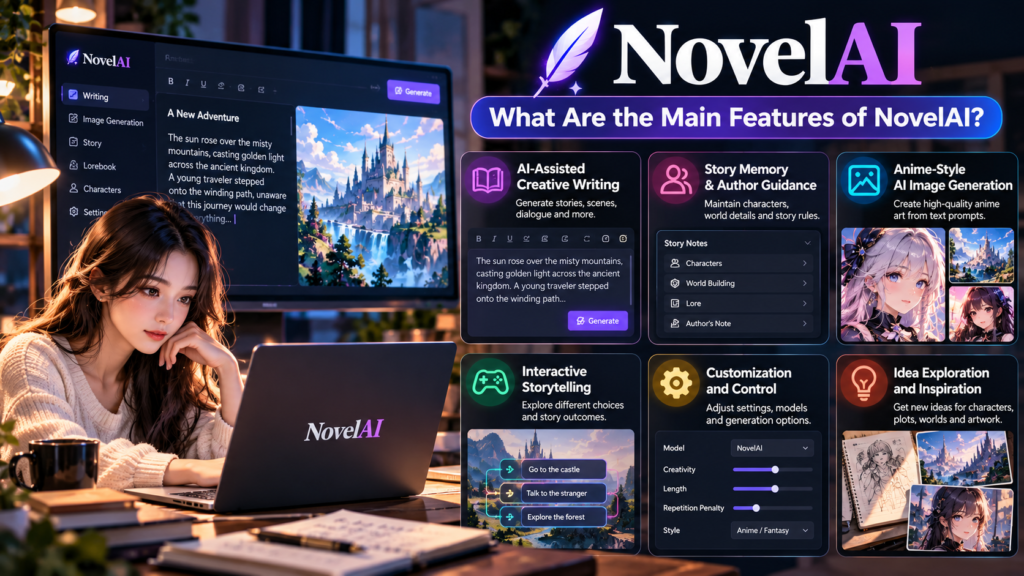
NovelAI combines several creative capabilities in one platform. The specific options available can depend on the selected subscription, model, and current product configuration.
1. AI-Assisted Creative Writing
NovelAI can help writers develop ideas and produce draft material without requiring them to compose every sentence manually.
Typical applications include:
- Continuing an unfinished story.
- Exploring alternative plot directions.
- Drafting dialogue between fictional characters.
- Describing locations and fictional environments.
- Rewriting passages to experiment with tone.
- Developing scenes from a short outline.
For example, a writer struggling with a chapter ending could generate several possible continuations and choose the one that best supports the intended plot.
The generated passages should be treated as drafts rather than finished literature. Human editing remains important for pacing, characterization, originality, and consistency.
2. Story Memory and Author Guidance
Long-form fiction requires more than fluent sentences. Characters need consistent personalities, fictional rules must remain stable, and earlier events should influence later developments.
NovelAI provides contextual controls intended to help writers guide generation and maintain relevant story information.
These tools can be particularly helpful when working on fantasy worlds with complicated histories or novels featuring large casts.
For example, a writer could establish that a fictional character is cautious, avoids violence, and distrusts royal authorities. Keeping those details available to the model may help it generate dialogue and actions that better fit the character.
However, contextual instructions are not a guarantee. The model can still produce behavior that conflicts with established information, especially in lengthy or complicated narratives.
3. Anime-Style AI Image Generation
NovelAI is also known for generating anime-inspired illustrations.
Users can experiment with different character designs, visual styles, environments, and compositions. Depending on the available model and controls, they may be able to influence aspects such as pose, appearance, lighting, and image proportions.
Common use cases include:
- Designing original anime characters.
- Exploring fantasy character concepts.
- Creating visual references for stories.
- Producing illustrations for personal creative projects.
- Experimenting with different backgrounds and art styles.
For authors, this creates a useful connection between writing and visual development. A character description can become the starting point for an illustration, which can then help the author refine the character’s appearance.
Nevertheless, generating a consistent character across multiple images can require experimentation. A similar prompt does not guarantee identical facial features, clothing details, or proportions in every result.
4. Interactive Storytelling
NovelAI can support interactive storytelling, in which users influence the direction of a fictional narrative.
Rather than following a fixed story, a user can introduce new decisions, ask the AI to explore a different outcome, or direct a character toward a particular event.
For example, a user might explore what happens when a detective confronts a suspect too early, allowing the AI to develop a different sequence of fictional events.
This approach can be useful for role-playing, creative experimentation, and discovering unexpected plot possibilities.
However, the experience is not the same as playing a professionally designed video game. The AI does not necessarily maintain a perfectly consistent world state, and story events may contradict earlier decisions.
5. Customization and Creative Control
Different writing projects require different approaches. A mystery novel may need restrained descriptions and carefully controlled information, while an epic fantasy story may benefit from elaborate worldbuilding.
NovelAI provides settings and contextual guidance that can influence how its models generate content. Users can experiment with prompts, available model choices, and other supported generation controls.
The practical benefit is flexibility. Writers can adjust the system to suit their creative goals rather than relying entirely on a fixed conversational format.
However, customization can involve trial and error. Users who expect every setting to have an obvious effect may need time to understand how different controls influence the results.
What Can You Use NovelAI For?
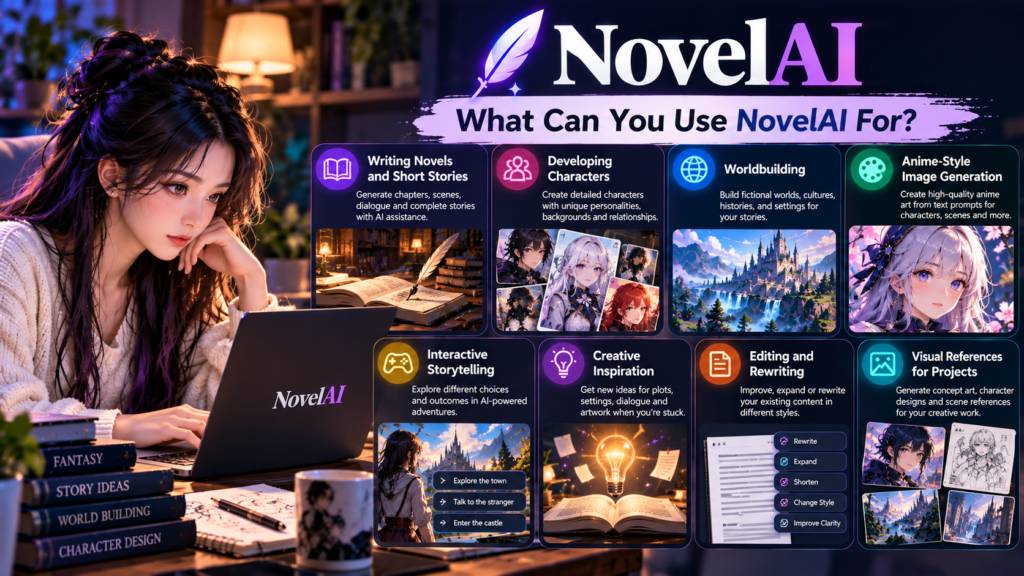
NovelAI is most useful when the task involves creating, exploring, or refining fictional content.
Writing Novels and Short Stories
Authors can use NovelAI to develop scenes, test dialogue, and overcome writer’s block.
Consider a writer creating a mystery novel. They already know the detective’s identity and the main crime, but they are unsure how to introduce the next clue.
The writer could ask the AI to explore several possibilities, such as a misleading witness statement, an unexpected document, or a contradiction in the suspect’s timeline.
The writer can then select, modify, or reject those ideas.
This approach makes the AI a creative collaborator rather than the final authority on the story.
Developing Fantasy Worlds
Worldbuilding often involves creating interconnected details about geography, politics, religion, history, and fictional technology.
NovelAI can help brainstorm these elements and turn rough notes into more developed descriptions.
For example, a writer could begin with the idea of a kingdom where magic is controlled by a small group of families. The AI might help explore possible political conflicts, social inequalities, and character motivations arising from that arrangement.
The writer should still establish the world’s rules and check that later passages follow them.
Creating Anime Characters
Artists and writers can use NovelAI’s image-generation tools to explore character concepts before producing finished illustrations.
A creator developing a fantasy protagonist might experiment with different hairstyles, clothing designs, color schemes, and environments.
These variations can help establish a visual direction for a comic, fictional universe, or personal project.
For projects requiring consistent character designs, the creator should keep reference images and written descriptions rather than relying exclusively on new generations.
Supporting Role-Playing
NovelAI can help users explore fictional scenarios and character interactions.
A user might create a medieval fantasy setting, define a character’s motivations, and guide the narrative through a series of decisions.
This can provide a flexible storytelling experience, although the AI may occasionally lose track of important details or introduce events that do not fit the established scenario.
Generating Creative Inspiration
NovelAI can also be useful when the main obstacle is not writing ability but a lack of ideas.
Users can explore alternative openings, imagine unusual settings, or test different character motivations.
The best results often come from treating generated material as a collection of possibilities. Instead of accepting the first response, users can identify the strongest ideas and develop them in their own style.
What Are the Advantages of NovelAI?
NovelAI has several potential advantages for people who regularly work on fictional stories or anime-inspired artwork.
A creative focus: Its writing tools are oriented toward fiction and storytelling rather than general question answering.
Flexible experimentation: Users can explore different scenes, character interactions, and plot directions without rewriting every draft manually.
Visual and written creativity: Combining AI writing and image generation can help creators connect narrative ideas with visual concepts.
Support for writer’s block: The platform can suggest possible continuations when a writer is struggling to develop a scene.
Customization: Available contextual controls and generation settings allow users to experiment with different creative approaches.
Rapid concept development: Writers can move from a rough idea to a more detailed scene or character concept relatively quickly.
These advantages are most meaningful when users already have a creative goal. The platform can accelerate brainstorming and drafting, but it cannot automatically determine which ideas are artistically effective.
What Are the Limitations and Risks of NovelAI?
Despite its creative capabilities, NovelAI has limitations that users should understand before relying on it for important projects.
1. Inconsistent Story Continuity
AI models can lose track of details in long narratives. A character’s personality may change unexpectedly, a previously established location may be described differently, or an earlier event may be contradicted.
Writers can reduce these problems by maintaining organized notes, providing relevant context, and reviewing generated passages carefully.
2. Repetitive or Predictable Writing
Generated fiction can sometimes rely on familiar expressions, repetitive descriptions, or predictable plot developments.
This may be particularly noticeable when generating several passages in succession without revising the output.
Writers should edit for voice, originality, pacing, and meaningful character development rather than assuming that fluent prose is automatically good prose.
3. Imperfect Image Results
AI-generated artwork may contain incorrect details, inconsistent accessories, or compositions that do not match the prompt.
The results can also vary between generations, making it difficult to reproduce a character precisely.
Users should expect to refine prompts, generate alternatives, and perform additional editing when visual consistency matters.
4. Factual Errors
NovelAI’s primary creative focus does not make it a dependable source for factual research.
If a writer is creating a historical novel, the AI might generate plausible-sounding but incorrect information about a historical figure, location, or event.
Important facts should be checked against reliable sources, especially when the content concerns real people, historical events, medicine, law, or other subjects where accuracy matters.
5. Privacy and Data Handling
Before uploading unpublished manuscripts, personal information, or commercially sensitive material, users should review the platform’s current privacy policy and terms.
Pay attention to how submitted content is processed, how long information may be retained, what data is collected, and which controls are available.
Do not assume that a creative platform’s privacy practices are identical to those of another AI service.
6. Copyright and Commercial Use
AI-generated content can raise questions about copyright, ownership, licensing, and the use of protected material.
The legal treatment of AI-generated writing and images varies by jurisdiction and can depend on the level of human creative contribution and other circumstances.
Users who intend to publish or sell AI-assisted work should review NovelAI’s current terms and consider the laws that apply to their situation. They should also avoid assuming that every generated image is automatically free of third-party intellectual property concerns.
Is NovelAI Free or Paid?
NovelAI has offered subscription-based access, with plan differences affecting the available features and usage allowances. Its pricing and plan details can change, so the current official pricing page is the appropriate place to confirm exact costs and included benefits.
When comparing plans, pay attention to the following factors:
- Text generation: Check the writing models and usage conditions included with each plan.
- Image generation: Review image-generation access and any applicable limits.
- Usage allowances: Understand whether a plan uses subscriptions, credits, or other resource limits for particular activities.
- Available features: Confirm which customization tools and generation options are included.
- Billing terms: Review renewal periods, cancellation conditions, and any applicable taxes.
A casual user who writes occasionally may have different requirements from an author who generates content every day.
For that reason, compare the current plan details with your actual workflow instead of choosing a subscription solely because it offers more features.
You can review the latest information on the official NovelAI website: https://novelai.net/
NovelAI vs. Other AI Writing and Image Tools
NovelAI is not the only platform available for AI-assisted creativity. The best alternative depends on whether someone prioritizes long-form writing, conversational assistance, visual generation, or a broader range of creative tasks.
| Tool | Main Focus | Best Suited For | Important Consideration |
|---|---|---|---|
| NovelAI | Fiction writing and AI artwork | Storytellers and anime enthusiasts | Specialized creative workflow |
| ChatGPT | General-purpose AI assistance and creative writing | Brainstorming, editing, research support, and varied writing tasks | Features depend on the selected model and plan |
| Sudowrite | AI-assisted fiction writing | Novelists developing scenes and manuscripts | Primarily focused on writing |
| Midjourney | AI image generation | Artists and creators exploring visual concepts | Not a dedicated long-form writing platform |
| Google Gemini | General-purpose AI assistance | Writing, analysis, and supported multimodal tasks | Creative capabilities vary by model and available tools |
Which Alternative Should You Choose?
Choose NovelAI if your main interest is fiction writing, interactive storytelling, or anime-inspired AI artwork within a creative environment.
Consider ChatGPT if you need a broader assistant for outlining stories, improving prose, explaining concepts, and working on tasks beyond fiction.
Sudowrite may be worth exploring if your primary goal is developing and revising longer fiction manuscripts.
Midjourney is more appropriate when image creation is the central task and you want a dedicated visual-generation workflow.
Google Gemini may suit users who want general-purpose AI assistance alongside supported creative and multimodal capabilities.
These tools are not interchangeable in every situation. Compare their current features, pricing, privacy terms, and usage limits before deciding which one fits your workflow.
How to Get Better Results From NovelAI
The quality of AI-generated content often depends on how clearly the user communicates the desired outcome.
Start With a Specific Goal
Instead of entering a broad request such as “write a fantasy story,” define the situation, characters, and intended tone.
For example:
“Write a fantasy scene in which a young apprentice discovers that her mentor has hidden a dangerous magical artifact. Use restrained dialogue, a mysterious atmosphere, and a gradual increase in tension.”
This prompt gives the model a clearer creative direction.
Provide Important Context
If your story contains established characters or fictional rules, make the relevant details available to the model.
For example, specify that the protagonist cannot use magic without experiencing physical consequences. This gives the AI an important constraint when developing future scenes.
Generate in Manageable Sections
Writing a complete novel in one uninterrupted generation is difficult to control.
A more practical approach is to work chapter by chapter or scene by scene. Review each section, correct inconsistencies, and update your notes before continuing.
Refine Rather Than Restart
If a generated passage is almost right, identify the specific problem.
You might need more natural dialogue, less description, a slower pace, or a stronger emotional response from a character.
Focused revisions can be more useful than repeatedly generating entirely new passages.
Keep Human Editorial Control
The writer should make the final decisions about plot, characterization, style, and meaning.
AI can suggest alternatives, but the author understands the intended themes and emotional direction of the work. That judgment is essential when turning generated drafts into a coherent story.
Frequently Asked Questions About NovelAI
1. What is NovelAI used for?
NovelAI is used for AI-assisted fiction writing, interactive storytelling, worldbuilding, character development, and generating AI artwork, particularly anime-inspired illustrations.
2. Is NovelAI free to use?
NovelAI has offered subscription plans and may provide limited introductory access or other trial options. Check its official website for current availability and pricing.
3. Can NovelAI generate images?
Yes. NovelAI includes AI image-generation capabilities that can create illustrations from text prompts, including anime-inspired characters and fantasy scenes.
4. Is NovelAI good for writing novels?
It can help with brainstorming, drafting scenes, developing characters, and exploring plot ideas. However, writers should review the output for continuity, originality, pacing, and consistency.
5. Can NovelAI remember characters across a long story?
It can use available story context and contextual controls to help maintain character information. However, it may still forget details or generate contradictions, so maintaining separate story notes is advisable.
6. Is NovelAI suitable for beginners?
Yes. Beginners can start with simple writing prompts or image descriptions and gradually experiment with more advanced controls as they become familiar with the platform.
7. Is NovelAI better than ChatGPT?
Neither is universally better. NovelAI is focused on creative storytelling and AI artwork, while ChatGPT supports a broader range of writing, research assistance, analysis, and everyday tasks. The better choice depends on your needs.
Conclusion
NovelAI is a specialized AI platform for people who want to explore creative writing, interactive storytelling, and AI-generated artwork. Its strongest appeal lies in helping users develop fictional worlds, experiment with characters, overcome writer’s block, and turn written descriptions into visual concepts.
However, the platform works best as a creative assistant rather than an independent author. Generated stories may contain inconsistencies, and images may require repeated attempts to achieve the desired result. Users should also review current subscription details, privacy policies, and licensing terms before committing to a particular workflow.
If you regularly write fiction or enjoy creating anime-inspired characters, NovelAI may be worth exploring. Start with a small project, test the available features, and evaluate how well the results support your creative process. The real value comes from combining the platform’s generation capabilities with your own judgment, imagination, and editing skills.
[…] Fiction Lab Review: Is FictionLab Worth Using? NovelAI: Features, Pricing, and How It Works Replika AI: Features, Privacy, Benefits and Risks NSFW Character AI Alternatives: Best […]