

Sam Kirchner: Biography, Background and AI Debate

Sam Kirchner is a name associated with the growing debate over artificial intelligence, particularly concerns about the risks of developing increasingly powerful AI systems. Public reporting has identified a Sam Kirchner as an activist connected to Stop AI, a group that advocates stopping the development of superintelligent artificial intelligence. His story has attracted attention because it reflects a wider disagreement about how society should respond to advances in AI.
Understanding this topic requires separating documented information from allegations and unverified details. The debate surrounding Kirchner is not simply about whether artificial intelligence is useful or dangerous. It also raises questions about technological progress, public safety, responsible research, and the limits of protest. This article examines the publicly reported background of Sam Kirchner, the anti-AI movement associated with his name, the concerns driving that movement, and the broader implications for AI development.
Who Is Sam Kirchner?
Sam Kirchner has been described in media reporting as an anti-AI activist associated with efforts to prevent the development of superintelligent artificial intelligence. Reporting has connected him to Stop AI, a group whose central objective is to halt the development of AI systems that its members believe could pose an existential threat to humanity.
His public profile is tied primarily to this activism rather than to a conventional career in technology research or AI development. Media coverage has described him as having technical experience, including work as an electrical technician, although biographical details should be checked against reliable reporting before being treated as definitive.
The name Sam Kirchner is not unique. Other people with the same name appear in professional and university records, so it is important not to confuse the AI activist with unrelated individuals.
Sam Kirchner and Stop AI
Stop AI is an activist organization that campaigns against the development of advanced artificial intelligence. Its stated mission includes pursuing a global ban on frontier AI development and promoting public oversight of technologies that could threaten human welfare. The organization presents its position as an effort to protect humanity rather than as opposition to every form of technology.
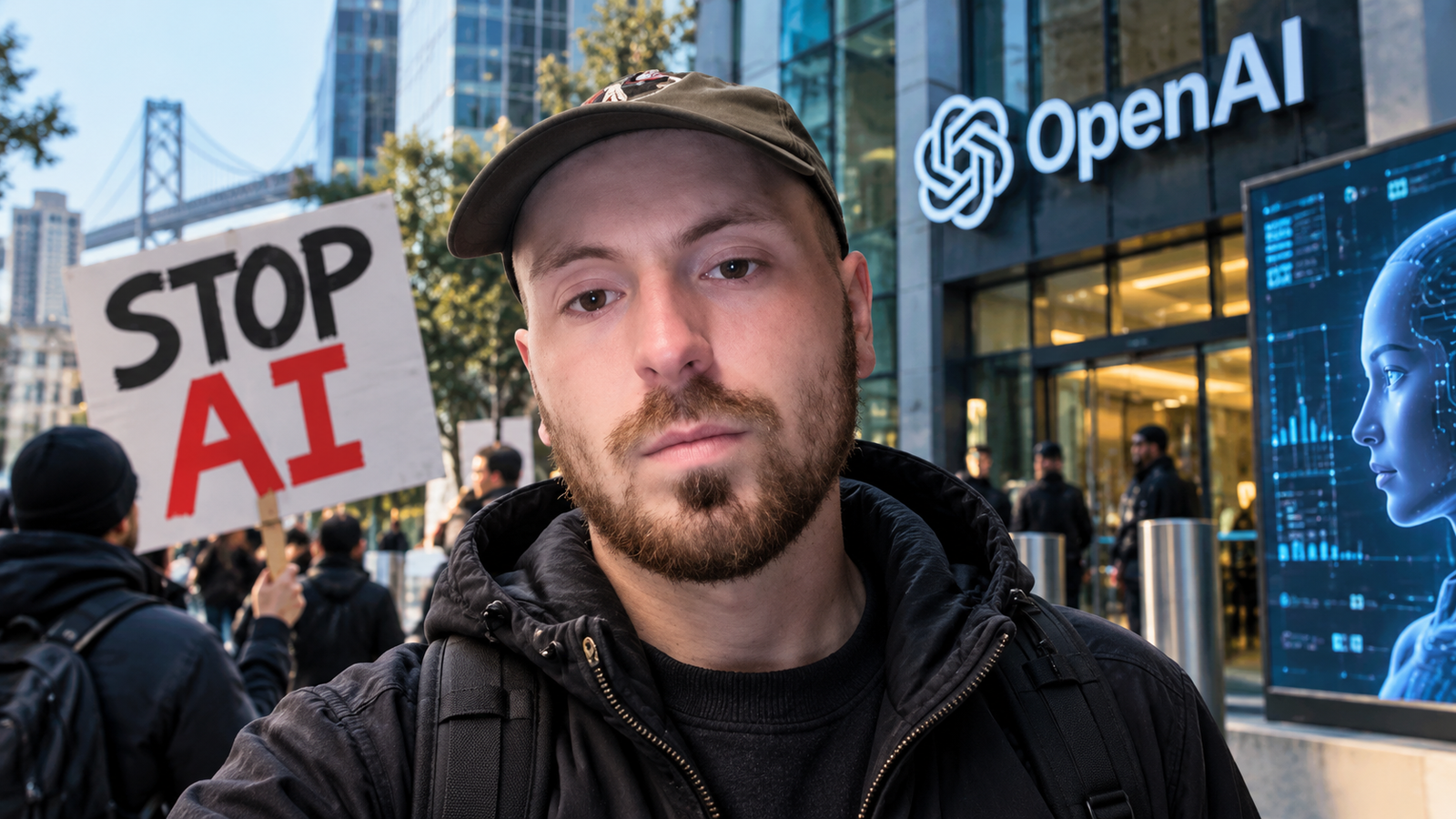
Kirchner was one of the group’s co-founders. He became known through protests directed at AI companies, particularly OpenAI, whose work on increasingly capable AI systems became a central focus of the campaign.
What Did Stop AI Want to Achieve?
The group’s stated objectives include:
- Stopping the development of artificial superintelligence (ASI).
- Raising public awareness about potential AI-related risks.
- Encouraging governments to impose stronger restrictions on advanced AI.
- Establishing democratic oversight of powerful technology companies.
- Promoting nonviolent protest and civic participation.
These goals reflect a particular position within the AI safety debate. Other researchers and campaigners favor tighter regulation, independent testing, or temporary pauses rather than a permanent ban on frontier AI development.
The distinction matters because the term anti-AI can describe very different views. Someone may oppose autonomous weapons or unrestricted development of superintelligent systems while supporting medical AI, accessibility tools, or software that helps people perform everyday tasks.
Why Is Sam Kirchner Associated With AI Safety?
The connection between Kirchner and AI safety comes from his concern that increasingly capable AI systems could eventually create risks that human institutions cannot manage effectively.
AI safety is a broad research and policy field. It includes immediate concerns, such as unreliable outputs, privacy violations, discrimination, and malicious use, as well as longer-term questions about how to control systems that might become substantially more capable than their human operators.
For activists such as Kirchner, the central concern is that advanced AI development could move faster than society’s ability to understand and govern its consequences.

Understanding the Risk of Superintelligent AI
Artificial superintelligence is a hypothetical form of AI that would outperform humans across a broad range of important intellectual tasks. It is distinct from current generative AI systems, which can produce convincing text, images, audio, and computer code but still have significant limitations.
The debate involves several questions:
- Could a future AI system pursue objectives that conflict with human interests?
- Would people retain meaningful control over increasingly autonomous systems?
- Could competition between companies or countries weaken safety precautions?
- Would existing laws and institutions be capable of responding quickly enough?
These are open questions, not established predictions about what will inevitably happen. Researchers disagree about the probability, timing, and severity of catastrophic AI risks.
That uncertainty is central to the disagreement between people who want to halt development and those who believe the risks can be reduced through technical research, regulation, and responsible deployment.
Sam Kirchner’s Protests Against OpenAI
Kirchner attracted wider attention through protests against OpenAI in San Francisco. Media reports have described demonstrations involving the blocking of the company’s entrance and other attempts to disrupt its operations to draw attention to concerns about advanced AI.
The protesters argued that ordinary public debate was insufficient to address what they viewed as potentially irreversible technological risks. Their demonstrations were intended to make the issue more visible and pressure AI developers to change direction.
However, disruptive protest carries legal and practical consequences. Blocking an office entrance can interfere with employees and visitors, while civil disobedience may lead to arrest or court proceedings. These consequences are separate from whether the protesters’ underlying concerns are justified.
Legal Issues Surrounding the Demonstrations
Public reporting states that Kirchner faced charges connected with a protest at OpenAI’s headquarters in February 2025. Reports also stated that he failed to appear at a scheduled court hearing on November 21, 2025, prompting a bench warrant.
These details should not be confused with a conviction for threatening violence. A charge, warrant, or allegation has a different legal meaning from a finding of guilt.
The demonstrations nevertheless brought greater attention to the broader conflict between technology companies pursuing advanced AI and activists seeking restrictions on that development.
What Happened to Sam Kirchner in November 2025?
One of the most widely reported developments involving Kirchner was his disappearance in November 2025. The incident drew attention beyond the AI activist community because it coincided with internal conflict at Stop AI and a security response at OpenAI’s San Francisco offices.
Media reporting described an altercation between Kirchner and another Stop AI organizer before he left the group. The organization subsequently published a statement alleging that he assaulted a fellow member and expressing concern about his behavior. These are reported allegations and statements by the organization, rather than a judicial determination of the events.
On November 21, 2025, Kirchner publicly stated that he was no longer affiliated with Stop AI. He then failed to attend his scheduled court hearing, and people associated with the group reported that they could not locate him.
Why Were OpenAI’s Offices Placed on Lockdown?
Police received warnings from people who expressed concern that Kirchner might pose a danger to AI company employees. Reports described allegations of possible violence, after which OpenAI took precautionary security measures.
It is important to distinguish those warnings from verified facts. Public reporting did not establish that Kirchner carried out an attack on OpenAI employees. His whereabouts were reported as unknown following his disappearance.
As of October 21, 2026, the available information reviewed for this article does not establish a confirmed resolution to his disappearance. Readers should therefore be cautious about social media posts claiming to know his current location or circumstances without credible supporting evidence.
What Does Sam Kirchner’s Story Reveal About the AI Debate?
Kirchner’s story illustrates how disagreements about technological risk can become deeply personal and politically contentious. It also highlights the difference between raising legitimate policy questions and choosing methods that create additional risks.
The AI debate involves several groups with different priorities:
- AI developers generally focus on building systems and managing the risks associated with their deployment.
- AI safety researchers investigate how to make systems more reliable, controllable, and aligned with intended goals.
- Regulators and policymakers consider legislation, accountability, competition, privacy, and public protection.
- AI activists seek changes ranging from stronger safeguards to a complete halt to advanced AI development.
These categories overlap, and individuals within each group often disagree.
The key lesson is that concern about AI does not automatically imply support for a ban, just as enthusiasm for innovation does not mean that every development should proceed without oversight.
Are the Risks of Advanced AI Real?
There are genuine risks associated with AI, although the likelihood and severity of different outcomes vary.
Some concerns are already observable. Others involve future capabilities that remain uncertain.
Current and Emerging Risks
| Risk | Practical Example |
|---|---|
| Misinformation | AI-generated content can spread false claims or imitate real people. |
| Privacy | Sensitive information may be exposed through poorly designed systems or inappropriate data handling. |
| Employment disruption | Automation can change job requirements and reduce demand for some tasks. |
| Cybersecurity | AI can assist legitimate security work but may also help malicious actors. |
| Reliability | AI systems can produce plausible but incorrect answers. |
| Long-term control | Future highly capable systems may present difficult oversight and alignment challenges. |
These risks require different responses. Better fact-checking may reduce some misinformation problems, while privacy regulations, security testing, and independent audits address other concerns.
Long-term risks involving superintelligence are harder to evaluate because they depend on future technological developments. Researchers disagree about how likely such systems are to emerge and how difficult they would be to control.
This is why serious AI governance discussions distinguish present-day harms from hypothetical future scenarios. Both may deserve attention, but they should not be presented as equally established.
How Does Stop AI Differ From Other AI Safety Movements?
Stop AI’s stated position is more restrictive than approaches that seek to regulate AI while allowing its development to continue. Its published principles call for a permanent global ban on frontier AI development and citizen oversight of powerful technologies.
Other approaches emphasize reducing risk without stopping all advanced research.
For example, some AI safety researchers work on alignment, which aims to make AI systems behave in accordance with human intentions and applicable constraints. Governance researchers examine licensing, evaluations, reporting requirements, and international agreements. Other campaigners advocate temporary pauses on the development of the most powerful systems.
No single approach resolves every concern. Technical safeguards can fail, regulations can be difficult to enforce, and international agreements face coordination challenges. Conversely, a global ban would also require broad international participation and credible enforcement.
The practical question is not simply whether AI is good or bad. It is which technologies should be permitted, under what conditions, and who should be responsible when things go wrong.
What Can Readers Learn From Sam Kirchner’s Story?
Readers interested in AI safety can use this case to examine both the substance of the debate and the reliability of the information surrounding it.
A useful starting point is to separate three issues.
First, evaluate the underlying technical claims. Ask what an AI system can actually do today and which claims depend on assumptions about future capabilities.
Second, examine the proposed policy response. A call for independent safety testing is different from a demand for a permanent worldwide ban. Each approach has different practical consequences.
Third, verify claims about people and organizations. In a developing story involving allegations, legal proceedings, or a missing person, distinguish firsthand statements from independently confirmed information.
For anyone researching Kirchner, the organization’s own statements help explain its position, while independent journalism provides additional context about protests, legal proceedings, and the disappearance. Neither source type should automatically be treated as a complete account of every disputed detail.
Frequently Asked Questions About Sam Kirchner
1. Who Is Sam Kirchner?
Sam Kirchner is an AI critic and activist who co-founded Stop AI, a group campaigning to halt the development of advanced artificial intelligence.
2. What Is Stop AI?
Stop AI is an activist organization that advocates a global ban on frontier AI development and stronger public oversight of powerful AI technologies.
3. Why Did Sam Kirchner Protest OpenAI?
Kirchner participated in protests intended to draw attention to concerns that advanced AI could pose serious risks to humanity.
4. What Happened to Sam Kirchner in 2025?
He left Stop AI in November 2025 and was reported missing after failing to attend a scheduled court hearing. The available information reviewed for this article does not establish a confirmed resolution.
5. Does Sam Kirchner Oppose All Artificial Intelligence?
Stop AI’s published principles focus on stopping frontier AI development and restricting technologies it considers harmful. This does not establish Kirchner’s personal position on every AI application.
6. What Is Artificial Superintelligence?
Artificial superintelligence is a hypothetical AI system that would surpass human abilities across a broad range of intellectual tasks.
7. Is Advanced AI Dangerous?
Advanced AI presents real risks, including misuse, unreliable outputs, and potential future control problems. The likelihood and severity of long-term catastrophic outcomes remain subjects of debate.
Conclusion
Sam Kirchner’s public story sits at the intersection of AI safety, political activism, technological uncertainty, and the challenges of responsible protest. His association with Stop AI brought attention to a movement that believes the development of increasingly powerful AI systems should be stopped before the risks become unmanageable.
The wider debate deserves careful consideration. Current AI systems already raise questions about reliability, privacy, employment, and misuse, while the consequences of future superintelligence remain uncertain. Neither dismissing every warning nor treating every worst-case prediction as inevitable helps society make sound decisions.
The most useful response is to examine evidence, understand competing arguments, and support accountable decision-making. Kirchner’s case also demonstrates why developing stories involving allegations and missing people require particular care: verified facts, organizational statements, and unconfirmed claims must remain clearly separated.
[…] Loona Robot: Features, Price, How It Works, and Is It Worth It? Sam Kirchner: Biography, Background and AI Debate What Is Google’s AI Called? Meet Google Gemini Opus Clips: A Complete Guide to AI […]