

Humanity’s Last Exam: A Complete Guide to the AI Benchmark

Humanity’s Last Exam is a challenging benchmark designed to test the limits of artificial intelligence. It focuses on difficult questions that require advanced knowledge, careful reasoning, and problem-solving skills. Unlike simple quizzes, this evaluation aims to discover whether AI systems can handle complex academic and professional tasks. The benchmark has attracted attention from researchers, technology companies, and people interested in the future of AI. Understanding its purpose helps explain how modern language models are evaluated. This guide explores what Humanity’s Last Exam measures, why it matters, and how its results can help people understand the strengths and weaknesses of artificial intelligence.
What Is Humanity’s Last Exam?
Humanity’s Last Exam is an AI evaluation created to measure performance on difficult questions across many academic subjects. It was developed by researchers who wanted a more demanding test than common benchmarks. The questions cover areas such as mathematics, science, humanities, and other specialized fields. Many require detailed knowledge rather than simple fact recall. The goal is to challenge advanced AI models with problems that can separate basic competence from deeper understanding. By examining how systems perform, researchers can better understand the progress of artificial intelligence and identify areas where current technology still needs improvement.
The benchmark is particularly interesting because it includes questions that may challenge even highly educated people. A strong result requires more than producing fluent sentences or recognizing familiar patterns. AI systems must interpret questions, identify relevant information, and develop accurate answers. Some tasks involve technical concepts that demand specialized training or careful calculation. This makes the exam useful for studying advanced reasoning abilities. However, a high score does not automatically prove that an AI system understands everything like a human. It provides evidence about performance on a selected set of challenging tasks.

Why Was Humanity’s Last Exam Created?
Many traditional AI benchmarks have become easier for modern language models. Systems trained on large amounts of internet text can perform well on familiar questions, standard tests, and common reasoning tasks. Researchers therefore needed a more difficult evaluation that could reveal meaningful differences between advanced models. Humanity’s Last Exam was created to address this challenge. Its questions are intended to test knowledge and reasoning at a level that remains difficult for current AI technology. The benchmark helps researchers study whether progress in AI is producing deeper abilities or mainly improving performance on familiar tasks.
Another important purpose is to encourage better AI evaluation methods. A model may perform well in everyday conversations but struggle with advanced mathematics, specialized science, or unfamiliar problems. A broad benchmark can reveal these differences more clearly. Humanity’s Last Exam also supports discussion about what intelligence means and how it should be measured. Researchers can compare systems, identify weaknesses, and develop better testing methods. These results are useful for understanding AI progress, although they should always be interpreted alongside other evaluations and real-world evidence.
How Does Humanity’s Last Exam Work?
Humanity’s Last Exam uses a collection of challenging questions covering different fields of knowledge. The questions are designed to test advanced capabilities rather than simple memorization. Depending on the task, an AI system may need to explain a concept, calculate a result, identify an accurate conclusion, or solve a complex problem. The benchmark includes questions that require specialized knowledge, which makes it difficult for a single model to perform equally well in every area. This broad coverage helps researchers examine the strengths and limitations of advanced artificial intelligence systems.
The evaluation process generally involves giving questions to AI models and checking their answers against established solutions or grading methods. Some questions have clear correct answers, while others may require expert review. Accurate grading is important because a model can produce convincing but incorrect explanations. Researchers must therefore consider both the final answer and the reasoning used to reach it. Benchmark results can be affected by question difficulty, available tools, and evaluation methods. For this reason, scores should be viewed as evidence of performance under specific testing conditions.
What Subjects Does the Exam Cover?
Humanity’s Last Exam covers a wide range of academic and professional knowledge. Its questions can involve subjects such as mathematics, physics, biology, chemistry, computer science, history, philosophy, and other specialized areas. This variety makes the benchmark different from tests that focus on one skill or subject. A model may demonstrate strong performance in one field while struggling in another. Broad coverage helps researchers understand these differences. It also shows why evaluating AI requires more than checking whether a system can answer everyday questions correctly.
The subjects included in the benchmark are important because advanced knowledge often depends on context and careful reasoning. For example, a mathematics question may require several logical steps before reaching a solution. A scientific question may depend on understanding a complex theory and applying it correctly. A humanities question may require interpreting evidence or comparing different ideas. These tasks can reveal weaknesses that are hidden by simpler tests. The benchmark therefore offers a demanding way to study how AI handles knowledge across different disciplines.
Why Is the Benchmark Difficult?
Humanity’s Last Exam is difficult because its questions are designed to challenge advanced AI systems. Many tasks require knowledge that is uncommon in ordinary conversations. Some problems also involve several connected steps, making it harder for a model to reach the correct answer. A system may understand individual facts but still fail when it must combine them accurately. This difference between knowing information and applying it effectively is central to advanced AI evaluation. Difficult questions can expose errors that would remain hidden during easier testing.
Another challenge is that language models sometimes produce answers that sound confident without being correct. This problem is often called hallucination. A difficult benchmark can reveal whether a model checks its reasoning carefully or simply generates a plausible response. However, not every mistake means the model lacks intelligence. Errors can result from unclear wording, missing information, or limitations in the evaluation process. Researchers must examine the reasons behind incorrect answers rather than relying only on a final score.
What Do AI Scores Tell Us?
Scores from Humanity’s Last Exam provide information about how well an AI model performs on challenging questions. A higher score generally suggests stronger performance on the tested tasks. However, the meaning of a score depends on the benchmark’s design, grading system, and comparison group. A result should not be treated as a complete measure of intelligence. AI systems can perform differently depending on the subject, question format, and tools available. Understanding these factors helps people interpret benchmark results more accurately.
Benchmark scores are most useful when compared across similar testing conditions. Researchers may examine how different models perform on the same questions or how a single model improves over time. These comparisons can reveal progress and remaining weaknesses. Still, a model’s benchmark performance does not guarantee success in practical situations. Real-world tasks often involve communication, judgment, changing information, and responsibility. Therefore, Humanity’s Last Exam should be considered one part of a broader evaluation process rather than a final verdict on AI capability.
Humanity’s Last Exam and AI Progress
Artificial intelligence has improved rapidly in areas such as language understanding, coding, mathematics, and scientific assistance. Humanity’s Last Exam helps researchers examine whether these improvements extend to especially difficult problems. If models perform better over time, that may indicate progress in knowledge and reasoning. However, improvement on a benchmark does not necessarily mean that AI has developed human-like understanding. Models may benefit from better training methods, improved data, or tools that support problem-solving. Researchers must consider these factors when studying progress.
The benchmark also encourages discussion about the future of advanced AI. As systems become better at difficult tasks, they may support researchers, students, engineers, and other professionals. At the same time, strong benchmark performance does not remove the need for human oversight. AI can still make mistakes, misunderstand instructions, or produce unreliable information. The most useful approach is to combine advanced technology with careful verification. This allows people to benefit from AI capabilities while recognizing its limitations.
How Can Students and Researchers Use It?
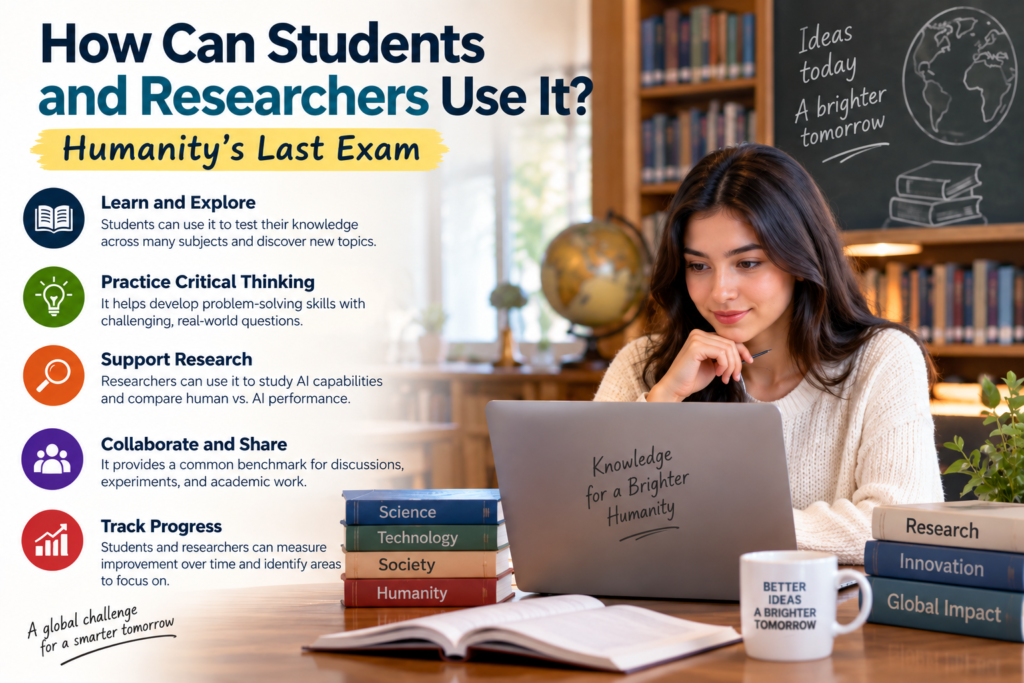
Students can learn from the ideas behind Humanity’s Last Exam by practicing difficult questions and checking their reasoning. The benchmark highlights the value of understanding concepts instead of memorizing answers. For example, a student studying physics can work through a problem step by step and explain why each formula applies. This approach builds stronger knowledge and helps identify mistakes. Students should not feel discouraged by difficult questions. Challenging tasks can reveal areas for improvement and encourage deeper learning.
Researchers can use the benchmark to study AI performance across different fields. They may compare models, investigate common errors, and develop improved evaluation methods. The results can also support research into reasoning, factual accuracy, and specialized knowledge. However, researchers should avoid drawing broad conclusions from one test alone. Combining benchmark results with other assessments provides a more complete picture. This is especially important when evaluating systems intended for education, scientific work, or professional use.
Limitations of Humanity’s Last Exam
Although Humanity’s Last Exam is designed to be challenging, it has limitations. No benchmark can measure every aspect of intelligence, understanding, or practical ability. Questions represent selected topics and testing methods, which means results may not reflect performance in every situation. A model might score well on written questions but struggle with physical tasks, teamwork, or real-world decisions. The benchmark therefore provides useful evidence without offering a complete description of an AI system’s abilities.
Another limitation involves the changing nature of artificial intelligence. As models improve, questions that were once difficult may become easier. Researchers must update evaluation methods to keep testing meaningful abilities. They also need to consider whether models have encountered similar questions during training. If a system has seen a question before, its answer may reflect memorization rather than independent reasoning. Careful benchmark design and transparent reporting help reduce these concerns and make results more useful.
Frequently Asked Questions
What is Humanity’s Last Exam?
Humanity’s Last Exam is a challenging benchmark for evaluating artificial intelligence. It tests advanced knowledge and reasoning across multiple academic subjects. Researchers use it to study how well AI systems handle difficult questions and where their abilities remain limited.
Who created Humanity’s Last Exam?
Humanity’s Last Exam was created by researchers working on advanced AI evaluation. The project brings together expertise from different academic fields to develop questions that challenge modern language models. Its purpose is to improve understanding of AI capabilities.
Why is Humanity’s Last Exam important?
The benchmark is important because many traditional AI tests have become easier for modern models. It offers more demanding questions that can reveal differences in knowledge, reasoning, and accuracy. This helps researchers evaluate progress more carefully.
Does a high score prove that AI is intelligent?
A high score shows strong performance on the tested questions. However, it does not prove that an AI system understands everything like a human. Intelligence includes many abilities that a single benchmark cannot measure completely.
Can students benefit from this benchmark?
Yes. Students can learn from its focus on difficult questions, careful reasoning, and accurate explanations. They can use similar problem-solving methods to strengthen their understanding of mathematics, science, and other academic subjects.
Conclusion
Humanity’s Last Exam offers an important way to study the abilities and limitations of modern artificial intelligence. Its challenging questions cover different subjects and require more than simple information recall. The benchmark helps researchers compare AI systems, identify weaknesses, and understand progress in advanced reasoning. However, its results should not be treated as a complete measure of intelligence. Real-world performance also depends on accuracy, judgment, communication, and human oversight. As AI continues to develop, demanding evaluations will remain valuable. Learning about this benchmark is a useful first step toward understanding how advanced AI is tested and what its results really mean.
[…] FictionLab AI: Features, Pricing, Uses & Review Humanity’s Last Exam: A Complete Guide to the AI Benchmark AI Agents in Healthcare: Benefits, Uses, and Future Is AI a Robot? Understanding AI vs. […]