

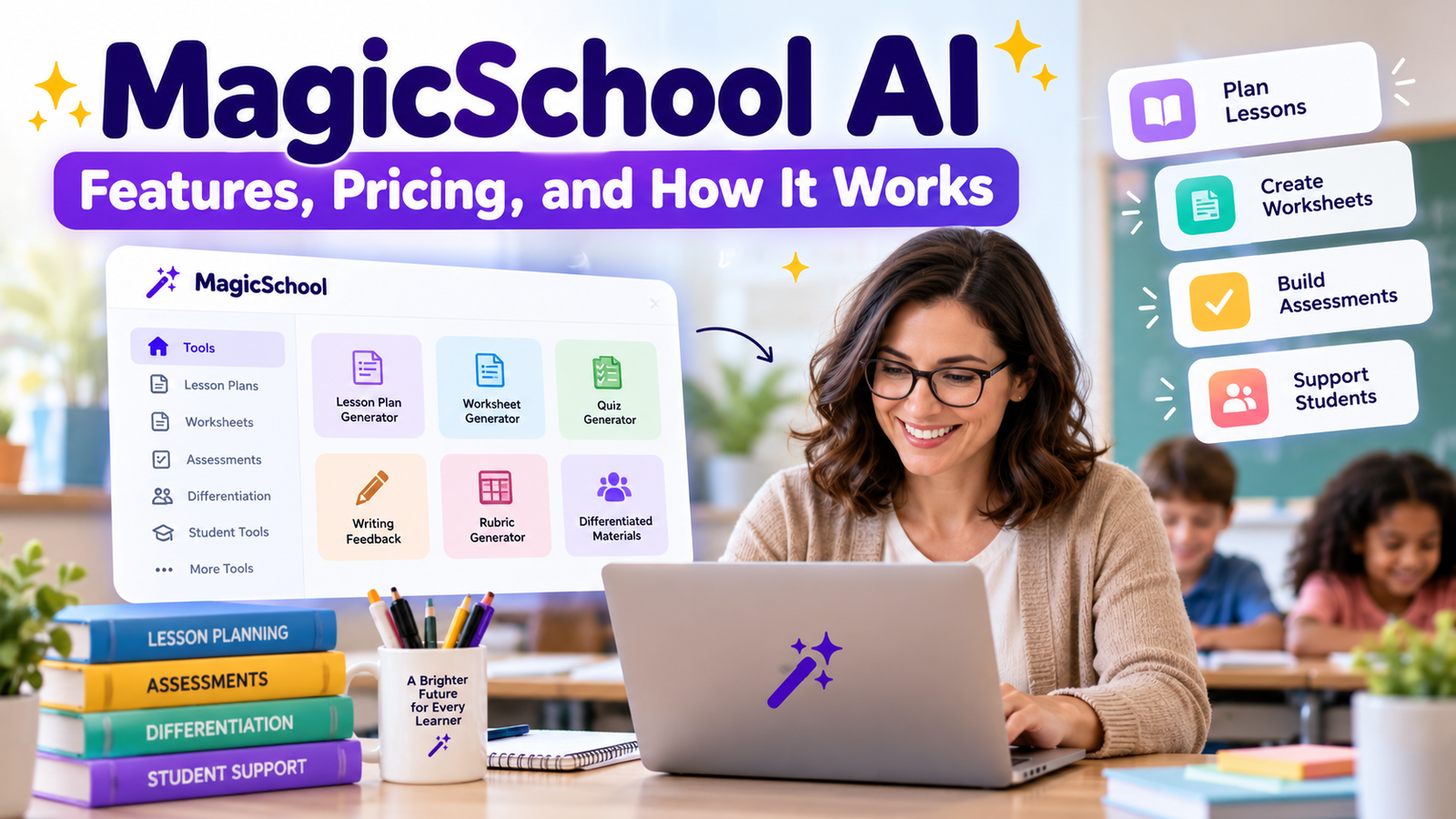
MagicSchool AI: A Complete Guide for Teachers and Students

MagicSchool AI is an artificial intelligence platform designed to help teachers plan lessons, create educational materials, develop assessments, and provide more personalized learning experiences. Unlike general-purpose AI chatbots, it focuses on the everyday tasks educators handle in schools, from preparing worksheets to adapting lessons for students with different learning needs.
The platform also offers student-facing tools that support studying, writing improvement, research, and guided learning under teacher supervision. Its features make it useful for educators who want to explore AI without building complicated prompts or switching between multiple applications. However, MagicSchool AI is not a replacement for teachers, and its generated content still requires human review.
In this guide, you will learn what MagicSchool AI is, how its tools work, which features are most useful, what its pricing plans include, and how schools can approach privacy and responsible AI use. You will also discover its limitations and how to decide whether it fits your teaching needs.
What Is MagicSchool AI?
MagicSchool AI is an education-focused AI platform built primarily for K–12 teachers, school staff, and students. It brings together specialized AI tools for lesson planning, assessment creation, classroom communication, differentiation, and other educational activities.
The main idea is straightforward: instead of asking a general chatbot to perform every teaching task through carefully written prompts, educators can choose a tool designed for a particular job. A lesson plan generator, for example, can guide a teacher through the information needed to prepare a lesson.
MagicSchool’s official website has listed more than 80 teacher tools and more than 50 student tools. Available options include worksheet generation, quiz creation, writing feedback, research assistance, and AI-supported tutoring. The precise features available to an individual user depend on the product and subscription plan.
Who Is MagicSchool AI For?
The platform is primarily intended for:
- Teachers: To prepare lessons, worksheets, quizzes, rubrics, and classroom materials.
- School administrators: To support instructional planning and educational technology adoption.
- Students: To practice skills, explore subjects, receive writing feedback, and study with guided AI tools.
- Special education professionals: To draft and adapt instructional materials for different learning needs.
- School districts: To manage AI adoption, establish appropriate safeguards, and provide educators with shared resources.
Although parents and independent learners may find educational AI useful, MagicSchool is designed around school-based teaching and learning rather than general entertainment or unrestricted chatbot conversations.
How Does MagicSchool AI Work?
MagicSchool AI uses generative AI to turn instructions and educational context into useful drafts. Generative AI is technology that creates new content, such as text, questions, explanations, and lesson materials, in response to a user’s request.
The platform uses multiple large language models (LLMs), including models from OpenAI, Anthropic, and Google, according to its published documentation. The system selects models for different tasks and adds education-focused guidance and safeguards around their outputs. Specific model availability can change as the platform develops.
A typical workflow looks like this:
- Choose a tool: Select a lesson planner, quiz generator, worksheet creator, or another relevant feature.
- Provide context: Enter the subject, grade level, learning objective, topic, or other requested details.
- Generate a draft: The AI processes the instructions and produces suggested educational content.
- Review the result: Check the material for factual accuracy, age appropriateness, curriculum alignment, and clarity.
- Customize and use it: Edit the output before sharing it with students or incorporating it into a lesson.
For example, a science teacher preparing a lesson on the water cycle might specify the grade level, lesson duration, learning objectives, and students’ existing knowledge. MagicSchool can generate a starting lesson plan with explanations and suggested activities.
The teacher must still verify the science, adjust the difficulty, and decide which activities suit the class. The AI accelerates preparation, but the educator remains responsible for the final lesson.
Key Features of MagicSchool AI
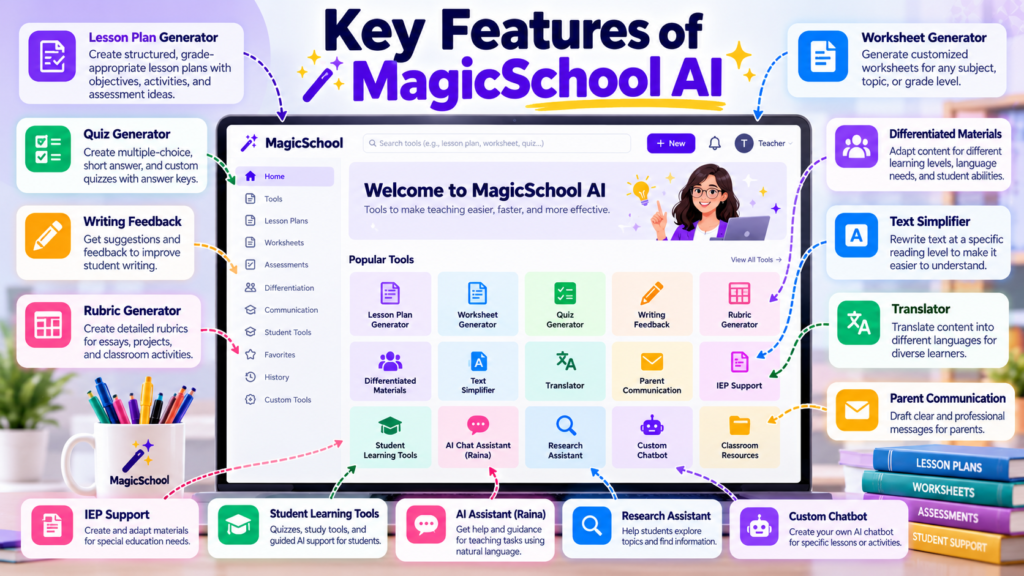
MagicSchool AI offers a collection of tools for different stages of teaching, from initial lesson planning to student feedback. Rather than treating every task as a general chatbot conversation, the platform organizes many activities into dedicated tools.
1. AI Lesson Plan Generator
The lesson plan generator helps teachers create a structured outline for a particular topic, subject, and grade level.
Depending on the information provided and the tool’s available options, a draft may include:
- Learning objectives
- Lesson activities
- Explanations of important concepts
- Suggested teaching strategies
- Questions to check student understanding
- Assessment ideas
Practical example: An English teacher preparing a lesson on persuasive writing can specify the students’ grade level, the lesson duration, and the skills they should develop. The resulting plan can provide a useful starting structure, which the teacher can adjust to match the curriculum.
The main benefit is reducing repetitive preparation work. However, teachers should check that the proposed activities are realistic for their available time, resources, and classroom needs.
2. Worksheet and Quiz Generators
Creating practice materials and assessments can take considerable time, especially when teachers need different versions for different ability levels.
MagicSchool provides tools for generating worksheets, multiple-choice quizzes, and other assessment materials.
Teachers can use these tools to:
- Prepare practice questions for a specific topic.
- Create revision exercises before an examination.
- Generate multiple-choice questions with answer options.
- Develop additional practice for difficult concepts.
- Draft questions at different levels of complexity.
For example, a mathematics teacher could generate practice questions about fractions for beginners and a more challenging set for students who have already mastered the basics.
The teacher should verify every answer, check that the questions test the intended skills, and remove ambiguous wording before using the materials in class.
3. Writing Feedback and Rubric Creation
Writing feedback is another useful application of educational AI. MagicSchool includes tools that help teachers prepare feedback and develop assessment rubrics.
A rubric explains how work will be evaluated. It might describe expectations for organization, evidence, grammar, creativity, or subject knowledge.
Instead of writing every criterion from scratch, a teacher can use an AI-generated rubric as a first draft and adapt it to the assignment.
Writing feedback tools can also help students identify areas that need improvement.
For example, a student writing an argumentative essay might receive suggestions about the clarity of the main argument, the organization of supporting points, and the use of evidence.
However, feedback must be interpreted carefully. AI can misunderstand an assignment or overlook important context. Its suggestions should support teacher judgment rather than automatically determine a student’s grade.
4. Differentiated Learning Materials
Students in the same classroom may have different reading abilities, language skills, backgrounds, and levels of prior knowledge. Preparing suitable materials for everyone can be challenging.
MagicSchool can help educators adapt instructional content to different learning needs.
Possible applications include:
- Simplifying a difficult explanation.
- Rewriting material at a specified reading level.
- Preparing additional practice questions.
- Translating educational content.
- Creating alternative explanations of a concept.
- Adjusting activities to suit different learning objectives.
Example: A teacher explaining photosynthesis could prepare one version with simple vocabulary for younger learners and another with more detailed scientific terminology for advanced students.
Both versions should communicate accurate science. Simplifying content should make an idea easier to understand without removing concepts essential to the lesson.
5. Raina AI Assistant
Raina is MagicSchool’s AI assistant, designed to help educators navigate the platform and work through teaching-related tasks using natural language.
Instead of deciding which specialized tool to open immediately, a teacher can describe the task and seek guidance on the appropriate workflow.
For example, a teacher might explain that they need a short reading activity, a set of comprehension questions, and an exit ticket for a particular grade. Raina can help guide the educator toward suitable tools or approaches.
This is especially useful for beginners who are still learning how to use AI effectively. It also makes the platform less dependent on knowing the exact name of every available feature.
As with other AI assistants, the usefulness of the response depends on the clarity of the request and the information available to the system. Educators should review the result before relying on it.
6. Student-Facing AI Tools
MagicSchool also provides student-facing learning tools through MagicStudent. These tools are intended to support learning activities under educator guidance.
Available examples include:
- AI learning assistant: Helps students explore concepts and ask questions.
- Quiz me: Supports practice and revision.
- Research assistant: Helps students work through research tasks.
- Writing feedback: Provides suggestions students can use when revising their work.
- Character chatbot: Supports guided conversations about historical figures or literary characters.
- Custom chatbot: Allows educators to create a more focused AI experience for a learning activity.
Student access is designed around teacher-assigned activities and classroom oversight rather than unrestricted use. Educators can select suitable tools and establish expectations for how students should use them.
These features can encourage independent practice, but they should not replace reading, problem-solving, discussion, or the effort required to understand a subject.
How Teachers Can Use MagicSchool AI in Real Classrooms
The most effective way to use MagicSchool AI is to connect it to a specific educational task. Generating content simply because a tool is available does not necessarily improve teaching.
Here are several practical workflows.
Preparing a Complete Lesson
A teacher who needs to introduce a new topic can use AI to develop an initial lesson structure.
A practical workflow is:
- Identify the learning objective.
- Enter the subject, grade level, and relevant classroom context.
- Generate a lesson plan.
- Create practice questions or a worksheet based on the plan.
- Check the materials against the curriculum.
- Adjust the lesson for the actual students and available time.
This approach can reduce the time spent switching between separate planning tasks. It also creates a connected set of materials rather than unrelated AI-generated documents.
Supporting Students Who Need Extra Practice
Suppose a student struggles to understand equivalent fractions. The teacher can use AI to create additional examples, simpler explanations, and practice exercises.
The student can then work through the material and discuss any remaining difficulties with the teacher.
This approach is useful because students do not always understand a concept after hearing the same explanation several times. A different example or representation may help.
However, teachers should check whether the student has understood the underlying concept rather than assuming that completing AI-generated questions demonstrates mastery.
Improving Classroom Communication
Teachers regularly write messages to parents, assignment instructions, reminders, and explanations of classroom activities.
MagicSchool can help draft these communications in a clear and professional tone.
For example, a teacher could request a friendly message explaining an upcoming science project, the materials students need, and the submission deadline.
The teacher should verify all dates, requirements, and school policies before sending the message. AI-generated communication should never be treated as automatically correct.
Creating More Consistent Assessments
A teacher can use AI to draft a rubric, quiz, or set of practice questions aligned with a learning objective.
The teacher then reviews the materials to ensure they measure the intended skills and apply consistent expectations.
For departments with several teachers teaching the same subject, shared rubrics and reviewed resources can also help improve consistency. Schools can explore shared collections and custom tools to make useful resources easier to reuse.
The important distinction is that AI can help prepare an assessment, but educators must decide whether it is fair, appropriate, and aligned with what students were actually taught.
Is MagicSchool AI Free?
Yes. MagicSchool AI offers a free plan for individual educators, alongside a paid Plus subscription and an Enterprise option for schools and districts.
The free plan is a practical starting point for teachers who want to explore AI without committing to a subscription. However, usage limits and access to advanced features differ between plans.
MagicSchool AI Pricing Plans
The following prices are indicative and should be verified against the platform’s current pricing before purchasing.
| Plan | Price | Best For |
|---|---|---|
| Free | $0 | Teachers exploring AI tools |
| Plus | $8.33 per month, billed annually, or $12.99 monthly | Individual educators who need higher usage limits |
| Enterprise | Custom pricing | Schools and districts requiring centralized management |
Prices are in US dollars. Taxes, billing conditions, and availability may vary.
What Does the Free Plan Include?
The free plan includes access to core educational features, including teacher tools, Raina, quizzes, and class writing feedback. Standard generation limits apply.
It is suitable for teachers who want to test lesson planning, create classroom materials, and explore AI-supported teaching workflows before paying for additional features.
What Does MagicSchool Plus Include?
The Plus plan includes the free features, along with benefits such as:
- Higher or unlimited generation allowances under the plan’s stated terms.
- Expanded output history.
- Additional AI-output editing capabilities.
- Access to student tools.
- Student learning insights.
- Advanced tool features.
These additions can be useful for educators who regularly prepare multiple lessons, assessments, and differentiated resources.
What Is MagicSchool Enterprise?
Enterprise is intended for schools and districts that need more centralized control over AI use.
Depending on the agreement, features may include single sign-on, learning management system integrations, administrative dashboards, district-specific customization, and additional safeguards.
Schools considering this option should request a quote and confirm which features, integrations, privacy agreements, and support services are included.
Is Plus worth paying for? It depends on how often you use the platform. A teacher who creates a few worksheets each week may find the free plan sufficient. Someone preparing materials every day may benefit from the higher usage limits and editing features offered by Plus.
MagicSchool AI Privacy and Safety
Privacy is particularly important when AI tools are used in schools. Teachers may handle student assignments, personal information, learning records, and sensitive educational documents.
MagicSchool publishes information about its privacy protections, security practices, and responsible AI policies. The company states that it does not sell student data or use student personal information to train AI models. It also describes encryption, access controls, and safeguards for student-facing tools.
These commitments are relevant, but schools should still examine the platform’s current policies and their own legal obligations before introducing it to students.
Does MagicSchool AI Protect Student Data?
According to its published student data policy, MagicSchool restricts the use of student information and places restrictions on AI providers’ retention and use of student personal data.
The platform also supports teacher oversight of student interactions. This allows authorized educators to monitor classroom activities where the relevant features are enabled.
However, privacy protection does not mean every piece of information should be entered into an AI tool.
Teachers should follow these precautions:
- Avoid including students’ full names in prompts unless necessary and authorized.
- Do not upload sensitive educational or medical records without appropriate approval.
- Follow school policies for student accounts and parental consent.
- Review data retention, access, and deletion arrangements.
- Confirm that the tool is approved for the intended classroom use.
These precautions matter even when a service has strong security measures.
Can MagicSchool AI Make Mistakes?
Yes. MagicSchool uses generative AI, and its outputs can contain inaccurate information, misleading explanations, biased language, or unsuitable examples.
For instance, an AI-generated history worksheet might contain an incorrect date. A science lesson could simplify a concept so much that it becomes misleading. A writing feedback tool might criticize a student’s valid interpretation because it does not match the expected answer.
Teachers should verify facts, check sources where appropriate, and review educational materials before distributing them.
Generated outputs should be treated as drafts for educator review, not final instructional decisions.
Advantages of MagicSchool AI
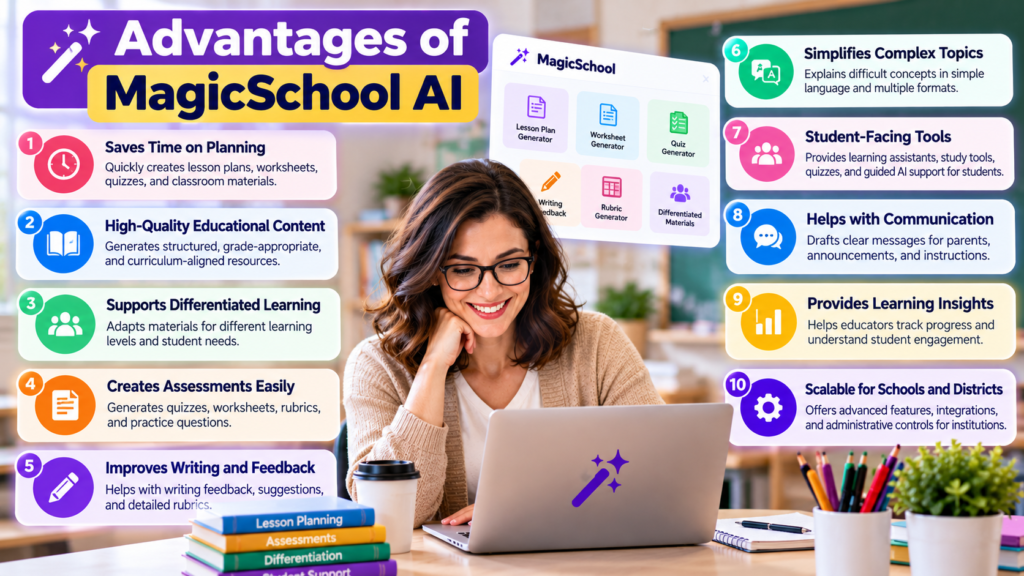
MagicSchool AI offers several practical benefits for educators, especially those who regularly prepare lessons and classroom materials.
1. Less Time Spent on Repetitive Preparation
Teachers can generate first drafts of lesson plans, worksheets, rubrics, and classroom communications instead of starting each document from scratch.
The time saved depends on the task, the quality of the instructions, and the amount of editing required.
2. More Flexible Learning Materials
The platform can help educators adapt explanations and exercises for different reading levels, learning goals, and subject requirements.
This can be useful when a single classroom contains students with varied levels of prior knowledge.
3. Easier Access to Specialized Tools
Dedicated tools reduce the need to develop complicated prompts for every task. Teachers can select a relevant workflow and provide the information it needs.
4. Support for Student Practice
Guided quizzes, writing feedback, and learning assistants can give students additional opportunities to practice concepts and improve their work.
These activities are most useful when they complement teacher instruction rather than replace it.
5. Options for Schools and Districts
The Enterprise plan provides administrative features that can help schools manage access, align tools with local expectations, and support broader adoption.
For institutions planning an AI program, centralized oversight can be more practical than allowing every classroom to introduce unrelated tools independently.
Limitations of MagicSchool AI
Despite its benefits, MagicSchool AI has limitations that educators should consider before making it part of their regular workflow.
AI Content Still Needs Human Review
Generated lesson plans and assessments can contain errors or overlook important curriculum requirements. Teachers must check whether the content is accurate, relevant, and suitable for their students.
Free Usage Is Limited
The free plan has standard generation limits. Educators who use the platform frequently may need to consider Plus or adjust their workflow to stay within the available allowance.
It Cannot Understand Every Classroom Context
AI may not fully account for a student’s learning history, classroom relationships, cultural background, or individual circumstances unless the relevant context is supplied. Even then, it cannot reliably replace a teacher’s direct understanding of the student.
Student Independence Requires Guidance
If students use AI to obtain complete answers instead of thinking through problems, the technology can undermine learning.
Teachers should design activities that encourage students to explain their reasoning, check information, and revise their own work.
School Compatibility Must Be Checked
A tool that works well for one school may not fit another school’s curriculum, privacy requirements, accessibility needs, or technology policies.
Schools should evaluate these requirements before adopting the platform at scale.
MagicSchool AI vs. ChatGPT: Which Is Better for Teachers?
Both can support educational work, but they serve somewhat different purposes.
MagicSchool focuses on structured teaching workflows. ChatGPT is a general-purpose AI assistant that can help with a much wider range of writing, research, analysis, and problem-solving tasks.
| Feature | MagicSchool AI | ChatGPT |
|---|---|---|
| Main purpose | Education-focused AI tools | General-purpose AI assistance |
| Lesson planning | Dedicated teaching tools | Can create plans through prompts |
| Quiz and worksheet creation | Specialized generators | Can generate questions and worksheets |
| Student learning | Guided, teacher-oriented tools | Depends on the product, settings, and use |
| General writing and research | Focused on educational needs | Supports a broad range of tasks |
| School administration | Enterprise features for institutional oversight | Depends on the plan and available organizational features |
| Best suited for | Teachers seeking structured educational workflows | Users needing flexible assistance across many subjects |
When Should Teachers Choose MagicSchool?
MagicSchool is a strong option when your main tasks involve lesson preparation, classroom assessments, differentiated materials, and supervised student AI activities.
Its dedicated tools can make common teaching tasks easier to organize.
When Might ChatGPT Be More Useful?
ChatGPT may be a better fit when you need broader help with research, complex explanations, creative projects, data analysis, or tasks outside the classroom.
Some educators may benefit from using both tools, provided they follow their school’s privacy and AI-use policies.
Neither platform guarantees accurate results. The better choice depends on your workflow, budget, and educational requirements.
How to Get Started With MagicSchool AI
Getting started is relatively straightforward. You do not need to understand machine learning or know how to write code to use its standard educational tools.
Step 1: Find the Platform
Search for MagicSchool AI and open its official website. Explore the available teacher tools.
Step 2: Create an Account
Register using an available sign-in method. If you are using the platform through a school, follow your institution’s account and access requirements.
Step 3: Choose One Practical Task
Begin with a task you already understand, such as creating a worksheet, drafting a lesson plan, or preparing a short quiz.
Starting with a familiar task makes it easier to judge whether the generated output is genuinely useful.
Step 4: Provide Clear Instructions
Include the relevant information, such as:
- Subject and topic.
- Grade level.
- Learning objective.
- Desired format.
- Reading difficulty.
- Important curriculum requirements.
For example, you could request a 20-minute introductory lesson on fractions for Grade 5 students, including a simple explanation, three worked examples, and five practice questions.
Specific instructions generally provide a more useful starting point than a vague request such as “Create a maths lesson.”
Step 5: Review and Improve the Output
Check the facts, revise unsuitable activities, and adjust the language to match your students’ needs.
If the result is too difficult or too basic, refine your instructions and generate a revised draft.
Step 6: Evaluate the Results
After using the material, consider whether it saved preparation time, improved clarity, or helped students understand the topic.
Keep the tools that provide measurable practical value rather than assuming that every AI feature belongs in your workflow.
Best Practices for Using MagicSchool AI Effectively
A thoughtful approach can make the platform more useful while reducing common AI-related problems.
Start with a clear learning objective. Decide what students should know or be able to do before generating a lesson or assessment.
Provide relevant context. Specify the grade, subject, topic, and constraints that affect the task.
Check facts independently. Verify important claims, answer keys, and curriculum references.
Protect student information. Share only the information necessary for an approved educational purpose.
Encourage independent thinking. Use AI to explain concepts, provide practice, or offer revision suggestions rather than automatically completing every assignment for students.
Keep educators responsible for decisions. Do not rely on AI alone for grading decisions, student placement, discipline, or other consequential judgments.
Review results over time. Compare the quality of AI-assisted materials with your existing teaching resources and adjust your approach accordingly.
These practices help keep AI in its proper role: a tool that supports professional judgment rather than replacing it.
Frequently Asked Questions About MagicSchool AI
1. What is MagicSchool AI used for?
MagicSchool AI helps teachers plan lessons, create worksheets and quizzes, prepare rubrics, develop classroom communications, and support guided student learning.
2. Is MagicSchool AI free?
Yes. MagicSchool offers a free plan with core teacher tools and standard usage limits. Paid Plus and Enterprise plans provide additional features.
3. Can students use MagicSchool AI?
Yes. Students can access guided learning tools through MagicStudent when enabled through the appropriate educational arrangements and teacher oversight.
4. Is MagicSchool AI safe for schools?
MagicSchool publishes privacy protections and classroom safeguards. Schools should review its current policies, applicable legal requirements, and their own technology rules before adoption.
5. Does MagicSchool AI replace teachers?
No. It can assist with preparation and learning activities, but teachers remain responsible for instruction, assessment decisions, and students’ educational needs.
6. Is MagicSchool AI better than ChatGPT?
MagicSchool is more focused on structured educational workflows, while ChatGPT supports a broader range of tasks. The better option depends on the user’s needs.
7. Can MagicSchool AI detect AI-generated student writing?
MagicSchool is not primarily designed to detect AI-generated student work. Its focus is on supporting teaching, learning, feedback, and responsible AI use.
Conclusion
MagicSchool AI offers a practical way for educators to incorporate generative AI into everyday teaching tasks. Its lesson planning, worksheet creation, assessment, writing feedback, and student learning tools can help reduce repetitive work and make it easier to prepare materials for different learning needs.
However, the value of the platform depends on how it is used. AI-generated content requires review, student privacy must be protected, and learning activities should encourage independent thinking rather than dependence on automated answers.
For individual teachers, the free plan provides a sensible starting point. Educators who use the tools frequently can compare the Plus plan with their actual needs, while schools should assess Enterprise features and governance requirements before wider adoption.
The best approach is to begin with one clearly defined classroom task, evaluate the results, and expand gradually when the technology genuinely improves teaching and learning.
[…] InferKit: What It Was, How It Worked, and the Best Alternatives MagicSchool AI: A Complete Guide for Teachers and Students Selira AI: Features, How It Works, Privacy and Limitations Herahaven: Features, AI […]