

InferKit: What It Was, How It Worked, and the Best Alternatives

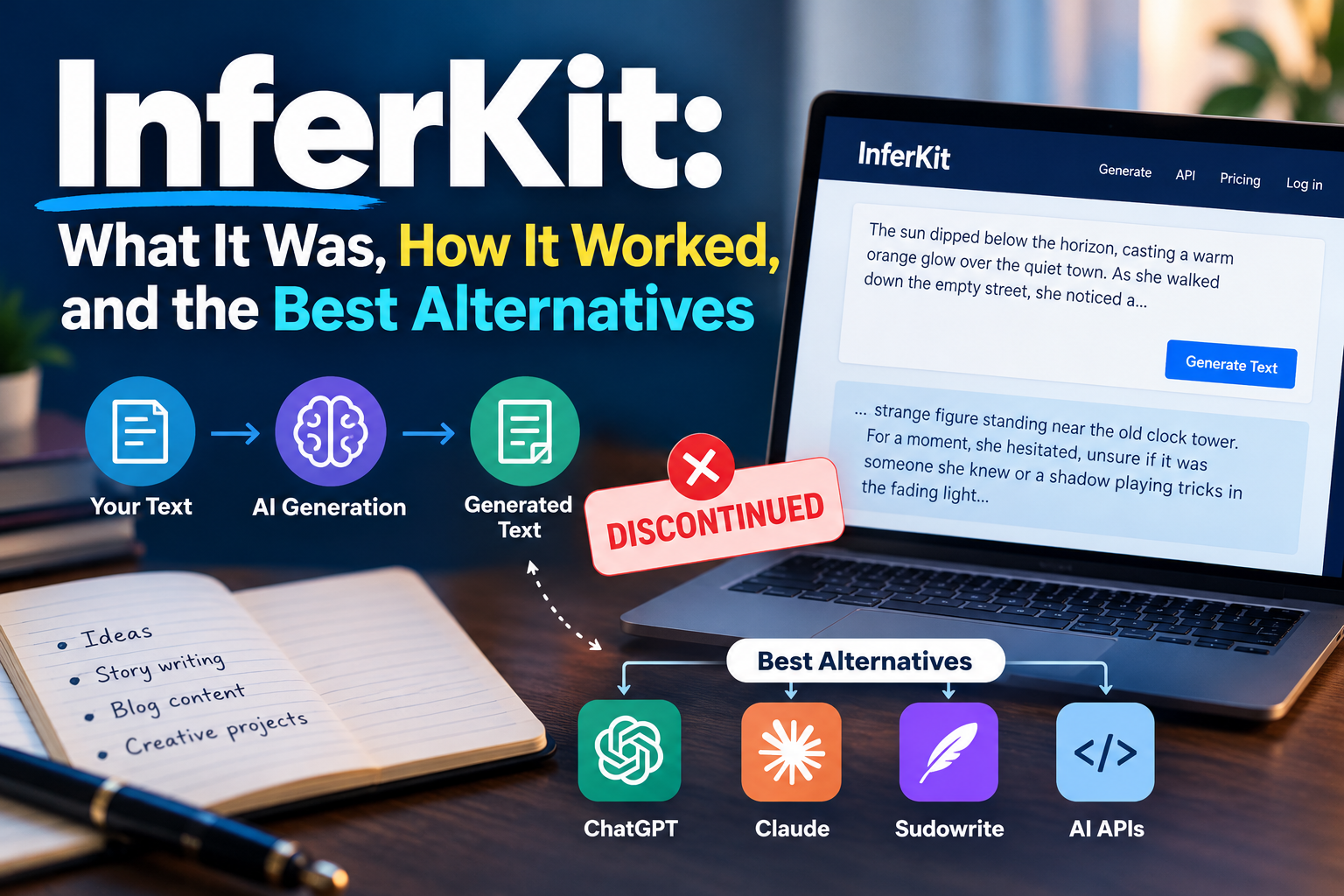
InferKit was an AI-powered text generation tool that helped writers, content creators, and developers generate text from an existing passage. Instead of answering questions through a conversational interface, it focused on predicting what words or sentences should come next. Users could explore ideas, continue stories, draft content, and integrate text generation into applications through its API.
However, there is an important update for anyone searching for InferKit in 2026: the original service has been discontinued. Its official website displays a closure notice explaining that the writing application became outdated as artificial intelligence advanced. The notice also states that paid subscriptions were cancelled and the last payment was refunded.
Understanding InferKit remains useful because its approach illustrates how earlier AI writing tools worked. This guide explains its original features, underlying text-generation approach, practical applications, limitations, historical pricing, and the alternatives worth considering today.
What Is InferKit?
InferKit was an online AI text generator designed to extend text supplied by a user. It allowed people to enter a passage and receive a continuation generated by a neural network.
For example, a writer could enter the beginning of a science-fiction story, and the tool would attempt to continue the scene. A marketer could provide the opening of a product description and generate additional copy. Developers could use its API to incorporate text generation into their own applications.
InferKit offered two main ways to work with the technology:
- Web interface: A browser-based environment for entering text and generating continuations.
- Developer API: A programming interface that allowed applications to request generated text.
The platform was particularly relevant to creative writers, independent developers, and people experimenting with early AI writing technology. However, it was primarily a text-continuation system rather than a modern conversational assistant.
That distinction matters. A text generator predicts a plausible continuation of the supplied passage, while an instruction-following assistant can respond to requests such as summarizing an article, explaining a concept, or rewriting a paragraph in a particular style.
InferKit is now discontinued, so these capabilities describe its historical functionality rather than a service that new users can access today.
Is InferKit Still Available in 2026?
No. The original InferKit service is discontinued, and its official website displays a closure announcement rather than an active writing application.
The announcement gives a straightforward explanation: advances in artificial intelligence made the writing application outdated, and its team decided to focus on other projects.
It also confirms that paid subscriptions were cancelled and the last payment was refunded.
However, the exact shutdown date is less certain. Secondary sources provide different dates, and the official notice does not specify when the service closed. Therefore, it is more reliable to describe InferKit as discontinued than to claim a precise closure date without stronger evidence.
What Does This Mean for Previous Users?
If you previously used InferKit, keep the following points in mind:
- New users: You should not expect to create an account and use the original service.
- Existing subscribers: The official notice states that subscriptions were cancelled and the last payment was refunded.
- Developers: Applications that depend on the original InferKit API need another text-generation provider.
- Saved writing: Do not assume that previously generated content remains available on the discontinued platform. Check your own saved documents and backups.
The original closure notice listed an email address for inquiries. If you need assistance with an old account or billing question, look for the contact information in the official announcement.
How Did InferKit Work?
InferKit used neural text generation to predict a continuation of text provided by the user. Its core approach was based on a principle that remains important in generative AI: a language model learns patterns in text and uses those patterns to produce a likely sequence of words.
Here is how the process worked in practice.
Step 1: Provide an Opening Passage
The user entered a sentence, paragraph, or story fragment into the text generator. The supplied passage established the topic, writing style, and context for the continuation.
For example:
The detective entered the abandoned house just before midnight. A strange sound came from the room upstairs, and the front door suddenly closed behind him.
This passage gives a text-generation model a clear setting and an unfinished situation.
Step 2: Generate a Continuation
InferKit analyzed the supplied text and generated additional content. Depending on the prompt, the result might continue the scene, introduce a new character, or develop the existing narrative.
The output was a prediction generated from learned language patterns, not a verified account of real events.
Step 3: Adjust and Refine the Result
Users could experiment with different prompts and generation settings to influence the output. Changing the opening passage could produce a different continuation, even when the general topic remained the same.
For example, a writer could add that the detective should discover a hidden letter rather than encounter another character. That extra context would guide the generated passage toward a more specific direction.
Step 4: Review the Generated Text
The final step was to evaluate the result and decide whether it suited the intended purpose.
Writers needed to check continuity, remove repetitive passages, and improve dialogue. Developers also needed to evaluate generated responses within their applications.
The important limitation: A plausible continuation is not necessarily a correct one. A language model can produce fluent sentences while introducing contradictions, invented details, or unsupported claims.
What Were InferKit’s Main Features?
InferKit’s original feature set focused on accessible text generation rather than the broader collection of tools available in many modern AI assistants.
Its main capabilities included the following.
AI Text Continuation
The central feature extended existing text. Writers could use it to explore possible next sentences, develop scenes, or overcome a blank page.
For example, a writer creating a fantasy novel could provide a description of a mysterious forest and ask the generator to continue the passage. The resulting text could serve as inspiration rather than a finished scene.
Adjustable Text Generation
The platform offered controls that allowed users to influence the amount and character of generated text. Historical descriptions also mention settings for steering output and varying its randomness.
These controls helped users experiment with different continuations. However, generating more text did not automatically improve its quality or relevance.
Browser-Based Writing Interface
The web interface made text generation accessible without requiring users to build their own machine learning systems.
This was useful for people who wanted to experiment with generative AI but lacked programming experience.
Developer API
InferKit also provided an API for integrating text generation into applications.
Developers could use this approach to add generated text to writing tools, games, or other software. However, an API integration required more work than simply entering a prompt into the browser interface.
Developers had to handle requests, responses, errors, and the limitations of the generated content.
Support for Creative Projects
The platform was associated with use cases such as:
- Fiction and short-story drafting
- Poetry and creative writing experiments
- Marketing copy and product descriptions
- Text autocomplete
- Prototype applications that generated language
These were potential applications of its text-generation capabilities, not guarantees that every output would be accurate, original, or ready to publish.
Because the service is discontinued, these features should be understood as historical capabilities rather than currently available functions.
Who Used InferKit and Why?
InferKit appealed to people who wanted a straightforward way to experiment with AI-generated language.
Its usefulness depended largely on the task.
Fiction Writers and Storytellers
Writers could use text continuation to explore alternative scenes, develop dialogue, or generate ideas when they struggled to move a story forward.
Consider a writer who knows that the main character must discover a secret but has not decided how the discovery should happen. A text generator could suggest several possible directions.
The writer would still need to select the strongest idea and make sure it matched the characters, plot, and tone.
Bloggers and Content Creators
Content creators could experiment with generated introductions, draft paragraphs, or alternative ways to express an idea.
For example, a blogger writing about home gardening might provide a paragraph about growing herbs indoors. A text generator could continue the explanation with ideas about sunlight, watering, and container selection.
However, generated advice would still require fact-checking. Gardening recommendations depend on the plant species, climate, growing conditions, and other details.
For professional SEO publishing, the goal should be to create useful, accurate content rather than simply increase the number of articles produced.
Developers Building Applications
Developers could use InferKit’s API to experiment with text-generation features without creating a language model from scratch.
A game developer, for instance, might want to explore dynamically generated dialogue for non-player characters.
Such a project would require testing to ensure that the dialogue remained relevant, appropriate, and consistent with the game’s story.
Students and Learners
Students could use text generation to explore creative writing ideas or examine how a passage might develop.
Nevertheless, generated material should support learning rather than replace it. Students need to understand the subject, verify factual claims, and follow their institution’s rules regarding AI assistance.
What Were the Advantages of InferKit?
InferKit had several characteristics that made it useful during its operational period.
A relatively simple workflow: Users could enter text and generate a continuation without learning advanced machine learning concepts.
Creative flexibility: The same general approach could support different writing tasks, from fiction to basic marketing copy.
Developer integration: The API allowed developers to explore text generation inside their own applications.
Useful for overcoming writer’s block: A generated continuation could give a writer something to react to, even if the first result was imperfect.
An accessible introduction to generative AI: The platform helped demonstrate how neural networks could produce coherent-looking text from a relatively small amount of user input.
However, these historical strengths should be considered in context. Modern writing assistants offer different workflows, and the original InferKit service is no longer available.
What Were InferKit’s Limitations?
InferKit’s approach had practical limitations that are still relevant when evaluating AI writing software.
Generated Text Could Contain Errors
Language models generate text based on learned patterns. They do not automatically verify every statement against reliable sources.
A continuation might introduce an incorrect historical date, contradict an earlier paragraph, or invent a detail that sounds convincing.
For fiction, this may create an inconsistency that requires editing. For educational or professional content, it can create a more serious accuracy problem.
Context Could Be Limited
Historical product documentation described a limit of approximately 3,000 characters of context for InferKit’s generator. This was a limitation of the original service, not a specification for modern language models.
Limited context can make it harder to maintain consistency across a long manuscript. If a character’s background or an earlier plot development falls outside the available context, the generated continuation may overlook it.
Text Continuation Was Different From Instruction Following
InferKit’s primary approach was to continue supplied text. This differs from an assistant designed to follow detailed instructions.
For example, these are two different requests:
- Text continuation: Begin a paragraph about electric vehicles and let the system continue it.
- Instruction following: Compare electric vehicles with petrol-powered cars in a table, explain the maintenance differences, and identify the limitations of each option.
The second request requires the system to follow a structured set of instructions rather than simply extend the opening passage.
Generated Text Required Editing
A grammatically correct passage can still be repetitive, poorly organized, or unsuitable for its audience.
Writers needed to check the logic, remove unnecessary material, and ensure that the output matched their intended voice.
The Service Is No Longer Operational
This is the most important practical limitation today. Even if InferKit once suited a particular workflow, its discontinued status means new users need another tool.
Developers must also consider migration costs, including rewriting prompts, adapting API calls, and testing the replacement system.
How Much Did InferKit Cost?
InferKit previously offered a limited free option and paid subscription plans. Historical third-party listings reported the following prices:
| Historical Plan | Reported Monthly Price | Reported Allowance |
|---|---|---|
| Free option | $0 | Limited weekly generation |
| Basic | $20 | 600,000 characters per month |
| Premium | $60 | 2.5 million characters per month |
These figures are historical, not current offers. The original service has been discontinued, and its official website no longer provides an active purchasing page. The figures come from historical third-party listings rather than a currently available official pricing schedule.
How Did Its Pricing Model Work?
InferKit’s reported paid plans used character-based allowances. The number of characters generated affected how much of the available quota a user consumed.
Character-based billing differs from token-based billing, which many modern AI services use. A token is a unit of text processing that may represent a word, part of a word, punctuation, or another text fragment.
Consequently, historical InferKit prices cannot be compared directly with modern AI API prices by looking only at the headline numbers.
Anyone replacing an old text-generation workflow should estimate costs using actual inputs and outputs, including repeated requests, long prompts, and unsuccessful generations.
Best InferKit Alternatives in 2026
Since InferKit is discontinued, the best replacement depends on what you want to accomplish.
Some users need help writing articles, while others want to continue fiction or integrate generated text into an application. These tasks require different features.
1. ChatGPT: Best for General Writing and Instruction Following
ChatGPT is a general-purpose AI assistant that can draft, rewrite, summarize, explain, and generate creative content. It also supports web research in experiences where search is available.
Unlike a text-completion-only workflow, users can provide detailed instructions and refine the result through follow-up messages.
For example, a blogger could ask ChatGPT to continue an unfinished article, maintain a particular tone, shorten repetitive sections, and suggest a more useful structure.
Best for: Bloggers, marketers, students, researchers, and people who want a flexible writing assistant.
2. Claude: Best for Drafting and Revising Longer Documents
Claude is another general-purpose assistant that supports writing, editing, analysis, and coding. It provides conversational workflows in which users supply instructions and refine the output.
A writer could provide an existing chapter and ask for suggestions that improve pacing while preserving the characters and overall plot.
As with other language models, the quality of the result depends on the instructions, available context, and complexity of the task. Users should also check important factual claims independently.
Best for: Document drafting, editing, analysis, and writing tasks that benefit from iterative feedback.
3. Sudowrite: Best for Fiction Writing
Sudowrite focuses on fiction writers and offers tools for story planning, drafting, rewriting, description, and brainstorming. Its features are designed to help authors develop and organize creative projects.
For someone who originally used InferKit to continue a story, a fiction-focused writing environment may be a better fit than a general text generator.
For example, a novelist could use it to develop a scene, explore different descriptions, or expand a short passage before revising the result manually.
Best for: Novelists, short-story writers, and authors who want tools specifically designed for fiction.
4. An AI Text-Generation API: Best for Developers
Developers who used InferKit to generate text inside an application may prefer a modern language-model API.
For example, an application could send a prompt to a model, receive generated text, and display the result in its interface. The exact implementation depends on the selected provider and its current API documentation.
Before switching, developers should evaluate:
- API authentication and supported endpoints
- Input and output limits
- Pricing and usage restrictions
- Response quality for their specific task
- Latency, reliability, and error handling
- Data retention and privacy policies
- Content moderation requirements
A replacement should be tested against real examples from the existing application. A service that produces excellent blog paragraphs may not be the best choice for short game dialogue or highly structured output.
Best for: Software developers, product teams, and businesses building AI-powered applications.
InferKit Alternatives Compared
| Tool or Approach | Best Use Case | Main Advantage | Important Consideration |
|---|---|---|---|
| ChatGPT | General writing and research assistance | Flexible instruction following | Verify factual claims |
| Claude | Drafting, editing, and document analysis | Conversational refinement | Check context and usage limits |
| Sudowrite | Fiction and storytelling | Writing tools designed for authors | Focused on creative writing |
| Language-model API | Custom software integration | Can be integrated into an application | Requires technical implementation |
The right option depends on the task, budget, privacy requirements, and desired level of control. Check each provider’s current documentation and pricing before making a decision.

How to Replace InferKit in an Existing Workflow
Switching from InferKit to another AI writing tool is not simply a matter of choosing a new website. The most suitable replacement depends on how you used the original service.
Step 1: Identify the Original Task
Start by identifying what InferKit actually did in your workflow.
Did you use it to continue fiction, draft blog paragraphs, generate product descriptions, or provide text inside a software application?
Write down the inputs, expected outputs, and any generation settings that mattered.
This makes it easier to evaluate replacement tools against real requirements rather than marketing claims.
Step 2: Rewrite Your Prompts as Clear Instructions
Older text-continuation workflows often began with an unfinished sentence or paragraph. Modern instruction-following assistants can benefit from a more explicit request.
For example, instead of entering:
Indoor gardening is a useful way to grow herbs…
You could ask:
Continue this paragraph for beginner gardeners. Explain the importance of sunlight, drainage, and watering. Use clear English, avoid unsupported claims, and keep the continuation under 150 words.
The second prompt describes the desired content, audience, tone, and length.
You can adapt the same principle to fiction by specifying the characters, scene, point of view, and intended mood.
Step 3: Test the Replacement With Real Examples
Choose several representative prompts from your previous workflow. Run them through the replacement and compare the outputs.
Evaluate accuracy, relevance, writing quality, consistency, speed, and cost.
For API-based applications, also test error handling and unexpected responses before using the new service in production.
Step 4: Review Privacy and Data Handling
Before submitting unpublished manuscripts, business documents, customer information, or other sensitive material, review the provider’s data policies.
Check what happens to submitted content, whether it may be used to improve models, how long it is retained, and which controls are available.
Do not assume that every AI writing service handles user data in the same way.
Step 5: Keep Human Review in the Process
AI can reduce the time required to produce an initial draft, but it cannot guarantee that every sentence is accurate or appropriate.
For published content, verify important claims, add original insights, and edit the result for the intended audience.
For software applications, establish appropriate testing and safeguards before allowing generated text to reach users automatically.
Common Misconceptions About InferKit
Several misunderstandings can make it difficult to evaluate InferKit or choose a replacement.
InferKit and Modern Chatbots Worked in Exactly the Same Way
They shared the broad goal of generating text, but their interfaces and intended workflows differed. InferKit emphasized continuation, while conversational assistants are designed to respond to explicit instructions and follow-up questions.
Generated Text Was Always Accurate
Fluent writing does not establish factual accuracy. A model can generate plausible but incorrect information, so important claims require verification.
InferKit Is Still Available Through Old Login Pages
Old reviews, directories, and links may continue to appear in search results. However, the official website displays a discontinuation notice. An outdated listing does not prove that a service is operational.
Every Project Named InferKit Is the Same Product
A search for the name may reveal unrelated software packages or developer projects. Before installing a package or using an API, check the publisher, documentation, repository, and stated purpose.
Do not assume that a project shares the original service’s technology or ownership simply because it uses the same name.
Frequently Asked Questions About InferKit
What Is InferKit Used For?
InferKit was an AI text generator used for continuing passages, exploring story ideas, drafting text, and integrating language generation into applications through an API.
Is InferKit Free in 2026?
No. The original service has been discontinued, so its historical free option is no longer available as an active offering.
Why Was InferKit Discontinued?
The official website states that advances in AI made the writing application outdated and that the team decided to focus on new projects. It does not provide a more detailed explanation.
Did InferKit Have an API?
Yes. The original platform offered a developer API for integrating text generation into applications. Developers now need a replacement provider.
What Was InferKit’s Historical Pricing?
Third-party listings reported a Basic plan at $20 per month and a Premium plan at $60 per month. These prices are historical and cannot be used to purchase the discontinued service.
What Is the Best Alternative to InferKit?
For general writing, ChatGPT or Claude may be suitable. Sudowrite is worth considering for fiction, while developers may prefer a language-model API. The best option depends on the intended task.
Can InferKit-Generated Text Be Used in Published Articles?
Previously saved text can be reviewed and edited for publication, subject to applicable rights and other requirements. Verify factual claims, improve the content, and check the relevant publication policies before publishing.
Conclusion
InferKit was an early AI text-generation platform that made it easier for writers and developers to experiment with automatically generated language. Its emphasis on continuing existing text provided a straightforward way to explore creative ideas and build text-generation features into applications.
However, InferKit is discontinued in 2026, so it is no longer a practical option for new projects. Anyone searching for the original tool should confirm its status rather than relying on outdated reviews or pricing pages.
The best replacement depends on what you need. General-purpose assistants can help with drafting and editing, fiction-focused tools provide specialized creative features, and developer APIs offer a way to build custom applications. Before choosing one, compare output quality, costs, privacy controls, and technical requirements. Most importantly, treat generated text as material to review and improve, not as a substitute for sound judgment, original thinking, and factual verification.